|
_____
Milk Loss Program Frequently Asked Questions
USDA recently release a set of frequently asked questions for its new Milk Loss Program. On September 11, USDA announced that it would take applications for its new program designed to compensate dairy farmers for milk dumped (or otherwise not marketed) due to natural disasters.
The deadline to apply for the Milk Loss Program is October 16, 2023. Contact your local FSA Service Center to apply.
USDA Milk Loss Program FAQs
Q1: Is all dumped milk eligible for MLP?
A1: No, only milk dumped in calendar years 2020, 2021, and 2022 that was dumped due to weather events where no payment was received, or partial payment was received for the dumped milk.
Q2: Is milk dumped due to antibiotics eligible for MLP?
A2: No, milk dumped due to antibiotics is not eligible.
Q3: What are eligible weather events?
A3: Drought, wildfires, hurricanes, floods, derechos, excessive heat, winter storms, freeze, polar vortex, and smoke exposure. Tornadoes are an eligible weather event for 2022.
Q4: Is a federal disaster declaration required for MLP?
A4: No, a federal disaster declaration is not required for eligibility in MLP.
Q5: How will a dairy operation know if the milk marketing organization paid for the dumped milk due to a weather event?
A5: The dairy operation will need to review the marketing statement for the applicable month and determine if pounds of milk production were recorded for each milk pick up. If recorded on the marketing statement most likely the organization paid for the dumped milk.
Q6: How are the pounds of dumped milk determined?
A6: MLP determines the average daily milk production for the month proceeding the month milk was dumped as the base period. The average daily milk production from the base period is multiplied by the number of days milk was dumped in the claim period and multiplied by the number of cows in the dairy operation herd.
Q7: What milk price is used to determine my payment for dumped milk through MLP?
A7: The milk marketing statement is required to be provided at MLP application which provides the gross payment price for the applicable month. The net payment price the affected dairy operation received is determined by deducting the hauling rate fee by cwt and the $0.15 promotion fee deduction from the gross payment price.
Q8: What determines how many days of dumped milk loss are eligible for MLP?
A8: The MLP eligible period begins on the day milk was dumped or removed and not marketed on the commercial market and ends on the day milk was last dumped or removed.
Q9: If I received an insurance indemnity payment for my dumped milk, am I eligible for MLP?
A9: If insurance paid for part of the value of the dumped milk, MLP will provide an additional payment up to the fair market value of the dumped milk.
Q10: Do affected dairy operations applying for MLP need to complete eligibility forms?
A10: Yes, the following forms are to be completed for MLP if not on file with FSA- AD-2047, CCC-860, CCC-901, CCC-902, FSA-510 if applicable, and AD-1026
Q11: Are MLP payments factored?
A11: Yes, MLP payments are factored. A 90 percent factor for SDA (socially disadvantaged) affected farmers and 75 percent factor for all other farmers.
_____
DMC Shelling Out Big Payments in 2023
Mizzou’s Scott Brown wrote an article for Hoard’s last week describing the Dairy Margin Coverage program’s climb to break 2021’s record for total payouts. So far in 2023, producers across the U.S. have received a combined $1.13 billion in DMC payments as compared to $1.19 billion in 2021.
Interestingly enough, Brown writes that on a national level, 46% of the year-to-date DMC payments came from June and July margins.
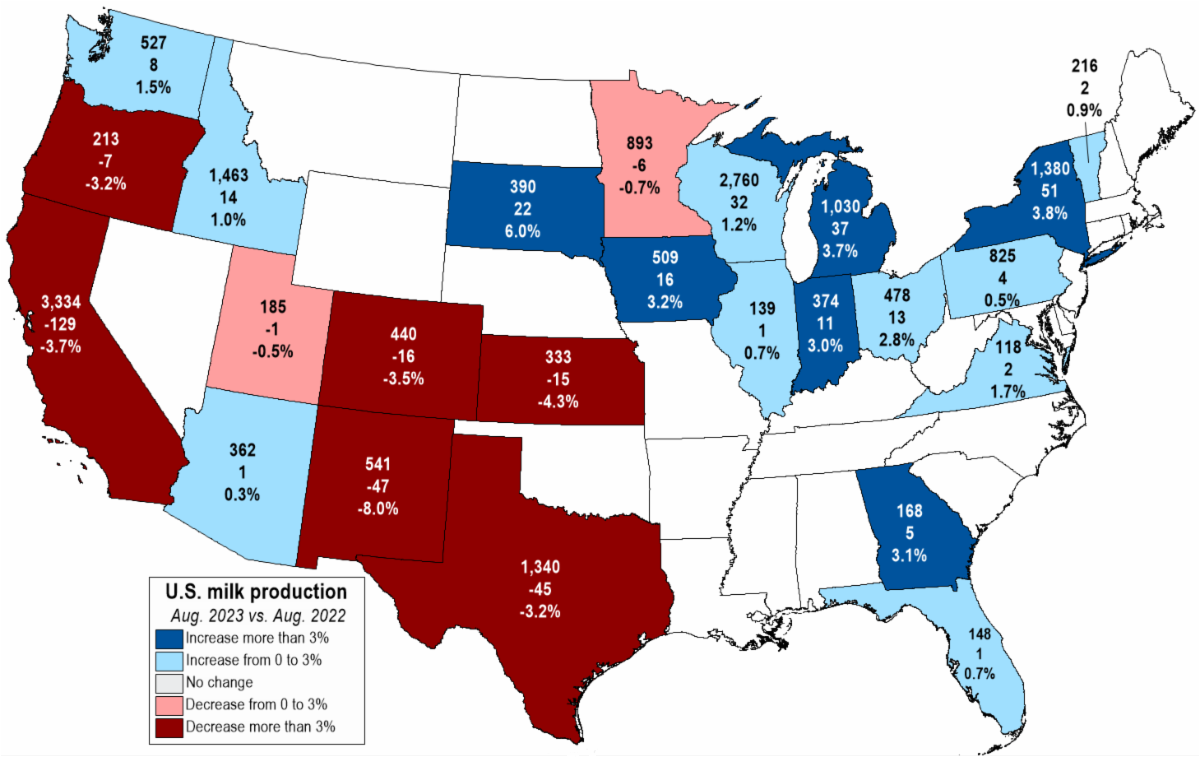
Georgia dairy farms have received $8.2 million in total payments so far this year with the average total payment per farm reaching $96,000 for the year. That places Georgia 26th in total payments but 12th nationally in average payment per dairy operation. 85 Georgia dairy farms signed up for DMC this year, good enough for 26th nationally in enrollment.
Hoard’s Dairyman Intel: It’s Another $1 Billion Year for DMC
_____
Dairy Groups Advocate for Dairy Products at Dietary Guidelines for Americans Committee Meeting
The Dietary Guidelines for Americans Committee is a panel of public health experts who develop nutrition standards for federal programs and policies every five years. The process is administered jointly by the US Dept. of Health and Human Services and USDA. Currently, the DGA Committee is hearing testimony ahead of its 2025-2030 report. The determinations set forth in the DGA’s report serve as the basis for several major nutrition and feeding programs including WIC, SNAP, and school lunch programs. Many of you who follow nutrition policy closely would add that the law governing USDA school nutrition programs references DGA standards as the final authority on what types of foods (including full fat milk and dairy products) can be served in schools.
Recently, the two largest dairy groups in the US, IDFA and NMPF, testified before this committee to advocate for increased consumption of full-fat dairy in the committee’s recommendations. IDFA VP for Regulatory Affairs Roberta Wagner outlined how research demonstrates that consuming dairy products, including full-fat dairy, has neutral or even positive impact on cardiovascular health.
NMPF’s Regulatory Affairs Director Miquela Hanselman and dairy farmer and olympic athlete Elle St. Pierre testified on the essential role dairy plays in combatting heart disease, type 2 diabetes, obesity, and stroke. St. Pierre also added that plant-based alternative beverages are nutritional different from real milk and that the committee should not infer that the benefits of real milk carry over to milk imitators.
The DGA Committee works through a five-step process to update the federal government’s nutritional guidelines. First, the committee identifies the scientific questions that should inform the scientific review process. Second, HHS and USDA appoint an advisory committee to review scientific evidence. Third, the committee reviews the science (we are currently in this phase). Fourth, based on the advisory committee’s report, USDA and HHS develop dietary guidelines. Finally, the federal agencies implement the guidelines into federal programs.
NMPF Statement on Testifying before DGAC
IDFA Statement on DGAC
Learn More About the Dietary Guidelines for Americans
_____
Southern Dairy Business Innovation Initiative Grants
The Southern Dairy Business Innovation Initiative (SDBII) is currently accepting applications for the Specialty Processing Equipment Grant and the Dairy Business Planning Grant.
Both of these grants are designed for producers who are interested in investing in their farm operation either by developing or expanding on-farm processing capabilities or contracting with/hiring experts to assist in planning for your farm’s future.
The Specialty Processing Equipment Grant is designed for applicants who are seeking to fund projects to increase processing efficiency, capacity, or build new processing capabilities. The grant has a maximum award amount of $300,000 and requires a 25% match.
The Dairy Business Planning Grant is designed to reimburse producers that are hiring experts to assist in business and succession planning or provide additional educational experiences to increase the operator’s working knowledge of the business. This grant has a $30,000 maximum award amount with no matching requirement.
For examples of possible projects and to see read the full program rules, check out the grant RFPs below.
Interested in Applying? Have Questions?
Visit SDBII’s Website or contact Georgia’s primary program contact, Dr. Jillian Bohlen at jfain@uga.edu or call/text 706-207-6614.
Any Georgia Milk Producers members that need assistance can also contact GMP. Email Bryce at bryce@gamilk.org or call 229-221-3906.
SBII Resources
SDBII Webpage
Webinar on SDBII Grants
Specialty Dairy Processing Equipment Grant RFP
Dairy Business Planning Grant RFP
The deadline to submit your completed application is 3:00 PM ET October 16, 2023. Please visit the SDBII Website for more details.
To submit your grant materials, use the following submission forms:
Specialty Processing Equipment
Dairy Business Planning
_____
GMP Hosts UGA Animal-Dairy Science & Crop-Soil Science Departments for Tour
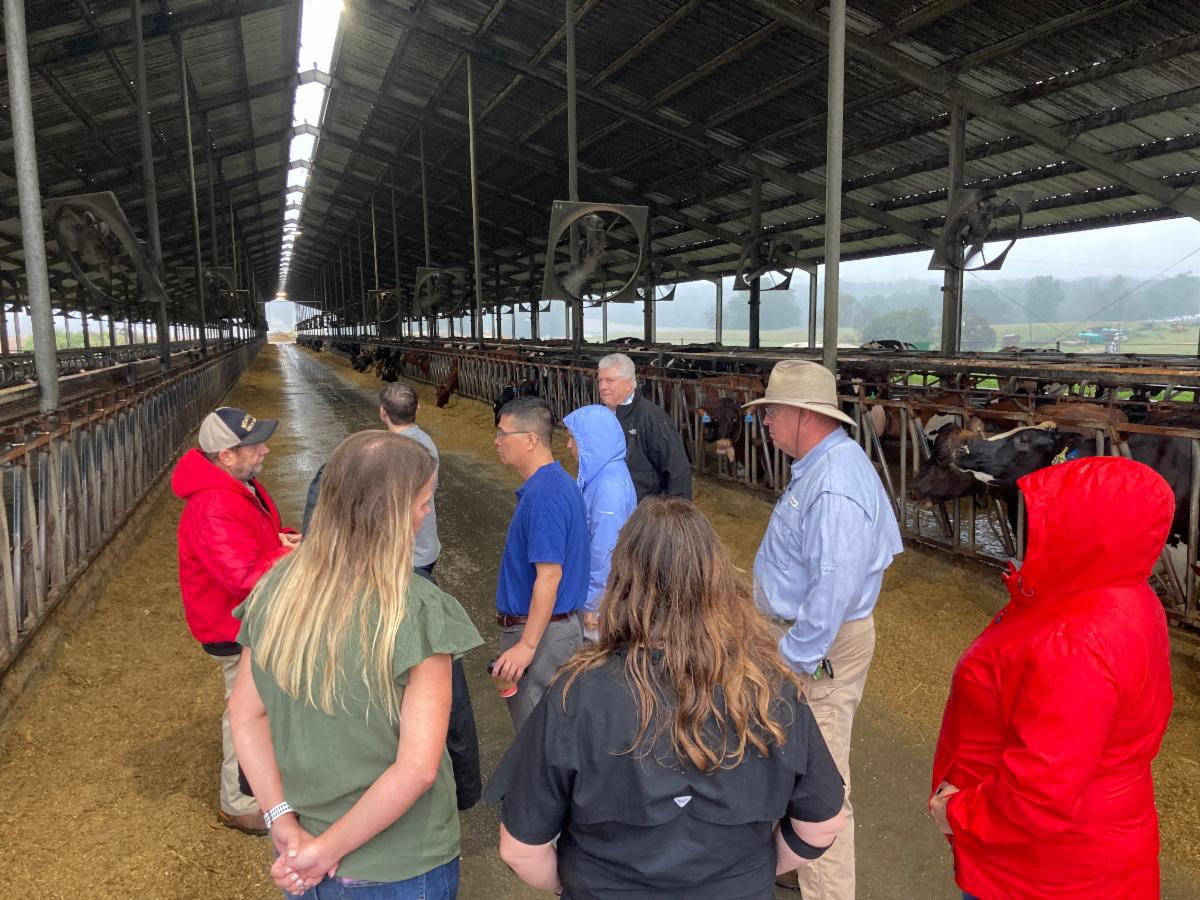
On September 15, members from the UGA Animal & Dairy Science and Crop & Soil Sciences Departments joined Georgia Milk Producers and representatives from Georgia Dept. of Agriculture and UGA Extension for a tour of Williams Dairy, Godfrey Dairy, and B & B Dairy in Morgan County. The tour centered on manure management and possible avenues for research and collaboration on nutrient management.
Thank you to Everett Williams, Megan Bell, Cuyler Johnson, and Danny Bell for hosting our tour and a special thank you to our friends at UGA for your continued support of Georgia’s dairy industry.
|