|
As I eagerly prepare for my upcoming sabbatical, scheduled for the 2023 spring semester, I joined a faculty writing group here at Gannon University. Led by Dr. Derek DiMatteo, assistant professor in the Department of English, these sessions usually begin with participants setting a writing goal for that session. Arriving at our September 28 session, I already had a goal in mind: to construct a writing schedule for my spring sabbatical. But to my surprise, this session began with a writing warmup exercise called proprioceptive freewriting.[1] Derived from the Latin word proprius,[2] which means, “one’s own,” the process promotes the activity of attentively listening to one’s inner voice. We were all instructed to sit quietly at a table, with pen and paper ready. “I’m going to play a Mozart piano concerto in the background, Dr. DeMatteo said. “For as long as the music plays, follow your thoughts wherever they lead and write exactly what you hear, as if they were spoken aloud.” I thought quietly for a moment, “This is a bit weird, but then so am I!” During this exercise, I was very surprised and deeply moved by the voice of my inner man.
Before we began writing, our instructor offered one final crucial direction: Listen to your thoughts and whenever something speaks to you, something interesting grabs your awareness, ask the question, “What do you mean by the word or phrase.” When Dr. DiMatteo started the music, immediately several themes raced within me, all competing to be heard.
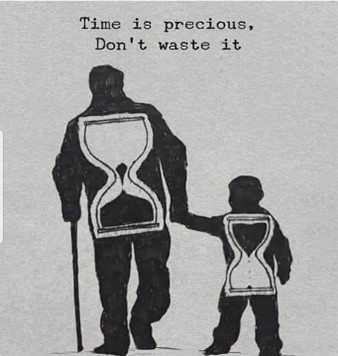
The themes of time, age, and legacy won the race. In November 2022 I will be 65 years old and, according to Erik Erikson, I will be wrestling in and through the psychosocial crisis of Ego Integrity versus Despair.[3] I do find myself more often engaging in personal reflections, moral debates, and deliberate introspection of my life. For me, as it is for most individuals, family is very important. I think quite frequently about the concept of family, my immediate, blended family, my extended family, and those special people, who, beyond biology, I now consider family. I care profoundly about each person. They have added considerably to the quality of my life.
I find it very peculiar that in thinking about my family in this moment, a strange feeling grips me. Strange, not in an abnormal or weird way, but in an unexpectant manner, accompanied by peculiar sensations. From time to time, though no one noticed, I found myself weeping. Why am I feeling this way? I have been married three times, though the original plan was to never divorce; to always remain married. The unbending Baptist and Pentecostal traditions that I learned early in my development, the dogma of “the husband of one wife” so inculcated into my soul, even now, are hard to shake. For years I wondered if divorce was my direct pathway to a fiery, burning hell. Broken covenants, bouts of guilt, lost integrity; the many aired lies, and the many altered lives (primarily the lives of my children) all have become collateral damage. They have been damaged, not by their personal decisions, but because of their responses to my personal choices.
My thoughts bounced around, like a pinball, back and forth with life and death judgments. I questioned, “Who is playing this game, controlling the paddles?” Some of my thoughts were of my mother and father, both deceased, and my son Brooks Jerome, who died as a five-month premature infant. I wondered how my parents perceived me; how Brooks and my other children will think of me – as I now think about the legacy of my parents. What will be my legacy? What are the important things I will leave to my children, my grandchildren? What are the critical life lessons taught to me? Am I passing them on, the good and the bad, to my children? I am flooded, overwhelmed with questions! And just as a man, overwhelmed with the weight of a life sentence, who learns to adjust, to adapt, and to find freedom in his mind, so too have I learned that I must do the same.
Clearly and unquestionably, my parents loved me, though each loved me very differently. Their love was a kaleidoscope of passionate and personalized presentations. Each memory captured in a slide show, an antique Eastman Kodak projector with black and white film in the carousel. Pictures of family gatherings; sometimes cloudy photos, darkened by temporary seasons of dust and decay, and the debris of our lives. The sounds of the fan and the operation of the projector fill the room. “But who’s operating the slide show?”
I imagined the pains of our past hurts; I began to recognize their hurts were passed on to me (hurt people hurt people).[4] Their pains, the untold family secrets, of shame and guilt loomed and lorded over me like uncompassionate correctional officers, were transmitted to me through their touch. We weren’t a touchy-feely family, but when touched by my parents, their touches seemed both magical and mysterious; indiscriminately pleasurable and painful.
Hands are incredibly deceptive. Hands that were used to protect fragile family relationships, suddenly, in a moment in the tinkling of an eye,[5] destroyed the very things they protected! How can you repair what appeared to be an unrepairable, irrevocably damaged relationship? Forgiveness? Sure thing, I was taught, “If you want to be like Jesus, learn to forgive others.” And I certainly wanted to be like Jesus.
The music of Mozart had long stopped, but I continued write, with caution, totally immersed in this proprioceptive writing thing, feeling like a junkie who could not stop using. I wanted to know the end of the process, the proprioceptive process, and the process of life, if the end could ever be reached.[6]
My soul longs to be free; to abound in the liberties of carbonated joy; to be released from the prison of personal unforgiveness. I find myself in the abyss, between gratitude and guilt. To know intimately and to have experienced personally, “For God so loved the world”[7] while simultaneously asking the most existential question, “How can God love me?” What do you mean, “How can God love me?”
And in that very moment, I remembered a life lesson taught by my mother. “Love is a risky venture, with few guarantees,” she had said to me. In one of our coffee table discussions, where we put “everything on the table” conversation, (Jada Pinkett calls her forum – Red Table Talk) I asked her, “Why did you leave us?” She responded, “I could no longer be with him!” Not satisfied with her response I asked her, “Then why did you come back?” Teary-eyed my mother said, “I could no longer live without you!” Instead of thinking of love as a binary category of winners and losers I have decided to concentrate on finding the courage to love and to forgive. The capstone lesson: You cannot lose when you love others.
|