Aligned Grey and White.png


August Update


August 1, 2023

Read all about it

Last month, the early childhood advocacy community celebrated a historic win for Missouri children and families when Governor Mike Parson signed the FY24 state budget.


This month, The Missouri Times published an op-ed penned by Aligned President Torree Pederson highlighting the magnitude of this meaningful win for the Show-Me State’s children.


Torree Pederson wrote, "I am proud of the role Aligned played in partnering with the Governor, key business leaders and policymakers within the Missouri legislature that led to this capstone moment of historical funding. For the past 10 plus years, our organization has been in our state capitol advocating to increase access for high-quality early childhood education for all Missouri children. With this additional funding, education leaders have the resources needed to deliver quality pre-K programs to children with the greatest need."


Read the entire op-ed here.


Pederson also spoke with Missourinet's Alisa Nelson about the short-term and long-term investments in children that will occur with this new funding and what other investments the state should consider as it works to build out these generational investments.


"We need the private sector to think about this space, but we also need to continue to beat the drum about what's needed from the public sector," she commented.


Listen to her interview here.

About Aligned


Aligned is the only state-wide non-profit, nonpartisan business group working in Kansas and Missouri on educational issues impacting the full development of our children, from supporting high-quality early learning to solid secondary programs that provide rigorous academic programs and real-world learning opportunities.


Our vision is that our public education systems in Kansas and Missouri have the resources and flexibility to prepare students to pursue the future of their choice.


We are currently focused on education policies that will strengthen early childhood education, teacher recruitment and retention, and school finance reform.


Learn more about our work.

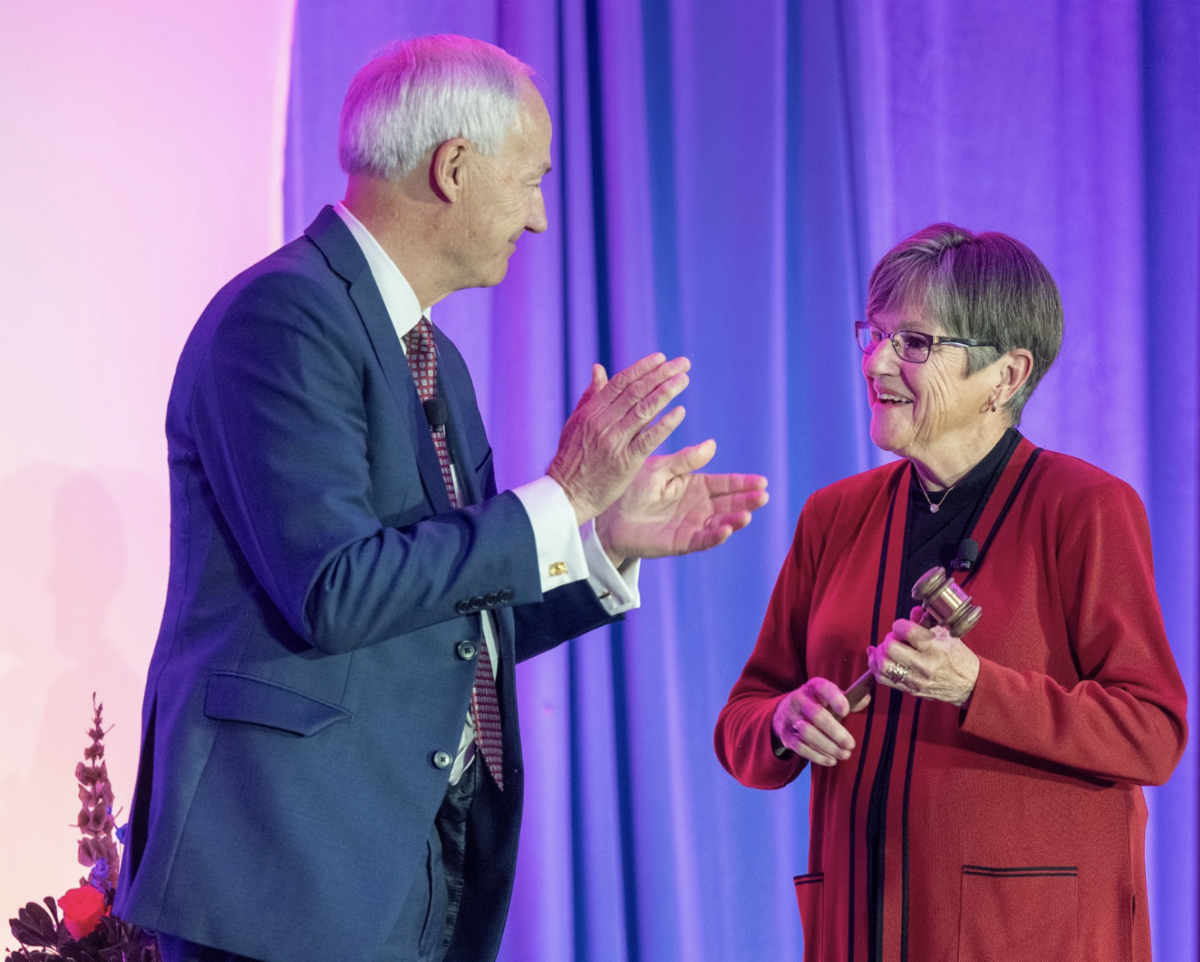
Former Arkansas Governor Asa Hutchinson, the outgoing Chair of ECS, presided over the official gavel exchange—marking the transition to Governor Laura Kelly’s term. Photo Credit: Kansas Office of the Governor

No summer slide for Kansas governor

Governor Laura Kelly logged a very busy July, launching programs, awarding funds, and being selected as the chair of the Education Commission on the States. In addition to all the education-related activity, Kelly has earned some significant economic development wins for the Sunflower State.


According to a press release issued in late June, Kansas has recruited more than $9 billion in new private sector business since Kelly took office. In addition, Lieutenant Governor David Toland has closed on 658 economic development projects, creating or retaining more than 43,500 Kansas jobs.


"Our tracking record of fully funding schools, investing in infrastructure, and expanding broadband access has resulted in more businesses choosing to call Kansas home," Kelly said.


On that note, here are some of the Governor's recent actions related to cradle-to-career investments:


Governor Kelly Announces Nearly $43.6M in Grant Funding, Creating Over 4,200 New Child Care Slots


As part of the Child Care Capacity Accelerator grant program, the $43,593,294 in funding will create 4,211 new child care slots across the state.


Rural communities like ours, fight to thrive and do not back down from challenges; however, the ability to expand childcare in our area has been very difficult to execute…The best initiatives do not just address one problem, they address multiple. The Accelerator Grant funding does this in spades," said Martin Burke, Superintendent, West Elk Schools. "I believe this has been a tremendous investment, an investment that all Elk County and Kansas citizens will benefit from for generations to come. Without the opportunity provided by the Accelerator Grant, West Elk may have never accomplished our goal of establishing child care availability in our communities.”


Kansas Child Care Task Force Works Toward Access, Quantity, and Quality Solutions


Kelly set up the task force to study ways to overhaul the administration of the state's child care system and consolidate programs spread across multiple agencies. The goal will be to create a new cabinet-level agency.


Governor Kelly Breaks Ground on New Child Care Facility in Great Bend


“My vision for my first term as well is to make Kansas the best place in the country to live and raise families,” Gov. Kelly said. “Providing child quality child care services is fundamental to that goal, devoting resources to early childhood development and care is the smartest investment in making sure children get a strong start and it sets them up for long term success.”


Governor Kelly Announces Launch of MeadowLARK Grant Program to Expand Apprenticeship Opportunities in Kansas


MeadowLARK will invest nearly $5.7 million over the next three years to advance integration efforts with local Workforce Boards across Kansas and establish Statewide and Regional Multi-Employer Intermediaries.


The Statewide Multi-Employer Intermediaries include:


  • K-12 Teacher Educator Registered Apprenticeship with the Kansas Department of Education
  • Justice Involved Registered Apprenticeship with local Kansas WorkforceONE


Kansas Awards More than $8 Million in Support Learning and Discovery Grants


The grant program will pay for the staffing, operating, and construction costs necessary to build a new multipurpose facility with broadband access in Wichita and cover some infrastructure improvements for the Children's Discovery Center in Topeka.

Pondering teacher shortages

Earlier this summer, Aligned researched teacher staffing data across the nation and in Kansas and Missouri to answer the following question:


Is the teacher shortage crisis real?


Our answer: 


It depends...


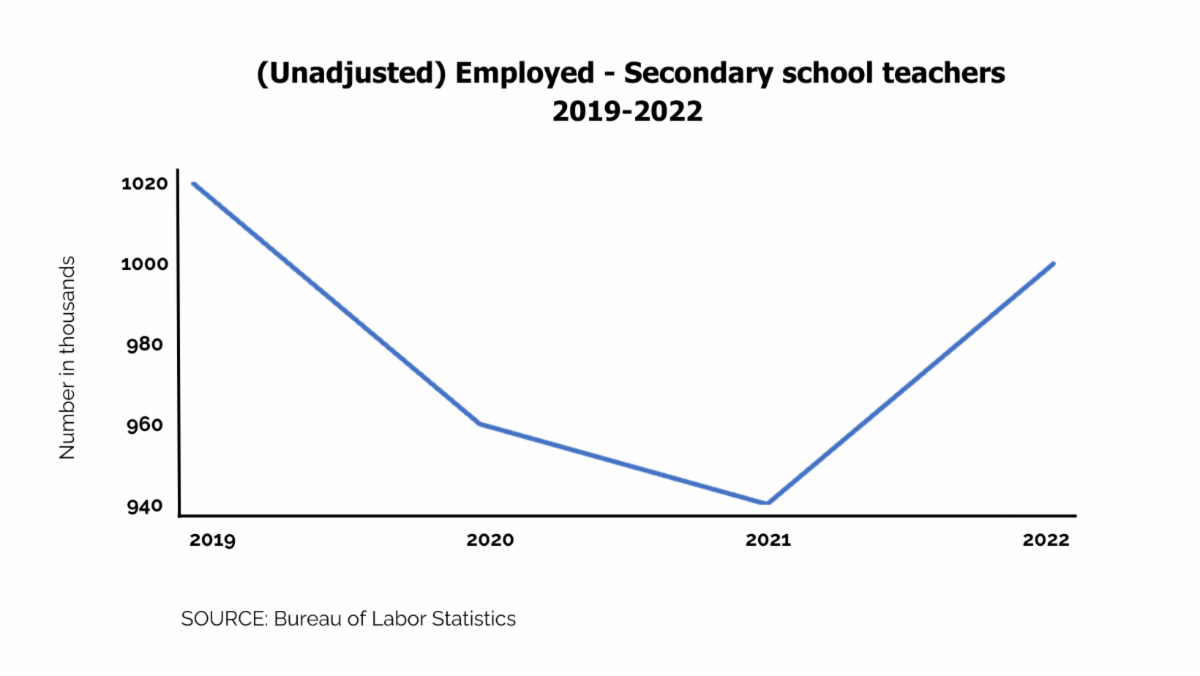
Labor force participation for secondary teachers did drop during COVID, and last fall, the National Education Association (NEA) cited a Bureau of Labor Statistics (BLS) survey that suggested there are currently 567,000 fewer educators in American public schools than before the pandemic. 


However, according to updated BLS data, teacher labor force participation has more or less rebounded. This chart shows labor force participation both pre- and post-pandemic.

Despite the fact that overall the staffing crisis looks to have rebounded, shortages do persist in certain locations and content areas.


The National Center for Education Statistics (NCES) reported that as of October 2022, 18 percent of public schools had one teaching vacancy, and 27% had multiple teaching vacancies. However, it's the high-poverty schools and schools with high-minority populations that have the most trouble with staffing. And most vacancies are in non-teaching staff positions like bus drivers, tutors, and custodians.


To note, the findings released by NCES are survey data from a School Pulse Panel, which is a study collecting information on the impact of the COVID-19 pandemic.


A closer look at Missouri and Kansas


There isn't one extensive dataset that accurately reflects where each state stands concerning the health of its teacher pipeline and the strength of its current workforce, which makes it difficult to compare apples to apples.


For example, the Education Commission on the States (ECS) offers a 50-state comparison with a state-by-state view of teacher recruitment and retention policies but offers no rankings listing workforce strength from weakest to strongest.


However, from the ECS policy guide, we learned that Missouri publishes current teacher shortage data, which links to a report published by the Department of Elementary and Secondary Education (DESE) in January 2021. The report includes longitudinal data on a number of areas including teacher shortages by subject areas, teacher recruitment, teacher retention, and teacher certificates issued.


DESE also publishes a state report card that displays data over a fixed period of time. Some of the data points includes enrollment, attendance, percentage of free and reduced-lunch student population, graduation rates and more.


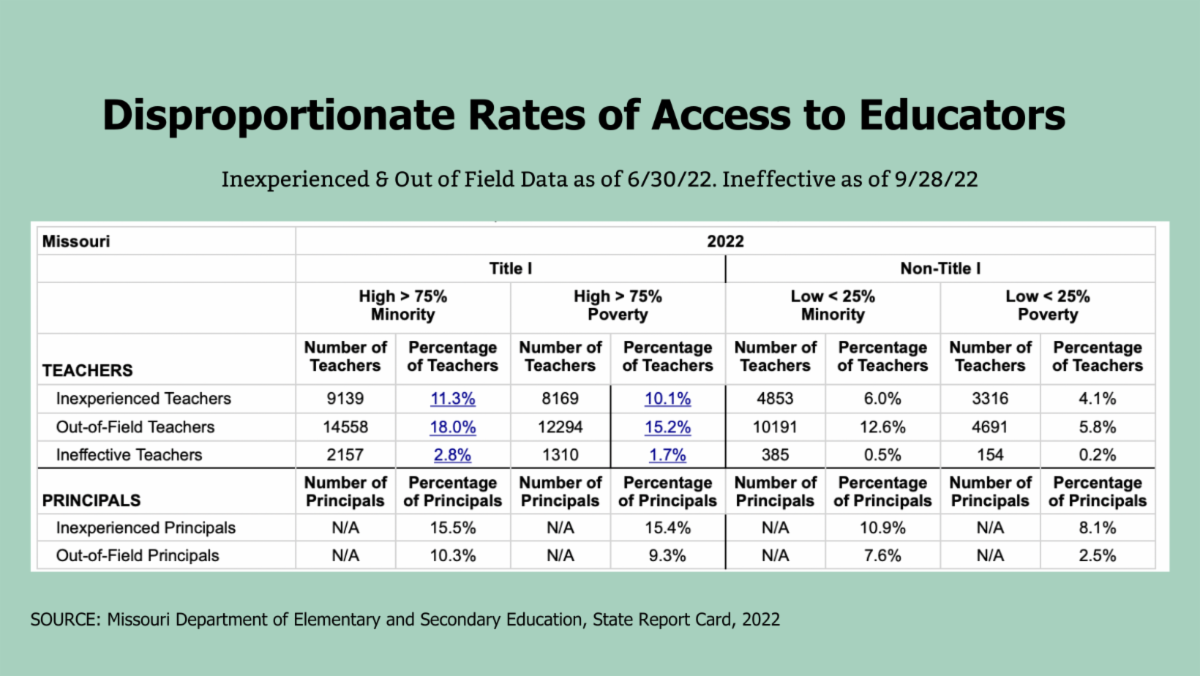
One data point in the report card shows the percentage of inexperienced, out-of-field, and ineffective teachers based on minority and poverty rates. Low-income communities show higher percentages of unqualified teachers which is a symptom of a teacher shortage. DESE data below provides more detail.

DESE uses appropriate certification of teachers and out of field data to identify the designated areas of critical shortages. 


For the 2021-22 academic year, the department reported 71,587 full-time teaching positions. And the number of inappropriately certified or vacant FTE throughout the state represented 5% of the total FTE (3,579 teachers).


Shortage areas (5% of total FTE) listed from most severe to least are:


  1. Elementary Education 1-6
  2. Mild/Moderate Cross-Categorical K-12
  3. Early Childhood Special Education B-3
  4. Early Childhood Education b-3
  5. Social Science 5-9
  6. Physics 9-12
  7. Mathematics 5-9
  8. Severe Development Disabled B-12
  9. Biology 9-12
  10. General Sciences 5-9
  11. Language Arts 5-9
  12. Mathematics 9-12
  13. Business Education 9-12
  14. Earth Science 9-12
  15. Chemistry 9-12 


Data published by the Kansas State Department of Education was out-of-date; however, according to a report from KMUW Radio in Wichita last summer, Kansas faced a "severe teacher shortage" based on roughly 1,400 unfilled positions which represented about 4% of teaching jobs. 


Why do all the headlines scream "mass exodus"?


Heather Schwartz, a researcher at RAND, a nonprofit organization that regularly surveys school districts, found that 77 percent of schools used the $190 million in federal pandemic funds to beef up their payrolls.


"Yes, there's a shortage in the sense that they have unfilled open positions. But it's sort of a misnomer to say the word 'shortage' because compared to pre-pandemic, there's more people employed at the school," said Schwartz. "Imagine that Google decided to expand its ranks of computer programmers. It might be hard to find so many software engineers, and it would feel like a shortage to IT hiring managers everywhere. That's what's happening at schools."


Don't believe the hype – but don't also ignore the problem.


In January of 2023, DESE reported a shortage of more than 900 FTE in the areas of high school biology, high school physics, middle school math and middle school general science.


And districts with high concentrations of minority populations and students from families in poverty still struggle to start the school year with a full roster.


What's the solution?


States are working to address teacher shortages through policy solutions that give districts more flexibility in hiring, innovative scholarship opportunities, and targeted funding. Here are some ideas that Missouri and Kansas have proposed or implemented.


Missouri


  • Legislation to allow school districts to offer differentiated pay to teachers based on expertise
  • Renaming the "Urban Flight and Rural Needs Scholarship Program" to "Teacher Recruitment and Retention State Scholarship Program" and funding it accordingly
  • School finance reform to inject more funding in high poverty schools
  • More flexibility to incentive retired teachers to keep teaching


Kansas


News & Nuggets

  • 16,000+ Kids Disenrolled from Medicaid - On Thursday the Missouri Department of Social Services (DSS) announced more than 32,000 Missourians lost Medicaid coverage in June, the first month of eligibility redetermination since the beginning of the COVID-19 pandemic. Of those disenrolled, 16,262 were children; nearly 11,000 of whom were disenrolled for 'procedural' reasons such as failure to return proper forms or an inability to be reached by department staff for verification  


  • Lead Testing Grants - On Monday the Biden Administration announced more than $58 million is available to schools and daycare facilities through the EPA to test and remediate drinking water sources for children


  • DMH Helping Teachers - On Monday the Missouri Department of Health (DMH) released a free text-based resource for Missouri educators to help improve mental health and prevent burnout 


  • Tracking Missouri's teacher workforce data ahead of the 2023-24 school year


  • A math problem for California schools: does data science = Algebra II


  • California has adopted a new way of teaching math


  • Twitter takes '@x' handle away from original owner


  • High school students introduced to Wash U college life during Rural Scholars Academy


Celebrate session wins with us in Kansas City

As you know, this year has been filled with great success for child care and early education in the Show-Me State. Because of all of your support and advocacy, we secured over $160 million in new investments for our kids and families! 


Aligned, along with Kids Win Missouri, EarlystART, and the Greater Kansas City Chamber of Commerce invite you to join us for a happy hour with fellow parents, providers, business leaders, legislators, and other partners and advocates to celebrate the wins of the 2023 legislative session.


We will serve appetizers and beverages!


RSVP here today to let us know you're coming. We look forward to seeing you in KC! 

Torree Pederson Signature.png

Torree Pederson

President

Aligned

Torree@WeAreAligned.org

(913) 484-4202

SIgnature_No_Background.png

Linda Rallo

Vice President

Aligned

Linda@WeAreAligned.org

(314) 330-8442

Torree_Pederson_WEB-3 closeup.jpg
Linda_Rallo_Headshot.png

Download our 2022 Annual Report

Visit our Website