Campaigning for Democracy And Socialism | |
|
August 9, 2024: The Week in Review
Defeat Trump's 'Otherizing' with 'Deep Listening.'
Organize at the Base to Find Anti-MAGA Common Ground
| |
|
Donald Trump is losing his marbles, and in plain sight.
That's an honest evaluation of his 90-minute rant at his Mar-A-Lago press conference yesterday. Breitbart, the favored opinion site of the MAGA right wouldn't comment directly, at least not yet. But down below the fold, it featured a CNN reporters summary. It was a 'dumpster fire' harming his campaign.
This is not news on this side of the political divide. If Trump's lips are moving, he's probably lying. But this rant revealed a deeper problem. Trump considers his own fantasies the truth, regardless of the facts. Yesterday he told a story of a harrowing ' emergency landing' helicopter ride with California's former governor, Willie Brown, leading Trump to be wary of helicopters. On the ride Trump said Brown, who had a fling with Harris early in her career, had nothing but bad things to say about her.
There one problem here. This helicopter ride never happened. What did happen was a Trump helicopter ride with former governor Jerry Brown and current governor Grant Newsom. They were reviewing wildfire damage, and landed in a spot without a pad, making it a bit bumpy. There was no discussion of Willie Brown and Kamala Harris. Willie Brown, in a later comment, considered it an amusing fantasy, and went on to praise Harris for her legal intelligence and political skills. The fact that the two dated for a few months when she was a DA in the Bay Area has been widely known for years.
But Trump, you see, doesn't make mistakes. You can fully expect him to field any questions about this event by attacking the questioner and changing the subject. In fact, his mind is going beyond a few 'senior moments'. All of us near or past our 80s have all experienced episodes when we had to wait a few moments searching for a word or name to pop up. But Trump is confabulating, creating 'memories' from imaginary or disconnected events.
Trump also has a hard time with simple rules of logic. He rigidly clings to 'either/or' when 'both/and' is often needed. He thinks Kamala Harris is a 'chameleon,' where one moment she's Black and another moment she's Indian-American. She can't be both at once, when nearly all of us are, including Trump. Is he a Scots-American or a German-American? Take my case. I'm a typical Western Pennsylvanian--5/8s Scots-Irish and ¼ German ancestry. Like most of us, I have no problem with 'both/and.'
But there's a method to Trump's irrationality here, one he convinces many of his followers to embrace. We can call it 'otherizing.' Trump paints his adversaries as not normal, beginning with his use of mocking nicknames. Because they can be disrespected, they are not quite like us. They are not normal, and when non-European ancestry or non Christian religion comes in, in goes beyond nicknames. Obama was called a Kenyan and a Muslim, when he was neither. His father was, but his mother wasn't. In fact, on his mother's side, Obama is a descendant of John Punch, and early Virginia African slave from the late 1600s. His surname, over time, became Bunche, as in Ralph Bunche, a notable UN diplomat from the mid-20th century. Ralph Bunche was Obama's distant cousin. In his Chicago years, the Obamas were members of the Trinity United Church of Christ. He was married there, and his children were baptized there.
How else does 'otherizing' work? I'm reminded of a time when a carload of us Aliquippa jazz-loving Western PA rebel youth drove to the 1960 Newport Jazz Festival in New England. Every step along the way, we laughed at all the funny 'accents' people had--New Jersey, New York, Newport. As for us, we didn't think we had 'accents' at all. We just spoke 'normal,' while the 'others' did not. As I now know, 'Pittsburghese' is one accent that's quite distinctive and widely known for its word oddities, such as 'Yinz' for the second person plural.
Trump's core trope for 'otherizing' is playing on 'whiteness' as 'normal' while any aspect of anything else can be pounced upon to make a wall and consolidate a core. Given the fact that the relative difference in undue advantages to the white skin that has been slowly eroded by partial civil rights victories, those who still cling to 'whiteness' are open to resentment, an emotion Trump plays like a violin in all his rants against immigrants of color. What you are witnessing if you listen to these rants, is the core irrationalism in much of both rightwing populism and fascism, and its use in shaping the'armor of one's character structure. .
The truth in our history is when African Americas rise, we all rise. And when they are held down, we are all held down, even if a tad less. That difference is put their to keep us thinking that there is such a thing as 'the white race' and we're in it.
How do we fight it? It's rarely done well at the top. And liberals looking down their noses at 'fly-over country' aren't very good at it. It requires left organization at the grassroots, but a left not afraid to get outside their comfort zone and engage with 'normal' people with views we might think mistaken or worse. The first thing to do is 'deep listening,' and asking probing questions, finding common ground to build on. We all have conflicted consciousness, with upsides and downsides. We have to find the positive aspect of it in our 'normal' neighbors and use it to see if we can engage in common action, no matter how small. Then we can jointly reflect on that action to see what new we have learned, and how we might do more. Organization is the central task, revolutionary education is the key link.
[Note: since this Links project was initiated by CCDS, I've been asked to avoid the 'editorial we' as much as possible. They have a point. But at times, I'll still make use of it, even if those ideas are always mine. -CD]
| | | |
WE ARE INVITING FEEDBACK!
Please send us your letters, comments, queries, complaints, new ideas. Just keep them short and civil. Longer commentaries and be submitted as articles.
DIFFICULTY READING US?
|
We're going to try something new, and you are all invited.
Saturday Morning Coffee!
Started in August 2022, then going forward every week.
It will be more of a hangout than a formal setting. We can review the news in the previous days' LeftLinks or add a new topic. We can invite guests or carry on with those who show up. We'll try to have a progressive stack keeper should we need one.
Most of all, we will try to be interesting and a good sounding board. If you have a point you would like to make or a guest to invite, send an email to Carl Davidson, carld717@gmail.com
Continuing weekly, 10:30 to Noon, EDT.
The Zoom link will also be available on our Facebook Page.
Meeting ID: 868 9706 5843
Let's see what happens!
|  |
IF NOT NOW
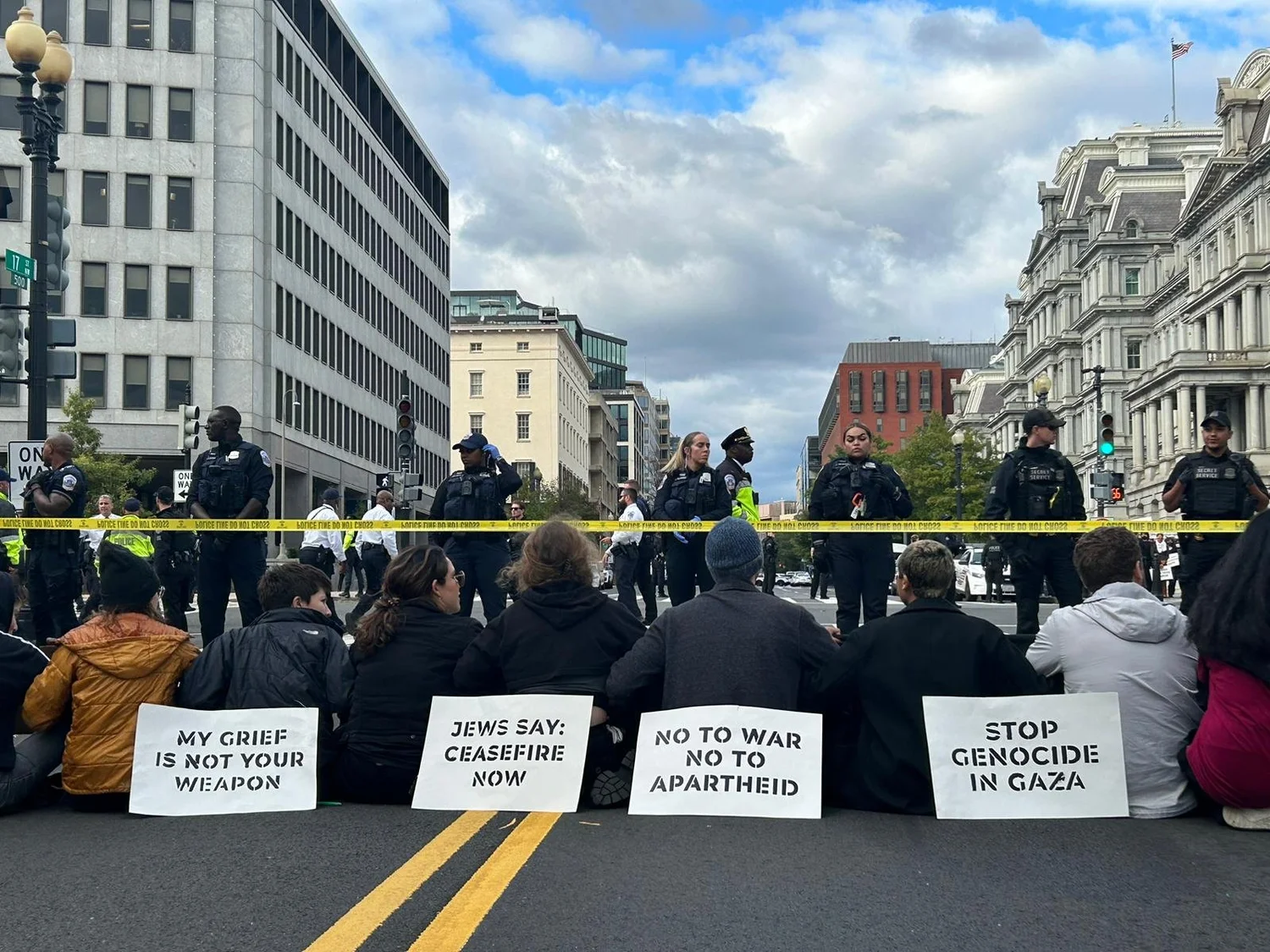
We are a movement of American Jews organizing our community to end U.S. support for Israel's apartheid system and demand equality, justice, and a thriving future for all Palestinians and Israelis.
Will you help us change the status quo in our politics and our community?
We’re going up against a powerful, wealthy establishment and rely on grassroots donors like you to grow our movement.
|  | |
In February 1939, more than 20,000 Americans filled Madison Square Garden for an event billed as a “Pro-American Rally.” Images of George Washington hung next to swastikas and speakers railed against the “Jewish controlled media” and called for a return to a racially “pure” America. The keynote speaker was Fritz Kuhn, head of the German American Bund.
Nazi Town, USA tells the largely unknown story of the Bund, which had scores of chapters in suburbs and big cities across the country and represented what many believe was a real threat of fascist subversion in the United States. The Bund held joint rallies with the Ku Klux Klan and ran dozens of summer camps for children centered around Nazi ideology and imagery. Its melding of patriotic values with virulent anti-Semitism raised thorny issues that we continue to wrestle with today.
Go here for Chapter One
and More Info
|  | |
Register now for the
2024 Worker Co-op Conference!
Join hundreds of cooperators and allies from around the nation and world in Chicago from September 12th through 14th for the Worker Co-op Conference – the only national event where worker-owners and allies from the labor and solidarity economy movements gather to learn and build power together.
The conference will feature speakers and workshops led by peers from around the country, a local business and organizing fair, industry-based meet-ups and celebration at the 2024 Worker Co-op Awards ceremony.
Register for the 2024 Worker Co-op Conference today on conference.coop.
| |  |
 | |
The success of the battle for the future of American Democracy-the struggle for progressive values-the battle between democracy and autocracy-between hope and fear-will not be determined entirely by the merits of our values or even the strength of our conviction.
It will be determined by how well American progressives organize to promote those values. It will be determined especially by how well we execute the nuts and bolts of election campaigns.
This book is about the fundamentals. It's about execution.
It's about the fundamentals of great electoral organizing, effective political communication, understanding the self-interest of the voters, political fundraising, using social media and other new technologies, creating high intensity field programs, voter mobilization, the qualities of great organizers.
It is a step-by-step field manual for how progressives can win electoral campaigns - and a textbook for anyone who wants to know how electoral politics really works.
Go here to purchase
|  | |
Project 2025: Everything You Need To Know In Two Minutes
Mehdi unpacks all 30 chapters of Project 2025—the handbook for Trump’s authoritarian overhaul of the U.S. government—in just 120 seconds.
Subscribe to Zeteo to support independent and unfiltered journalism:
https://zeteo.com/subscribe
|  | |
2024: The Politics
Americans Want
August 18-19, Chicago, IL
Join us in Chicago for a two-day event dedicated to advancing progressive policies and celebrating 20 years of activism with Progressive Democrats of America.
Day 1: Sunday,
August 18, 2024. 9am-5pm
Day 2: Monday,
August 19, 2024. 9am-5pm
Early-bird Single Day Registration: $20.00
Early-bird Two Day Registration:
$30.00
Stay tuned, we’re excited to bring a full program that includes the following panel topics:
Left-Progressive politics: the antidote to the Crisis of American Democracy
Recasting US Foreign Policy: Human Rights and International Solidarity
Organized Labor on the Rise: the 2020s and Beyond!
Focus on our Cities: Developing a Template for 21st Century Urban renewal and prosperity
Addressing and Overcoming Structural Racism; Guaranteeing Civil, Health and Economic Rights for All (LGBTQ+, the ERA)
Building a Prosperous Middle-Class Society with Low-to-No Poverty: a 21st Century Economic Bill of Rights
The Climate Emergency: What Real Solutions Look Like and How We Achieve Them
Honoring Our Past, Present and Future: Rev Jackson, Bernie Sanders, the Squad and the Emergence of the Electoral Political Movement that America Needs Today and the Foreseeable Future
Register Here
|  | |
August 30 – September 2.
As global crises deepen, social movements the world over are striving toward new visions and experimenting with new strategies. From Palestine to the US and beyond, radical politics have re-emerged as necessary for both survival and full liberation. At this critical juncture, the Socialism 2024 Conference will be a vital gathering space for today’s left.
A four-day conference featuring dozens of participatory discussions, lectures, and workshops organized by activists from all over the country, the Socialism Conference will host exchanges between existing organizers and organizations, while bringing in new layers of the politically curious as part of building our radical traditions and movements. Join us August 30 – September 2.
Go Here for more details
| | |
Last Week's Saturday Morning Coffee
| |
News of the Week, Plus More
| |
|
Read More via Z3RO COOL on 'X'
Trump Just Entered His 'Fat Elvis' Phase
By Thom Hartmann
Alternet
Aug 5, 2024 - I hear it frequently on my radio/TV program: Americans are baffled about what’s happened to Donald Trump.
He used to seem so formidable, a very real threat to American democracy, the pal of dictators around the world. Now even Putin is dissing him, cutting the very prisoner deal with President Biden that Trump said a few weeks ago the Russian dictator would only do with him.
He’s gone, in the minds of many Americans, from being a danger to being merely weird. What happened?
The simple reality is that Trump has entered the Fat Elvis phase of his career.
He hasn’t grown or developed new routines; he’s just reliving his old hits every day, playing to a nostalgic and mostly elderly audience who fondly remember his glory days.
His pathetic attempt to question the racial identity of Vice President Harris was just a warmed-over version of his Obama Birther slanders; they played well back in the first decade of this century, but now they’re just old and flat.
His claim that Hispanic immigrants and asylum seekers are “taking Black jobs” is just a makeover of his 2015 coming-down-the-escalator pitch. It was new and novel then and caught the love and attention of racists all across America; now it’s just a tired retread.
His forcing Republicans in the House to vote down the border bill that Oklahoma Republican Senator James Lankford principally wrote just adds to the perception that he’s a rank hypocrite with little interest in actually solving America’s problems.
His newest fundraising grifts — “gold” tennis shoes, bloody-ear bobble head dolls, raising the Mar-a-Lago entrance fee for spies and hangers-on to $1,000,000 — are every bit as pathetic and sloppy as his old pitches for Trump steaks, Trump water, and his failed Trump “First Class” Airline.
His entire career in the media has been characterized by rich-frat-boy flamboyance and testosterone-driven excess, from publicly cheating on each of his three wives to bragging about leering in the dressing rooms of teen beauty pageants to his faux “successful businessman” routine on NBC. Today, though, nobody is shocked, amazed, or impressed; more Americans pity him than are in awe of his proclaimed masculinity.
The one aspect of his public persona that hasn’t much changed is his naked racism, although even that has become boring. He’s now desperately trying to slice-and-dice the American electorate so he can pit separate groups of people against each other or suck up to whatever faction he thinks might save his doomed candidacy.
He’s trying to appeal to boomers by saying he’ll repeal the income tax Reagan put on Social Security; it’s not working because boomers remember that every one of the four budgets his administration produced when he was president called for radical cuts in Social Security.
He thinks he can ingratiate himself with Jews by saying that Kamala Harris “doesn’t like Jewish people” when most Americans know she’s married to one. When that didn’t work, he tried sucking up to Benjamin Netanyahu and inviting him to Mar-a-Lago; most Americans realize that both men are spinning political plates in the air as fast as they can to avoid going to prison for corruption. Now he just sounds like an aging antisemite afraid of jail.
He believes young people will swoon when he says he wants to eliminate income taxes on tips, but most young workers are still old enough to remember that in 2020, as the Economic Policy Institute noted in their headline, “Trump administration finalizes regulation that will cost tipped workers more than $700 million annually.”
He thinks trash-talking women, calling them “nasty” and other epithets, will bond men to him; instead, they imagine him bursting in on their mothers, sisters, wives, or daughters in a Bergdorf-Goodman dressing room.
In each one of these efforts to either turn Americans against each other or slice off and nail down a segment of the electorate, Trump is ignoring what most citizens are fundamentally concerned about: the physical, emotional, and fiscal health of our entire country.
Nobody — outside of his Greene/Gaetz/Boebert fan club in the House — believes his promise to pardon the people who tried to beat over 140 police officers to death is righteous; it just makes him look and sound like a sleazy, washed-up, wannabee mob boss who hates cops.
The only “new” policies Fat Elvis Trump has come up with are those brought to him by billionaires dangling campaign contributions:
— He wanted TikTok banned until billionaire Jeff Yass — the largest American investor in the platform — visited him at his shabby golf motel.
— He correctly pointed out that Bitcoin is a risky commodity rather than a currency until Bitcoin aficionados and billionaires Elon Musk, Joe Lonsdale, Doug Leone, Shaun Maguire, Antonio Gracias, and Cameron and Tyler Winklevoss came to his defense.
He doesn’t have any new vision for America: he just wants to be the star of his own version of The Apprentice, reliving the highlights from his glory days and, of course, keeping himself out of prison by taking control of the Department of Justice.
He oversaw the unnecessary deaths of a half-million Americans, giving America the second-worst Covid death rate in the world because of his incompetence.
He gave us the worst economy since the Republican Great Depression of the 1920s.
He nearly destroyed an international alliance of democracies that it took good men and women across dozens of nations — and two bloody world wars — a century to put together.
Fat Elvis Trump thinks he can keep spinning the old hits, but polls now show that — outside of his elderly white rally audiences — Americans have figured him out, are tired of his cons, and have moved on.
And it couldn’t happen at a better time: A new day is at hand if enough of us will simply show up and vote this November. ...Read More .
| |
|
Photo: al-Jazeera
Israeli Minister Laments That 'Nobody Will
Let Us' Starve 2 Million Gazans To Death
"This is what fascism and the desire for mass extermination and displacement look like," a Palestinian-American expert said. "These criminals want to eliminate all Palestinians in Gaza, not just Hamas."
By Edward Carve
Common Dreams
Aug 05, 2024 - Far-right Israeli minister Bezalel Smotrich on Monday said that it might be "justified and moral" to cause two million Palestinian civilians to starve to death until Hamas returns Israeli hostages, drawing criticism from humanitarian groups.
Human rights campaigners have demonstrated that Israel is limiting and delaying aid into the Gaza Strip, and even using starvation as a "weapon of war." United Nations' experts warned earlier this month that famine had spread across the enclave, calling it an "intentional and targeted starvation campaign against the Palestinian people" and "a form of genocidal violence."
The comments from Smotrich, Israel's finance minister, added further weight to critics' charges that the country's leaders are uncommitted to addressing the humanitarian crisis in Gaza.
"We bring in aid because there is no choice," Smotrich, the finance minister, said at a conference hosted by the right-wing news outlet Israel Hayom. "We can't, in the current global reality, manage a war. Nobody will let us cause two million civilians to die of hunger, even though it might be justified and moral, until our hostages are returned."
"We live today in a certain reality, we need international legitimacy for this war," he added.
Ahmed Fouad Alkhatib, a Palestinian-American fellow at the Atlantic Council, argued that Smotrich's comments indicated a genocidal intent to kill all of the people of Gaza. "This is what fascism and the desire for mass extermination and displacement look like," he wrote on social media. "These criminals want to eliminate all Palestinians in Gaza, not just Hamas."
Jehad Abusalim, executive director of the Institute for Palestine Studies, said Smotrich's comments were "horrifying but not surprising."
"This vile rhetoric is just the tip of the iceberg," he wrote on social media. "Smotrich is a minister in a government that Western leaders claim shares their values."
Peace Now, an anti-occupation Israeli group, condemned Smotrich's remarks in several social media posts, expressing disbelief that a "senior member of our government" would say such a thing and arguing that it would be "justified" for the U.S. to sanction Smotrich.
"All the way to the Hague," Peace Now wrote, suggesting that Smotrich or other Israeli leaders were guilty of war crimes.
Smotrich implied that allowing in any aid to Gaza was a public relations exercise aimed at quelling international criticism of the Israel's assault on the enclave, which has killed nearly 40,000 Palestinians since October, according to the Gaza health ministry.
Hamas and affiliated militant groups killed more than 1,100 Israelis in a horrific massacre on October 7, taking about 250 hostages, only about half of whom have since been returned. Israeli authorities have said they believe more than 70 hostages are still being held alive, while more than 40 have died.
The International Court of Justice (ICJ), the United Nations' top court, has issued a series of rulings against Israel this year, determining that the country must prevent acts of genocide in Gaza and provide sufficient aid, stop its assault on Rafah, and end its unlawful occupation of Gaza and the West Bank immediately. In May, the International Criminal Court, which was founded in 2001 to establish accountability for the world's most serious crimes, sought arrest warrants for Israeli and Hamas leaders.
Humanitarian groups including Amnesty International and Human Rights Watch have said repeatedly that Israel has not complied with the first ICJ ruling—Israeli forces continue to obstruct aid transport and distribution in Gaza, despite mass starvation there. ...Read More
| |
|
Photo: Pamela Drew, “sign Bronx 4-6-24 Benjamin Netanyahu War Criminal,” July 6, 2024 / CC BY-NC 2.0
The ICC Indictments Are a Great Thing
We know Netanyahu is a war criminal. Now it’s time to prove it.
By Jeffery L
Liberation Road Substack
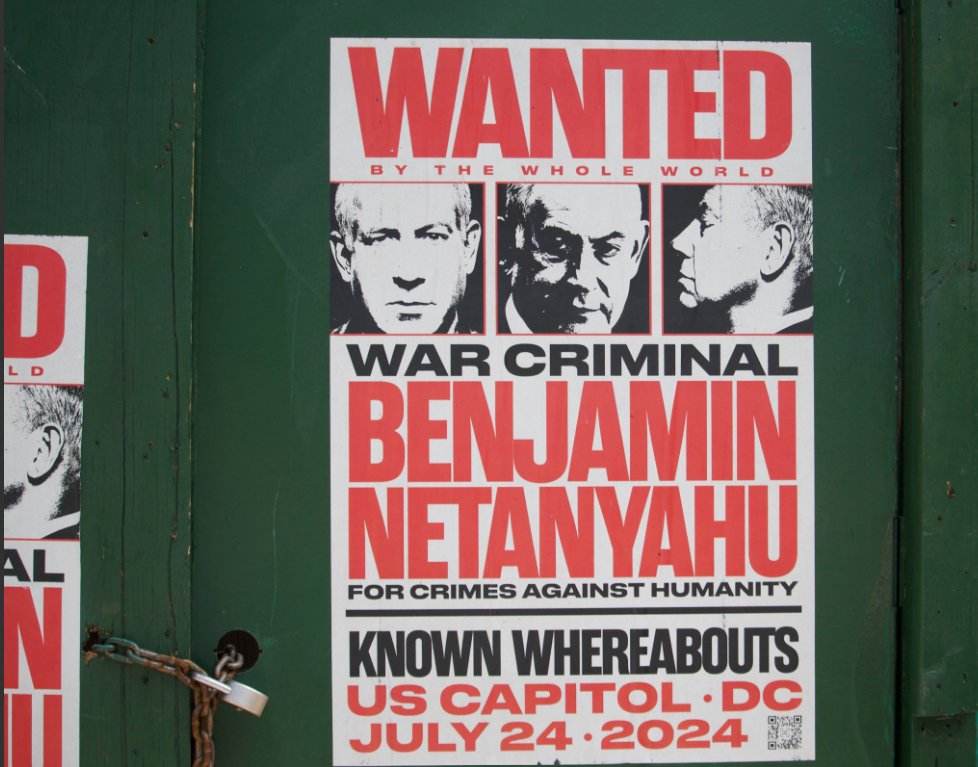
Aug 09, 2024 - During his recent address to the US Congress, protestors rightly decried Israeli Prime Minister Benjamin Netanyahu as a “war criminal”. They are correct—in pursuing the ongoing genocide in Gaza, Netanyahu has clearly committed war crimes and crimes against humanity. That’s why it is crucial that we support Netanyahu’s indictment by the International Criminal Court (ICC) and put pressure on the US government to do the same.
In May, the chief prosecutor of the ICC announced that he would seek a warrant for the arrest of Israeli Prime Minister Benjamin Netanyahu, as well as the leaders of Hamas. Last week, the UK’s new Labor government dropped plans to challenge these warrants, removing one impediment to a successful ICC indictment of Netanyahu for war crimes and crimes against humanity. US Leftists should call on the Biden administration to follow the UK’s example and rescind its objection to the indictments.
The ICC indictments are extremely important, and they should be supported by the left for at least four reasons. First, and most importantly, they put increased pressure on Israel to stop committing genocide. Second, they point the way toward a post-Atlanticist world where no country—not even the United States or its “special” friends—is above international law. Third, they neutralize Israel’s absurd claims that its genocidal actions in Gaza qualify as legitimate self-defense. And fourth, they can help us move people still exclusively fixated on the victims of October 7 to see the larger picture, creating a vehicle for neutral fact-finding about what really happened, both on October 7 and since.
Let’s explore these four points more.
First, an ICC indictment against Netanyahu would provide another point of leverage to compel Israel to cease its genocidal attack on Gaza. There has never been an ICC indictment against an active elected official of the US or one of its allies. This shows the enormous gravity of the crimes of Israel, and the clarity with which the international community sees them for what they are. As an unprecedented step, it puts even greater pressure on Israel to cease the genocide. This pressure is not only diplomatic, but increasingly economic, as investing in a country whose head of state has an ICC warrant out for them certainly poses an added risk. Just this week, the UK’s largest pension fund made significant divestments from Israeli assets.
Second, an indictment against a major US ally would be a key step towards a more just international order—one where no one nation or club of nations is above any other in the application of criminal, economic or political law, and no nation's sovereignty is conditional upon its bending to the will of another. The formal equality of nations within an international system of justice mirrors the formal equality of citizens within a democratic nation-state, and has been the dream of socialists and honest liberals alike for a long time. The minimal condition for such a modest system of basic fairness is an international legal mechanism to hold accountable the military and political leaders of states which commit crimes against humanity, war crimes, and other heinous acts.
Today, the framework and legal mechanism to create this system exist in the International Criminal Court and the UN’s International Court of Justice (ICJ). In the past, the ICC has faced accusations of serving as a tool of Western imperialism, punishing leaders from states of the Global South while giving the leaders of whiter, wealthier nations a free pass. These accusations have merit, but we should not dismiss the ICC’s earnest mandate or conclude its checkered history precludes it ever serving as a genuinely fair international tribunal. Fairness requires a higher body greater than any nation to which all nation states are held accountable. Holding Israel, a US ally, accountable for its crimes is a vital step towards universalizing the promise and premise of the court as a tribunal of genuinely international justice— a vital stepping stone into a world beyond US global dominance.
Third, ICC indictments of both Israeli and Hamas leaders will take the wind out of the sails of the powerful red herring that Israel’s genocidal actions in Gaza qualify as legitimate self-defense. Israel’s claims of self-defense are fraught with Islamophobia, white supremacy and settler colonialism, but are nonetheless compelling for many who haven’t bothered to examine the dark underside of their emotional conviction. Elevating an independent force that is capable of holding both Hamas and Israel to account for their wrongs can help neutralize the rhetorical and emotional power of such appeals.
Neutral fact finding and the notion that no one should be above the law is a familiar and accessible concept that can be applied to the international community in general and Israel and Hamas in particular. It’s not Israel’s place to hold Hamas accountable for war crimes, it’s the place of the ICC and ICJ. An independent investigation can shine the spotlight on Israeli vigilantism, in both Gaza and the West Bank. Equality before the law on matters of genocide, war crimes, and crimes against humanity should be bedrock principles of the left.
Finally, an ICC-led investigation will cut through competing narratives to determine what actually occurred on October 7 and subsequently. There is already overwhelming evidence that Israel is guilty of genocide, war crimes and crimes against humanity: the death toll, the tactics, the civilian targets. But while the sheer scale of this genocidal assault far exceeds the Israeli loss of life on October 7, some remain so stubbornly fixated on Hamas’ initial attacks that they can’t see the broader picture. An impartial investigation of both Israel and Hamas will cut through these concerns and counteract misinformation that has been widely circulated.
Whether intentional fabrications or accidental miscalculations, the distance between what happened and what’s been reported is significant, and many questions remain. The number of Israeli civilians killed on October 7th, for instance, has been revised down from 1,400 to 1,200, to 850. The United States, Israel and Hamas are not qualified to determine what exactly has and has not happened. We need a neutral, third-party investigation to learn the truth.
We must celebrate and uphold the ICC and ICJ. We must support the criminal indictments by the ICC against Israel, but also against Hamas, in the interest of finding out what really happened on October 7, and, if necessary, holding its leaders accountable to the standards of international law. No one is above the law, not in the world that we want to live in, and Israel must be held accountable for genocide.
Jeffrey L has done bothersome and occasionally disruptive labor, community and political organizing in the South and on the East Coast. He also sometimes writes. ...Read More
| |
|
Photo: U.S. Army's 'Task & Purpose'
Blistering Fact-Check Debunks 'Utterly Baseless
Swift-Boating' of Walz’s Military Record
By Alex Henderson
Alternet
August 08, 2024 - After Vice President Kamala Harris announced Minnesota Gov. Tim Walz as her presidential running mate, it didn't former President Donald Trump and Sen. J.D. Vance (R-Ohio) long to start attacking him. And one of Vance's lines of attack is claiming, with zero evidence, that Walz is distorting and exaggerating his military record.
In an August 8 column, MSNBC's Steve Benen debunks MAGA claims about Walz's military service and argues that Republicans are trying to "swift-boat" Walz in much the same way that Democratic presidential nominee John Kerry was "swift-boated" by President George W. Bush's supporters in the 2004 election.
"In 2004, a group called Swift Boat Veterans for Truth, bankrolled in part by a Republican megadonor and Justice Clarence Thomas benefactor, smeared then-Democratic presidential nominee John Kerry's military service," Benen explains. "The deceptive operation was guided in part by a GOP consultant named Chris LaCivita. Twenty years later, LaCivita is a top member of Trump's 2024 operation, and wouldn't you know it, Swift-boating, like birtherism, is making a sudden comeback."
By "birtherism," Benen is referring to Trump "promoting messages related to" Harris' "birth certificate."
Some MAGA Republicans are falsely claiming that Harris is ineligible to run for president because both of her parents were born outside the United States (her mother in India, her father in Jamaica). But in fact, the Oakland-born Harris is a lifelong U.S. citizen.
Ohio Capital Journal's Charlie Hunt, in an August 8 op-ed, stresses that Harris clearly enjoys "birthright citizenship" under the U.S. Constitution's 14th Amendment.
Similarly, Benen, in his MSNBC column, tears apart Vance's claim that Walz is resorting to "stolen valor."
"Based on all of the available evidence," Benen observes, "this line of attack appears utterly baseless. Walz enlisted in the Army National Guard as a teenager, and his military service spanned nearly a quarter of a century. The Minnesotan served honorably, rose to the rank of command sergeant major, and retired as a master sergeant in 2005. Months after his retirement, Walz's unit was deployed, which is apparently of interest to the Republican attack machine, but which does not appear to be controversial."
Benen adds, "In fact, Vote Vets, a progressive veterans group, published a brief summary, fact-checking the anti-Walz smear, and helping set the record straight.
Steve Benen's full MSNBC column is available at this link.
| |
|
Photo: Counter-protesters assemble in Walthamstow, northeast London, chanting ‘refugees welcome here’ (Getty)
'Hate Not Welcome’: Thousands Of Anti-Racism Protesters in UK Take To Streets In Show Of Defiance Against Far Right
Far-right demonstrators fail to show up and thousands of counter-protesters turn out after police braced for more violence
By Jane Dalton
The Independent UK
Aug 8, 2024 - Large-scale expected violence by far-right groups failed to materialise after thousands of counter-protesters turned out to stand against them.
Huge chants of “we fight back” and “refugees are welcome here” were heard on the streets of several major cities in England, outnumbering any thugs intent on causing trouble.
It comes after police warned more than 100 demonstrations could take place across the UK on Wednesday for another evening of unrest after a week of riots in places including Sunderland, Hartlepool, Liverpool and Rotherham.
Some 6,000 riot officers were standing by after gatherings had been anticipated in 41 of the 43 police force areas in England and Wales, with prosecutors warning a “hit list” of immigration centres and lawyers by the far right could amount to terrorism.
Police from southeast England were sent to northern cities on Wednesday to back up resources in northern cities after intelligence suggested further violent scenes were planned.
But on Wednesday night, the far right was barely seen in areas such as east London, Bristol, Oxford, Middlesbrough and Brighton.
Several hundred demonstrators holding anti-racism banners marched peacefully through the streets in Birmingham. It was estimated more than 1,500 counter-demonstrators turned out in Bristol.
Aldershot, Hampshire, was one of the few places where police officers rushed to separate opposing groups after tempers flared.
A group chanting “stop the boats” confronted a Stand Up to Racism group and angry shouting occurred.
In Sheffield, South Yorkshire, around 500 anti-racist demonstrators gathered and chanted pro-refugee slogans, but there was no sign of any far-right groups. Scores of police were in the area with riot helmets hanging from their belts.
Police in Northampton asked counter-protesters to leave after planned anti-immigration protests in the town failed to materialise.
However, there was some isolated disorder in Croydon, south London. The Metropolitan Police said about 50 people had “made clear their intention is to cause disruption and fuel disorder”.
The force said people had dragged and thrown objects down the road, and thrown bottles at officers. Eight people were arrested for assaulting emergency workers, possession of offensive weapons and other offences.
Forces across the UK have started issuing CCTV appeals to identify people in connection with the widespread unrest over the past week. ...Read More
| |
|
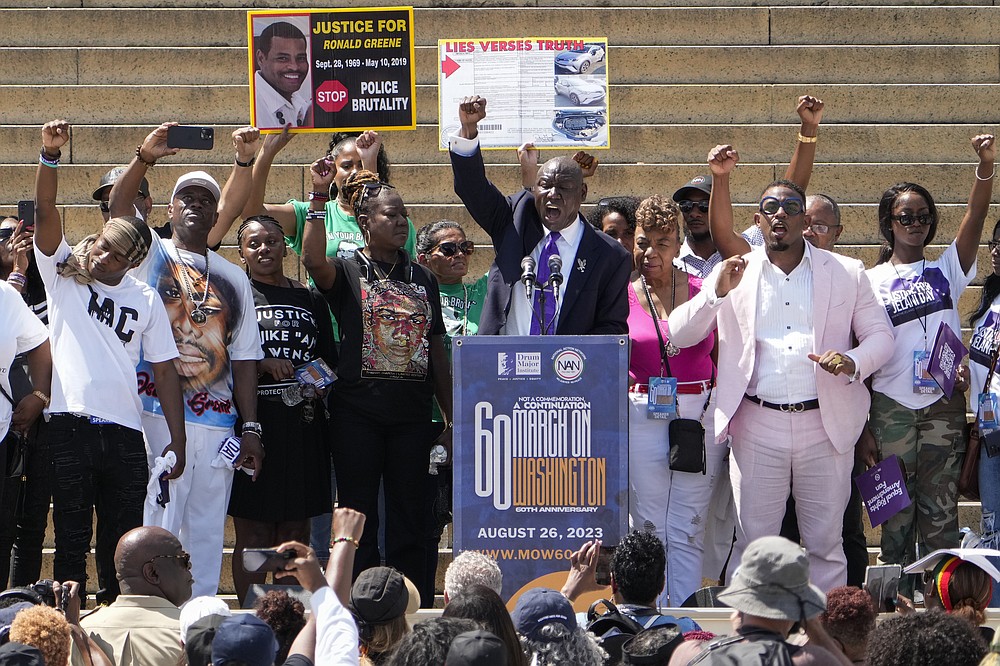
Photo: Attorney Ben Crump speaks during the 60th Anniversary of the March on Washington at the Lincoln Memorial in Washington, Saturday, Aug. 26, 2023. (AP Photo/Andrew Harnik)
Crow Jim: Project 2025’s Obsession With Reverse Racism
Blueprints for conservative rule can’t get enough of the smear that fighting racism against Black people amounts to racism against white people.
By Rick Perlstein
The American Prospect via Portside
When you split your time between writing the history of American conservatism, and writing journalism about conservatism now, bouts of déjà vu are an occupational hazard. Last week, one had me flashing back to the days of disco.
Roy Cooper is the Democratic governor of North Carolina. His lieutenant governor, Mark Robinson, is one of the most terrifying authoritarians in the Republican bestiary, the guy who recently told a church audience that “some folks”—in context, he appeared to be including liberals who want to “cancel you” and “kick you off social media”—just “need killing.” Under North Carolina’s constitution, this is the person who bcomes acting governor any time the governor goes out of state. That is why Cooper announced he was withdrawing his name from consideration to be Kamala Harris’s running mate—because every time he left the Tar Heel State to campaign, he feared the same thing would happen that happened to Jerry Brown after his re-election as California’s governor in 1978.
-
A colorful Republican record producer named Mike Curb had won the race for lieutenant governor. He had been specifically recruited to run, he revealed in his memoir, precisely to make it harder for Brown, who Ronald Reagan’s advisers believed would be harder to beat than Jimmy Carter, to run for president while simultaneously running the state. California, you see, had a similar provision in its state constitution. Just as soon as Brown traveled to Washington to testify on the California gasoline shortage, Curb started appointing Republican lawyers to lifetime judicial appointments. You really must have just fallen out of the coconut tree if you think the GOP only started hating democracy when Donald J. Trump arrived on the scene.
I felt similar déjà vu when Republicans started calling Kamala Harris a “DEI hire.” The charge is as old as the civil rights movement itself. Back then, they called it “reverse racism,” or “Crow Jim”: same thing as Jim Crow, only with the object of oppression reversed—get it? The jargon changed, but the principle is the same: Any effort at equity for minorities is “racism” against whites: affirmative discrimination, as the title of a 1975 book by the neoconservative Harvard social scientist Nathan Glazer put it. You saw that last week when Elon Musk momentarily banned the jocularly named “White Dudes for Harris” account from X, because, after all, X doesn’t allow “racists.”
This same snot-nosed fallacy absolutely saturates Project 2025.
On page 692: The Biden administration’s “‘equity’ agenda” is “racist.” On 342: “officials should protect educators and students in jurisdictions under federal control from racial discrimination by reinforcing the Civil Rights Act of 1964 and prohibiting compelled speech.”
Translated from wingnut-ese, they aim to compel teachers in schools run by the Bureau of Indian Education, or schools on military bases, not to speak about the racist parts of the American past. To do otherwise would be racist. This old-time religion threads its way through the chapters on the Departments of Labor (582), Education (336, 342, 348, 358), HHS (495), Treasury (708), State (88), Defense (103), the National Security Council (51), USAID (279)—and, naturally, Dr. Ben “Totally Not a DEI Hire” Carson’s chapter on the Department of Housing and Urban Development (515). The solution, naturally, is “colorblindness.”
The same thinking is present in the document’s many attacks on measuring “disparate impact,” the civil rights enforcement technique of measuring discrimination by results rather than impossible-to-discern evidence of intent. Counting how many minorities are represented in a given institution in order to build a case that they are being discriminated against is bad, because “crudely categorizing employees … fails to recognize the diversity of the American workforce.” We’ve noted that quotation before. Mark it well. We’ll return to it.
IN LARGE PART, A REAGAN-ERA HERITAGE FOUNDATION STAFFER who fell asleep on a Friday and woke up exactly 40 years later would be able to return to work the following Monday. All he would need is a copy of the Project 2025 version of Mandate for Leadership and a glossary. He’d surely be delighted to read how much of the language he and his colleagues came up with back then (“During the past 15 years there has been a concerted nationwide effort by professional educationalists to turn elementary school classrooms into vehicles for liberal-left social and political change in the United States”) finds exact echoes today (“Large swaths of the department have been captured by an unaccountable bureaucratic managerial class and radical Left ideologues who have embedded themselves throughout its offices and components.”).
Other stuff, though, would require several years of Fox News highlight reels before he could make heads or tails of it. Far more than in 1981, the date of Heritage’s first Mandate for Leadership, to be a conservative in 2024 demands fluidity in an entire parallel reality. This is no more harrowingly the case than in Project 2025’s chapter on the Justice Department—from which our Republican Rip Van Winkle would come away learning that one of the two or three gravest challenges for law and order in the United States is “violent attacks on pregnancy care centers.”
What’s a “pregnancy care center,” you—and he—might ask? That’s one of those Potemkin women’s health care offices pro-lifers set up to ensnare people seeking abortions and feed them propaganda, to terrify them into forcibly giving birth instead. How come you, as a nonresident of the right wing’s tempered-steel-hardened information silos, haven’t heard about this terrorism epidemic? Because it’s made up.
According to an investigation from The Intercept, not a single pregnancy care center or its staffers suffered bodily injury—although, after the Dobbs decision, several were vandalized. But a concerted pressure campaign on the FBI from Republican officials against what Sen. Chuck Grassley (R-IA) claimed was an epidemic of “pro-abortion violent extremism” led to an almost tenfold increase in investigations into abortion-related “domestic terrorism.” The FBI doesn’t break down these statistics according to whether the targets were performing abortions or preventing them. But given that, during the same period, investigations the FBI categorizes as attacks on “racially or ethnically motivated extremists” and “anti-government, anti-authority” attacks decreased by over 50 percent, it’s safe to say that the FBI is not “ignoring” this problem, but giving it a bear hug.
Back in January, when I interviewed journalist Jeff Sharlet about why the transformations brought about by the Trumpian moment in American politics are impossible to understand without knowing what happened in countries like Italy and Germany in the 1920s and ’30s, he spoke of fascism as a “dream politics,” an “aesthetic,” and an entire all-encompassing “mythology.” This is what I thought back to reading Project 2025’s chapter on the chief law enforcement module of the federal government. The reason it is so chilling is the number of times it precisely inverts reality, or just makes up its own reality, in service of an argument that it is the Biden Justice Department, and not Trump administrations past and potentially future, that is guilty of “unprecedented politicization and weaponization.” The supposed epidemic of terrorism against “pregnancy care centers” is a perfect example.
Another thing a Rip Van Winkle might suppose is that among the gravest problems the American justice system faces is “the department’s use of the Freedom of Access to Clinic Entrances (FACE) Act to harass pro-life demonstrators.”
The chapter singles out the supposed “harassment” visited upon one Mark Houck, proprietor of the “unapologetically masculine” Catholic lay ministry “The King’s Men.” The FBI “came to his door with guns drawn to arrest the 48-year-old father of seven” due to “a minor altercation with an activist who was harassing one of his children in front of an abortion clinic.” This is contrasted, without any supporting documentation, to the DOJ’s alleged simultaneous habit of “dismissing prosecutions against radical agents of the Left like Antifa.”
What you wouldn’t know from this account is that at his trial, which he blogged for the faithful before riding the publicity to a failed run for Congress, Houck admitted to the assault.
ON PLANET HERITAGE, THE JUSTICE DEPARTMENT is an anti-right Gestapo. The alleged law enforcement crisis that gets the most space in the chapter is familiar to any Fox News viewer, though you have probably never heard of it. In 2021, at the height of the Virginia gubernatorial race in which the Republican candidate made the supposed ideological outrages of liberal school boards his central campaign issue, the DOJ posted a mild letter of concern about violence and threats of violence against liberal school board members. Project 2025 describes it as a conspiracy of Attorney General Merrick Garland to target and harass people who were merely exercising their “constitutional and statutory rights,” in an effort to “chill the free speech rights of parents” by citing “supposed ‘threats’” that, while they were “politically convenient,” were also entirely “imaginary.” ...Read More
| |
|
Photo: People watch as a mounted U.S. border agent patrols along the beach by the wall separating the U.S. and Mexico on January 28, 2019 in Tijuana. (Photo: Scott Olson/Getty Images)
When Walls Are the Only Answer, We’re Asking the Wrong Question
Border barriers respond to only one question: How do we stop them? Our starting point should be: Why are so many people on the run?
By Sarah Towle
Common Dreams
Aug 08, 2024 - The U.S. Border Patrol turns 100 this year, marking a century of hunting people; stoking vigilante violence; and erecting physical, technological, and bureaucratic barriers—many lethal—against human beings in need. But walls have never been the solution. Indeed, they are the reason cruelty, chaos, and corruption prevail at our crossroads, especially along the U.S. frontier with Mexico. Patrols and checkpoints, gateways and guns, militarization—in lieu of humanitarian mobilization—these represent the real crisis at our borders today: the hardening of the human heart, a world in which empathy has seemingly expired.
Border barriers respond to only one question: How do we stop them?
Our starting point should be: Why are so many people on the run?
Over the last 40 years, a deterrence-to-detention-to-deportation pipeline that daily flouts legal due process has grown up all around us, hiding in plain sight just outside our privileged view.
History matters, and this history is no exception because much of what we’re dealing with today was Made in the USA. It is the legacy of climate breakdown, driven largely by our stubborn dependence on fossil fuels. It is the consequence of U.S. economic imperatives that incentivize corporations to migrate south in search of low wages, little taxation, and no environmental controls. It is the heritage of a foreign policy perspective wherein Latin America and the Caribbean exist for U.S. enrichment.
From the Banana Wars to the Dirty Wars, through the so-called Wars on Drugs and Terror, the U.S. role in rendering whole regions unlivable, thus forcing human displacement, is little discussed. While there is significant and excellent academic scholarship documenting this reality, it is kept swept under the rug, out of sight and out of mind, as if the powers that be don’t want us to know.
So here’s what you should know.
When the Berlin Wall fell in 1989, the power and wealth accumulated by the Cold War iron triangle at the intersection of bureaucracy, industry, and self-interest was threatened. So the military-industrial complex pivoted to managing and maintaining borders worldwide. A border-industrial complex was born, and the betrayal of the international refugee protection regime began.
There were about a dozen walls around the world when Berlin’s came down. There are now close to 90 built or in the works. And while erected much as their medieval counterparts had been—to divide and exclude—modern walls are no longer exclusively physical. They extend to the outer limits of linked surveillance systems and troop movements. As a result, the U.S. southern border of 2024 stretches as far as Colombia; Fortress Europe can be felt throughout North Africa, deep into the Sahara Desert.
Though the militarization of the U.S. southern border began well before the shattering events of September 11, 2001, that event propelled the border-industrial complex into overdrive, with the wealthiest and most privileged nations already primed to turn their backs on post-WWII human rights commitments. Favoring a security-first paradigm, 21st-century profiteers and demagogues are now making bank—or political hay—in thwarting the movement of humans fleeing hunger, horror, and harm.
The foot soldiers in this cruel war against the world’s most vulnerable people—those who’ve been forced to leave home because home has become too dangerous to stay—include the U.S. Border Patrol.
A sub-agency of the U.S. Customs and Border Protection since 2003, the U.S. Border Patrol became official 100 years ago, on May 28, 1924. The first appointed agent, Jefferson Davis Milton, was the son of a Confederate governor and enslaver. Offspring of an era when Slave Patrols carried out the dictates not of law, but of plantation “justice,” Milton became a Texas Ranger in the late 1870s, when still a teen. Tasked with the ethnic cleansing of Indigenous peoples, the recapture of formerly enslaved Black people, and the suppression of Mexican-origin property holders who took issue with white colonial settlers moving in and moving them off their land, the Texas Rangers of Milton’s day relied on the same raw, physical violence and brutality bequeathed to them by their Slave Patrol forebears.
Then came the 1875 Page Act, Congress’ second-ever legislation restricting immigration. It sought to check the numbers of Chinese laborers lured to the U.S., first by the discovery of California gold, then by the construction of the transcontinental railroad. The subsequent Chinese Exclusion Act of 1882 made it harder for expelled Chinese to get back into the U.S.; and impossible for new Chinese arrivals to gain entry at all.
Of course, Congress needed an armed guard to enforce this legislation as well as an office to maintain the force. So, in 1904, the first U.S. immigration police force was born: the Mounted Guard of Chinese Inspectors. It was made up of former Slave Patrollers, Klansmen, and Texas Rangers, like Milton. The human link between yesteryear’s slave and today’s border patrols, Milton brought to the Mounted Guard of Chinese Inspectors the same “shoot first and ask questions later” attitude he learned as a ranger. From 1924, he passed that culture of impunity to his new Border Patrol recruits just as U.S. lawyer, conservationist, and hardened eugenicist, Madison Grant, became a household name with his 1916 publication, The Passing of the Great Race. Claimed by Hitler as “my Bible,” the book is the bedrock of the Fox News/Breitbart/MAGA-party “Great Replacement Theory” today.
The fear-mongering Madison’s book kicked up in the 1920s might have been the country’s first Culture War. It certainly played an active role in Congress passing the Emergency Quota Act of 1921, with humans still referred to as “aliens,” even in the modern era. The follow-up Immigration Act of 1924, also known as the National Origins Act; authorized the creation of the Border Patrol; further tightened the quotas; and stiffened punishments for what was now called “illegal” entry," criminalizing the act of crossing the line “without inspection” by a border official. The National Origins Act would remain in place until the 1960s, as would the blatant exploitation of Mexican laborers.
Mexicans had moved throughout the borderlands without issue for centuries. They helped to expand and grow the U.S. economy; they turned California’s Imperial Valley into some of the most productive land on Earth. From 1924, when the U.S. southern border was closed and Mexican migration thwarted, treaties had to be negotiated when labor was needed to keep crops from dying in the furrows and factory assembly lines from failing to meet their projected yields. A political compromise was forged between Congress and the southwestern land barons: They could have their cheap labor as long as it was kept temporary and marginalized. This is when the Border Patrol went from merely hunting people to herding folks for the captains of U.S. corporate agriculture, too.
Fast-forward to the 2010s. When whole families as well as unaccompanied children began to arrive at the U.S. southern border—fleeing violence, starvation, climate breakdown, and other repercussions of U.S. political interference, military operations, and economic exploitation—that might have caused us to consider the human costs of our global adventurism; it should have triggered a humanitarian response at our southern border and a rethink of our outmoded immigration and asylum systems. But it didn’t.
Instead, the model of “prevention through deterrence”—unleashed 10 months after NAFTA became official in January 1994 and built on thwarting human migration through the cruelest of means—hardened. Over the last 40 years, a deterrence-to-detention-to-deportation pipeline that daily flouts legal due process has grown up all around us, hiding in plain sight just outside our privileged view. It is now the global behemoth that many decry as “broken” but which is working just fine for the demagogues and profiteers that benefit from it. In their world, where the outsider is to be feared and our so-called “security” reigns paramount, the 20th-century promise of the universality of human rights no longer applies.
But when home becomes too dangerous to stay, people move. We always have, and we always will—part of the human story since the dawn of time.
That is why deterring humans with walls has never worked, except to inflict misery and to kill. And why the 100-year birthday of a federal agency tasked with people-hunting and herding; prone to stoking vigilante violence; and intent on erecting physical, technological, and bureaucratic barriers—many lethal—against human beings in need is nothing to celebrate. ...Read More
| |
Digging Deeper into the Current Conjuncture: | |
 | |
Here is what the media isn't telling you about the riots that have swept across the UK
The rioters share the same ideology as our leaders
By Council Estate Media, UK
The genocide in Gaza and the riots in the UK have an obvious parallel - a hatred of Muslims and other races who are deemed inferior. Both the riots and the genocide are driven by supremacist ideologies that are intrinsically linked, and adhered to by our leaders. Our politicians are just respectable versions of the drunken yobs, who wear suits and ties. Their only disagreement with those yobs is they make fascism look bad.
One of the UK’s biggest yobs is Tommy Robinson, someone who Americans might not be familiar with, but British people sadly are. Little Tommy, whose real name is Stephen Yaxley-Lennon, is a guy who gets angry when rapes and violence are allegedly carried out by Muslims and immigrants, but falls silent when they’re carried out by anyone else.
Yaxley-Lennon has been a member of the British National Party and British Freedom Party, as well as a “political adviser” to the head of the UK Independence Party. Imagine being at the heart of an empire and demanding your independence…
Yaxley-Lennon stoked up riots with false claims on social media about “armed Muslims” while he was lying on a beach in Cyprus, safe from the violence he was unleashing. This came after social media users falsely claimed a brutal murder of three girls in Southport was carried out by a Muslim. When it turned out the murderer was born to Christian parents, it was decided this was the fault of Muslims anyway, and also the fault of anyone who doesn’t hate Muslims.
“It’s all you’re fault we’re smashing up the country!” the fascists cried.
One interesting factoid about Yaxley-Lennon is that his parents are Irish immigrants, so when is he going home? This is one example of an immigrant failing to respect our laws, yet Yaxley-Lennon is so lacking in self-awareness, he is both a British nationalist (despite what the British did to the Irish) and a white supremacist. He just so happens to also be a Zionist. Little Tommy likes to wear Mossad t-shirts and says he would fight for Israel, despite not being Israeli or even Jewish. He just has an affinity with members of racial groups who impose themselves on other racial groups.
As The Guardian and other outlets have reported, Yaxley-Lennon is funded by pro-Israel lobbyists in the US, which surely counts as interference in our democracy. Philadelphia-based think tank Middle East Forum is one of his biggest sponsors and has admitted spending $60,000 on demonstrations during Yaxley-Lennon’s trial for contempt of court.
MEF president Daniel Pipes described Yaxley-Lennon as one of the people “trying to sustain their civilisation, trying to keep Europe Europe, trying to keep the West the West.” He added: “Overall, I think that their effort is sound and needed.” Imagine the lack of self-awareness it takes for a Zionist to be anti-immigration…
Yaxley-Lennon is reportedly also funded by pro-Israel billionaire Robert Shillman (who sits on the board of Friends of the Israel Defence Forces), as well as the Gatestone Institute and the David Horowitz Freedom Center. It remains to be seen why they think it’s important to donate to a British fascist whose only claim to fame is being the best at hating Muslims…
While you might be forgiven for thinking this is all an anti-Semitic conspiracy theory (isn’t everything these days?), the above has been covered by the Times of Israel of all places. As much as Zionism is an awful ideology, not all Zionists are stupid enough to think an association with Stephen Yaxley-Lennon is good optics. Some Zionists pretend to be moderates…
It’s not just pro-Israel lobbyists who have an affinity with Stephen Yaxley-Lennon, many of our so-called journalists do too. Although most would not admit to it, they certainly share Yaxley-Lennon’s prejudices.
There are some individuals who are not afraid of being linked to the UK’s foremost knuckle-dragger: Yaxley-Lennon has been boosted by Elon Musk on Twitter, supported by Donald Trump’s British ambassador, and even hosted by Tucker Carlson on his show, but others try to be subtle. ...Read More
| | |
 | |
The Supreme Court Needs Fixing, but How?
President Biden has proposed radical changes to the Court. Reviewing them is a reminder of why reform is so hard, despite dissatisfaction and a wealth of ideas.
By Amy Davidson Sorkin
The New Yorker
Politics, more than many fields, can be unjust. Last week, at the L.B.J. Presidential Library, in Austin, President Joe Biden boasted about his judicial expertise: “I’ve been told that I’ve overseen more Supreme Court nominations as senator, Vice-President, and President than anyone in history—anyone alive today, I should say.” As chairman or ranking member of the Senate Judiciary Committee, Biden did help manage the confirmation hearings of eight nominees to the Court (one of whom, Robert Bork, was voted down) and a Chief Justice. That’s almost a full bench. But as President he has named only one Justice: Ketanji Brown Jackson. Donald Trump, on the other hand, whose most intense court experiences before going to the White House were with bankruptcy judges, put three Justices on the Court—Neil Gorsuch, Brett Kavanaugh, and Amy Coney Barrett.
Now, two years after those three helped to overrule Roe v. Wade, there is a sense that something is off balance about the Court—about its composition, its ethics, and its general connection to democracy. Its approval ratings hover around thirty-five per cent. And it was clear, in Austin, that Biden himself felt cheated. Trump didn’t benefit just from fate; Mitch McConnell, then the Senate Majority Leader, had held one seat open for him in 2016 and kept another in his hands by rushing the process in 2020. The result, Biden said, was a Court marked by “extremism,” with its legitimacy at risk. He had long resisted pressure from the left flank of his party to pursue Court reform, but with only months left in the White House, he had come to offer a set of radical changes.
To review Biden’s proposals, though, is to be reminded of why reforming the Court is so hard, despite the dissatisfaction and a wealth of ideas. He proposed three measures, the first of which is not so much a reform as a rebuke: the “No One Is Above the Law Amendment” to the Constitution. It would effectively overrule the Court’s decision, in Trump v. United States, dangerously asserting that former Presidents have broad immunity from criminal prosecution for their actions in office. But any amendment requires first a two-thirds majority in each house of Congress, and then ratification by three-quarters of the states—thirty-eight in all, a big number. Alternatively, two-thirds of the state legislatures could demand a constitutional convention, which might put the entire document up for grabs. This has never happened, and could be calamitous in a time of Trumpism.
Biden’s second proposal was for staggered term limits, with each Justice serving eighteen years, instead of the current lifetime appointment. In theory, this would give every President two picks per term. There is much to recommend term limits; the United States is an outlier in not having them. Until the late nineteen-sixties, Justices spent an average of about fifteen years on the Court; for those who have departed since 1970, the average has been about twenty-six years. A fixed term might make the confirmation process less ugly and less expensive (tens of millions are now spent on lobbying and ads), addressing problems that aren’t confined to one party. There might be more room for deliberation and less for resentment.
However, a Presidential commission on the Supreme Court, convened in 2021, was divided over whether term limits would require a constitutional amendment. Under the Constitution’s Article III, federal judges “hold their Offices during good Behaviour,” which has meant for life, as long as they aren’t impeached and convicted. (No Justice has ever been removed that way.) There are a number of proposals for getting around the lifetime rule legislatively—assigning a less powerful “senior” role to longer-serving Justices, or creating “temporary” seats on the Court—but each has risks. And the Court would probably consider itself the arbiter of constitutionality.
Biden’s third proposal should be the most achievable: an enforceable code of ethics for the Justices, which Congress could pass. Right now, for offenses that aren’t impeachable, the only code the Justices have is voluntary. ...Read More
| | |
|
New Journals and Books for Radical Education...
Use Changemaker for Your Holiday Gifts,
Thus Lending Us a Hand, Too!
| |
|
From Upton
Sinclair's 'Goose Step' to the Neoliberal University
Essays on the Ongoing Transformation of Higher Education
By Daniel Morris
and Harry Targ
Paperback USD 17.00
This is a unique collection of 15 essays by two Purdue University professors who use their institution as a case-in-point study of the changing nature of the American 'multiversity.' They take a book from an earlier time, Upton Sinclair's 'The Goose-Step A Study of American Education' from 1923, which exposed the capitalist corruption of the ivory tower back then and brought it up to date with more far-reaching changes today. time. They also include, as an appendix, a 1967 essay by SDS leader Carl Davidson, who broke some of the original ground on the subject.
Click HERE to Purchase
| |
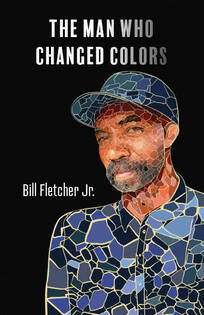
The Man Who Changed Colors
By Bill Fletcher, Jr.
When a dockworker falls to his death under strange circumstances, investigative journalist David Gomes is on the case. His dogged pursuit of the truth puts his life in danger and upends the scrappy Cape Cod newspaper he works for.
Spend a season on the Cape with this gripping, provocative tale that delves into the
complicated relationships between Cape Verdean Americans and African Americans, Portuguese fascist gangs, and abusive shipyard working conditions. From the author of The Man Who Fell From The Sky.
“Bill Fletcher is a truth seeker and a truth teller – even when he’s writing fiction. Not unlike Bill, his character David Gomes is willing to put his life and career in peril to expose the truth. A thrilling read!” − Tavis Smiley, Broadcaster & NY TIMES Bestselling Author
| |
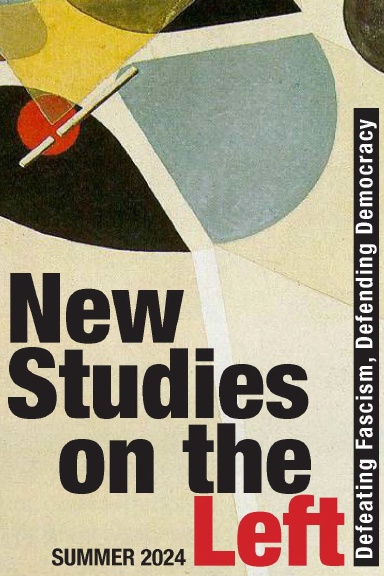 | |
New Studies
on the Left
Paperback $19.95
...is a journal of socialist theory and practice. It is the successor to ‘Dialogue and Initiative, published as an annual journal of the Committees of Correspondence for Democracy and Socialism in book form from 2012 to 2022. It will continue the CCDS policy of left unity, including articles with a variety of left perspectives, including debates.
This issue contains over 30 articles grouped under the headings of Analysis and Global Reach, Debate and Controversy, Labor, Socialism, and Book Reviews. Some are reprinted from other sources, but many appear here for the first time.
Among the authors are David Bacon, Joan Braune, Carl Davidson, Bill Fletcher, Jr., Jerry Harris, Jay Jurie, Paul Krehbiel, Sun Liping, Adewale A. Maye, Duncan McFarland, Jasmine Payne-Patterson, Vijay Prashad, Nikhil Pal Singh, Harry Targ, and Janet Tucker.
Table of Contents
Click HERE to purchase
Click here for a free copy of Paul Krebiel's article 'Union Stewards Councils: the Next Step Forward'
| |
A China Reader
Edited by Duncan McFarland
A project of the CCDS Socialist Education Project & Online University of the Left
244 pages, $20 (discounts available for quantity orders from carld717@gmail.com), or order at :
The book is a selection of essays offering keen insight into the nature of China and its social system, its internal debates, and its history. It includes several articles on the US and China and the growing efforts of friendship between the Chinese and American peoples.
| | |
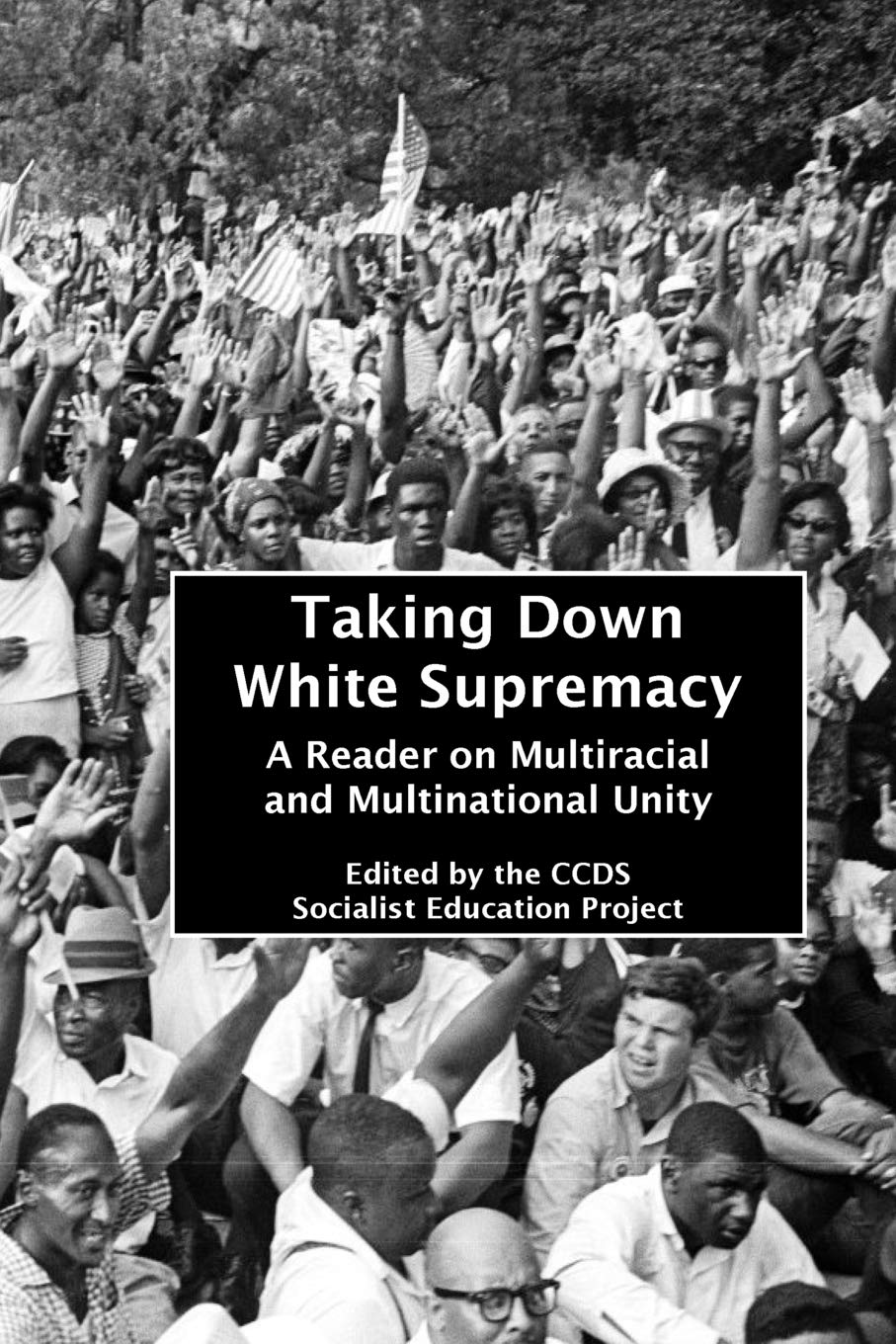
Taking Down
White Supremacy
Edited by the CCDS
Socialist Education Project
This collection of 20 essays brings together a variety of articles-theoretical, historical, and experiential-that address multi-racial, multi-national unity. The book provides examples theoretically and historically, of efforts to build multi-racial unity in the twentieth century.
166 pages, $12.50 (discounts available for quantity), order at :
| | |
|
Paintimg: Galileo getting in trouble with the church with his telescope.
Whose Christianity Do Christian Nationalists Want?
It was the diversity of Christianity, as much as other faiths,
that inspired the founders' concern for religious liberty.
By Marci A. Hamilton
Religion News Service
Aug 8, 2024 (RNS) — Vice President Kamala Harris is a Baptist whose faith has been influenced by the nonviolent principles of Mohandas K. Gandhi and the Rev. Martin Luther King Jr., as well as the social justice movement for women’s rights. In the weeks since she became the Democrats’ choice for president, her views have been attacked by Christians on the right who claim to want Christian leaders to lead the United States — as long as it’s not Harris’ brand of Christianity.
When the right starts talking about “Christians,” we must always respond by asking, “Which Christians?”
With Jews, Muslims and people of other faiths present before the founding, there has never been a unified religious culture in the United States. Nor has there been a monolithic Christianity. Rather, more than 200 Christian sects, with sometimes conflicting beliefs, might all be considered “minority” religions.
The founders recognized this, and it was the multiplicity of Christianity that inspired the separation of church and state. As James Madison, who wrote the First Amendment, sagely warned: “Who does not see that the same authority which can establish Christianity, in exclusion of all other religions, may establish with the same ease any sect of Christians, in exclusion of all other sects?”
All the founders, in fact, seemed to foresee the power grab that today’s conservatives are attempting in equating the term “Christian” with any one set of beliefs.
President George Washington, an Episcopalian, attended Quaker, German Reformed and Roman Catholic services and wrote to Baptists, Methodists and Jews to quell their concerns about religious oppression. His support for the separation of church and state was based on the reality that, in his words, “Religious controversies are always productive of more acrimony and irreconcilable hatreds than those which spring from any other cause.” The United States has experienced a civil war, but no religious ones, because of the separation of church and state.
Washington and the founders saw too how Christian sects established oppressive fiefdoms that imposed the same tyranny the founders had come to America to escape. President William Howard Taft once made the point that the Puritans “came to this country to establish freedom of their religion, and not the freedom of anybody else’s religion.”
The Puritans and Congregationalists in Massachusetts persecuted the Baptists and Quakers with beatings, fines, whippings, imprisonment, mutilation and murder for practicing a “wrong” kind of baptism and other “false” beliefs. Many were expelled, and all were taxed to support Massachusetts’ official church.
Maryland was founded as a safe haven for Catholics, but when Episcopalians came to power they established their sect as the state’s official church, to which public officeholders were required to pledge an oath and all taxpayers contributed. Papists were regularly persecuted.
It is no overstatement to say that separation of church and state is the most original constitutional principle the United States has introduced to the world. In Europe the religious will to power was accepted as a feature of governance. British monarchs executed Protestant or Catholic dissenters, depending on who was in power. Inquisitions, hardly restricted to Catholics or to Spain, were common tools of religious oppression. It took the diversity of religious believers here for the founders to see a new order, one where no religion controls the government.
The evolution of this brilliant innovation can be traced at least as far back as Anne Hutchinson, who was convicted in Massachusetts in 1637 for heresy and sedition for her theological critique of Puritan pastors. After being excommunicated, Hutchinson and her family joined Roger Williams, the founder of Rhode Island, who had also been ejected from Massachusetts. In a 1644 pamphlet, he had called for a “hedge or wall of Separation between the Garden of the Church and the Wildernesse of the world.”
The Quaker founder of Pennsylvania, William Penn, said in 1675 that when it comes to religion, “force makes hypocrites; ’tis persuasion only that makes converts,” and in 1680, “Religion and Policy … are two distinct things, have two different ends, and may be fully prosecuted without respect one to the other.” Pennsylvania would become the most religiously diverse colony.
Yet for all the advocacy for religious tolerance, in 1773, the New England Baptist preacher Isaac Backus felt moved to issue “An Appeal to the Public for Religious Liberty, Against the Oppressions of the Present Day.” Railing against religious persecution being waged against Baptists, he painstakingly laid out why the civil authority must not dictate anyone’s faith, while the faithful must respect civil authority.
Twelve years later, Madison, in his landmark argument to the Virginia Legislature, “Memorial and Remonstrance Against Religious Assessments,” argued that faith must not be mandated by government, because it is a “fundamental and undeniable truth that religion … can be directed only by reason and conviction, not by force or violence.”
Virginia’s bill to tax all citizens for Christian education, he concluded, “degrades from the equal rank of citizens all those whose opinions in religion do not bend to those of the legislative authority. Distant as it may be, in its present form, from the Inquisition, it differs from it only in degree. The one is the first step, the other is the last in the career of intolerance.”
Madison’s argument applies to Christian supremacists of today: “If religion be not within the cognizance of civil government, how can its legal establishment be necessary to civil government?” A just government, he wrote, “will be best supported by protecting every citizen in the enjoyment of his religion with the same equal hand which protects his person and his property; by neither invading the equal rights of any sect, nor suffering any sect to invade those of another.”
Christian nationalists, née supremacists, claim the United States once had a unitary Christian polity to sell their crass historical revisionism. They have taken to undercutting the Constitution itself by flaunting John Adams’ statement that “Our constitution was made only for a moral and religious people.” Yet as President Adams, writing to recommend that the Senate ratify the Treaty of Tripoli, declared, the U.S. government is “not in any sense founded on the Christian religion.”
Yet 30% of Americans have fallen for the Christian supremacists’ word games, with more than half of Republicans embracing the Christian nationalist movement.
A key tactic has been to refer to anyone opposed to their Christian beliefs as “secular.” In October 2022, Federalist Society don Leonard Leo, who helped engineer the current conservative Supreme Court, told an audience in Washington, “Catholicism faces vile and immoral current-day barbarians, secularists and bigots.” The Becket Fund, a legal group that focuses on religious liberty cases, sees itself as a bulwark against “secular” culture.
The reality is that millions of opponents to the nefarious Christian nationalist movement are religious believers. Secularism is a political worldview that holds that no one religion should be in control of the government, and as the history above shows, secularists can be legitimately religious. But for the religious right, true religion and secularism are opposites, and they are sacred believers battling infidels. Their dominance in arguments about religious liberty, which not long ago meant defending small sects’ practices against the majority, pushes other believers into the background.
Nowhere has this dynamic been more effective than in the abortion debate. Millions of American Christians are pro-choice people of faith. More than half of the nation’s 31.6 million Black Protestants believe abortion should be legal. Six in 10 U.S. Catholics back abortion rights. In the Southern Baptist Convention, seen as a monolith against abortion, 30% believe abortion should be legal. A high percentage of white mainline Protestants, from Presbyterians to Episcopalians, also support abortion, not to mention Jews, Muslims and Hindus, among others.
The U.S. has always been a religiously diverse country, and some believers have always grasped for political power to impose their faith on others. Today’s religious right, which has co-opted the Republican Party, would like us to believe they are restoring a bright and shining past of religious consensus. In fact, they are emulating those who sought to establish their own sect of Christianity despite their ugly record.
(Marci A. Hamilton is a constitutional law professor at the University of Pennsylvania and the author of “God vs. the Gavel: The Perils of Extreme Religious Liberty.” The views expressed in this commentary do not necessarily reflect those of Religion News Service.) ...Read More
| |
CHANGEMAKER PUBLICATIONS: Recent works on new paths to socialism and the solidarity economy
Remember Us for Gift Giving and Study Groups
Interested in Studying Gramsci? In a Serious way? We have a group that meets Sundays via Zoom, 11am-12:30pm, facilitated by Piruz Alemi. We go paragraph by paragraph, even line by line, reading aloud, then discussing, through The Prison Notebooks, using an online PDF. If you are interested contact Carl Davidson at carld717@gmail.com
HERE'S ONE OF THE LATEST FROM CHANGEMAKER:
| |
Treat someone to a wonderful book.
And treat yourself, too!
Powerful stories, wonderful gifts.
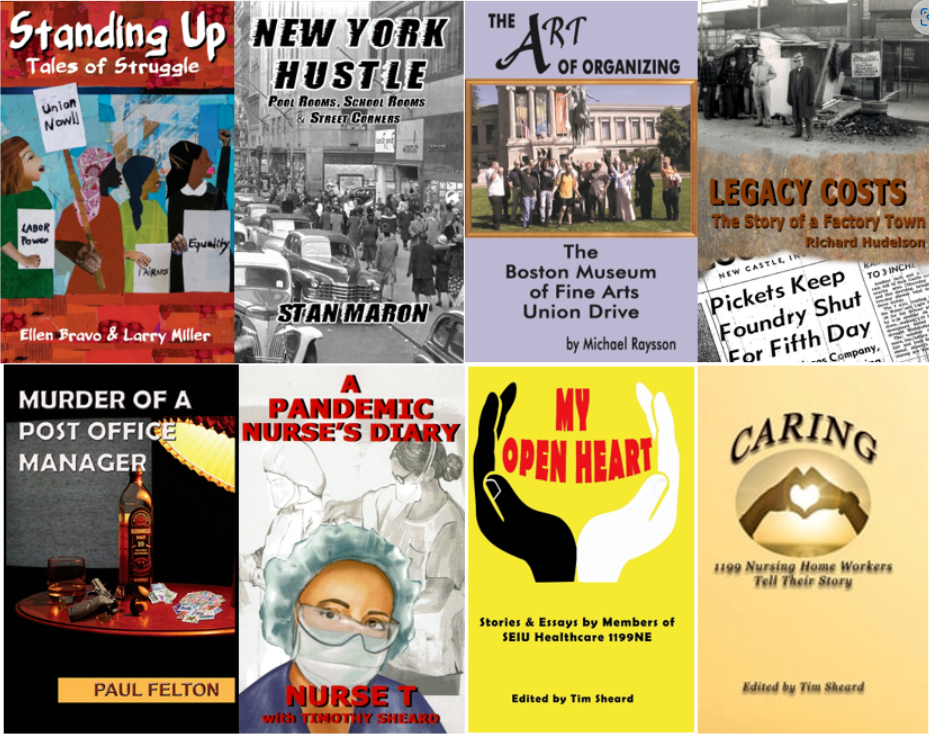
As they stand up, slow down, form unions, leave an abusive relationship or just stir up good trouble, the characters in this multi-generation novel entertain and enlighten, make us laugh and rage, and encourage us to love deeply, that we may continue the fight for justice.
"So much fiction is about escape and fantasy, but these powerful Tales of Struggle will enrich our real and daily lives." ─ Gloria Steinem
“What a wonderful story of class, class struggle and regular people. The story is about struggle and change, but also about joy and humor. Great work! ─ Bill Fletcher, Jr., author of Solidarity Divided
Price: $15.00
| |
|
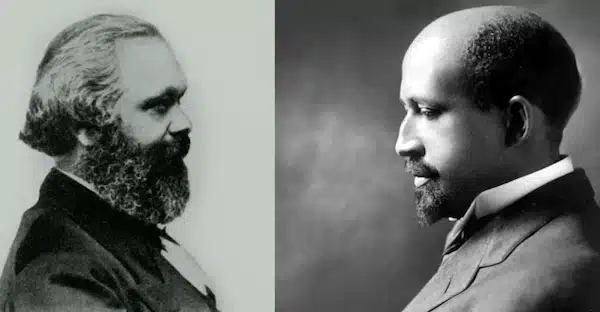
History Lesson of the Week: Karl Marx and the Negro
‘Karl Marx and the Negro’ by W.E.B. Du Bois
From The Crisis. Vol. 40 No. 3. March, 1933.
Originally published: Revolution's Newsstand on August 2024 by The Crisis A Record of the Darker Races (more by Revolution's Newsstand) (Posted Aug 05, 2024)
WITHOUT doubt the greatest figure in the science of modern industry is Karl Marx. He has been a center of violent controversy for three-quarters of a century, and for that reason there are some people who are so afraid of his doctrines that they dare not study the man and his work. This attitude is impossible, and particularly today when the world is so largely turning toward the Marxian philosophy, it is necessary to understand the man and his thought. This little article seeks merely to bring before American Negroes the fact that Karl Marx knew and sympathized with their problem.
Heinrich Karl Marx was a German Jew, born in 1818 and died in 1883. His adult life, therefore, reached from the panic of 1837 through the administration of President Hayes. The thing about him which must be emphasized now was his encyclopedic knowledge. No modern student of industry probably ever equalled his almost unlimited reading and study.
He knew something about American Negroes from his German comrades who migrated to the United States; but these emigrants were of little help so far as his final conclusions were concerned. Kriege, a German radical, who came to the United States, said frankly in 1846, that “We feel constrained to oppose abolition with all our might.” Weitling, a Communist, paid scant attention to the slavery question. The German Labor Convention at Philadelphia in 1850 was dumb on slavery. Even Weydemeyer, Marx’s personal friend, said nothing about slavery in his Workingmen’s League, which was founded in 1853, although the next year he opposed the Kansas-Nebraska Bill. When the League was re-organized in 1857, it still said nothing about slavery, and a powerful branch of the League which seceded in 1857 advocated widespread serfdom of blacks and Chinese. Then came the war and Marx began to give the situation attention.
“The present struggle between the South and the North,” he wrote in 1861, “is…nothing but a struggle between two social systems, the system of slavery and the system of free labor. Because the two systems can no longer live peaceably side by side on the North American continent, the struggle has broken out.”
He was well acquainted with those splendid leaders of the English workers who kept England from recognizing the South and perhaps entering the Civil War, who employed Frederick Douglass to arouse anti-slavery sentiment, and who organized those monster mass meetings in London and Manchester late in 1862 and early in 1863. ...Read More
| |
|
Howling at the Moon
Mexico Solidarity Project from July 31, 2024
| |
|
Bill Gallegos, a veteran Chicano liberation activist, environmental justice leader, and revolutionary socialist, has a lot to howl about.
The US Republican Party held its national convention this week and, as expected, nominated Donald Trump to be their presidential candidate. Speakers treated convention goers to a consistent frenzy of near-hysterical anti-immigrant rhetoric, squarely placing the blame for the influx of immigrants on President Biden. Speaker after speaker accused the Biden administration of opening up US borders to all immigrants, always referred to as criminals, murderers, rapists, child-sex traffickers and the cause of the deadly fentanyl epidemic in the US. One speaker even claimed that US President Biden was encouraging 3 million undocumented immigrants to vote in the coming election!
The convention was a diabolical festival aimed at convincing US voters, mostly white but also from communities of color, to vote Republican in November and sweep Congress, the Senate and the presidency. To make his case, Trump used the bogeyman “evil immigrants” allegedly brought into the country by Democrats to dilute the blood of "real" Americans.
Already, the US has forced responsibility for migrants onto Mexico with the “stay in Mexico” policy. Taking in and caring for a population of millions would impose an enormous economic and social burden on Mexico. But the danger to Mexico is much more: Republicans threaten to launch missiles into Mexico to take out the drug cartels. This could injure and kill thousands. In the current degraded state of US politics, these threats are evoking little media or political outrage.
The threats of military action and ethnic cleansing would place enormous pressure on president-elect Claudia Sheinbaum’s new administration as she works to implement a progressive people’s program in Mexico.
More than ever, we need a robust solidarity movement between the US and Mexico — unions and worker centers, environmental justice and mainstream environmental groups. Women, youth and cultural communities must also reach out to each other. As the great African leader Samora Machel advised us, “Internationalism is strategy, not charity.”
Sí Se Puede!
| |
 |  |
New Liberation Road
Booklets supporting the Mexico Solidarity Project
By Bill Gallegos
Liberation Road is the only major US revolutionary socialist organization that has a developed position on Chicano Liberation, and one of the few that understands and works to build solidarity with the socialist movements and revolutionaries of Mexico. Now we have something that explains those positions - a series of Liberation Road pamphlets entitled Adelante! (Forward!). The pamphlets were developed collectively by several comrades, with support from comrades outside the organization.
The articles are enhanced and enriched by the powerful art and culture that is a major component of the pamphlets. While Adelante! was introduced at the recent Mexico Solidarity tour of the Mexico Solidarity Project they are meant as important resources for all comrades of Liberation Road — to better understand our strategic perspectives on Chicano Liberation and Mexico Solidarity (internationalism), and to help us promote those perspectives in all of our mass and red work.
This has always been an important task for our organization, but now more than ever as the New Confederacy seems to have made immigration the center of their attack on democracy, equity, and social justice. In order to support comrades in understanding and advancing our strategic perspectives we are going to be conducting at least one webinar to discuss our line and how to integrate Adelante! in your work. Adelante! is a product of love comrades, an expression of the spirit element that Che Guevarra insisted is at the heart of every true revolutionary’s work. A link to download the booklets will be available by next week. Meanwhile, contact Bill Gallegos at billg4@gmail.com
| | |
|
Our Amazing Resource for Radical Education
CURRENT FEATURE: In the 'Study Guides' Section
A 4-PART STUDY OF THE SHAPING OF THE
RUST BELT WORKING CLASS.
From the settlers to the present, and how its consciousness is conflicted. Prepared by Carl Davidson and Rebecca Tarlau,
with some help from the DSA Rust Belt group.
|
There are hundreds of video courses here, along with study guides, downloadable books and links to hundreds of other resources for study groups or individuals.
Nearly 10,000 people have signed on to the OUL for daily updates, and more than 150,000 have visited us at least once.
Karl Marx's ideas are a common touchstone for many people working for change. His historical materialism, his many contributions to political economy and class analysis, all continue to serve his core values--the self-emancipation of the working class and a vision of a classless society. There are naturally many trends in Marxism that have developed over the years, and new ones are on the rise today. All of them and others who want to see this project succeed are welcome here.
|
| |
Video for Learning: How Our Elites INCITED Far Right Uprising In England: Don't Let Them Get Away With...20 min | |
Harry Targ's 'Diary of a Heartland Radical' | |
This week's topic:
Click the picture to access the blog.
| |
|
Tune of the Week: Adrianne Lenker - 'Once A Bunch,' with Lyrics ...5 min
| |
|
Book Review: Dan La Botz and The Veracity of Fiction
By Martha Sonnenberg
New Politics
… people nowadays prefer to judge rather than to understand, to answer rather than to ask, so that the voice of the novel can hardly be heard over the foolishness of human certainties. – Milan Kundera
July 21, 2024 - With Radioactive Radicals, Dan La Botz has written a bold and unique novel that is ultimately a novel of questions and uncertainties. It is a novel that defies conventional literary genres: neither a roman a clef, an historical or political novel, or an autobiographical novel.
It is at once a novel that takes the reader through the turbulent decades from the 1960’s through the early 2020’s, and a novel of a generation, of friendship, of buddies, of organizational history and of labor history. And while it can be read as encompassing all these genres, it is not merely any of them. It will be compared to novels like Harvey Swados’ Standing Fast, or Simone de Beauvoir’s, The Mandarins, but is unlike either. It is a novel of questions that need to be asked, not answers. The book is about consciousness and how it changes over time, and it is about the pain of transformation from certainty to uncertainty.
Radioactive Radicals is a novel of vision. We are given a clue with the narrator-protagonist’s name, Dirk Leeuwenhoek–Leeuwenhoek being the 17th century inventor of the microscope. La Botz , with the insight of his narrator, looks through the lens of his literary microscope at what lies beneath the surface of particular histories, of the 60’s radicalism, of the 70’s and 80’s labor union struggles (Teamsters), and of a Marxist, anti-Stalinist but not quite Trotskyist, organization devoted to the slogan, “ no democracy without socialism and no socialism without democracy,” and “socialism from below”, the Independent Socialists (1) and of friendships and intimate relationships along the way. Through Dirk’s own senses, over the course of 50 years, he probes some uncomfortable truths about the meaning of radical history. He casts a unique and provocative light on this history, a history in which many readers will have participated. He does this with the additional use of interesting literary techniques and a touch of magical realism.
The book is first about a generation, that of the “Baby Boomers”, born between 1942 and 1952, beneath the mushroom cloud of the atomic bombs dropped on Hiroshima and Nagasaki. Dirk Leeuwenhoek and his friend Wes Kinsman are born under the shadow of that cloud, Wes on August 6, 1945, and Dirk on August 9, 1945. They, and the generation of which they are a part, are infused with the pervasive radioactive soot from the bombs, with radiocaesium, formed by the nuclear fission of Uranium 235 and Plutonium 239. Radiocaesium , or cesium 137, is a real product, and has well documented effects on soil, plant life, and human bodies, including an association with pancreatic cancer.
However, in my own reading of the novel, La Botz uses radiocaesium as magical realism, a metaphor which draws all aspects of the novel together and over time. Dirk’s radiocaesium leads to a fantastical aura affecting all of us born under the nuclear cloud and causes a special glow, an altruism, a desire for justice and importantly, a pheromonic romanticism with strong erotic impulses. Affected by this radioactive aura, Dirk tells us “…mere glances and the slightest touches produced orgasms and sometimes preposterous pledges of love forever…I came to believe that there was the right person out there, somewhere, the other half of the dyad. One searched for that person, found that person, fell in love and married, and then was happy ever after.” Both Dirk and Wes live through decades of radiocaesium induced romantic relationships and marriages which fail.
Friendship and kindred souls
Wes and Dirk are richly drawn characters, drawn so well, with glimpses into their psyches, that we feel we really know them—which is not to say they don’t surprise us. They are born only days apart and become comrades who love each other and share confidences about their insecurities, their love relationships, and their politics. Yet Wes and Dirk are very different. Wes comes from the fields of Iowa, and Dirk from the urban life of Chicago. Wes is the passionate, down to earth, folksy, often emotional one (he cries easily) who is instinctively able to connect with people. His commitment to working class organizing is unimpeachable. He also has some significant medical and mental problems. Dirk is both a poet and an intellectual, with a keen mind that observes and analyzes. He writes poetry, articles and books for and about union organizing. Both Wes and Dirk are politicized in the 60’s and initially subscribe to the I.S.’s turn from students and the middle class to the American working class. They both became involved in union organizing, and in the Teamsters for Democracy movement formed within the Teamsters’ union. (2) But Dirk’s poetic vision allows him to see the human toll of a down turning economy. He sees beyond political positions and factional debates; he sees not only a class, but suffering human beings:
People weren’t buying new cars, they weren’t repairing old cars, they weren’t getting their cars washed…If you paid attention, you also noticed that working peoples’ clothes didn’t look so good, the material was worn thin, the clothes were patched and mended…On the streets in working class neighborhoods one noticed that children’s clothes, too, looked poorly…a lot of people looked grim…This was all visible to the naked eye after 1975, if the eye was open.
It is Wes, however, who internalizes his working-class involvement, in part due to his inherent humility. Even at the beginning of the “turn to the working class”, he is skeptical of the comrades who thought they were ready, after a short time on the job and in a union, to form a revolutionary party that would lead the working class to the overthrow of U.S. capitalism.
…you and your comrades, just three or four of you, have been in the mills and plants for less than six months, maybe…You have no real first-hand experience with working class life. You have to learn the job, get to know the other workers, find out what the issues are and see who is prepared to organize and fight.
Here Wes is expressing the importance of real connections with workers, not just as workers, but as real people working together, similar to what Stan Weir called ‘informal work groups’. (3) Wes becomes a skilled organizer because he is willing to listen and learn. He is constantly questioning how socialism can connect with working class life.
The evolution of consciousness
It is Dirk’s voice that propels this novel, the voice of one who observes at the same time he is making his own history. What he observes over time is, essentially, the negation of what he has believed for decades. He watches the erosion of democracy from both the theory and practice of his ‘heroes’ and his organization.
He follows Cesar Chavez into the agricultural fields of California and watches Chavez transform from a passionate organizer of farmworkers into an authoritarian leader who does not tolerate dissent. Wanting to help and support Chavez and the farmworkers, Dirk is heartbroken when he is expelled, along with other leftists, from Chavez’s group. (4) He watches Fred Getz, founder of (fictional)Teamsters for Democracy, and respected I.S. member, transform from a skilled organizer into another authoritarian leader intolerant of dissent, who relates to people only in terms of their use to him and who viciously denigrates all who dare question him. He closes debates and crushes anyone who differs with his views. When Wes questions a particular strategy, Getz replies, “You know nothing about the Teamsters’ union. No one knows as much as I do.”
As Dirk watches these leaders turn into their opposites, he sees changes in his organization as well. First, he begins to realize that the I.S. leadership does not have its eyes open to what is happening to the working class in terms of how workers actually live their lives. Second, he sees anti-democratic tendencies and elitism in the certainty and arrogance with which I.S. leaders address issues. This approach is personified by Lowenthal, the brilliant and articulate strategist/theorist, always seeing the next crisis as the opportunity for a revolutionary party to lead the working class to make a socialist revolution. Lowenthal pushes to form a vanguard organization with militant cadres, ready to take up arms. The cadre demands a single focus on politics/union organizing above all else in its members lives. Dirk watches the leadership modeling itself after the leaders of the Russian Revolution. The character Glen Wolfe, a British leftist who becomes a significant leader in the group, pushes for this “Bolshevization”, and wears clothes— leather jacket, harness boots, “modeled on the old Bolshevik Party leaders garb at the time of the Russian Revolution.” Dirk perceives how the Russian Revolution and the soviets:
became the inspiration for generations of leftists…Bolshevism became a part of rules and standards that regulated a not very democratic and usually quite authoritarian centralism…a vanguard party that was seldom in the van, a revolutionary party that…could not make a revolution, so that the whole idea weighed like the dead hand of the past in the minds of young radicals. (5)
In his personal life, Dirk’s politics interfere with his relationships. As yet another relationship falls apart, he realizes that “Here we were, idealists, socialists, she a feminist, and yet we failed to even be decent people.” (6)
This is what Dirk witnesses: no attention to working class self-activity, no socialism from the below, no humility, and a lot of hubris. There is no vision of how socialism might look and what might happen the day after the revolution. The leadership of the organization sees itself, with undiluted certainty, as the builder of rank-and-file groups transforming them into class struggle organizations. The working class becomes more a thing, an object to be transformed by the more elite, sophisticated and educated vanguard.
As Dirk continues to witness what is happening in the lives of working men and women during the hard times of the 70’s and 80’s, he realizes how out of touch this political posturing is. He finally recognizes the connection between the romantic view of love which told him there was only one true love, and the equally romantic political view that there is one crisis that will lead the working class to make a socialist revolution. Both views are unrealistic, idealistic and objectifying of either a sexual partner or the working class. These observations shake him to his core. And here Dirk breaks the Fourth Wall of the novel, speaking directly to the readers with soul searching interludes and asides, musing about what makes this book a novel and what it might be about.
Breaking The Fourth Wall
The concept of the Fourth Wall began as a theatrical technique. It described actors breaking through the invisible wall which separated the performers from the audience. In literature the Fourth Wall has been called “metafiction,” or self-conscious fiction, or “metalepsis”, the transgression of narrative levels. The literary technique makes the relationship between a character and the reader more intimate. La Botz the author, and Dirk Leeuwenhooek, the fictitious author, break the literary Fourth Wall and use interludes and asides to talk directly to the readers. He wants us to grapple with the question of how much we, and the novel’s characters, are determined by the material conditions in which we find ourselves-the effects of radiocaesium and the Atomic Age, corporate America, and labor bureaucracy- versus how much we can listen to our own consciousness of inner questions and uncertainties to make significant changes in determining our conditions, our politics and our visions for the future. The hope is as sentient human beings, as thinking and feeling men and women, we will maintain our agency, listen to our internal and fermenting questions about politics, and in turn change ourselves and the conditions in which we operate. This can only happen, Dirk says, if people can clearly see and understand the conditions around them by asking questions and challenging the certainty of the vanguard strategy. In the First Interlude he says:
I want to grasp for myself what happened and then share with you the pattern into which everything fits. That is why I am writing a novel, because though truth may be stranger than fiction, fiction always has more veracity than mere facts…this is the method of fiction, where we recombine real events into new stories.
Later, in the Second Interlude he says
I had an opportunity to rethink who we were—the American people and my generation—where we had come from, what we believed and did, and what it all meant…I pondered why our leftists’ movements had not been more successful.
La Botz is doing for us what Victor Serge saw as the essence of literary creation, that is “to liberate the confused forces one feels fermenting within…” (7) For me this rang true as I remember my own confused feelings and unsettling skepticism as a very young member of I.S., too intimidated by the leadership even to think of expressing those feelings. Readers will decide for themselves whether they resonate with feelings of uncertainty, and skepticism. There will be readers who may not have questions and misgivings about their political history, or who feel that this book does a disservice to that history. However, I mention Victor Serge once again. In articulating the observations and confused thoughts and skepticism of Dirk and Wes, La Botz, the author, is fulfilling what Serge called the writer’s “double duty.” Serge wrote that
If literature wishes to accomplish its entire mission…it cannot close its eyes to the revolution’s internal problems…(the revolution) therefore must be defended at one and the same time against its external and it internal enemies…the seeds of destruction it bears within itself. (8)
The Richness of the novel
An entire essay could be written about the novel’s depiction of women. This is primarily a novel about men. Women are not major characters and are mostly described by their physical attributes before their intellectual and/or political thinking. But this is, in truth, how it often was on the left, and maybe still is.
The sixties and seventies were confusing times for everyone. The women’s movement was happening, and here Dirk’s encounter with Shulamith Firestone is fascinating. He, and many male leftists supported the women’s movement and began calling themselves feminists—which they were not, as they did not grasp the depth of what the women’s movement was about and as they continued the objectification of women, and rarely challenged conventional women’s roles. There were exceptions, of course.
Women were caught between their desire for independence and their socialization as women in a patriarchal society. They were reflecting on their relationships with men, in bed, at work and in politics. While one might remain critical of this reality, La Botz, through Dirk and Wes, does give us some unique insights into what men were actually feeling during those times. Men, too, operated in a patriarchal and macho culture, but like the novel’s characters, hidden in their psychic caves they felt vulnerable, and their egos depended not only on male approval, but also on female desire for them. They idealized women at the same time they objectified them.
The Subjunctive Mood
La Botz , through his narrator, again subverts the traditional role of author in commenting on how the tone of the novel might have been different. In another “aside” Dirk muses on how his story could have been different had he written the novel in the subjunctive mood, looking at the “what ifs” and the “maybes”. He tells us, “The subjunctive mood deals with matters of uncertainty and doubt, questions of fear and judgment, issues of necessity and obligation, opposition and possibility.” Would the left, and his own organization, have been more successful had it acknowledged uncertainty, curiosity and questions about strategy, rather than putting forth strategies with absolute certainty. Would uncertainty have allowed I.S. members and union organizers more creative space to develop real human, rather than instrumental, connections with other organization members and with members of the working class. La Botz, through the subjective lens of his narrator Dirk, is asking whether socialism could benefit from a little less hubris and a little more humility.
Radioactive Radicals raises questions that are so important today, given the current state of chaos, hysteria and fear that define the world we live in. Trying to replicate the methods of the Russian Revolution seems not to have helped us work through the political miasma surrounding us. Can our mistakes help a new generation of idealistic young leftists as they confront a world of increasing authoritarianism, the threat of a Trump presidency, and the existential effects of environmental climate change? Can we help them recognize that reality is constantly changing, and political responses and political leadership must also change accordingly? Can we help young radicals express their concerns, their questions and their uncertainties. Can our mistakes help them gain the strength to break free of old strategies, so they are free to create a new vision of how to transform themselves and the world? Can we help them treat each other with respect and realize that how we behave now has implications for the kind of socialism we want?
There is so much more to this novel that could be discussed. I imagine and hope that readers will be discussing and arguing about it for some time.
Martha Sonnenberg is a retired physician and former consultant in hospital quality and safety. ...Read More, there are excellent Notes the end. -CD
| |
|
Photo: Carrie-Anne Moss (playing FBI agent) and Sven Nordin, playing the dark Wisting. --BBC
TV Review: 'Wisting', A Norwegian Noir Detective at Work
A Norwegian homicide detective—paired with an FBI agent—on the hunt for a serial killer is a singular presence in this show on Sundance Now.
By Dorothy Rabinowitz
Wall Street Journal
This seamlessly woven thriller centers on the life and work of homicide detective William Wisting, a hero devoid of any trace of psychological darkness, internal demons, or singular passions of any kind—he’s not devoted to the opera either—characteristic of so many fictional detectives. For this, and all other aspects of Wisting’s heroically stolid presence (a stellar performance by Sven Nordin), there is every reason to be thankful as the 10 episodes of this superbly layered drama (begins Wednesday, Sundance Now) roll on. (“Wisting” is based on the Norwegian crime novels “The Cave Man” and “The Hunting Dogs” by Jørn Lier Horst and was written and created by Trygve Allister Diesen and Kathrine Valen Zeiner.)
As the story begins, the action is focused on the hunt for a serial killer operating in Norway. It’s the country in which the murderer was born—but one to which he has only recently returned from America, where he had left a bloody trail of murdered young women. So it happens that members of the FBI are dispatched to Norway, to join Wisting’s detective unit in the effort to capture him. The head of this American team is FBI Special Agent Maggie Griffin, portrayed, captivatingly, by a steely Carrie-Anne Moss. Maggie comes to join Norway’s hunt for the serial killer with a passion largely driven by guilt. She had led the investigation of the prime suspect when he was still in the U.S. but had failed to charge him—she wanted more conclusive evidence, certain though she was of his guilt. The killer took the opportunity to run—to his homeland.
Agent Griffin soon discovers there are certain rules concerning the way Norwegian police track a killer that are unlike anything she’s accustomed to—or that she’ll put up with. The kind involving hidden cameras, for instance. Her look of amazement when Wisting sternly tells her, as they go off to search for the whereabouts of the killer, that there can be no use of hidden cameras—because there must be no invading the privacy of citizens—is wonderful to behold. There are other rules as well that come as news to the American agent—the one, for instance, that dictates when it’s forbidden for a police officer to carry a gun while making an official inquiry. In one scene, a Norwegian who is the subject of an investigation demands to know whether the police officer taking his fingerprints has the right to do that. There’s no missing the emphasis on progressivism and citizens’ rights in this picture of a culture.
The thriller aspect, never less than terrifying, dominates in “Wisting.” But there’s no missing the power of another force—namely, the talkiness. Arguments about legality, morality and justice abound along with the natural flow of viperous town gossip. But in none of this does the stoic Wisting take any part. He’s a recent widower seemingly adjusted to his loss, though from time to time he’s shown casting a longing look at the empty bed space beside him. A loving parent, he’s run into trouble because he failed to take time out from his pursuit of murderers for the lunch date scheduled with his young adult children.
At one point he’s confronted with his son’s sorrowful assertion that he isn’t much of a priority in his father’s life—a cliché the show’s writers would have done well to avoid. But this charge ends up seeming only to enlarge Wisting’s character. Mr. Nordin’s portrayal is eloquent in its evocation of a man rooted in a reality incomprehensible to his children—a man who knows what his life’s work means. Such a man has no apology to make for his choices, no trouble telling the children, as he does, that his police work is more urgent than remembering lunch. He doesn’t trouble to mention the life at stake, the serial killer on the loose.
The last five chapters find Wisting embroiled in two critical battles—one involving strange accusations of ethical violations that could threaten his career, the other a final struggle in pursuit of the killer. The action here is, like all the rest, set against spectacular landscapes, packed with blood-freezing encounters and virtuoso plot turns. In this 10-part series, every episode lives. No small achievement. ...Read More
| |
522 Valencia St.
San Francisco, CA 94110
415 863-6637
| | |
| Is the content of this email relevant to you? | | | | | | |