|
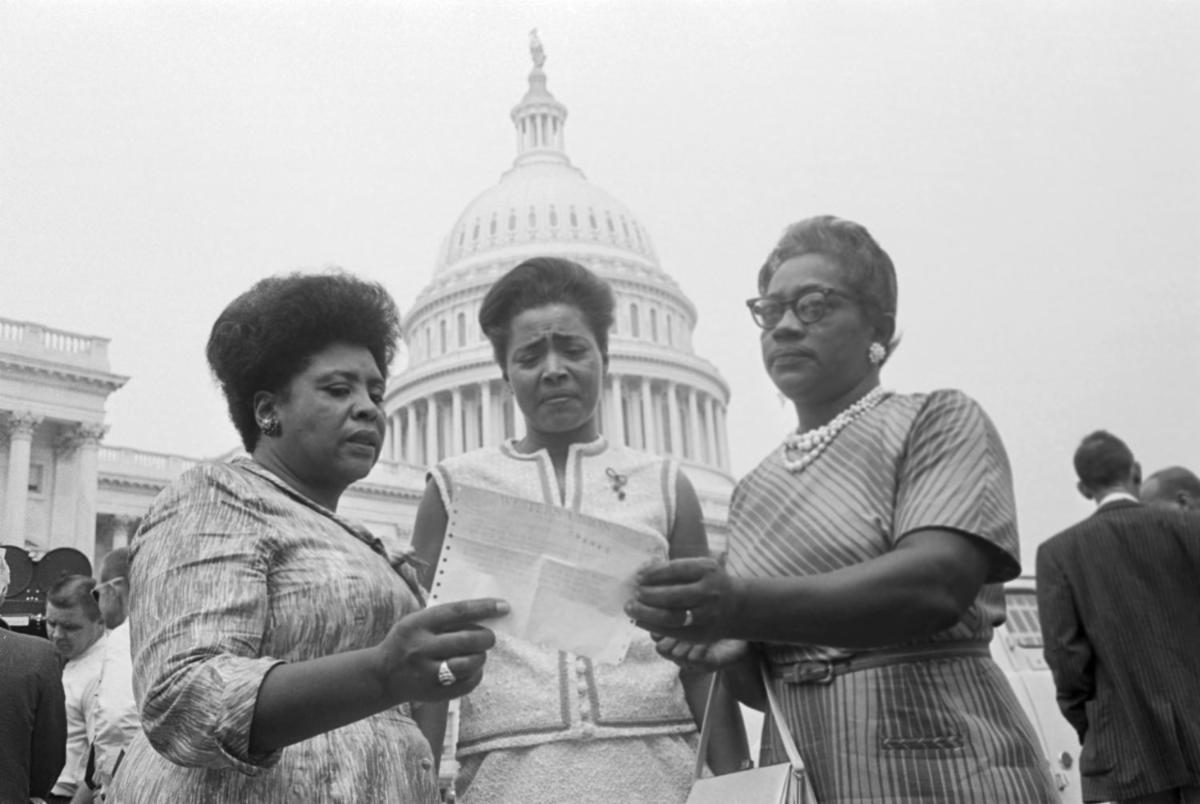
Last November, in the wake of Election Day in Mississippi, I wrote a Love Letter to Black Voters. Today, I am writing a thank you letter to Black Women. President Joesph Robinette Biden shared on Sunday, July 21, 2024, that he would no longer seek re-election for the Office of President of the United States of America. He later proclaimed, “I revere this office, but I love my country more.” As images of Vice President Kamala Harris flashed across the screen with endorsements from top leaders, President Biden, President Clinton, Secretary Clinton, Congressman Thompson, and many more, I immediately thought about the excitement that will greet us in the City of Chicago at the Democratic National Convention. Through the numerous calls, political calculations, and conversations about the rules of the convention, I took a moment to reflect. In my reflection, I could hear the words of Fannie Lou Hamer nearly 60 years ago to the date: “Mr. Chairman, and to the Credentials Committee…” I felt the strategic movements of Victoria Gray Adams, Annie Devine, and all the members of the Mississippi Freedom Democratic Party (MFDP), many of whom were MS State Conference NAACP leaders, such as our state president for 33 years, Aaron Henry. The Mississippi Freedom Democratic Party embarked on a journey that led them to contest the DNC of 1964 in Atlantic City, NJ.
As it is well known, the MFDP was offered a compromise. They were asked to accept two seats out of 68 for their troubles. The pressure mounted not only from individuals in opposition to them but also from like-minded leaders. At the present moment, when Kamala Harris, a Black woman, is the Democratic nominee for President of the United States of America, I am reminded of the words of Fannie Lou Hamer that were not captured by the cameras. It was her exchange with Adam Clayton Powell, a smooth-talking yet well-intentioned Congressman from Harlem, that was so pivotal to this moment 60 years later. Adam Clayton Powell, with all the political savviness he could muster up, said to Fannie Lou Hamer, “Why don’t you just take the compromise…it is a great deal.” Fannie Lou Hamer folded her arms, revved back in her seat, and said, “Mr. Adam Clayton Powell, how many bales of cotton have you picked? How many beatings have you taken?” After a pregnant pause, he tried to utter a response, but he could say nothing. I can only imagine he was speechless because he knew that Mrs. Hamer and others in the Jim Crow South had endured so much to accept so little. Congressman Powell may not have had words at that moment, but I do. Thank you.
Thank you to Mrs. Hamer, to the MFDP, and most importantly, to Black women for always serving as the consciousness of our political fight for freedom. Black women are owed a debt of gratitude for this historical moment. I find it divine that there is a direct correlation between a Black woman from Mississippi who was a sharecropper and beaten half to death in her pursuit to gain the right to vote and the first Black woman to become the Democratic Nominee for President. It is the delegates of the Democratic Party, of which one-third are African Americans, who select the nominee. They have cast a ballot for a Black woman when 60 years ago, many of them could not even cast a ballot to vote.
Moreover, it was the uncompromising spirit of Black women such as Annie Devine, Victoria Gray Adams, Fannie Lou Hamer, and countless others at the 1964 DNC in Atlantic City, NJ, that led to the changing of the party rules at the 1968 DNC in Chicago, and now in 2024 once again in Chicago, we will make history. The road to November is a critical one, where Black voters near and far must be educated and engaged. The political discourse of today is both a reflection of the last 60 years and a glimpse into the next 60 years. There will be time to discuss the importance of the election and issues of all candidates running for the highest office of the land. Today, I just want to take a moment to acknowledge how far we have come and the progress that has been made. Progress rarely comes without sacrifice, and no one has sacrificed more than Black women in the name of freedom and building a country that loves all its people. Black women have sacrificed their bodies, lives, livelihoods, and political ambitions, all while uplifting our communities, Black men, and inspiring the future by raising Black children.
It was Congresswoman Shirley Chisolm, the first Black woman to serve in Congress and who also ran for President of the United States in 1972, who said, “If they don’t give you a seat at the table, bring a folding chair.” Now, there is an opportunity for a Black woman to occupy the highest seat in the land. I say thank you to Black women who have been bringing folding chairs to the table, all the while building tables of their own where all can sit. I say thank you to the Black women in my life who have given me a seat at the table. Black women like my mother, Alva Peyton Taylor, who taught me at a tender age one must always fight for what is right no matter how big the battle, and she fights for Black people day in and day out in the criminal justice system. Black women like my sisters Ayana Kinnel and Afia Polk, who nurtured and guided me throughout my childhood with the love and care of a second and third mother. Black women like Nsombi Lambright Haynes, who gave me my first internship in high school and college and continues to provide me with counsel. Black women like Allytra Perryman, who is my thought partner for the Mississippi State Conference NAACP, and who leads with love and a community-centric model. Black women like Denese Carroll who taught me everything I know about data while I was a young, curious mind. Black women like Amber Thomas, who I met as a teenager and who always has at the forefront of her mind how our movements can change the material conditions of people’s lives.
It is because of Black women, my daughter was born into a world where her first notion of a President was a Black man, and now, having a better understanding as a 12-year-old watching the election unfold, a Black woman being President is not a far-fetched dream but could be months away from reality. My daughter truly believes that there are no limits or bounds to what she can accomplish in life. Peyton sees becoming a Black woman as a superpower.
As a Black man in America, I could not fight for the advancements of our people with the NAACP and beyond without Black women. This is true for every Black man in America.
I thank Black women for the moment. I stand with you in the struggle; I stand beside you in the fight. The conversation this cycle might be about Arizona, Georgia, Michigan, Minnesota, Nevada, North Carolina, Pennsylvania, and Wisconsin, but there would not be a conversation if it were not for uncompromising Black women from Mississippi. As Black women know well, there is no fight too big when it comes to freedom and saving our democracy. For when Black women fight, and we fight for Black women, we win!
Sincerely,
|