17596359-3418-4db6-9cb0-dc5402b60d54-thumbnail image


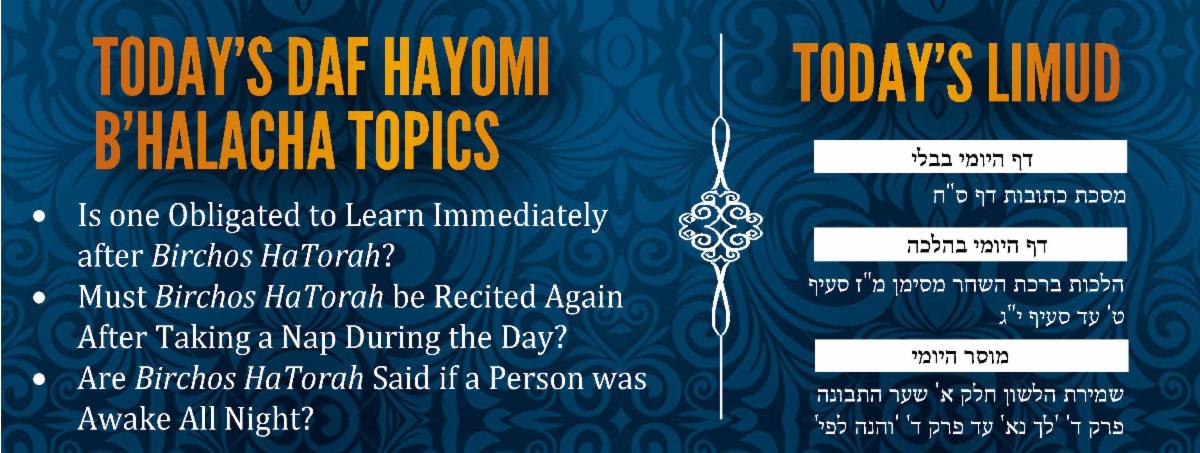
Is one obligated to learn immediately after Birchos HaTorah?

Many opinions hold that Birchos HaTorah are like standard birchos hamitzvah in that if one does not immediately perform the mitzvah after saying the brocha, the brocha is invalid. According to this view, one must learn immediately after saying Birchos HaTorah. One should not even answer Kaddish or Kedushah before learning a bit. Shulchon Aruch, however, rules that although it is proper to follow this practice, if one did not do so he is still yotzei the brocha. In deference to this view, instead of repeating the brochos if there was an interruption, one should have in mind to fulfill his obligation when saying Ahava Rabbah. It has become customary to say the pesukim of Birchos Kohanim, the mishnah of Elu Devarim and the passage of Elu Devarim Sh’ein Lahem Shiur after Birchos HaTorah. In this way, one will have read from Mikrah, Mishna and Gemara.


סעיף ט וס"ק יט-כא; ביאורים ומוספים דרשו, 23

abe6ff95-3eec-4d93-bbab-c2e93762fb5e-thumbnail image


Must Birchos HaTorah be recited again after taking a nap during the day?


Birchos HaTorah cover all the talmud Torah which will take place that day. If one plans to return to his learning after attending to his daily activities, they are not considered interruptions to the mitzvah. If one did not intend to return to learning, the poskim disagree about whether it is necessary to make a new brocha. Daily activities include business involvement, napping, and tending to bodily needs. If a person goes to bed in the middle of the day and falls into a more significant sleep than just a nap, the Rishonim disagree about whether he must make a new brocha. The custom is to not to make a brocha. In deference to the majority view that maintains that a new brocha is necessary, one should have in mind to fulfill his obligation with Ahavas Olam. There are various opinions on how to define the difference between a nap and a significant period of sleep. Many Achronim say that if one changes out of his clothing, goes into bed and sleeps for at least thirty minutes, it is considered a significant sleep.


סעיף י-יב וס"ק יג, כג, כה ו־כח; ביאורים ומוספים דרשו, 17 ו־25

eee28a1f-6e29-47c3-9a82-97539fcbf44b-thumbnail image


Are Birchos HaTorah said if a person was awake all night?


If one did not sleep all night, the Achronim disagree about whether it is necessary to recite Birchos HaTorah in the morning. Some say that since there was no interruption, the previous day’s Birchos HaTorah will cover the day’s learning. Others say that Chazal instituted these brochos as daily blessings like the rest of the Birchos Hashachar. Since it is an uncertainty, one should not make a new brocha. Instead, he should arrange to hear the brochos from someone else with intent to fulfill his obligation. If one had slept during the previous day, some Achronim rule that he can make a brocha after not sleeping at night. Others do not agree with this ruling.


ס"ק כח; ביאורים ומוספים דרשו, 30

  • Shulchon Aruch rules that thinking Torah thoughts is not the equivalent of speaking Torah. Therefore, one may think Torah thoughts prior to saying Birchos HaTorah. A posek may also issue a halachic ruling without explaining his reasoning before Birchos HaTorah. Other poskim maintain that although it is not the equivalent of speaking, thinking is still a fulfillment of talmud Torah.


  • If one did not say Birchos HaTorah before davening, he should intend to fulfill his obligation when he says the brocha of Ahavah Rabbah (or Ahavas Olam). This brocha, which is a request for success in learning, is similar in theme to Birchos HaTorah. To make it clear that the brocha was said for Birchos HaTorah, one should start to learn immediately after davening.


  • In some instances, a person is obligated to say Birchos HaTorah at night. One can be yotzei with the brocha of Ahavas Olam during Ma’ariv.


  • Can Birchos HaTorah be recited before daybreak?


  • Why do women say Birchos HaTorah?


  • Which brochos may be said while it is still nighttime?
PLEASE NOTE:  The information in this email is for learning purposes only. Please review the Mishna Berura and Biurim U'Musafim before making a halachic decision. Hebrew words are occasionally transliterated to enable a smoother reading of the text. Common Ashkenazi pronunciation is generally used in these cases.
Daf Hayomi B'Halacha Shiur
Rav Asher Eisenberger
Rabbi Asher Eisenberger
Synopsis of Today's Halachos
Rabbi Yerachmiel Garfield
Synopsis of Today's Halachos
This Week's Limud