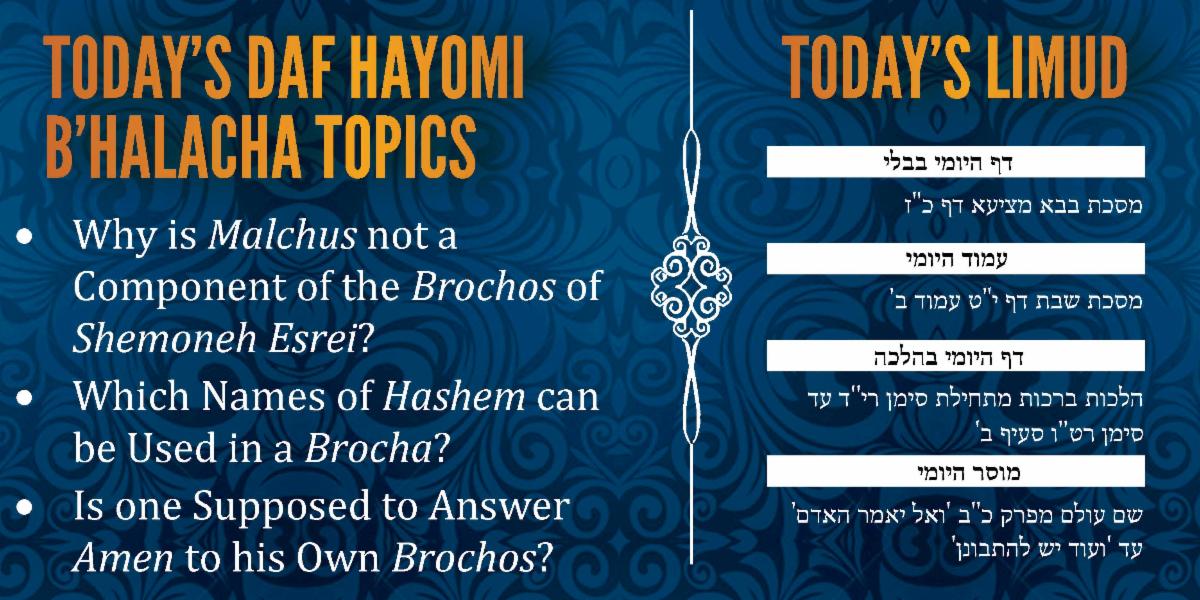
Why is malchus not a component of the brochos of Shemoneh Esrei?

The Gemara teaches that any brocha which does not mention the name of Hashem and refer to Him as the King (shem v’malchus) is not a brocha. If either of these qualifications is omitted, the brocha must be re-recited properly. There are a number of exceptions to this rule. A brocha which is smucha l’chaverta (connected to another brocha) is not required to have shem v’malchus if the first brocha in the sequence has shem v’malchus. For this reason, the brochos of Shemoneh Esrei are recited without the combination of shem and malchus. Although the first brocha does not incorporate malchus with Hashem’s name, saying Hakel Hagodol takes the place of malchus. The poskim add that if a person replaced Melech by saying that Hashem is Avinu Hagadol or Av Ha’olam, he is yotzei bedieved.


סי' רי"ד ס"א ס"ק א'-ב' ביאורים ומוספים דרשו 2


Which names of Hashem can be used in a brocha?


Every brocha mentions Hashem’s name at least twice--Hashem Elokeinu. B’dieved, a person is yotzei if he only mentions it once. In addition, one can be yotzei by saying any of the seven names of Hashem that are forbidden to be erased. Alternatively, if one says Rachmana or Hamakom he is also yotzei. Some poskim propose that saying Hamakom was only acceptable in the time of Chazal, when people used that phrase to describe the Ribono shel Olam. Since the term is no longer commonly used today, one would not be yotzei with that description. If one merely refers to Hashem as Harachaman or Hashem Yisborach, he is not yotzei.


ס"ק ד' שעה"צ ס"ק ג' ביאורים ומוספים דרשו 4, 5


Is one supposed to answer Amen to his own brochos?


According to the Shulchan Aruch, a person should answer Amen to his own brocha if it is the final brocha in a series. Examples include the last brocha of Birchos Kriyas Shema at Ma’ariv and Boneh Yerushalayim in bentching (Boneh Yerushalayim is the final brocha min haTorah of bentching). In his view, one should also respond Amen when he finishes the brocha of Yishtabach and the final brocha of Hallel. They are considered the final brochos of a series since they are connected to the opening brochos of Pesukei D’zimrah and Hallel. Rema maintains that one should only answer Amen to his own brocha after Boneh Yerushalayim. Saying Amen after a brocha that one recites which is not in these categories (according to either opinion) is described by the Gemara as meguneh (degrading).


סי' רטו ס"א ס"ק א'-ג'

  • As we have learned, one person can be motzei others when people have a kevius together on bread or wine. Nonetheless, it has become customary for each person to make his own brocha regardless of the food that he is eating. It is unclear why this has become the minhag, since it is preferable for one person to recite the brocha on behalf of others. One reason might be that people are not proficient in the halachos of being yotzei from another person.


  • Is a person obligated to respond Amen to a brocha while he is learning?


  • Should one answer Amen to a brocha he hears by phone?


  • Should one answer Amen to a brocha recited by an irreligious Jew?
PLEASE NOTE:  The information in this email is for learning purposes only. Please review the Mishna Berura and Biurim U'Musafim before making a halachic decision. Hebrew words are occasionally transliterated to enable a smoother reading of the text. Common Ashkenazi pronunciation is generally used in these cases.
Daf Hayomi B'Halacha Shiur
Rav Asher Eisenberger
Rabbi Asher Eisenberger
Synopsis of Today's Halachos
Rabbi Yerachmiel Garfield
Synopsis of Today's Halachos
This Week's Limud