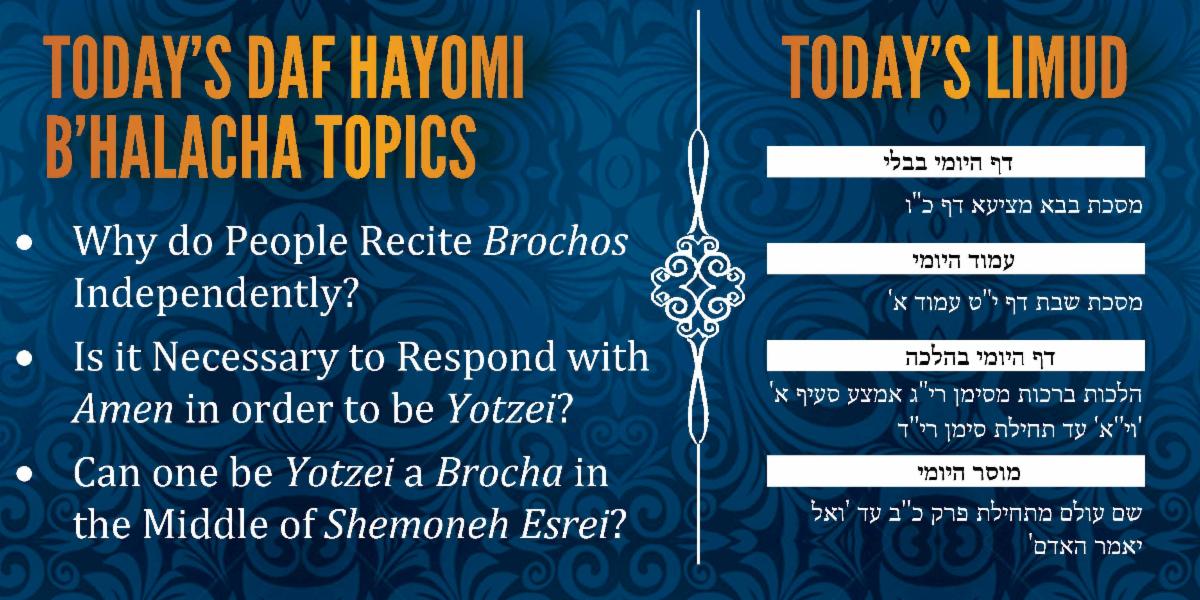
Why do people recite brochos independently?

As we have learned, one person can be motzei others when people have a kevius together on bread or wine. Nonetheless, it has become customary for each person to make his own brocha regardless of the food that he is eating. It is unclear why this has become the minhag, since it is preferable for one person to recite the brocha on behalf of others. One reason might be that people are not proficient in the halachos of being yotzei from another person. Although most people listen to another person recite Kiddush and Hamotzi on their behalf on Shabbos, in some communities every person recites Kiddush and Hamotzi on his own since it is difficult to pay attention to someone else’s recitation for the duration of the brocha.


סי' רי"ג ס"א ס"ק י"ב ביאורים ומוספים דרשו 11


Is it necessary to respond with Amen in order to be yotzei?


If one will be yotzei with another person’s brocha, he should answer Amen at the end of the brocha. Aside from the mitzva of always responding with Amen when one hears a brocha, it is especially important to affirm one’s belief in the brocha when being yotzei.  B’dieved, if one did not answer he is still yotzei, since listening to the brocha is equivalent to reciting it. There are some Achronim who hold that if the person reciting the brocha does not have an obligation to recite it, those who listen will only be yotzei if they answer Amen. Others do not agree with this stringency.


ס"ק יז ביאורים ומוספים דרשו 19


Can one be yotzei a brocha in the middle of Shemoneh Esrei?


If one is in the middle of Shemoneh Esrei and hears a brocha, some poskim say that he can only be yotzei if he is between brochos (and not in the middle of a brocha). When one is being yotzei a brocha, he should not respond with boruch Hu uvoruch shmo in the middle of the brocha since that is a hefsek. In addition, he cannot be facing an ervah or tzoah when listening to the brocha, since it is as if he is reciting the brocha himself.


ביאורים ומוספים דרשו 19

  • If people are sitting together to eat in a kevius, one of them can recite the brocha rishona on behalf of the others. This is actually the best approach, in accordance with b’rov am hadras Melech (the more people who do a mitzva together, the greater the honor to the King).


  • Some poskim hold that it is preferable to listen to Kiddush or Havdala while sitting, as there is more of a kevius when people sit together. Others hold that as long as the listeners are standing in one place, there is a kevius and they can be yotzei while standing.


  • Regarding a brocha achrona, each person should recite the brocha on his own except in a situation of zimun. This is because at the end of the meal, when everyone is going on his way, there is no kevius.


  • Why is malchus not a component of the brochos of Shemoneh Esrei?


  • Which names of Hashem can be used in a brocha?


  • Is one supposed to answer Amen to his own brochos?
PLEASE NOTE:  The information in this email is for learning purposes only. Please review the Mishna Berura and Biurim U'Musafim before making a halachic decision. Hebrew words are occasionally transliterated to enable a smoother reading of the text. Common Ashkenazi pronunciation is generally used in these cases.
Daf Hayomi B'Halacha Shiur
Rav Asher Eisenberger
Rabbi Asher Eisenberger
Synopsis of Today's Halachos
Rabbi Yerachmiel Garfield
Synopsis of Today's Halachos
This Week's Limud