What is the earliest time that one can daven Ma’ariv on Friday night?

As we have learned, there are two opinions regarding the deadline for davening Mincha/the beginning of the time to start davening Ma’ariv: one holds that it is at Plag Hamincha and the other holds that it is at the end of the day. A person can choose either opinion to follow, but he must be consistent (e.g. he should not daven Mincha after Plag one day and daven Ma’ariv before nightfall the next day). Friday night is an exception; a person who usually davens Mincha until the end of the day can still daven Ma’ariv after Plag if he wishes to accept an “early Shabbos”. He should be mindful, however, to daven Mincha before Plag. Under pressing circumstances, a person can change his practice from one day to the next, but he should be careful to remain consistent throughout a given day. If a tzibur davened Mincha after Plag and it will be difficult for them to reconvene in shul after nightfall, they can be lenient and daven Ma’ariv after Plag.


סי' רל"ג ס"ב ס"ק ו'-יא ביאורים ומוספים דרשו 17


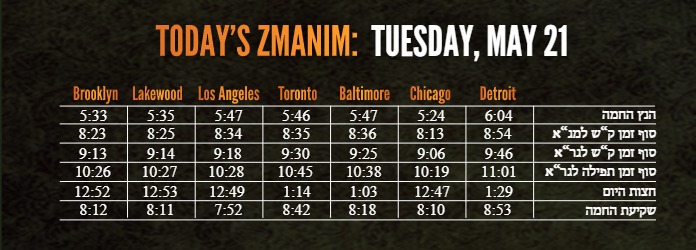
When is the day over?


Many people follow the opinion that Mincha can be davened until the end of the day, and then Ma’ariv can begin. To determine that exact time, a number of points must be established: 1) At the end of each day, there is a period known as Bein Hashmashos. This is a time of uncertainty, not clearly defined as either day or night. It lasts approximately fifteen minutes. 2) In the view of the Mishnah Berurah, a person should not daven Mincha or Ma’ariv during this time, since there is a question about whether it is night or day. 3) There is a well-known disagreement regarding the timing of Bein Hashmashos. Some say that it begins at shkiyah rishonah (literally, the “first sunset”)—i.e. the time the sun dips below the horizon. Others say that it only begins about 50-60 minutes later, at a time known as shkiyah shniyah. Accordingly, these two opinions disagree as to the final time one may daven Mincha. See below for a practical ruling on this matter.


ס"ק יד


Can a person daven Mincha after sunset?


Lechatchila, a person should be stringent and make sure to complete Mincha (both the silent Shemoneh Esrei and Chazoras Hashatz) by the first shkiyah. One should even forego tefilah b’tzibur in order to do so. B’dieved, if one did not daven by then he can still daven until the time of the second sunset. He should daven as soon as possible to minimize the delay. If there are already two stars in the sky, it is no longer permissible to daven -- even if it is before shkiyah shniyah. Some say that if a person will be davening after sunset, he should have in mind the following stipulation: If this is still the time for Mincha, this tefilah should be Mincha. Otherwise, it should count as Ma’ariv and the subsequent tefilah will be a make-up for missing Mincha. Some Achronim hold that one may not daven Mincha after the first shkiyah under any circumstances.


נ"ל ביה"ל ד"ה דהיינו ביאורים ומוספים דרשו 24

  • Some Gedolim daven at Mincha Gedolah and many yeshivos do as well, either to avoid questionable situations of eating before davening or to maintain uninterrupted afternoon learning sessions.


  • The hours of the day generally refer to shaos zmanios (halachic hours, each of which is 1/12 of the length of a given day). There is a well-known disagreement among the poskim as to whether the length of a day is calculated from sunrise to sunset or from daybreak until nightfall.


  • All opinions agree that Kriyas Shema should not be said before nightfall. Some poskim say that when one davens Ma’ariv after Plag, the brochos he recites still go toward the previous day’s count.


  • Why do we wash our hands before davening?


  • What is the solution if there is no water available?


  • Can a person daven Mincha twice?
PLEASE NOTE:  The information in this email is for learning purposes only. Please review the Mishna Berura and Biurim U'Musafim before making a halachic decision. Hebrew words are occasionally transliterated to enable a smoother reading of the text. Common Ashkenazi pronunciation is generally used in these cases.
Daf Hayomi B'Halacha Shiur
Rav Asher Eisenberger
Rabbi Asher Eisenberger
Synopsis of Today's Halachos
Rabbi Yerachmiel Garfield
Synopsis of Today's Halachos
This Week's Limud