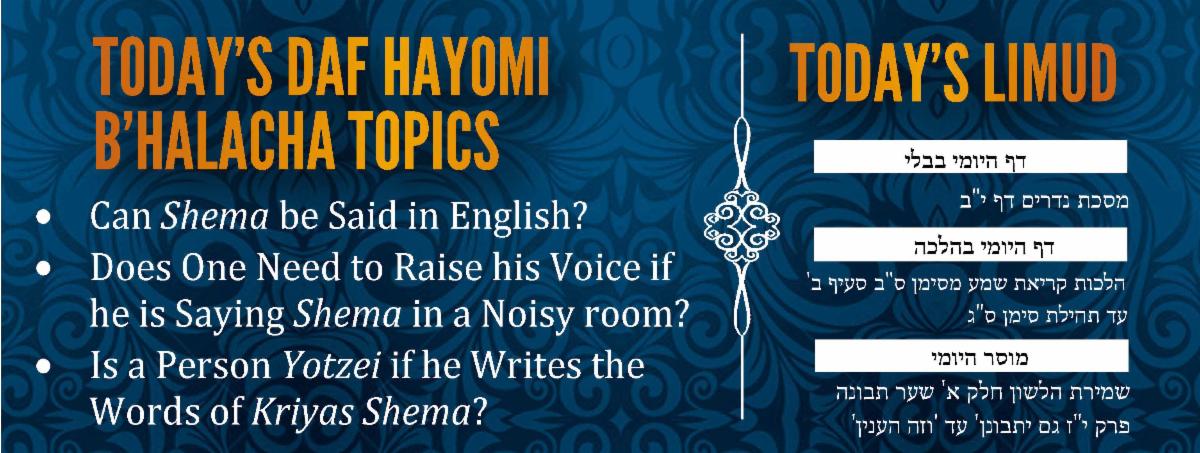
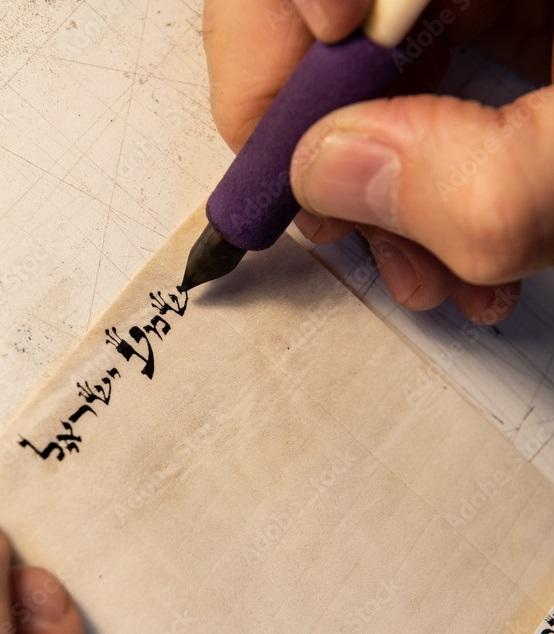
Can Shema be said in English?

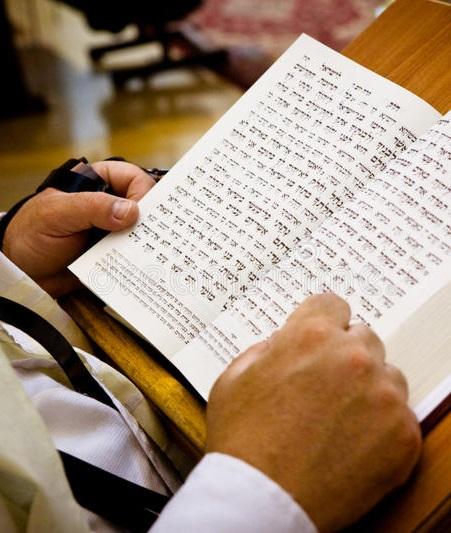
It is permissible to daven, recite brochos and say Kriyas Shema in languages other than Lashon Kodesh. One must understand the language, and it must be an accepted language spoken by most of the local populace. Nonetheless, it is appropriate to recite all tefillos in Lashon Kodesh. The poskim say that presently, even according to the basic halacha, one must daven in Lashon Kodesh. Since there are many words whose meaning is uncertain today, exact translation is not always possible. When using Lashon Kodesh, it is not necessary to know the meaning of the words.


סעיף ב, ס"ק ג, וביה"ל ד"ה יכול


Does one need to raise his voice if he is saying Shema in a noisy room?


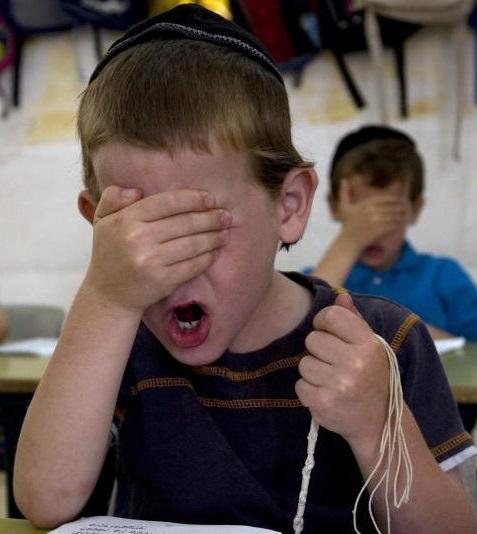
Shema must be read audibly, loud enough for the one reciting it to hear the words. Some say that this is a Torah requirement. The poskim discuss whether one must raise his voice when saying Shema in a noisy room. Some say that it is not necessary, since the words would have been audible if he had been in a quiet room. B’dieved, a person is yotzei even if his words are not audible, provided that he mouths the words.


סעיף ג, ס"ק ד, וביה"ל ד"ה ואם; ביאורים ומוספים דרשו, 6-5


Is a person yotzei if he writes the words of Kriyas Shema?


The Gemara discusses whether hirhur is k’dibur--whether thinking a thought is equivalent to articulating it. Most Rishonim rule that it is not, and that a person is not yotzei if he merely thinks the words of Kriyas Shema. Some Rishonim rule that with respect to brochos, hirhur is k’dibur even in the case of a mid’oraisa. The halacha follows the majority view. Thus, if a person did not articulate the words of Kriyas Shema or any brocha, he is not yotzei. The Achronim discuss whether writing is considered more significant than thinking. Some say that it is the equivalent of mouthing the words, and that one who wrote the Shema is yotzei b’dieved.

ס"ק ו ו־ז וביה"ל ד"ה יצא; ביאורים ומוספים דרשו,7

  • A person who listens to someone make a brocha and has intent to be yotzei fulfills his own obligation. This concept is known as shomeya k’oneh (listening is the equivalent of speaking). The poskim disagree about whether this rule can be applied to Kriyas Shema as well.


  • When a person reads Lashon Kodesh--when learning Tanach, reciting Pesukei D’zimrah or davening--he must be exact in his pronunciation. Care should be taken to stress each word, so that the end of one word is not combined with the beginning of the next.


  • When reading the words u’kshartem l’ois, a person should touch his tefillin shel yad. Similarly, when saying v’hoyu l’totafos, one should touch his shel rosh


  • Can Shema be said while lying in bed?


  • When is it forbidden to be stringent?


  • Can Shema be said while driving?
PLEASE NOTE:  The information in this email is for learning purposes only. Please review the Mishna Berura and Biurim U'Musafim before making a halachic decision. Hebrew words are occasionally transliterated to enable a smoother reading of the text. Common Ashkenazi pronunciation is generally used in these cases.
Daf Hayomi B'Halacha Shiur
Rav Asher Eisenberger
Rabbi Asher Eisenberger
Synopsis of Today's Halachos
Rabbi Yerachmiel Garfield
Synopsis of Today's Halachos
This Week's Limud