Grants for Community-Based Organizations – Virtual Event | |
DEQ’s Office of Environmental Justice invites you to a public stakeholder engagement call about funding and grants to benefit justice communities. The webinar will provide an overview of the EPA’s Environmental Justice Grants, which include $30 million for community organizations and $70 million for partnerships between community organizations and government entities such as DEQ. The webinar, which will be recorded, will also highlight funding opportunities for water quality monitoring, brownfields redevelopment, and coastal community resilience. Register for the webinar at this link. The webinar will be recorded and shared with all registrants. Contact the Office of Environmental Justice if you have any questions. | |
Draft Consolidated Erosion & Stormwater Management Regulation Available | Chapters 68 and 758 of the 2016 Acts of Assembly (the “Consolidation Bill”) combine DEQ’s existing statutory programs relating to erosion and sediment control and stormwater management and directed the State Water Control Board to adopt regulations to carry out the purposes of the Acts. Through consolidating these three chapters, the new regulation clarifies program requirements, eliminates redundancies, and corrects inconsistencies between erosion and sediment control regulations and stormwater management program regulations. No substantive changes to existing erosion and sediment control minimum standards or to the post-construction stormwater management technical criteria are part of this regulatory action. The comment period will run from Feb. 8 to April 10, and will include a public hearing on March 15. Following the comment period, DEQ will prepare a written summary of comments received on the draft regulation and the agency’s responses prior to presenting the regulation to the Board for final adoption. | |
Water Monitoring Plan Available | |
|
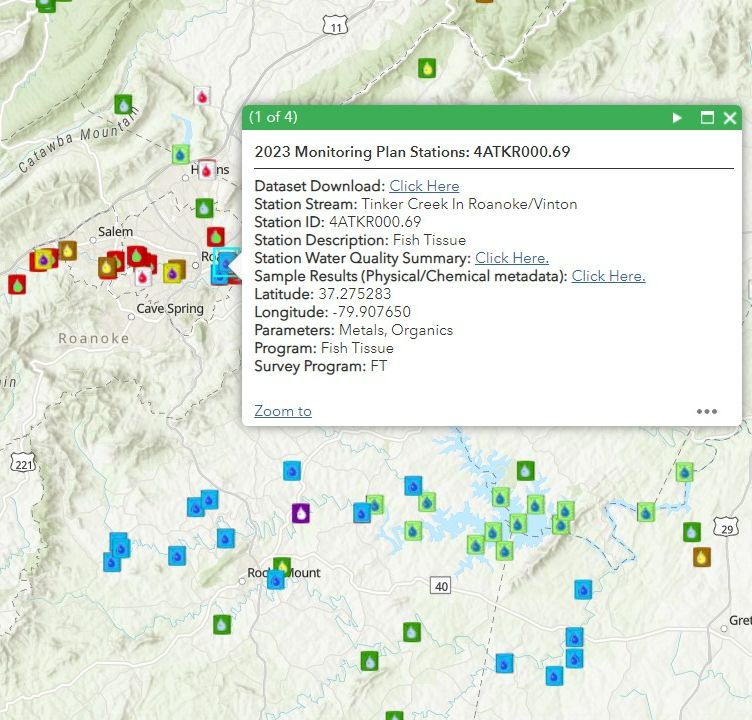
Every year, DEQ shares its water monitoring plan, which summarizes the water quality monitoring activities to be conducted that year. The plan and interactive map contain detailed information on DEQ’s monitoring activities including the station locations, specific conditions, frequency of monitoring, and costs. DEQ uses the monitoring plan to calculate laboratory analysis costs, evaluate statewide monitoring efforts, and provides a convenient source from which to extract descriptive summaries of specific regional and statewide programs. A description of each monitoring program included in the plan can be found on the Survey Program Codes sheet within the plan.
| |
Middle Chickahominy PFAS Response | |
|
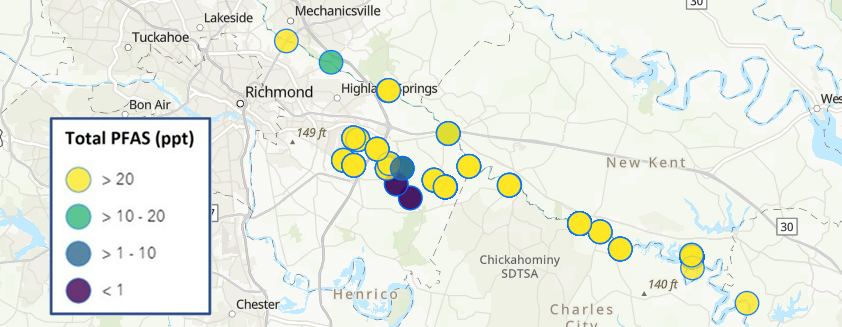
In 2021, Newport News Waterworks alerted DEQ to elevated PFAS concentrations in the Middle Chickahominy River watershed. PFAS is a class of "forever chemicals" that are found in many household and industrial products including food packaging, nonstick cookware, carpet and upholstery, waterproof clothing, and firefighting foams. Since becoming aware of the issue, DEQ, the Virginia Department of Health, and Henrico County have coordinated a joint response focused on identifying and mitigating any potential risks to public health.
Fish tissue, sediment, and surface water samples were collected at locations throughout the watershed, including Chickahominy Lake, and levels appear to be highest in White Oak Swamp. The agencies will continue collecting data and federal technical and policy recommendations regarding PFAS as they develop, and will use this information, along with additional monitoring datasets, to inform response. To learn more about the Middle Chickahominy PFAS response view the interactive Story Map and webpage, which will be updated with additional information as it becomes available.
| |
DEQ Enforcement Manual Updates | |
|
In order to help streamline the enforcement process, updates have been made to the DEQ Enforcement Manual. The manual update reflects changes to staff instructions to implement agency efficiencies. It is important to note that the manual update does not change how the agency calculates civil charges. Manual changes are as follows:
- Collaboration with Central Office is not required when the proposed civil charge is $15,000 or less (this does not apply to High Priority Violations or Significant Noncompliance)
- An enforcement recommendation plan is not required if the civil charge is less than $15,000 (a civil charge worksheet and detailed analysis is still required for all cases)
- An Informal Fact-Finding fast-track enforcement process is now available for cases with a civil charge of $15,000 or less (see page 159)
- OneDEQ case load allocation (see page 9) and new enforcement timeline (see Chapter 3)
- Central Office enforcement staff are now the lead for all enforcement actions involving state or federal agencies, regardless of who the responsible party is,
- Public notice requirements have changed (see page 22)
| |
Alternative Erosion and Sediment Control Measures | |
|
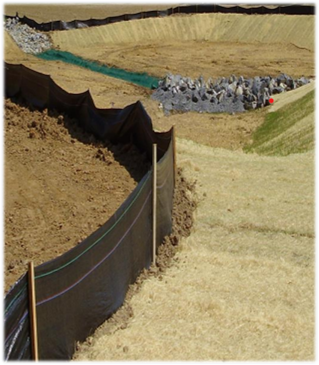
DEQ strives to improve its plan review process by ensuring consistency and efficiency in reviewing requests to use alternative erosion and sediment control (ESC) measures on plans where DEQ serves as the Virginia Erosion and Sediment Control Program (VESCP) authority. Alternative ESC measures (including proprietary measures) will be considered when the typical details, installation notes, materials, and maintenance requirements are provided on the ESC plan submitted to DEQ and will be reviewed to ensure the alternative ESC measures are equivalent with the minimum standards outlined in the Virginia ESC Regulations and handbook. DEQ approval of the ESC plan will be viewed as acceptance of the alternative ESC measures for the particular land-disturbing activity. Note that if alternative ESC measures are proposed after the ESC plan has been approved, a modified plan should be submitted to DEQ prior to initiating use in the field. This process only applies where DEQ serves as the VESCP authority; the use of alternative ESC measures where DEQ is not the VESCP authority should continue to follow the requirements of the local VESCP authority. Contact SWMguidance@deq.virginia.gov for questions about these changes.
| |
Amended Reimbursement Rates for Petroleum Remediation | |
An addendum to the 2022 Usual and Customary Rate Schedule for reimbursement from the Virginia Petroleum Storage Tank Fund has been issued. The Usual and Customary Rate Schedule is used by DEQ to identify and reimburse reasonable costs for work conducted to investigate and remediate eligible petroleum releases. New forms and worksheets are available from the Petroleum Tanks Reimbursement webpage. | |
Assessment of Unauthorized Discharges, Overflows, and Bypasses of Sanitary Wastewater | |
As of Feb. 2, Assessment of Unauthorized Discharges, Overflows, and Bypasses of Sanitary Wastewater, GM02-2010, Amendment 4, is effective. The purpose of this amendment was to revise compliance auditing procedures for unauthorized discharges, overflows, and bypasses from facilities covered by a Virginia Pollutant Discharge Elimination System or Virginia Pollutant Abatement permit to ensure the guidance is protective of the environment, provides flexibility in monitoring and compliance enforcement, and provides flexibility to focus staff resources to resolve concerns in a timely manner. | |
Public Participation Opportunities | |
|
Visit the DEQ website for comment opportunities on pending enforcement orders and permit actions. The following regulatory actions are available for public comment:
-
Order and local variance for data centers located in the Counties of Fairfax, Loudoun, and Prince William; public comment period closes March 14. Public hearing Feb. 27 at 11 a.m. at DEQ Northern Regional Office, 13901 Crown Court, Woodbridge VA.
-
Regulation for Emissions Trading; public comment period closes March 31. Public hearing March 16, 2 p.m. at DEQ Central Office, 1111 E. Main St. Richmond, VA.
-
Virginia Pollutant Discharge Elimination System General Permit for Concrete Products Facilities; public comment period closes March 31. Public hearing March 10, 11 a.m. at DEQ Piedmont Regional Office, 4949-A Cox Road, Glen Allen, VA.
-
Reissue and amend, as necessary, the Virginia Pollution Abatement (VPA) Regulation and General Permit for Animal Feeding Operations and Animal Waste Management; public comment period closes March 31.
-
Draft Virginia Erosion and Stormwater Management Regulation; public comment period closes April 10. Public hearing March 15 at 10 a.m. at DEQ Central Office.
-
Proposed General VPDES Permit for Discharges of Stormwater from Small Municipal Separate Storm Sewer Systems; public comment period closes April 14. Public hearing March 20 at 2 p.m. at DEQ Piedmont Regional Office.
| |
|
Are you committed to protecting human health and the environment? Apply for a job at DEQ. Some open positions currently open are:
- Talent Management Specialist (Richmond; closes Feb. 27)
- Compensation & Benefits Specialist (Richmond; closes Feb. 27)
- Environmental Justice Coordinator (Harrisonburg, Henrico, Lynchburg, Richmond, Roanoke; closes Feb. 27)
- Deputy Director for HR Operations (Richmond; closes Feb. 27)
- Air Inspector (Prince William; closes Feb. 28)
- Air Quality Monitoring Specialist (Henrico; closes Feb. 27)
- VWP Specialist (Harrisonburg; closes March 1)
- Permitting Ombudsman (Richmond; closes March 3)
- Stormwater Inspector (closes March 3)
- Mitigation Specialist (Richmond; closes March 3)
- Enforcement and Data Quality Coordinator (Richmond; closes March 3)
- Stormwater Plan Reviewer (Richmond; closes March 3)
- Stormwater and Erosion & Sediment Control Plan Reviewer (Richmond; closes March 3)
| | | | |