|
DCJS Victims Services News:
Domestic Violence Awareness Month Edition
| |
| |
 | |
Domestic Violence Awareness Month – October 2023
Chad Felts, Capacity Building and Sustainability Coordinator (New role with the DCJS Juvenile & Child Welfare Team!)
October was first officially declared as National Domestic Violence Awareness Month (DVAM) in 1989, closely following the creation of the first nationwide domestic violence toll-free hotline in 1987. Evolving from a National Day of Unity first organized by the National Coalition Against Domestic Violence (NCADV) in October 1981, DVAM’s original goals included raising awareness and connecting advocates across the country who were working to end violence against women and their children.
Beginning in 1995, the Domestic Violence Awareness Project (DVAP) has led the planning and organization efforts for DVAM at the national level. DVAP, a coalition of several national organizations working together to end domestic violence, helps highlight the importance of transforming awareness into action during October and beyond.
Over the years, DVAM has continued to grow in importance, thanks to enhanced outreach and awareness efforts from regional, statewide, and local domestic violence organizations and advocates. This year, as always, DCJS would like to recognize and applaud the efforts of the many dedicated community partners across the Commonwealth who are working to end domestic violence in Virginia.
|  | |
Important Dates in October 2023
October 2: National Day of Unity
October 19: Purple Thursday
October 22–25: NCADV Conference (Washington, D.C.)
| |
DCJS Victims Services Training
"Firearm Awareness and Risk for Victim Advocates"
Virtual Training
Part One – October 19, 2023
Part Two – October 26, 2023
In observance of Domestic Violence Awareness Month, DCJS is offering a two-part training series, "Firearm Awareness and Risk for Victim Advocates." This training series provides insight into the intersections of intimate partner violence (IPV) and firearms, including prevalence, severity, risk, and lethality. It also provides victim advocates with the guidance and tools to provide victim-centered, trauma-informed firearm safety assessment and planning for survivors of IPV.
| |  |
Domestic Violence Awareness Month Resources | Domestic Violence Awareness Month Video – This short video presents an overview of the impact and prevalence of domestic violence. |
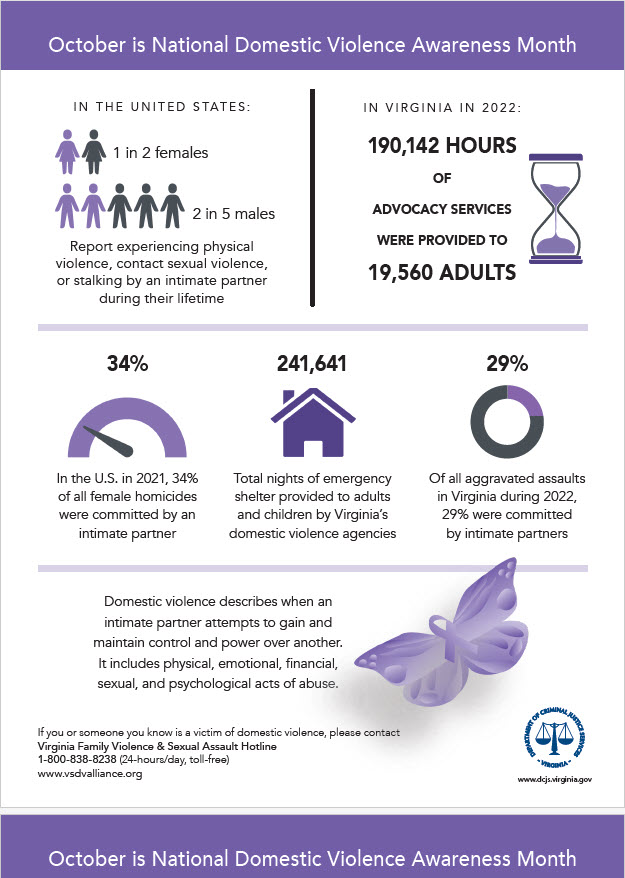
Domestic Violence Infographic Sheet – A downloadable fact sheet containing statistics and resources related to domestic violence. | | |
|
How Can the disAbility Law Center of Virginia Help Victims?
Andi Martin, Sexual Assault Intimate Partner Violence Program Coordinator
DCJS recently joined a partnership with the disAbility Law Center of Virginia (dLCV) and the Virginia Sexual and Domestic Violence Action Alliance to improve the way sexual assault victims with disabilities access and experience services in Virginia. This project is funded by the Office on Violence Against Women through a three-year grant. Our project is still very new, and I cannot wait to share more about this project as we get further in. I have learned a lot about dLCV through this partnership, and I hope you find this information helpful in your work with victims.
dLCV is a non-profit, statewide organization whose mission is to “advance independence, choice and self-determination; protect legal, human and civil rights; and eliminate abuse, neglect and discrimination of people with disabilities through zealous and uncompromising legal advocacy and representation.” dLCV is independent from state and local governments and their services are free of charge.
Much of the work done by dLCV relates to accessibility and accommodations protected by the Americans with Disabilities Act (ADA). dLCV would be an appropriate referral for victims who are having problems with accessing or receiving accommodations for public services, such as court services, domestic violence sheltering, and receiving medical care. dLCV advocates for individuals to help remove barriers to services. Two examples of barriers are 1) physical barriers, such as buildings that are not accessible to people who use wheelchairs, and 2) communication barriers, such as no way to communicate with an individual who is deaf or hard of hearing. dLCV also investigates abuse, neglect, and discrimination of people with disabilities from public service institutions. This is particularly valuable work because many times, situations of abuse, neglect, and discrimination do not fall under the purview of Adult Protective Services. If you work with a victim who is facing these challenges, consider referring them to dLCV.
To receive assistance from dLCV, victims may call 1-800-552-3962 on Mondays, Wednesdays, and Fridays during business hours, or they can complete an on-line intake form which is found on the dLCV website and linked here.
If you have questions about your agency’s responsibilities under the ADA, please visit www.ADA.gov.
| | | |
|
Domestic Violence Has No Gender
Dawn Bush, Victims Crisis Assistance & Response Team (VCART)
Outreach & Training Specialist
As we honor Domestic Violence Awareness Month, let's explore that domestic violence has no gender. When addressing this topic, many minds immediately think of female victims, but as we know, domestic violence has no such gender boundaries.
Research shows that one in four men have experienced some form of physical intimate partner abuse (eg, slapping, shoving, pushing), one in seven have been victims of serious injury as the result of intimate partner abuse (eg, beating, burning, strangulation ), and one in 18 men have been stalked by an intimate partner at some point in their life ( https://ncadv.org/ ). While these numbers may not seem as high as those of women who endure domestic violence, it is much less likely that men will report having experienced abuse.
Society tends to have a hard time understanding how a man can be a victim of domestic violence; However, we must remember that abuse comes in all forms, not just in a way that leaves visible bruises. Abuse can be mental, verbal, and financial, which can occur regardless of gender. Like with any other victim/survivor, we must start by believing male victims of domestic violence and providing the same resources and assistance as we would with any victim.
There are more resources and safe spaces available to male victims now than there have been in the past; However, we still have work to do when it comes to offering male victims a safe place to feel heard, believed, and assisted in their journey.
| | |
 | |
SERVICE
Sharon Reed, Victims Services Program Specialist
What is Service? Merriam-Webster.com defines service as "a helpful act; a contribution to the welfare of others; a useful labor that does not produce a tangible commodity". But what is the real meaning of service? I believe service is a choice: a calling to help others obtain a sense of safety, well-being, and a better way of life.
Jenny Santi wrote in her article, “The Secret To Happiness Is Helping Others” for Time Magazine, “There is a Chinese saying that goes: ‘If you want happiness for an hour, take a nap. If you want happiness for a day, go fishing. If you want happiness for a year, inherit a fortune. If you want happiness for a lifetime, help somebody.’ For centuries, the greatest thinkers have suggested the same thing: Happiness is found in helping others.”
Studies have shown that serving others can benefit your own mental health and well-being. The benefits of serving others include reducing feelings of loneliness and stress, as well as enhancing a sense of community, increasing optimism, and increasing happiness.
I have worked in many roles serving victims during my 35-plus years of employment. During that time, I have been afforded many opportunities in the criminal justice field. As I considered these opportunities, my husband Steve Reed, would always ask, “If you took the money out of it, would you be happy in that position?” When I examined the opportunity in that light, my path was always clear.
Service can become habitual. You feel good when you help someone out of a bad situation, walk them through a difficult process, or help them through the worst day of their life. It comes with an ebb and flow: the highs and the lows, the adrenaline rushes, and the emotional exhaustion. But you, the advocates, continue to assist with each case, each survivor, each victim.
As we honor Domestic Violence Awareness Month, remember the survivors of domestic violence you had the privilege to walk with during your time of service. They brought their own struggles and heartbreak; however, they also remember the success stories. Those who have moved on to a better life, a better partner, and a happy adventure because of the services, information, and guidance you provided. Thank you all for your selflessness, empathy, compassion, and your continued service.
|  | |
DCJS VICTIMS SERVICES STAFF SPOTLIGHT
Featuring Aria Chipley, Victims Services Program Specialist
Please share a little about your educational and professional background.
This journey began in Southeast Alaska, where I attended the University of Alaska Southeast in Juneau, AK. During my undergraduate internship, I worked in a high-risk sex offender management program in a correctional facility. After graduation, I transitioned into working with Batterer Intervention Program (BIP) offender intervention both in community and corrections. Additionally, I worked providing hospital accompaniment to victims/survivors of domestic and/or sexual violence. After many winters with endless snow, I decided to relocate to the Carolinas. I worked in the courts providing services to victims of crime, and again as a facilitator for community BIP offender intervention programming. I returned to victims services by working as a domestic violence victim advocate, DSS Liaison, and finally as a domestic violence program coordinator at a nonprofit agency. Throughout these roles, I worked with grants and throughout the years, recognized that I wanted to know more. In pursuit of these goals, I decided to attend graduate school for Public Administration. I became one of two new Victims Services Program Specialists at DCJS and I completed my Master of Public Administration through Arkansas State University in May 2023.
What is your role at DCJS?
I work as a Victims Services Program Specialist. I have the opportunity to work with victim-serving programs in the Northern Neck/I-95 Corridor region(s) of the Commonwealth, ensuring compliance across multiple grants and providing technical assistance.
Why were you interested in working for Victims Services at DCJS?
I have worked in nonprofits providing direct services for many years, so general grant knowledge was familiar. It wasn’t until I began working more with grant reporting that I developed an interest in grant management. While completing my MPA, I relocated from the Carolinas to Richmond. I knew that I wanted to continue supporting victims, but I also wanted to further my knowledge and experience with grant work. I had experiences covering the spectrum regarding grant monitors, some amazing and others that I did not want to repeat. I knew that in keeping true to my passion for serving victims, I wanted to further my experience by supporting the staff at victim-serving agencies. Grant work is extensive, and I didn’t want to contribute additional burdens to programs ensuring compliance. Instead, I wanted to shift my focus to supporting the foundation of these agencies through compliance and technical assistance. I researched DJCS extensively to ensure that my goals and objectives for providing services aligned with those of DCJS. Nearly six months later, I’m happy to continue using this opportunity as a grant monitor to ensure victim-serving agencies have access to the resources and support they need to continue serving victims throughout the Commonwealth.
What do you enjoy most about your work with DCJS?
Knowing that the learning never stops. In providing technical assistance, I work to treat every interaction as a new learning opportunity. Providing technical assistance not only helps the program, but it also helps the monitor improve their specific subject knowledge and can be utilized in future technical assistance requests to this program and others across the Commonwealth. I am able to learn more about the program itself, the work being done, and how to best incorporate feedback from the field to better serve and support victim-serving programs.
What has been your proudest accomplishment at DCJS?
Grant reviews and site visits are the major ones, but I am thankful for the daily opportunities to talk with programs and provide same-day technical assistance.
Prior to working at DCJS, what has been your most unusual or interesting job?
I grew up in a few states but call Southeast Alaska home. I lived in a very remote town, only accessible by boat or plane. The town was the entrance to a National Park. I worked alongside the National Park Service Rangers, and we would board a cruise ship for the day. We answered questions on the park, helped people spot wildlife (humpback whales, puffins, harbor seals, sea otters, sea lions, bears, and more!), discussed the glaciers, eagerly awaited potential glacial calving, and discussed environmental impacts.
Getting to/from the “office” was one of the most exciting parts. We took a boat and rode alongside the cruise ship (it slowed down, we sped up), where the ship staff opened a side “door,” and we climbed a ladder up to the ship and back down when leaving at the end of the day.
When you were a child, what did you want to be when you grew up?
That is an excellent question. Truly, I’m unable to remember. I do know that whatever it was – working in grants was not part of it. Now, I can’t imagine doing anything else.
If you could only vacation in one place for the rest of your life, where would it be and why?
There are so many options! If I had to choose, I really loved Mendocino County, California. The weather was perfect, the waves incredible, and being surrounded by the giant Redwoods; it was magical.
What would you title your autobiography?
I love music, so it needs to be a song title. “Learning to Fly” seems like the right fit.
| | |
|
Resources for Economic Advocacy for
Domestic Violence Survivors
Tricia Everetts, Victims Services Training Coordinator
Economic abuse is a form of domestic violence that involves limiting or preventing a victim's financial stability to increase dependence on the abusive partner in order to control the victim. This can take many forms, such as preventing the victim from working, limiting access to bank accounts, forcing the victim to take out loans or debts in their name, fraudulently taking out loans without the victim's consent, and destroying or stealing their property.[1] These tactics can leave victims feeling trapped in abusive relationships and unable to support themselves. In one study, 99% of domestic violence victims surveyed reported experiencing some form of economic abuse.[2] Assessing and addressing economic abuse is important in assisting victims as they seek safety and justice.
Many resources are available to help advocates support survivors who have experienced economic abuse, including:
-
The Center for Survivor Agency & Justice (CSAJ) offers many resources related to economic advocacy for survivors and advocates, including downloadable resources and pre-recorded webinars to help victim advocates strengthen their economic advocacy practice and build community partnerships to support survivors better as they journey towards safety and financial stability.
-
The Consumer Advocacy Toolkit provides downloadable desk tools for advocates on topics such as Survivor-Centered Economic Advocacy, Debt Advocacy, Advocacy for Credit Reporting and Repair, Assessing Needs and Tracking Economic Barriers and Outcomes, Navigating Consumer Systems, and others. These desk tools include questions to ask to assess for financial abuse, safety considerations, and guidance and tools for identified financial abuse issues such as identity theft or coerced debt. You can download these tools at https://csaj.org/resource/consumer-advocacy-toolkit/. They also provide a downloadable four-part compendium on coerced debt and holistic advocacy with survivors of domestic violence. This resource can be found here.
- The Independence Project, through the National Network to End Domestic Violence (NNEDV), offers no-interest microloans to assist survivors in building a positive credit history. Loans of $100 are provided to approved applicants with loan payments of $10/month for ten months. To learn more or to obtain an Independence Project application, please visit https://nnedv.org/content/independence-project/
-
NNEDV also offers pre-recorded webinars, complete with downloadable resources on topics such as:
- The Economic Impact of Social Determinants of Health
- Debt Consolidation and Debt Dispute
- Credit-Building Through Micro-lending
- Child Tax Credit (CTC) Outreach and the Get CTC Portal
-
NNEDV and the Allstate Foundation offer downloadable resource guides and curricula for their “Moving Ahead” training program. This program provides an overview of financial abuse, helpful tools, and guidance on financial safety planning, budgeting, improving credit scores, and many others. You can download these resources here.
- In collaboration with the National Endowment for Financial Education, the National Coalition Against Domestic Violence (NCADV) presents a series of pre-recorded webinars for domestic violence survivors and advocates. Topics include “Rebuilding Financially After Domestic Violence,” “Housing Options for Domestic Violence Survivors 101,” “Transitional Housing: Moving to a More Secure Future,” “Retirement Planning for Survivors and Advocates,” and many others.
[1] National Coalition Against Domestic Violence. “What is Economic Abuse?” downloaded from https://ncadv.org/blog/posts/quick-guide-economic-and-financial-abuse
[2] Adams, A.(2011). “Measuring the Effects of Domestic Violence on Women’s Financial Well-Being”, Center for Financial Security. University of Wisconsin-Madison.
| | |
 | |
VSDVVF Agency Highlight: Korean Community Service Center
of Great Washington
Tierra Williams, VSTOP & VSDVVF Program Coordinator
Korean Community Service Center of Greater Washington (KCSC) is a non-profit 501(c)(3) that was founded in 1974 with a commitment to provide basic transportation and interpretation assistance to visitors and immigrants from Korea. To date, the organization has expanded its services and provides support to other Asian immigrants living within the metro DC area. Since its establishment, KCSC has provided a variety of services to over 150,000 Asian American immigrant families and currently provides services to about 1,000 Asian Americans each month at four different office locations (KCSC, 2023). The organization provides comprehensive services including social support, housing, counseling, immigration assistance, job readiness training, victim services, relationship enhancement education, health promotion, and mental health counseling.
According to The Commonwealth Institute, there are around 728,700 immigrants in the Northern Virginia area, comprising 25% of the state’s population (The Commonwealth Institute, 2021). Within the Commonwealth of Virginia, there is a significant need for culturally specific services to meet the diverse needs of all communities. Following a victimization, survivors are faced with the overwhelming tasks of seeking services and navigating various systems. For underserved communities, there are additional obstacles that can come in the form of language barriers, limited access to culturally relevant services, and cultural values that may not encourage seeking social supports. As a direct service provider with a dedicated victim service division, KCSC meets a significant need by offering victim services to limited English proficient, low- to moderate-income Asian families residing in the Metropolitan Washington DC area, including Montgomery, Prince George, and Howard Counties in Maryland, and Fairfax, Arlington, Prince William, and Loudoun Counties and the Cities of Alexandria and Falls Church in Virginia.
KCSC's victim service division is dedicated to ending domestic violence and sexual assault through the implementation of effective strategies and solutions tailored to support the needs of Asian communities. The organization is staffed by bilingual professionals to minimize language and cultural barriers to ensure culturally appropriate services. The victim service division aims to meet the unique needs of clients through a wide range of services which include individualized case management, court accompaniment, interpretation and translation services, counseling and support group sessions, legal assistance for immigration, and other matters in collaboration with pro bono community lawyers, transitional and supportive housing, workshops, and educational seminars on domestic abuse and sexual assault. The organization also provides urgent financial support to victims to assist with emergency expenses, rent, food, transportation, and utilities, with funds raised by the “Sharing Love Campaign.” This provides a one-stop approach to services which limits the need for clients to have to seek services elsewhere. Moreover, KCSC operates a sexual and domestic violence hotline (1-888-987-4561). Referrals for services are received via the hotline, word of mouth, law enforcement, courts, healthcare providers, community leaders, other providers, as well as community outreach efforts.
As a VSDVVF subrecipient since 2008, the Korean Community Service Center of Greater Washington has been able to provide a multitude of culturally specific services at the micro, mezzo, and macro levels. The organization provides services to about 90 to 100 families impacted by domestic violence and sexual assault annually (75% Korean, 20% Chinese, 5% Filipino, Vietnamese, or from other backgrounds). The Director of Family Services and Quality Assurance comments that the receipt of VSDVVF funds has played a pivotal role in enabling the organization to establish their victim services as well as enhance their response to victims affected by domestic violence and sexual assault. VSDVVF has allowed the organization to expand their capacity to assist victims within their service area, as well as enhance their community collaborations with other local providers to promote a holistic approach to service delivery. In addition, VSDVVF funds have empowered the organization to host various community engagement activities designed to promote public awareness and education related to domestic violence and sexual assault services. Through a comprehensive approach to service delivery, KCSC is able to fulfill their mission to “…assist and empower Asian Americans and new immigrants to become well-adjusted and fully contributing members of the United States through social services, education, advocacy, and the development of resources.” For more information, please visit KCSC Home (kcscgw.org).
References
American Immigration Council (2020). Fact Sheet: Immigration in Virginia. Retrieved from https://www.americanimmigrationcouncil.org/research/immigrants-in-virginia
Korean Community Service Center of Greater Washington (2023). Victim Services
The Commonwealth Institute for Fiscal Analysis. (2021) A Profile of Our Immigrant Neighbors in Northern Virginia. Retrieved from https://www.thecommonwealthinstitute.org/2020/07/29/a-profile-of-our-immigrant-neighbors-in-northern-virginia/#:~:text=In%20the%20Northern%20Virginia%20region,the%20national%20average%20of%2014%25.
| | | | | | |