DBI YEAR 1 NEWSLETTER UPDATE
|
|
|
|
|
|
|
|
|
|
|
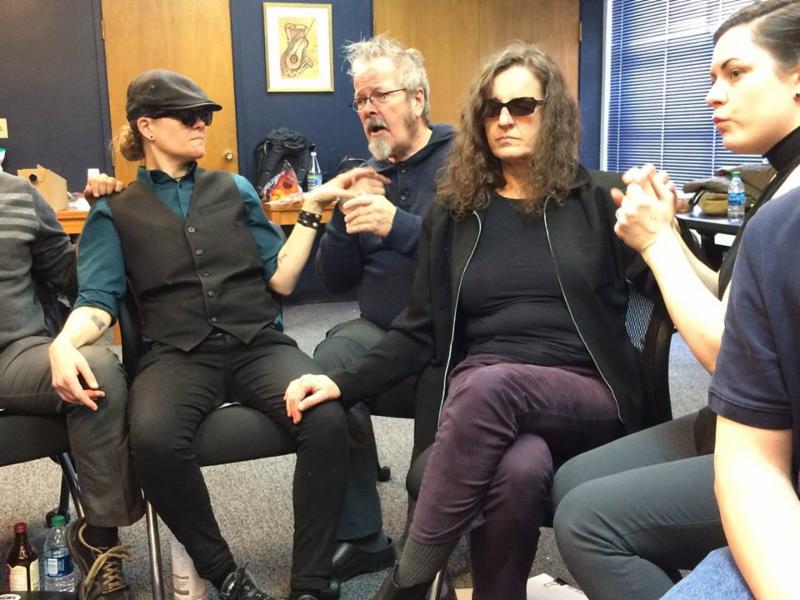
Image description: Seated in picture from left to right: aj granda, Terry Dockter, Jelica Nuccio and Anna Mansell Karagiannis. Terry and Anna are interpreting tactiley. Jelica has her hand on aj's leg.
|
|
|
Welcome to the first DeafBlind Interpreting National Training & Resource Center newsletter! We’ve been very busy since the launch of this grant project in January 2017. We are excited about this five-year interpreter training grant opportunity and look forward to working with and meeting many of you as we work to put our modules and trainings together.
Within a framework of evidence-based practice, the DeafBlind Interpreting National Training and Resource Center (DBI) is charged with enhancing communication access for persons who are DeafBlind by increasing the number of qualified interpreters able to effectively interpret utilizing protactile ASL, tactile communication and other strategies to meet individual needs. The project will also work with DeafBlind individuals who will serve as mentors, language models, and educators in this specialization, and build the capacity of VR, interpreter educators, interpreters and other service providers to better serve DeafBlind constituents, giving them the knowledge and skills to incorporate evidence-based practices into their daily work.
Project staff
include CM Hall (Project Co-Director), Heather Holmes (Project Co-Director), and Elayne Kuletz (Web Manager). Primary consultants, Jelica Nuccio and aj granda, will provide in-depth training to interpreters and DeafBlind mentors in protactile ASL and mentoring.
Approximately 20 content experts from around the country are also assisting in the effort. Over the course of the 5-year grant, trainings will be held both online and in person. DBI will also serve as a resource center of training materials for interpreters.
|
|
|
The DeafBlind Interpreting National Training and Resource Center has launched a website (
dbinterpreting.org
), blog, and Facebook page. We have welcomed thousands of online visitors and are proud to be a part of a growing online community. We are also cultivating a digital resource repository of DeafBlind interpreting content through a Digital Commons and publishing our virtual training space. To stay connected with us and receive future updates about our projects, join us online! You can follow
our blog
or like DBI
on Facebook
. You can also sign up or reach out with us to ask a question through our website
link
.
|
|
|
INITIAL CORE TEAM MEETING HELD
|
|
A blog post, written by CM Hall, DBI Co-Director:
In March, the staff for the DBI grant, Dr. Cheryl Davis, CM Hall, Heather Holmes and consultant, Pauline Annarino, assembled a 3-day meeting in Seattle to review the DBI mission, values, and vision of the grant charge. Members of the Core Team met at the DeafBlind Service Center and discussed the strategic plan for the 5-year interpreter training grant. Our first Core Team Meeting was a tremendous and intensive 3-day experience. Our meeting was knee-to-knee, shoe-to-shoe, in contact, giving protactile feedback as well as feedback on the grant project goals and activities.
- aj granda, DeafBlind, ProTactile ASL Trainer from WA.
- Jelica Nuccio, DeafBlind, ProTactile ASL Trainer from WA.
- Roberto Cabrera, DeafBlind, Vocational Rehabilitation Counselor from CA.
- Jason “Jaz” Herbers, DeafBlind, Interpreter Educator from OH.
- Rebecca Cowan-Story, Hearing/Sighted from GA.
- Unable to be present, but a part of the Core Team, is Dr. Terra Edwards, Hearing/Sighted, Professor from MO.
Just thinking about holding our first big grant meeting for the DeafBlind Interpreting National Training & Resource Center over three days in Seattle with a majority of the meeting participants being DeafBlind community leaders and key stakeholders was exciting. Simultaneously, I imagined potential challenges could arise, but having been a part of this community for over two decades, I knew it would also present intangible – and literally tangible—rewards that regularly remind me why I got into studying interpreting and Deaf/DeafBlind Culture.
It required a lot of advance work to coordinate all the travel, lodging, meeting location details, SSP and interpreter logistics. Yet once everyone comes together and there is protactile ASL as far as you can touch, it makes all those pesky details melt. It’s what we aspire to create in this grant: a PTASL-accessible environment for everyone. It was an education for all involved — learning about our grant goals and activities over the five years, and learning how to give in-the-moment information and feedback that affirms our inclusive environment and an autonomous one for all. It was a long three-days, but the immersive environment was a great refresher for those more experienced in PTASL and opened up a whole new world and created a lot of “aha!” moments for those who were touching it for the first time.
I can’t wait to see how many more folks, DeafBlind, hearing/sighted, hard of hearing, are all more PTASL-savvy at the end of this grant. I hope we feel a little closer to one another and validate the DeafBlind community’s language in the process.
-- CM Hall
|
|
|
LEADERSHIP TRANSITION -- NEW CO-DIRECTORS NAMED
|
|
In July, Dr. Cheryl Davis, the Director of the DBI grant and the Regional Resource Center on Deafness at Western Oregon University, left to pursue work as a Senior Analyst with the Willamette Education Service District’s Center for Education Innovation, Evaluation and Research. Dr. Davis served as the Principal Investigator on several interpreter training and vocational rehabilitation grants, as well as the DBI grant. We are sad to see her go. Her time, talents, and grant management expertise will be missed, but we wish her well!
In advance of her departure, a succession plan was installed wherein CM Hall, formerly the Project Manager on the DBI grant, and Heather Holmes, formerly the Resource Manager on the DBI grant, would become co-directors for the interpreter training project funded by RSA.
|
|
|
SURVEYS, FOCUS GROUPS & INTERVIEWS CONDUCTED TO ASSESS DEAFBLIND INTERPRETING SKILLS
|
|
As a part of the work to train interpreters to better serve DeafBlind individuals, a national baseline survey was disseminated in June 2017 to assess the number of interpreters who work with DeafBlind individuals. We followed that survey up with focus groups, another survey about competencies and interviews. We are assessing the data from all these respondents to better determine what the needs, competencies and qualifications of DeafBlind interpreters are.
The first survey conducted was our baseline to help us establish a count of the number of interpreters in this country who are working with DeafBlind individuals. This information is not currently available as there is no certification or licensure to rely on. The online survey asked for identifying information for two purposes: the ability to track survey completers by email address and name, so that we can evaluate our records for duplication and so that in future phases of the DBI grant project we may also create a DeafBlind Interpreter Directory.
Additionally, in August during the Seabeck DeafBlind Retreat, a national gathering of DeafBlind individuals, several focus groups took place to solicit feedback on the qualifications of DeafBlind interpreters.
During the months of September and October, online focus groups and interviews took place as well as a national needs assessment survey to determine what needs that DeafBlind individuals have and expect of their interpreters.
|
|
|
#WHYISIGNPTASL AWARENESS CAMPAIGN LAUNCHED NATIONWIDE
|
|
In the last few years, you may have seen promoted over social media the #WhyISign effort to promote the use of sign language. In the effort to train interpreters in DeafBlind individuals’ language, DBI is modeling our social media effort to crowdsource videos using the #WhyISignPTASL. We recognize the need to train more interpreters who know, understand, and raise awareness of protactile ASL as separate and distinct from visual ASL.
We encourage everyone to participate in this effort and help promote the #WhyISignPTASL campaign effort. All videos are welcome. Send us your short videos and we will work to make them accessible with captioning and voice over.
If you make a video, please include:
1) Your name
2) Are you DeafBlind, Deaf, Hearing, Hard of Hearing, and/or Sighted?
3) Where you live
4) If you work, what do you do?
5) Why do you choose to use protactile ASL and what are the benefits you gain from using it? Why have you embraced this language and taken it and made it your own?
6) Add #WhyISignPTASL at the end.
Email videos to
dbi@wou.edu
. Please limit your video to 1-2 minutes.
Video description: Jelica Nuccio, DBI DeafBlind consultant and content expert, is sharing her #WhyISignPTASL video. Click on video below to view on our DBI YouTube channel.
|
|
|
DOCTORAL RESEARCH INFORMS INTERPRETER TRAINING GRANT
|
|
The DBI grant is committed to training interpreters in the language and culture of DeafBlind individuals who utilize interpreters. The foundational research that informed the grant application was based on Dr. Terra Edwards
ProTactile ASL dissertation
. Dr. Edwards and Dr. Diane Brentari, along with lead consultant, Jelica Nuccio, with
Tactile Communications
, just received funding from the
National Science Foundation
to further the phonological research on protactile ASL, a new language that has begun to emerge over the last decade, with its own linguistic markers, parameters and features centered in touch as the vehicle for information and autonomy. DBI has partnered with two DeafBlind leaders and trainers who have worked to educate and inform DeafBlind individuals as well as interpreters about the philosophy, attitude and movement of PTASL. Four introductory vlogs have been created and are viewable on the
ProTactile ASL YouTube channel
. These videos were not produced by DBI and are not captioned or voiced over.
|
|
|
DBI PRESENCE AT CONFERENCES
|
|
Two of our Core Team Members are sharing about DBI at stakeholder conferences. Roberto Cabrera, a Vocational Rehabilitation (VR) counselor who is DeafBlind participated in the 5th Biennial Council de Manos Conference: "Breaking Barriers" conference. He co-presented a workshop entitled, “Overlooked Us? DeafBlind Community” with other DeafBlind community leaders, Jasper Norman and Yashaira Romilus.
Rebecca Cowan-Story, a VR counselor and nationally-certified sign language interpreter will be presenting on the DBI grant with a session entitled, “DeafBlind Interpreting: Aiming for Equal Access” at the TASH Conference (TASH: Equity, Opportunity, and Inclusion for People with Disabilities).
Additionally, Heather Holmes, Co-Director of the DBI grant facilitated a focus group of VR professionals at the national ADARA conference in May in Portland, OR. The composition of the focus group included DeafBlind, Deaf and hearing/sighted professionals working in the field of VR.
|
|
|
DEAFBLIND REPOSITORY AND RESOURCES
|
|
The DBI interpreter training and resources grant is charged with sharing resources to better prepare interpreters working with DeafBlind people. Our mission is to increase knowledge, attitudes, beliefs, behaviors and skills of working interpreters. To that end, as interpreters working with the DeafBlind community, it is paramount that there be an awareness of hearing/sighted privilege as well as what DeafBlind cultural values and norms are. John Lee Clark, a DeafBlind author and poet, recently wrote on the topic of
Distantism
, and how interpreters are accustomed to following sighted norms and keep physical space between themselves and consumers. DeafBlind culture demands a level of comfort with touch as the vehicle for interpreting and relaying information. The insightful post on Distantism is a worthy read, and invites the reader to acknowledge different cultural values and privileges when considering how best to work with DeafBlind individuals. If you have other DeafBlind interpreting and cultural resources to share for the repository, please email to
dbi@wou.edu
.
|
|
|
THANK YOU FOR YOUR SUPPORT!
|
|
DBI is excited to work with you all on this new interpreter training project. Thank you for reaching out to us, for sharing our Facebook posts and #WhyISignPTASL videos, for participating in our surveys, focus groups, and interviews. Thank you for letting us know who you are and how you are invested in better preparing interpreters to work with DeafBlind individuals. Please keep in touch with us at
dbi@wou.edu. Touch you later!
|
|
|
OUR VISION
DBI envisions a world that celebrates the life and culture of DeafBlind persons, a world where DeafBlind people have influence and control over their destiny and dreams.
OUR MISSION
The mission of DBI is to honor the diversity and range of communication preferences of DeafBlind individuals, or those who have a combination of vision and hearing loss, by increasing the range and number of culturally-competent and qualified interpreters and mentors.
OUR CORE VALUES
Among many others, DBI holds these core values as it conducts its work:
Autonomy:
We are committed to supporting the autonomy of DeafBlind individuals and those with a combination of vision and hearing loss.
Integrity:
We value the integrity of our relationship with the DeafBlind community through the life of the grant and beyond.
Collaboration:
We recognize the key to creating change is engaging in active collaboration with our mentors, community partners, stakeholders and service providers.
Humanity:
We work to honor our collective humanity and respect the DeafBlind’s community’s culture.
Results:
We believe in the strength of evidence-based practices and that without evaluation, effectiveness and impact cannot be measured or assumed.
Trust:
We believe that the DeafBlind Community’s language is unique and are honored to be entrusted by the DeafBlind community and RSA to carry out this important work and take this responsibility very seriously.
Stewardship:
We recognize the fiscal and programmatic responsibility given to us by our funders and are committed to ethical and responsible practices in all we do.
|
|
|
The contents of this communication were developed under a grant that began on January 3, 2017, and will continue through December 31, 2021. The project is made possible through a grant from the US Department of Education, Rehabilitation Services Administration, H160D160005; Training of Interpreters for Individuals Who Are Deaf or Hard of Hearing and Individuals Who Are Deaf-Blind program (CFDA 84.160D): Interpreter Training in Specialty Areas. The contents do not necessarily represent the policy of the Department of Education and you should not assume endorsement by the Federal government.
|
|
|
|
|
|
|