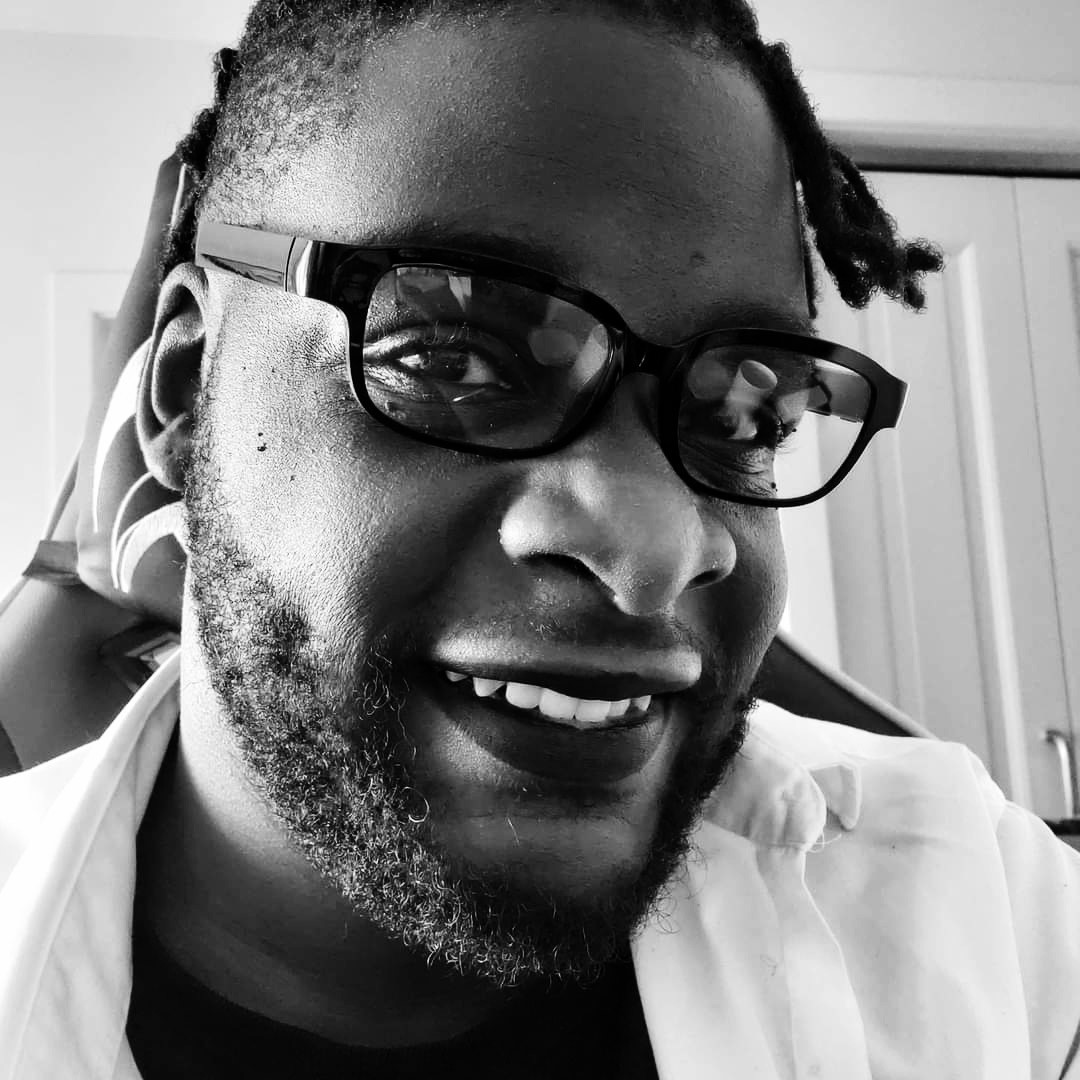
[Image: Black and white photo of D’Arcee, an African American with a beard and black rimmed glasses in a white t-shirt smiling]. | |
An American Intermission: A Few Thoughts
Un Intermedio Americano: Algunas Reflexiones
| |
|
In this edition: An American Intermission: A Few Thoughts
En esta edición: Un Intermedio Americano: Algunas Reflexiones
| |
Este artículo está disponible en español después de la versión en inglés. | |
An American Intermission: A Few Thoughts | |
|
This is the third #TheDisabledBlackMagellan blog by Agent of Change, D’Arcee Neal who is a fellow in ECNV’s Ford Foundation Disability Justice Initiative. Over the next year, D’Arcee will share his thoughts and experiences about disability and intersectionality with BIPOC, LGBTQIA+ and other marginalized identities.
By D’Arcee Neal, Agent of Change
| |
|
This particular month, amidst the constant thread of PTSD and gaslighting that Denmark put me through, I find myself back on good ole American soil. Listening to that uniquely homegrown blend of racist misogyny on Britney Griner’s return home, or to the imaginary wail of Christian conservatives over Starbucks Happy Holidays cups, I have to say: it’s good to be home if only for a respite. My travels will resume internationally next month but just because I find myself back in America, doesn’t mean that I don’t see the ways that disability and its global contexts continue to affect me. I spend my life as an educator, an activist, and a consultant advocating for the rights of racial disability so that others might experience a smoother, more equitable disabled life where they are, because they’ve heard or know better. But what happens when that disability strikes you in your own body?
That’s the question I found myself thinking about as I watched Celine Dion give her emotional testimony, diagnosed with Stiff Person’s Syndrome this month as she was forced to cancel her upcoming tour yet again. When a friend sent me the link, I found myself genuinely heartbroken for her, but not because I am a fan (the only Celine song I can tell you I know is from Titanic) or because I felt like she was milking the press for sympathy. Rather, my sadness came from my empathy both as a singer of 36 years myself and just the human perspective from watching the erosion of a livelihood in real time. In disability studies, we often have the inevitably pointless discussion of which would appear to be worse between an acquired disability or an inherent one. In Celine Dion’s case, neither mattered because the bottom line was, it was clear that she remains completely devastated. But I’d find myself more personally invested in this question not even a week later; when I developed a significant ear infection, which has drastically affected my hearing on one side, to date. Despite trying to rationalize everything I was doing and paying hundreds of dollars for specialists to examine my ear, I still remember panicking as I poured cap after cap of hydrogen peroxide into my left ear, feeling ashamed and alarmed at the same time. As a wheelchair user, I’ve already lost the ability to walk, and a major life function as a result of cerebral palsy. I’ve learned to overcome that. But I was still thinking, honestly, that I couldn’t have this happen too. To clarify, in no way am I disparaging hearing loss or Deaf communities and I see them as beautiful vibrant adaptations of communication that are perfectly fine the way they are. But I was wondering, am I still allowed to panic about this? As someone who studies and works in disability, how am I meant to confront the understanding that I may and will at someone point gain other disabilities? Where is the space for questioning or grief in the moment of acceptance that we fight for?
It's a good question. Because so many people are quick to immediately discount the work of disability as lesser, I feel like we mainly still have to fight for step one. The world is still trying to wrap its head around the basic idea that people with disabilities are people first, and that no such idea makes you inherently worse off, but no we’re not that there yet. We’re not even close. If you need any more proof of that, see Brendan Fraiser’s newest film The Whale, which as the title suggests operates as both a dramatic and a morality tale wrapped in fat phobia. The echoes of such ideas from these types of movies then make their way into the general conscious, like it did when I had to talk to a Danish student who told me she didn’t understand the concept of disability pride. Apprehensively, she asked “if a person is sick, why is that something to celebrate? They haven’t returned a normal body yet. They’re not well, and so we shouldn’t be glorifying illness.” My response was simple. “I don’t take pride in having cerebral palsy. We don’t celebrate a cancerous mutation. And yet, do you want us to wait for that so-called return to normality before we recognize disabled people as people? Is not the contribution you make while sick, or inflicted, off-balance or disabled still worth it? That is the point. It’s what I do while having cerebral palsy that makes it a point of pride.”
It makes sense when you look at it holistically. And yet I could not see such an idea as the left side of my head was (and continues to be) filled with the static of a phantom television blaring next to my skull. Knowing that tinnitus can lead to permanent hearing loss, I wondered and continue to wonder what I should’ve done to prepare myself better, just as an advocate. Is it fair to exist within two bodies at once? Can I be a disabled person, afraid of the possibility of an unknown variable, and not ready to move toward the acceptance just as yet? I’m not sure. Additionally, I don’t know if the internet would even let me. As one of the equally complicated parts in disability activism, much like the confusion over a collective message, the ability to hold multiple views on disability and how it affects each and every person’s life is something that is unique and individual. I don’t profess to be any good at figuring it out. But I realized that I am still human. I can appreciate the beauty and power of Deaf culture while still being addicted to Spotify (and running Beyonce’s “Renaissance” over yet again for another round on my phone.) I enjoy the ability to hear sounds just as much as I appreciate the ability to learn ASL, but in truth, I also know this may not be enough.
| |
Don't forget to support ECNV by shopping at AmazonSmile!
AmazonSmile is a simple and automatic way for you to support your favorite charitable organization every time you shop, at no cost to you. When you shop at AmazonSmile, you’ll find the exact same low prices, vast selection and convenient shopping experience as Amazon.com, with the added bonus that Amazon will donate a portion of the purchase price to ECNV.
| |
Un Intermedio Americano: Algunas Reflexiones | |
|
Este es el terser blog #TheDisabledBlackMagellan del Agente de Cambio, D'Arcee Neal, miembro de la Iniciativa de Justicia para Discapacitados de la Fundación Ford de ECNV. Durante el próximo año, D'Arcee compartirá sus pensamientos y experiencias sobre la discapacidad y la interseccionalidad con BIPOC, LGBTQIA+ y otras identidades marginadas.
Por D'Arcee Neal, Agente de Cambio
Este mes en particular, en medio del hilo constante de PTSD y gaslighting que Dinamarca me hizo pasar, me encuentro de vuelta en el buen suelo estadounidense. Al escuchar esa mezcla única de misoginia racista en el regreso a casa de Britney Griner, o el lamento imaginario de los conservadores cristianos con los vasos de Starbucks Happy Holidays, tengo que decir: es bueno estar en casa aunque solo sea por un respiro. Mis viajes se reanudarán internacionalmente el próximo mes, pero el hecho de que me encuentre de regreso en Estados Unidos no significa que no vea las formas en que la discapacidad y sus contextos globales continúan afectándome. Paso mi vida como educadora, activista y consultora abogando por los derechos de la discapacidad racial para que otros puedan experimentar una vida discapacitada más tranquila y equitativa donde están, porque han escuchado o saben mejor. Pero, ¿qué sucede cuando esa discapacidad te golpea en tu propio cuerpo?
Esa es la pregunta en la que me encontré pensando mientras veía a Celine Dion dar su emotivo testimonio, diagnosticada con el síndrome de la persona rígida este mes, ya que se vio obligada a cancelar su próxima gira una vez más. Cuando un amigo me envió el enlace, me sentí realmente desconsolado por ella, pero no porque sea un fanático (la única canción de Celine que puedo decirles que conozco es de Titanic) o porque sentí que estaba ordeñando a la prensa en busca de simpatía. . Más bien, mi tristeza provino de mi empatía como cantante de 36 años y solo de la perspectiva humana de ver la erosión de un sustento en tiempo real. En los estudios de discapacidad, a menudo tenemos la discusión inevitablemente sin sentido de cuál parecería ser peor entre una discapacidad adquirida o una inherente. En el caso de Celine Dion, ninguno de los dos importó porque, en definitiva, estaba claro que ella sigue completamente devastada. Pero me encontraría más involucrado personalmente en esta pregunta ni siquiera una semana después; cuando desarrollé una infección de oído importante, que ha afectado drásticamente mi audiencia por un lado, hasta la fecha. A pesar de tratar de racionalizar todo lo que estaba haciendo y pagar cientos de dólares para que los especialistas examinaran mi oído, todavía recuerdo entrar en pánico mientras me echaba una capa tras otra de peróxido de hidrógeno en la oreja izquierda, sintiéndome avergonzado y alarmado al mismo tiempo. Como usuario de silla de ruedas, ya perdí la capacidad de caminar y una función vital importante como resultado de la parálisis cerebral. He aprendido a superar eso. Pero todavía estaba pensando, honestamente, que no podía permitir que esto sucediera también. Para aclarar, de ninguna manera estoy menospreciando a las comunidades sordas o con pérdida auditiva y las veo como hermosas adaptaciones vibrantes de la comunicación que están perfectamente bien tal como son. Pero me preguntaba, ¿todavía puedo entrar en pánico por esto? Como alguien que estudia y trabaja en discapacidad, ¿cómo debo confrontar el entendimiento de que puedo y tendré en algún momento tener otras discapacidades? ¿Dónde está el espacio para el cuestionamiento o el duelo en el momento de aceptación por el que luchamos?
Es una buena pregunta. Debido a que muchas personas se apresuran a descartar inmediatamente el trabajo de la discapacidad como menor, siento que principalmente todavía tenemos que luchar por el primer paso. El mundo todavía está tratando de entender la idea básica de que las personas con discapacidades son primero personas, y que esa idea no empeora la situación inherentemente, pero no, todavía no hemos llegado a eso. Ni siquiera estamos cerca. Si necesita más pruebas de eso, vea la película más reciente de Brendan Fraiser, The Whale, que, como sugiere el título, funciona como una historia dramática y moral envuelta en gordofobia. Los ecos de tales ideas de este tipo de películas se abren paso en la conciencia general, como sucedió cuando tuve que hablar con una estudiante danesa que me dijo que no entendía el concepto de orgullo por discapacidad. Con aprensión, preguntó: “si una persona está enferma, ¿por qué es algo para celebrar? Todavía no han devuelto un cuerpo normal. No están bien, por lo que no deberíamos estar glorificando la enfermedad”. Mi respuesta fue sencilla. “No me enorgullezco de tener parálisis cerebral. No celebramos una mutación cancerosa. Y, sin embargo, ¿quieres que esperemos a esa llamada vuelta a la normalidad para reconocer a las personas con discapacidad como personas? ¿No vale la pena la contribución que haces mientras estás enfermo, o herido, fuera de balance o discapacitado? Ese es el punto. Es lo que hago mientras tengo parálisis cerebral lo que lo convierte en un motivo de orgullo”.
Tiene sentido cuando lo miras holísticamente. Y, sin embargo, no podía ver tal idea ya que el lado izquierdo de mi cabeza estaba (y sigue estando) lleno con la estática de un televisor fantasma a todo volumen junto a mi cráneo. Sabiendo que el tinnitus puede provocar una pérdida auditiva permanente, me preguntaba y sigo preguntándome qué debería haber hecho para prepararme mejor, solo como defensor. ¿Es justo existir dentro de dos cuerpos a la vez? ¿Puedo ser una persona discapacitada, temerosa de la posibilidad de una variable desconocida y aún no lista para avanzar hacia la aceptación? No estoy seguro. Además, no sé si Internet me lo permitiría. Como una de las partes igualmente complicadas en el activismo de la discapacidad, al igual que la confusión sobre un mensaje colectivo, la capacidad de tener múltiples puntos de vista sobre la discapacidad y cómo afecta la vida de todas y cada una de las personas es algo único e individual. No pretendo ser bueno para averiguarlo. Pero me di cuenta de que todavía soy humano. Puedo apreciar la belleza y el poder de la cultura sorda mientras sigo siendo adicta a Spotify (y escucho "Renacimiento" de Beyonce una vez más en mi teléfono para otra ronda). Disfruto la capacidad de escuchar sonidos tanto como aprecio la capacidad de aprender ASL, pero en verdad, también sé que esto puede no ser suficiente.
| [Imagen: Fotografía en blanco y negro de D’Arcee, un afroamericano con barba y anteojos de montura negra en una camiseta blanca sonriendo]. | |
¡No olvide apoyar ECNV comprando en AmazonSmile!
AmazonSmile es una forma simple y automática de apoyar a su organización benéfica favorita cada vez que compra, sin costo para usted. Cuando compre en AmazonSmile, encontrará exactamente los mismos precios bajos, una amplia selección y una experiencia de compra conveniente que en Amazon.com, con la ventaja adicional de que Amazon donará una parte del precio de compra a ECNV.
| | |
|  |
Follow Us on Social Media | | | | |


![[Image: Words Amazon in black with a half arrow smile and the words smile in orange. Under it the words "You shop. amazon gives."]](https://files.constantcontact.com/be4809eb501/4232b26f-ec5d-4b3d-87b4-36f22bb21562.png)


