Measuring Performance Leads to Greater Long-term Success Measuring Performance Leads to Greater Long-term Success
Performance Measurement (PM) is used to assess the efficiency and effectiveness of initiatives. PM is a systematic approach to monitoring, measuring, assessing and reporting on the progress that a strategy is making towards a desired outcome. The degree of success (desired outcomes) helps inform future planning decisions.
OMAFRA has developed two comprehensive resources which are available to support the knowledge and skills of economic development professionals interested in measuring and monitoring the progress and success of economic development initiatives.
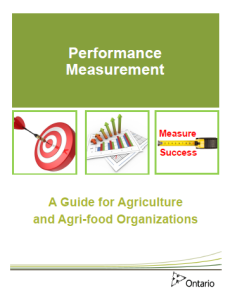
- For Agriculture and Agri-Food organizations, OMAFRA has developed the Performance Resources: A Guide for Agriculture and Agri-Food Organizations. This is a resource that can be used to support organizations to understand, develop and benefit from the performance measurement process. It can be applied to new programs or projects or ones that are already up and running.
It employs qualitative and quantitative measures and can be used as a report back measure for the success of funded projects and strategic plans
- For Economic Development Professionals there is the guidebook called Measuring Up! This is a resource that outlines performance measurement concepts and processes. It builds awareness of and develops the skills needed to successfully integrate performance measurement in an economic planning process.
The guidebook introduces performance measurement, provides a step-by-step systematic approach to developing measures and offers a variety of examples and templates.
These resources help economic development professionals and agriculture and agri-food sector organizations utilize performance measurement to improve the success of their economic development plans. Engaging in performance measurement helps inform decision making, create accountability and build consistency in desired outcomes.
Effective Organizations: Learn to be an Effective Leader
There is no secret recipe or magical formula to become an effective leader. It is a process of trial and error, successes and failures. Never stop learning, and with practice you can increase your success in leadership!
You've heard the expression "He/She is a born leader." Are all leaders born? Or can leadership be learned?
The evidence shows that leadership can be learned. We all have leadership potential, just as we have some ability to sing or run. Some people may have a more natural inclination in some areas than others, but each of us has a starting point to build on with training and practice. You do not have to be officially designated as a leader of a group to be an effective leader.
Leadership is a process that helps a group to achieve its goals. Leaders and group members can mutually influence each other's ideas.
"The person who exhibits leadership is... someone that makes things happen that would not happen otherwise."
(A.D. Edwards and D. Jones)
Leaders should be well organized and have made time in their lives for their organization. Leadership requires commitment.
Leadership is a mix of knowledge, values, skills, and behaviours. Each of us has beliefs about what characteristics an effective leader should possess. Different groups will also have different beliefs or values about what "makes" an effective leader than other groups have. Your group will assess your leadership, and your success may depend on how well your leadership characteristics match those that they value.
It is important, then, for a leader to know his/her own abilities, knowledge and values and how others perceive them. For example, if "trust" is a quality which is highly valued by your group, then it is important for you to be viewed as a trustworthy person. By knowing your own strengths and weaknesses, you can also develop a plan to work on those areas you may wish to improve.
"Recognizing strengths and compensating for weaknesses represents the first step in achieving positive self-regard." (Warren Bennis & Burt Nanus)
A successful leader makes an effort to learn and practise skills. Some of the more essential components are: the knowledge and understanding of specific tasks; the skills and ability to communicate, build teams, vision, and take risks; and, a value for individuals, the group, and its responsibilities.
New Local Food Investment Fund
The Ontario government is providing $6 million over three years to increase sales of local food by making it more widely available and building awareness of the variety of food grown and produced in Ontario.
The funds will be administered by the Greenbelt Fund, through the Local Food Investment Fund which
will continue to support efforts to increase the amount of local food served in broader public sector institutions and to increase access to markets for farmers and processors. This funding is not restricted to the Greenbelt, and is available to organizations across Ontario. In addition, it will support projects that will help Ontarians learn more about local foods.
|
|
Crop Rotations for each Farm Property
Don't rely on conducting soil inspections only in the fall, prior to seed order. Fall conditions can change quickly and reduce your ability to successfully conduct the pest assessment. Plan ahead and try to do some of the soil inspections in the spring to also use towards your fall seed order.
Click here for examples of different crop rotations and how they can affect if and when a soil inspection or crop loss assessment should be done.
House Fly Control in Poultry Barns!
OMAFRA has developed a new book, "House Fly Control in Poultry Barns," that describes integrated pest management practices for fly control. It outlines ways that you can tailor fly control strategies to match your unique farming situation.
Poultry operations provide an ideal environment for house fly populations to thrive. Controlling the house fly population in your poultry barns is important in maintaining a healthy barn environment, as:
- Large fly populations can damage equipment and increase biosecurity risk.
- Large fly populations can decrease poultry production.
- Flies can act as carriers of food-borne diseases, carrying bacteria such as Salmonella and E. coli from one location to another.
Controlling house fly populations can also reduce nuisance complaints from your neighbours.
The OMAFRA web page at
ontario.ca/livestock
has links to poultry resources, such as nutrient management and biosecurity information. Visit
ontario.ca/cbly
for information about poultry housing.
Contact the Agricultural Information Contact Centre at 1-877-424-1300 or
ag.info.omafra@ontario.ca
for more information on pest management, normal farm practices and poultry farming.
What Is The Impact Of Manure On Soil Organic Matter?
Christine Brown,
Nutrient Management Lead, OMAFRA
Regular manure applications combined with forage-based rotations are the envy of crop producers when soil organic matter (SOM) levels and soil resilience are considered. What is the actual organic matter benefit from manure to the soil, and how does that vary with different types of manure and organic amendments?
Livestock manure is an excellent source of nutrients and organic matter for the soil. However manure composition, soil characteristics and application management will impact the nutrient and organic matter value.
Factors Impacting Nutrient & Organic Matter Benefits
Manure composition varies with animal type, age, feed ration and the environment.
- Ruminants usually have forage based diets, while monogastrics (i.e. hogs) are fed grain-based rations. Beef and dairy manure contain undigested forages and often contains bedding materials. These materials are high in cellulose and lignin and take longer to decompose in soil when compared to the less complex sugars from undigested corn.
- Animal stage / age will influence the amount of feed consumed, but also dictate the protein and mineral content.
- Ration formulations vary. High production phases require more concentrated diets, including phosphorus, potassium and trace elements such as calcium. Regular and high application rates of manure will build up phosphorus and potassium levels, pH (in acidic soils). Micro-nutrients deficiencies, including zinc and sulphur, are rare with regular applications.
- The animal environment (housing) determines the amount and type of bedding. The storage method and additional materials or wastewater determine the manure dry matter content. The carbon-to-nitrogen (C:N) ratio of wood chips (200+) will be much higher than straw (50 - 80).
- The C:N ratio is the proportion of organic carbon to total nitrogen of manure or organic material. The nitrogen is a food source for the soil micro-organisms while they break down the carbon material. When that process is complete, the soil microbes die and decompose. The microbial nitrogen is then returned to the soil and becomes available to the plants. This is considered the "organic nitrogen" component. How long this process takes depends on the ratio of carbon to nitrogen in the material.
- Manure or organic material with C:N ratio under 20:1 is considered ideal for crop production. When there is not enough nitrogen in the organic material to break down the carbon, the micro-organisms utilize nitrogen from the soil. When C:N ratios are higher than 25 to 30:1, it could result in a nitrogen deficiency of a crop that relies on soil nitrogen, such as corn.
Manure will add organic matter but also adds nutrients. Over-application of nutrients could lead to crop damage or nutrient losses into the environment. In addition, any benefits from soil organic matter are easily negated if soil compaction results from application on unfit soils.
Read more ...
UOIT Introduces Innovative Agricultural Leadership Program
"Our unique program has been proudly developed in collaboration with various economic development  initiatives and agricultural partners in the Region of Durham, Municipality of Clarington, Northumberland County, Peterborough County and the City of Kawartha Lakes," says Stephen Rose, Director, MDC and Associate Dean, Faculty of Business and Information Technology (FBIT), UOIT. "Whether they are owners, partners or responsible for the operational or day-to-day functions of an agri-business, program participants will immediately be successful and prepared advocates for the agriculture industry," initiatives and agricultural partners in the Region of Durham, Municipality of Clarington, Northumberland County, Peterborough County and the City of Kawartha Lakes," says Stephen Rose, Director, MDC and Associate Dean, Faculty of Business and Information Technology (FBIT), UOIT. "Whether they are owners, partners or responsible for the operational or day-to-day functions of an agri-business, program participants will immediately be successful and prepared advocates for the agriculture industry,"
- communication
- human resources
- leadership style and management strategies
- marketing and advocacy
- change and implementation of strategies for an agricultural business
Registration is restricted to those who work specifically within the agricultural sector (such as farm managers/owners, supervisors, business development managers, etc.).
Join the growing list of MDC graduates!
For more information, please contact:
Betty Khattab, Program Co-ordinator
Management Development Centre
University of Ontario Institute of Technology
905.721.8668 ext. 3290
mdc@uoit.ca
Youth Engagement Showcase
(source, Milton Canadian Champion)
Do you know a young leader that has taken charge and tackled important issues in the community? If so, consider nominating them for the Youth Engagement Showcase, Rural Ontario Institute's most recent initiative.
The showcase, which will profile the compelling stories of youth from across Ontario's rural communities, aims to highlight the impact young citizens can have in their communities and demonstrate how different types of rural communities can successfully involve youth in addressing local challenges.
"Today's engaged youth represent the future leadership of rural Ontario," said Norman Ragetlie, the Institute's director of policy and stakeholder engagement. "The exodus of youth from rural towns to urban centres is a common trend but evidence illustrates that engaging youth people in leadership roles before they leave for post-secondary education is integral to improving return rates."
Up to eight finalists will be profiled through individual documentaries filmed in the nominee's hometown. The videos will feature involvements and accomplishments as well as shine a special light on community programs and organizations that are successfully engaging youth.
Nominations for the Youth Engagement Showcase will be accepted until November 27. Nominees must be 29 years of age or younger and reside in or be actively involved in a rural community in Ontario.
|
|