|
|
|
Connecting
May 3, 2024
Click here for sound of the Teletype
| |
|
Colleagues,
Good Friday morning on this May 3, 2024,
A reminder that services for our colleague Gene Herrick will be held at 2 p.m. Eastern on Saturday at the Rocky Mount Christian Church in Rocky Mount, Va. You will be able to watch the service through the church’s Facebook site, either live or later on as it will remain on the site.
And we share news of an upcoming remembrance of our colleague Will Lester and his formidable four-decade career at The Associated Press and his work with the National Press Club. There will be a short program at the National Press Club, Zenger Room, on Wednesday, May 15, from 5:30 to 7:30 p.m. Eastern where you’ll be able to share your memories about working with Will. There will be light hors d’oeuvres and a cash bar.
Because of the number of pending life’s celebrations, Connecting will include them at the end of each issue.
Your brain need some exercise?
We lead with news of a new Connecting feature – Cranial Cardio – suggested and engineered by our colleague Doug Pizac as a way to push all of us to think more and exercise our grey matter. Read all about it in our lead article.
Have a great weekend – be safe, stay healthy, live each day to your fullest.
Paul
Introducing: Cranial Cardio
Doug Pizac - What with a good portion of Connecting members being seniors, with Paul’s permission I’m starting an ongoing Connecting feature that pushes people to think more logically and exercise their brains. And it may also help the younger generation(s) still working to think more clearly when confronted with what appears to be complicated issues that are actually simple in nature.
I’ve been using various questions with my college students for over a decade to get them to clear their complex mind thoughts and think out of the box. My challenges have always been extra credit points on the mid-term and final exams I give. Very few, however, get the answers correct even though they are very simple in nature. And once told, there are usually several “Aaaaaghs” in the class.
To relieve the pressure of a timed sit-down exam, I’m going to give you the question on a Friday to think about it over the weekend whereupon the answer will be in Monday’s Connecting.
Here’s the first one:
There are various methods that physically measure the passing of time, such as a wrist watch, a stop watch, a grandfather’s clock, etc. Not counting electronic/digital devices that do not physically move, name the time piece that has the FEWEST number of moving parts.
Good luck! See you on Monday.
As to future questions, I have a few and am open to contributions from Connecting members to test your fellow colleagues. If you have any, please email them directly to me for collecting and culling - home@pizac.com And please use Cranial Cardio in the subject line. Paul has enough on his plate already, and I could use some new ones to further challenge my students.
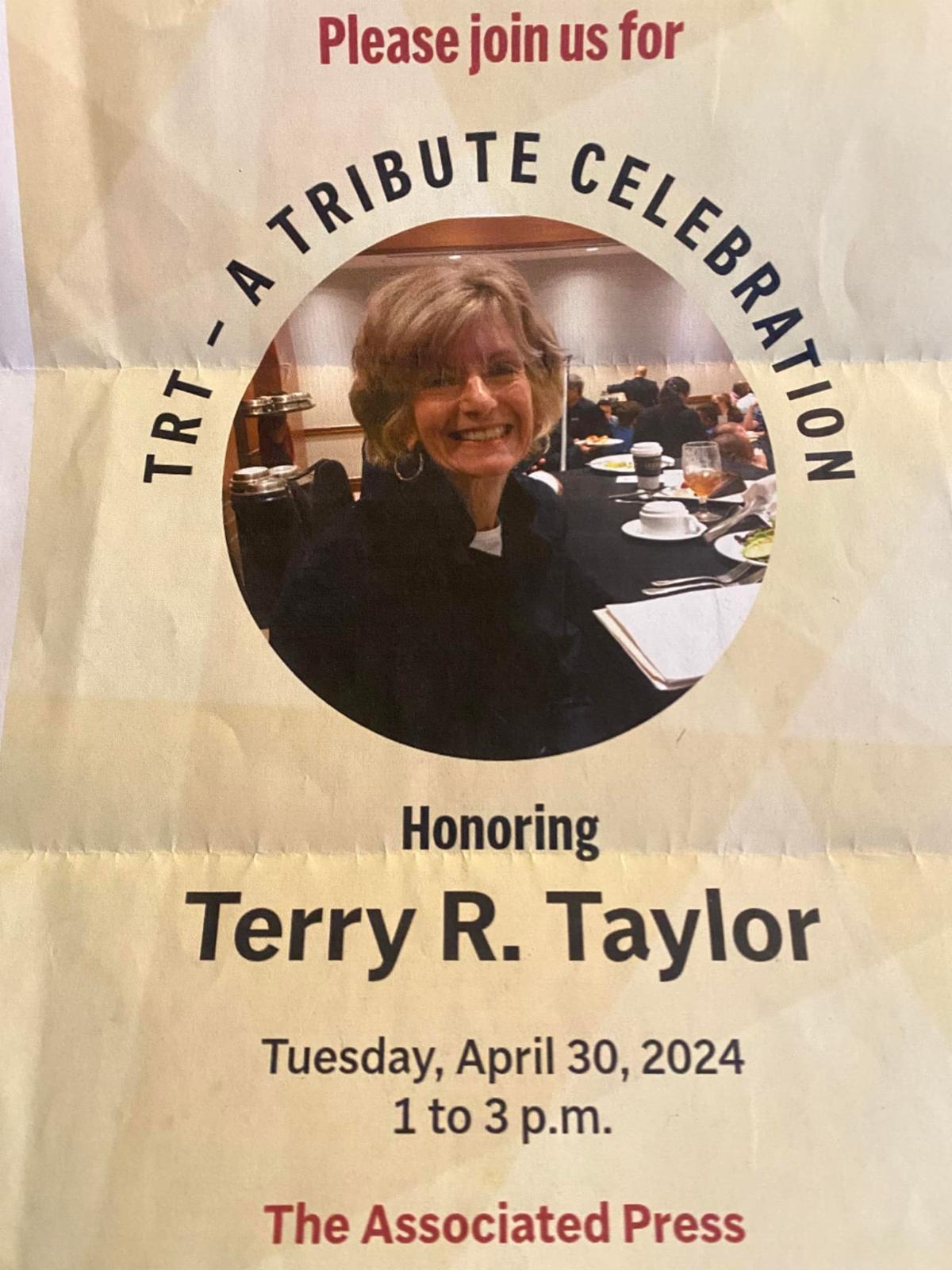
Terry Taylor: A trailblazer, and so much more
| |
Ron Sirak - On Tuesday, I drove into New York City to attend a celebration of the life of Terry R. Taylor, the longtime Sports Editor of The Associated Press who passed away in November after a lengthy battle with cancer. Terry was the first woman to be Sports Editor at The AP and she was a leader in sports journalism at a time when women were still fighting for equal access to the athletes they covered. But Terry was much more than a pioneer for her gender. She was a trailblazer who correctly anticipated the challenges ahead for print journalism in a changing landscape of news delivery.
I didn’t become a sports writer until I was 37 years old, spending the first 17 years of my career as a news writer/reporter/editor. In 1987, I was a supervising editor on the General Desk at The AP, the nerve center of its news coverage, when then Sports Editor Darrell Christian offered me the Assistant Sports Editor job. For various reasons, it took eight months to finalize the deal and Terry, who was Deputy Sports Editor at the time, worked two jobs – Deputy Sports Editor and Assistant Sports Editor – for those eight months to keep the job open for me.
When Terry became Sports Editor in 1992, she made me the Deputy Sports Editor. In 1993, she assigned me to write the main AP story from the Ryder Cup. That went well and she then had me write the main story from all the men’s majors championships in 1994 and 1995. By mid-1995, it became clear that health issues were making it impossible for Bob Green, the AP golf writer for 26 years, to continue in his job. I went to Terry with a plan for how to reshape the golf beat and when I was 45 years old, she gave me the title AP Golf Writer.
Until then, the AP Golf Writer covered 43 PGA Tour events a year. I suggested to Terry that we shouldn’t let the men’s tour dictate how we cover golf and that we needed to cover women’s golf, the amateur game, the business of golf and have an opinion column so The AP could have a voice in the game. Her only words to me were: “Give me a plan.” I did, we implemented it in January 1996 and in August of that year Tiger Woods turned pro, golf exploded as a story and we were well positioned to cover it. In 1997, I did a story on the economic impact of Tiger’s first year as a professional. That piece was widely picked up by papers and it resulted in me being offered a job at Golf World and Golf Digest magazines, which were then owned by The New York Times company.
Personally, I owe much to Terry Taylor. Every woman working in sports journalism today owes a debt of gratitude to Terry Taylor. But most importantly, the profession of journalism should honor the visionary role Terry Taylor, and her mentor, Darrell Christian, played in fighting for quality reporting and first-rate writing at a time when changing modes of news delivery were altering the landscape of journalism.
Terry understood the impact ESPN had on morning newspapers well before the news desk at The AP reacted to how CNN was changing the demands of morning papers. She knew that we had to tell more than who won. She raised the demands on her staff for higher quality writing and deeper reporting. And most importantly, she demanded that the same high standards of accountability required in print journalism be brought to the new forms of delivery.
My first job at The AP was taking dictation from writers covering baseball games. Laptops didn’t exist then. That’s the world Terry Taylor walked into, working her way from Assistant Sports Editor to Deputy Sports Editor to Sports Editor. She was a smart, hardworking, funny, talented journalist and an extremely loyal friend. As she was fighting her illness, I thanked her for allowing me to reshape the golf beat at The AP, which altered the course of my career. She laughed and said: “I had no choice; there was no stopping you.” That’s the nicest thing anyone has ever said to me professionally. But that’s who Terry was: She made it about me, not her.
Yes, Terry Taylor was a trailblazer for women in sports journalism, but she was so much more than that. She always fought for things bigger than herself, whether it was her faith, her family or her friends. And she fought for journalism. She believed deeply in the profession and she demanded that those who worked for her approach it with the same passion and dedication as she did. Terry Taylor made us all find a gear we didn’t know we had. Thank you, my friend. Few have fought the good fight as relentlessly as you – and certainly not with as many laughs! As one journalist to another, TRT, I’ll leave you with this: --30--
AP Book reunites family after nearly a century
|  | |
|
Some newfound members of the Romejko family at a smaller reunion this year organized by Maciej Romejko, front row far left.
Sonya Zalubowski – This is a story of serendipity that pierces the veils of the past to connect branches of my family thanks to AP Books’ publication last year of my memoir “Eye on Solidarity.”
The book covers my unsuccessful attempts in 1981 at finding my roots in Poland, while also covering the watershed labor movement that began the unraveling of the Soviet Union.
This past January, I received a very polite email from Warsaw from a man named Maciej Romejko, the original surname of my grandfather John Romer (whose last name was changed by mistake by immigration officials after he immigrated in the early twentieth century to the United States).
Maciej said he was doing genealogy research on the Romejko family and he believed we were related through my grandfather. He had found me through searches for my mother Helen and my book that mentioned both her and my grandfather.
He included a photo taken in the Pacific Northwest from the early 1930s that indeed was my grandfather along with my grandmother and Helen, then about age 12. It was a photo I’d never seen but there was no doubt, this was my family.
Excited at the prospect of learning about my grandfather’s family—I only knew scattered details and we’d lost any contact—I wrote back acknowledging the photo.
Now, Maciej opened the route to a wealth of family news, both present and past. My grandfather, he said, was born in the 1880s, the second of six children. The youngest included Maciej’s own grandfather born in the early 20th century. And Maciej was in touch with other descendants of many of those original children.
He put me in touch as well with one of them, Marek Romejko, who’d served in the Polish army at U.N. Postings, including in the United States. Both Marek and Maciej, who escaped Poland because of his Solidarity activism to live in New York during the 1980’s, speak fluent English.
Maciej eagerly shared all the information he’d traced of family roots back to the 1700s, and their farming existence in a Polish enclave in the area of Vilnius in Lithuania, which had joined with Poland in the Middle Ages. Poland ceased to exist in the late 18th century and was carved up by neighboring powers, including Russia. The family at some point moved to nearby Belarus for land, as families grew, in the 1900s, Maciej said.
Maciej sent more photos of my grandfather, as a young man in the United States, another photo I’d never seen, that another relative still had. And further photos of my grandfather that children had colored with ink and dog eared from handling.
But, all communication appeared to have stopped by 1939 as the world turned to wars that started in Poland and finally their resolution. Poland’s border was moved West, and the Soviet Union took over the area where the family had lived. The Romejko’s moved again, back into reconstituted Poland.
Maciej learned old Russian along the way to search old church records. Along the way, he shared facts he’d discovered that filled in smatterings of information my grandfather had shared with me: They could only speak Polish at home, the official language outside was Russian. His brother Franczisek had become a priest.
Maciej found the encyclopedia entry about Franczisek and his tragic end. He became something of a hero to this day for the people of Belarus because of his campaign to have the liturgy in the people’s own language, for which he was removed from the priesthood. It was reported he committed suicide, but Maciej and I wonder at the real cause of his death, a shot to the head.
Men were conscripted into the Russian army. My grandfather had told me he served as a soldier at some point. My mother said, he had gone back and forth between America and Poland. Maciej produced the record that showed in 1914 as WWI started he crossed back to America. This time for good.
Maciej said as a student he used to stand daily to find out the news outside the building in Gdańsk where inside I covered Solidarity’s first and only congress in 1981.
Now the two families of Maciej and Marek and all their children, aunts, uncles, cousins are planning a large reunion in northern Poland this October. Barring any problems, I hope to return where I am sure to learn so much more from this long-lost family. I have this sense of ghosts of the past coming along as my baggage!
-0-
Here is an excerpt of an email Maciej Romejko wrote my niece Natonya here in the U.S. about “eye on solidarity:” and what the book means to him…as former solidarity mbr who fled Poland in 1980s after polish crackdown
I'm glad that Sonya wrote this book, because it very truly shows how difficult a period it was in Poland at that time. I think it is a very valuable testimony of the era, because - as we say in Poland - she wrote it from the heart, not avoiding her delights, but also disappointments. I remember these times very well, because I had just started my studies in Gdańsk in October 1981 (or actually in summer 1981, because I had the so-called initial internship in the Gdańsk Shipyard, where Solidarity was founded in 1980) and this first breath of freedom in many years was very important to me, as a young person, who was just beginning a new stage in his life. Even though it was a difficult time then, it was also beautiful, because it gave me - us - hope that maybe something would change for the better in our country, what finally happened after a few more years.
More on Gannett
Tom Fenton - Upfollowing Brent Kallestad's comments on Gannett. Same in El Paso: the daily has shrunk from a high of 103,000 to 9,500 Sunday, now six days a week, reduced page count and smaller broadsheet size. What I am curious about is how the group's larger metros have fared with the loss of AP view so much national and international news from far-flung locations. Wonder if any Connecting colleagues in areas served by Gannett's larger papers have noticed a difference in coverage?
AP wins National Headliner Award
“The Pandemic’s Missing Students,” an AP investigation into the hundreds of thousands of students who dropped off public school rolls at the start of the COVID-19 pandemic, has earned a National Headliner Award from the Press Club of Atlantic City in the Newspapers education writing by an individual or team category.
Click here for listing of awards.
Connecting Sky Shot
| |
|
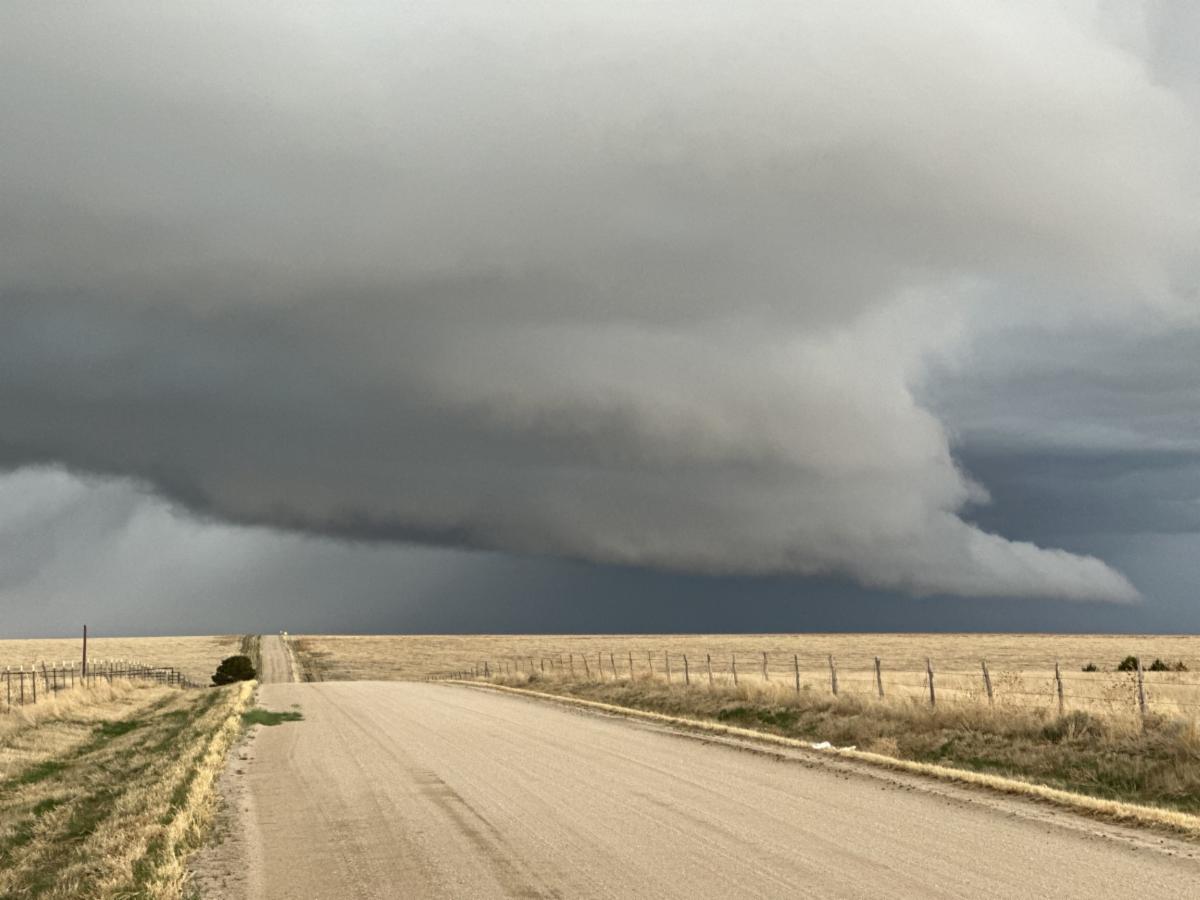
Michael Weinfeld - While everyone else was looking at the ground searching for the elusive Mountain Plover (after all, it was during the annual Mountain Plover Festival in Karval, Colorado), I couldn't keep my eyes off the cloud formations. They seemed to change by the minute. And yes, we did get soaked.
Parachuting at Pendleton, Oregon
| |
|
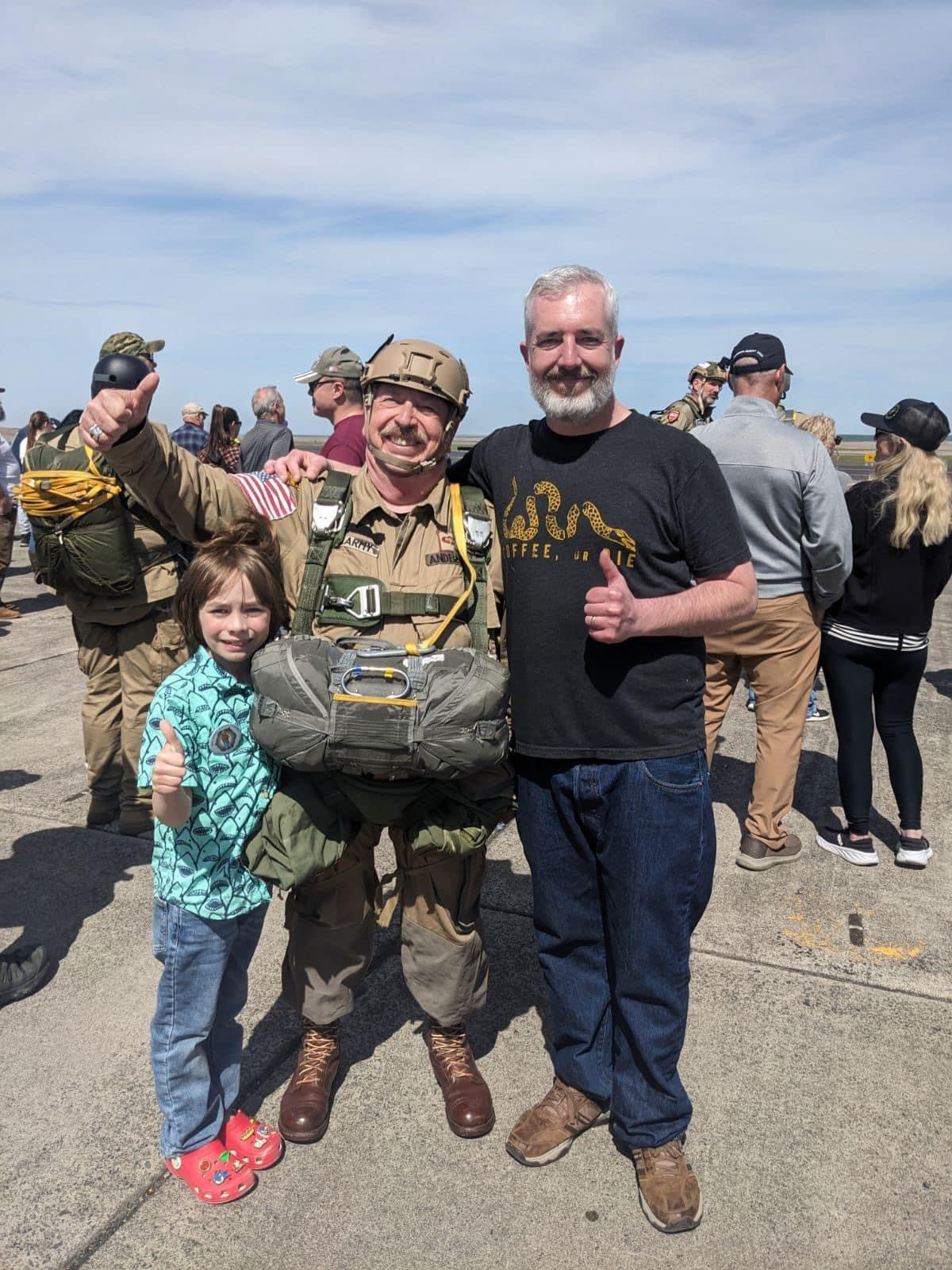
From left: grandson Phillip, 7 years old, granddaddy paratrooper Dennis, 71, and my Marine vet son Garrett, 38, at Eastern Oregon Airport, Pendleton.
Dennis Anderson - Photo is my “Fallujah Marine” vet son Garrett who brought my grandson Phillip to watch our All Airborne Battalion veteran team jump in Pendleton Oregon on April 13.
The jump was to commemorate the history of 555th Parachute Infantry Battalion of WWII. The “Triple Nickle” is renowned in Airborne lore but less well remembered than the Tuskegee Airmen.
It was the all-Black paratrooper unit organized too late to send overseas. Their thankless secret mission, Operation Firefly was to pioneer smoke jumping to put out wildfires, some ignited by Japanese incendiary bombs floated in on the jet stream across the Pacific Northwest in 1945.
Gen. James Gavin, hero of D-Day, bucked Army brass and put the “Triple Nickles” in a WWII Victory parade and folded them into the 82nd Airborne Division.
Most in my time at AP Los Angeles knew I was an Army paratrooper, because we always tell them. I’m 71 now and don’t know when I will make a final jump but this was probably the only time I could do it with son and grandson present.
AP Los Angeles Bureau Chief John Brewer ensured that AP health insurance covered son Garrett’s hospital birth bills while I was still probationary in 1985.
It was fitting to honor the valor of paratroopers who served honorably before President Truman’s order to end a racially segregated military.
| |
Connecting wishes Happy Birthday | |
|
Stories of interest
Student journalists are covering their own campuses in convulsion. Here’s what they have to say (AP)
BY DAVID BAUDER AND CHRISTINE FERNANDO
NEW YORK (AP) — Ordered by police to leave the scene of a UCLA campus protest after violence broke out, Catherine Hamilton and three colleagues from the Daily Bruin suddenly found themselves surrounded by demonstrators who beat, kicked and sprayed them with a noxious chemical.
On American campuses awash in anger this spring, student journalists are in the center of it all, sometimes uncomfortably so. They’re immersed in the story in ways journalists for major media organizations often can’t be. And they face dual challenges — as members of the media and students at the institutions they are covering.
Across the country from the University of California, Los Angeles late Tuesday, a student-run radio station broadcast live as police cleared a building taken by protesters on the Columbia University campus, while other student journalists were confined to dorms and threatened with arrests.
Read more here.
-0-
A Statement From the Pulitzer Prize Board
As we gather to consider the nation’s finest and most courageous journalism, the Pulitzer Prize Board would like to recognize the tireless efforts of student journalists across our nation’s college campuses, who are covering protests and unrest in the face of great personal and academic risk. We would also like to acknowledge the extraordinary real-time reporting of student journalists at Columbia University, where the Pulitzer Prizes are housed, as the New York Police Department was called onto campus on Tuesday night. In the spirit of press freedom, these students worked to document a major national news event under difficult and dangerous circumstances and at risk of arrest.
Click here for link to this statement. Shared by Linda Deutsch.
-0-
Columbia University student journalists had an up-close view for days of drama (AP)
BY HEATHER HOLLINGSWORTH
Student journalists on the Columbia University campus knew what was coming long before police with riot shields arrived to begin arresting the pro-Palestinian protesters.
They had watched the situation spiral as the protesters stood their ground, refusing to abandon Hamilton Hall and using a pulley system to bring supplies into the building they had occupied.
The reporters, working for university and online U.S. and international publications, suspected negotiations with administrators were going nowhere when the protesters began donning COVID-era masks to hide their identities. Some began sleeping on the floor in journalism classrooms or offices out of fear of missing something.
But when a journalism professor began writing the phone number to call if they were arrested in permanent marker on their arms, that was the moment it became clear: They were capturing history.
Read more here.
-0-
Gannett hits pause button on its promise to restaff its smallest papers (Poynter)
By: Rick Edmonds
For most of 2023 year and all of 2024 so far, Gannett has promised that it is working to add hundreds of new editorial positions, backfilling the many openings that were lost after a December 2022 hiring freeze, then growing further.
The pledge includes restaffing many of the chain’s smallest dailies, ones that have been languishing with one or no locally based journalists as more profitable metros get attention and resources.
Chief Content Officer Kristin Roberts said of the new approach in Gannett’s quarterly earnings call with analysts:
“Last year, we launched an initiative with the conviction that putting reporters into our smallest newsrooms was critical, but not enough on its own to be sustainable.
We needed to experiment with new ways of engaging hometown readers at a small-site scale. Our reporters combined first-person voice with a newsletter approach that invited readers to join them in experiencing their community firsthand, the results were remarkable and gave us the confidence to boldly expand this strategy.”
There was a notable omission, though.
Roberts didn’t say that the company hit the brakes on hiring for that key small newsroom position three months earlier.
The people already on board in the beta version of what Gannett calls the I-30 Initiative could stay. Authorizations to proceed with other hires stopped. Some candidates who were expecting to start soon have had the offer rescinded. According to internal communications, the “pause” has now been rolled over through the second quarter.
Read more here. Shared by Linda Deutsch.
-0-
Stephen A. Smith would like even more of your attention (Washington Post)
By Ben Strauss
JERSEY CITY — One recent afternoon, Stephen A. Smith was standing center stage on a set that only recently sprang from his imagination but now had all the bells and whistles: lights above, four cameras, video screens, a long, late-night-TV-style couch, a wall of photos of Smith with his famous acquaintances — Magic Johnson, Kobe Bryant, Taylor Swift.
He was contemplating a question: Which SpongeBob character would make the best NFL quarterback? On the screen was a lineup of deep-sea creatures from the Nickelodeon cartoon: A crab, a plankton, the famous sponge.
“Ladies and gentleman, I haven’t seen much of SpongeBob,” Smith said. “Damn it! But I’m going to entertain y’all by guessing. … Let me just look at it and gauge who looks the most athletic.”
He stepped toward the camera. Jiggled his eyebrows, pursed his lips. Then he launched into the take.
“I’m not interested in Plankton. I don’t like the way he looks.”
“Patrick … you look like a pink skinhead.”
Finally, the verdict: “I’m going to go with Mr. Krabs. That’s what I’m going to do. SpongeBob’s legs are too skinny, the head looks like it weighs too much and the arms are too short.”
Read more here.
Celebrations of Life calendar
Terry Anderson, May 8 - Terry’s family issued an invitation to a memorial event to be held on Wednesday, May 8, from 6 to 9 p.m. Eastern at Associated Press headquarters, located on the 19th floor of 200 Liberty Street in New York City. The family said: “We hope you’ll be able to join us for an evening of laughter, tears, and warm memories of the man so many of us loved and respected. Food will be provided by the Lebanese restaurant Ilili, and we will supply wine and soft drinks.
If you can’t make it in person, the memorial live-stream can be viewed on the Overseas Press Club YouTube channel found at this link. If you plan to attend, RSVP here by May 7 at 12 noon.
-0-
Will Lester, May 15 to be honored for formidable four-decade career at The Associated Press and his work with the National Press Club. There will be a short program at the National Press Club, Zenger Room, on Wednesday, May 15, from 5:30 to 7:30 p.m. Eastern where you’ll be able to share your memories about working with Will. There will be light hors d’oeuvres and a cash bar.
-0-
John Brewer, June 8 – Our colleague Cecilia White, a longtime friend of John, said his Celebration of Life will be held Saturday, June 8, between 1-2 p.m. Pacific at the Vern Burton Community Center in Port Angeles, Wash. The center is located downtown at 308 E. 4th Street.
| |
Today in History – May 3, 2024 |  | |
Today is Friday, May 3, the 124th day of 2024. There are 242 days left in the year.
Today’s Highlight in History:
On May 3, 1979, Conservative Party leader Margaret Thatcher was chosen to become Britain’s first female prime minister as the Tories ousted the incumbent Labour government in parliamentary elections.
On this date:
In 1802, Washington, D.C., was incorporated as a city.
In 1937, Margaret Mitchell won the Pulitzer Prize for her novel, “Gone with the Wind.”
In 1947, Japan’s postwar constitution took effect.
In 1948, the Supreme Court, in Shelley v. Kraemer, ruled that covenants prohibiting the sale of real estate to Blacks or members of other racial groups were legally unenforceable.
In 1960, the Harvey Schmidt-Tom Jones musical “The Fantasticks” began a nearly 42-year run at New York’s Sullivan Street Playhouse.
In 1987, The Miami Herald said its reporters had observed a young woman spending “Friday night and most of Saturday” at a Washington townhouse belonging to Democratic presidential candidate Gary Hart. (The woman was later identified as Donna Rice; the resulting controversy torpedoed Hart’s presidential bid.)
In 2006, a federal jury in Alexandria, Virginia, rejected the death penalty for al-Qaida conspirator Zacarias Moussaoui (zak-uh-REE’-uhs moo-SOW’-ee), deciding he should spend life in prison for his role in 9/11.
In 2009, Mexican President Felipe Calderon told state television that a nationwide shutdown and an aggressive informational campaign appeared to have helped curtail an outbreak of swine flu in Mexico.
In 2011, Chicago’s Derrick Rose became at age 22 the NBA’s youngest MVP.
In 2015, two gunmen were shot and killed by a police officer in Garland, Texas, after they opened fire outside a purposely provocative contest for cartoon depictions of the Prophet Muhammad.
In 2016, in a stunning triumph for a political outsider, Donald Trump all but clinched the Republican presidential nomination with a resounding victory in Indiana that knocked rival Ted Cruz out of the race.
In 2018, a federal grand jury in Detroit indicted former Volkswagen CEO Martin Winterkorn on charges stemming from the company’s diesel emissions cheating scandal. (Under Germany’s constitution, he could not be extradited to the U.S. to face charges.)
In 2021, Bill and Melinda Gates said they were divorcing after 27 years of marriage; the Microsoft co-founder and his wife said they would continue to work together at the world’s largest private charitable foundation.
In 2022, President Joe Biden blasted as “radical” a leaked Supreme Court draft opinion throwing out the Roe v. Wade abortion rights ruling after 50 years. Chief Justice John Roberts said he had ordered an investigation into what he called an “egregious breach of trust.”
Today’s Birthdays: Singer Frankie Valli is 90. Sen. Jim Risch, R-Idaho, is 81. Sports announcer Greg Gumbel is 78. Sen. Ron Wyden, D-Ore., is 75. Pop singer Mary Hopkin is 74. Singer Christopher Cross is 73. Rock musician David Ball (Soft Cell) is 65. Country singer Shane Minor is 56. Actor Amy Ryan is 56. Actor Bobby Cannavale (ka-nuh-VAL’-ee) is 54. Music and film producer-actor Damon Dash is 53. Country musician John Driskell Hopkins (Zac Brown Band) is 53. Country-rock musician John Neff is 53. Actor Marsha Stephanie-Blake is 49. TV personality Willie Geist (TV: “Today”) is 49. Actor Christina Hendricks is 49. Actor Dule (doo-LAY’) Hill is 49. Country singer Eric Church is 47. Actor Tanya Wright is 46. Dancer Cheryl Burke is 40. Soul singer Michael Kiwanuka is 37. Actor Zoe De Grand Maison is 29. Rapper Desiigner is 27.
| |
Got a photo or story to share? | |
|
Connecting is a daily newsletter published Monday through Friday that reaches more than 1,800 retired and former Associated Press employees, present-day employees, and news industry and journalism school colleagues. It began in 2013. Past issues can be found by clicking Connecting Archive in the masthead. Its author, Paul Stevens, retired from the AP in 2009 after a 36-year career as a newsman in Albany and St. Louis, correspondent in Wichita, chief of bureau in Albuquerque, Indianapolis and Kansas City, and Central Region vice president based in Kansas City.
Got a story to share? A favorite memory of your AP days? Don't keep them to yourself. Share with your colleagues by sending to Ye Olde Connecting Editor. And don't forget to include photos!
Here are some suggestions:
- Connecting "selfies" - a word and photo self-profile of you and your career, and what you are doing today. Both for new members and those who have been with us a while.
- Second chapters - You finished a great career. Now tell us about your second (and third and fourth?) chapters of life.
- Spousal support - How your spouse helped in supporting your work during your AP career.
- My most unusual story - tell us about an unusual, off the wall story that you covered.
- "A silly mistake that you make"- a chance to 'fess up with a memorable mistake in your journalistic career.
- Multigenerational AP families - profiles of families whose service spanned two or more generations.
- Volunteering - benefit your colleagues by sharing volunteer stories - with ideas on such work they can do themselves.
- First job - How did you get your first job in journalism?
- Most unusual place a story assignment took you.
Paul Stevens
Editor, Connecting newsletter
paulstevens46@gmail.com
| | | | |