|
|
|
Connecting
March 18, 2024
Click here for sound of the Teletype
| |
|
Colleagues,
Good Monday morning on this March 18, 2024,
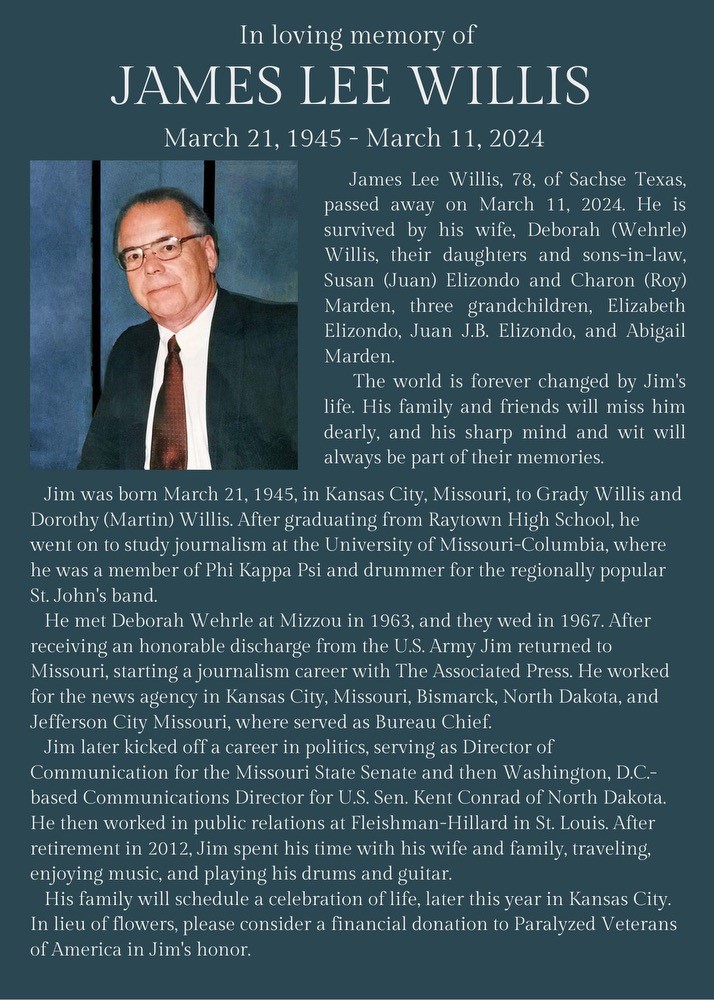
Our colleague Jim Willis – who headed Associated Press coverage of Missouri politics for 10 years – has died after a battle with cancer.
He was 78 when he died March 11. Connecting learned of the sad news from colleague Terry Ganey, who Jim succeeded in 1977 when Terry joined the St. Louis Post-Dispatch. And when Jim left the AP for a position with the Missouri Senate, he was succeeded by Karen Ball – who went on to a great Washington career. Karen died last November.
Jim’s son-in-law, Juan Elizondo, also a Missouri journalism alum, was an AP reporting intern in Kansas City before working in statehouses in Lansing and Austin early in his career.
If you have a favorite memory of working with Jim, who also served as Bismarck correspondent, please send it along.
The Tyranny of the Early Riser - Night Owls of the World, Unite!
That’s the headline of a recent column by our colleague Dan Perry, whose lead was:
Let me tell you about my buddies Jules and Jim. Jules awakes with the roosters, concludes cross-fit by 6:30 a.m. and leaps to his eight-hour workday at 7:30 a.m. sharp. Jim stumbles to the shower by 10 a.m., is still clearing cobwebs at 11 a.m., and at noon begins a workday that might take him well past midnight. Which of the two is widely deemed the more industrious?
I think every reader knows that by and large, it’s Jules. Few will factor in Jim’s longer hours, and some will consider him bizarre. The assumption that mornings equal industry is so widespread that it can only be the result of an international conspiracy: the Tyranny of the Early Riser.
In its quest for world domination, the Tyranny deploys jackhammer agitprop in the form of cliches drummed into our skulls from birth. “The early bird gets the worm.” “Early to bed and early to rise keeps a man healthy, wealthy and wise.” Culture and tradition, ancient and new, brim with the Tyranny’s propaganda.
So what about you – an early riser or not? If you worked in an AP bureau, you’re wakeup time could be all over the map. Share your own story.
Here’s to a great week – be safe, stay healthy, live each day to your fullest.
Paul
| |
|
Ode To Norm Abelson
By Larry Margasak
March 20 I’ll be 81
Just as spring has begun
Forty-eight year AP career
Now a Smithsonian volunteer
A daily gym rat but I must say
There’s time for Connecting every day
I only regret that I’ll never be
A poet like Norm at 93
Happy birthday to AP’s poet laureate!
UPI’s Harry Culver was a master of the air during WWII
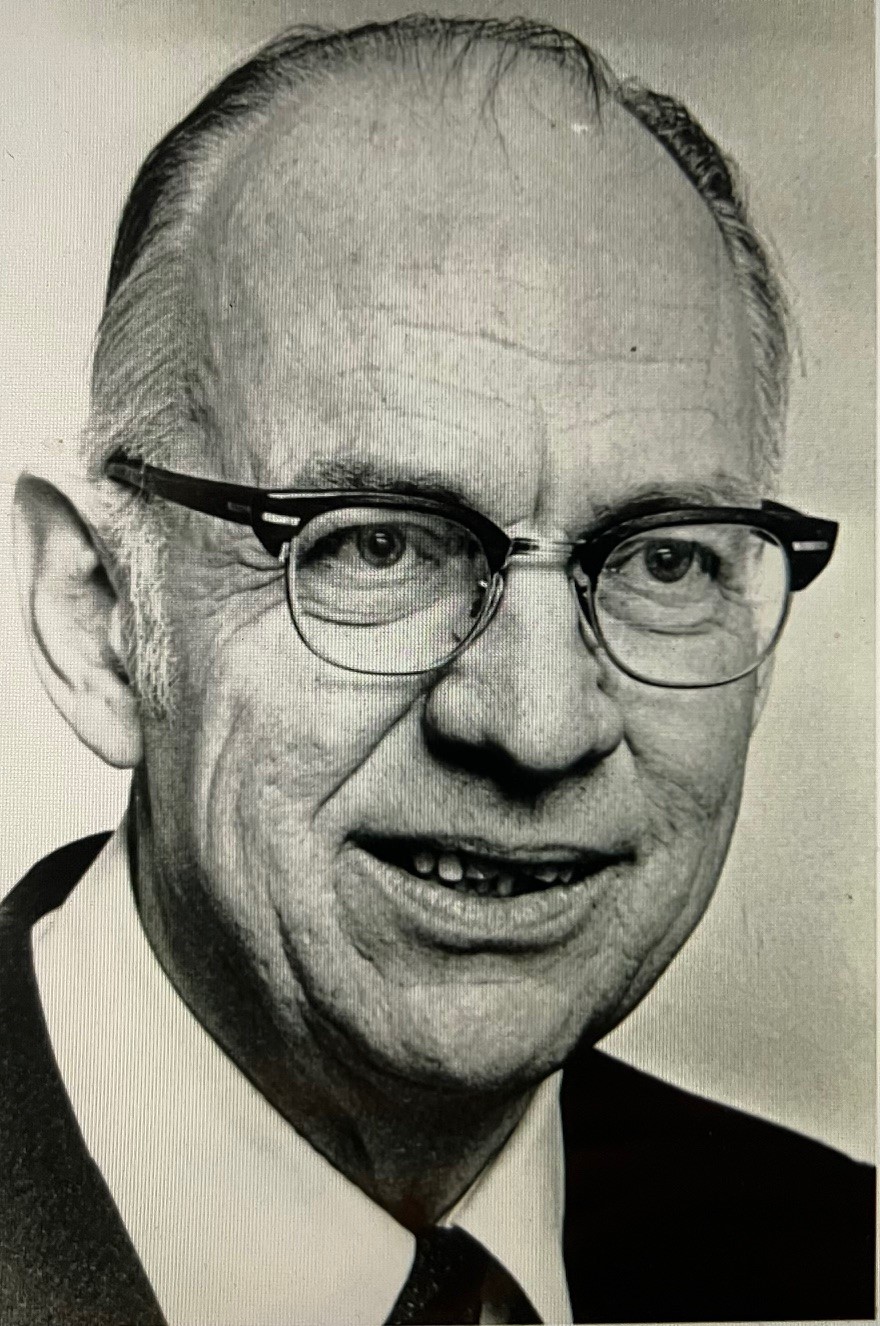
Lindel Hutson - Watching the recent ``Masters of the Air’’ series brings memories of Harry Culver, the UPI’s highly respected Oklahoma state Capitol reporter who flew B-17s as part of the 8th Air Force’s 92nd Bomb Group based at Podington, England.
Culver, a captain and flight leader, flew 33 combat missions over Germany and was shot down once.
| |
|
He participated in some of the more infamous raids of the war, including the Schweinfurt-Regensburg raid, which was depicted in episode three of the “Masters”’ series. He also flew the Dresden fire storm raid, a mission that later in life came back to haunt him.
Culver had retired by the time I arrived in Oklahoma City, but I met him a couple of times and once sat next to him at a luncheon. Someone asked about the Schweinfurt mission and he just smiled and said, ``I’m lucky to be here.’’ I remember him being complimentary to the AP’s statehouse crew, headed by the venerable Ron Jenkins.
John Greiner, a reporter for The Oklahoman whose father-in-law, Maj. Gen. Stanley F. H. Newman flew fighter planes in World War II and Korea, worked with Culver covering state government. Greiner wrote about some of Culver’s air war adventures for the newspaper.
Culver’s bomber was one of 311 B-17s in the wave that struck Dresden in February 1945, dropping an estimated 800 tons of explosives and incendiaries.
Conservative estimates placed the death toll at 135,000. The bomb blasts killed thousands, but more died from a firestorm that erupted with strong winds and temperatures up to 1,000 degrees.
Culver, who grew up on a farm at Homestead in northwest Oklahoma, told Greiner he was unaware of the horrendous Dresden destruction until it was detailed in a 1965 book.
``Sometimes I wake at night in a sweat about it,’’ Culver told Greiner. ``I regret very much that it happened. On the other hand, there was no such thing as a clean war. There were other bombing missions. While we always try to convince ourselves we were hitting military targets, thousands of bombs went astray and killed civilians.’’
Culver said, ``I don’t know how to explain this. Every time you went on a mission, you killed people. This (Dresden) was just much, much worse. I really enjoyed flying, but I never really enjoyed bombing.
``I always disliked the idea of hurting people, but there wasn’t any choice, and I rationalize, with good reason I think, that Hitler had to be stopped.’’
On a January 1945 mission to bomb railroad marshaling yards at Cologne, Culver’s plane, Mary Jane, named for the wife of the crew chief, was hit by anti-aircraft fire.
``Then there was a terrific whoomph from a second, this time a direct hit, that caused us to lose two engines on the right side," Culver told Greiner.
The B-17 began falling and gushing gasoline from its right wing. An observer in another plane said Culver’s bomber was upside down and spiraling toward the ground.
The B-17 dropped almost two miles before Culver and his co-pilot could regain control.
The plane was rapidly losing altitude, Culver said. ``Then a strange thing happened,’’ he said. ``I seemed to hear a voice saying to me, `Harry, why haven’t you tried to pray?’’ He prayed: ``Oh, God, help this thing climb.’’
He managed to crash land and the entire crew walked away from a plane with an estimated 350 bullet and flak holes.
During his 35 years with UPI, Culver, a member of the Oklahoma Journalism Hall of Fame, was known nationally for his work with the Wire Service Guild.
He died in 2005 at the age of 82. In his UPI obituary, Jim Wieck, former Southwest Division news editor for the news service, said, ``As an officer of the Wire Service Guild, Harry fought hard for UPI staffers during negotiations and on work-related issues as they arose. At times we were on the opposite sides of the issues but he was a real gentleman and it always was a pleasure to work with him."
During his UPI years, Culver served as the national president of the guild and served 14 years on the International Executive Board of the Newspaper Guild, including 10 years as chairman. He also served 10 years on the Executive Committee of International Federation of Journalists.
Newman, a native of Chicago and a graduate of the University of Illinois, flew in three wars and was credited with shooting down the last German airplane of World War II.
He flew 57 combat missions in P-51 fighters while serving with the 9th Air Force in Europe. Newman flew 100 combat missions in the Korean War, and in Vietnam he flew cargo missions.
In 1956, he was appointed operations officer of the 185th Fighter Squadron of the Oklahoma Air National Guard. He retired with the rank of major general in 1983.
He died on April 22, 2023 – four months shy of his 100th birthday.
Solano Chronicles
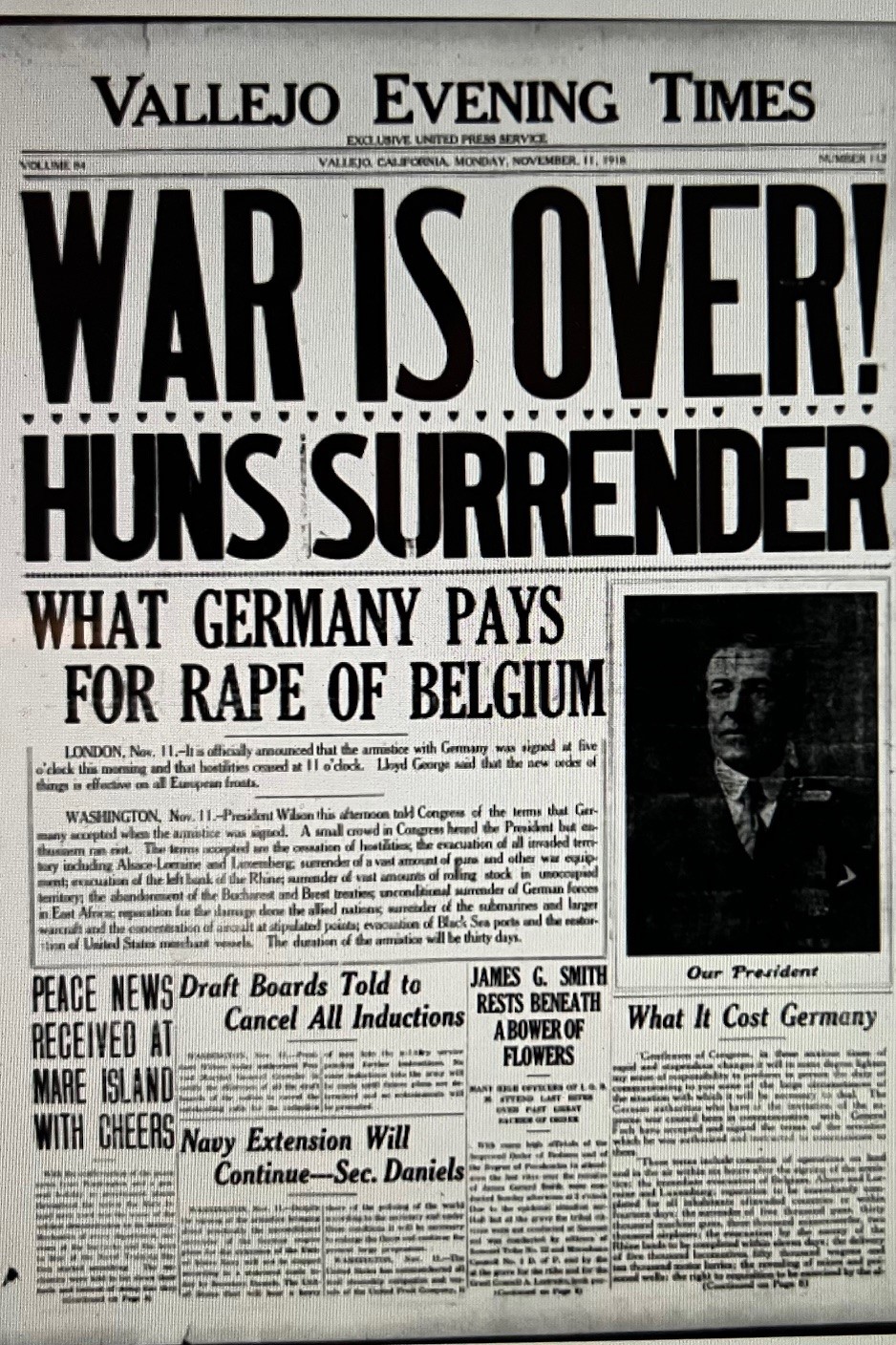
Brendan Riley - A year-long effort by local journalists, historians and researchers has produced long-sought results: a digitized, easily searchable database of Vallejo newspapers dating to the 1860s.
| |
|
The Newspapers.com database was sought by the online newsroom Open Vallejo, the Mare Island Historic Park Foundation (MIHPF), the Vallejo Naval and Historical Museum and the Genealogy Society of Vallejo-Benicia, working with the University of California.
Until now, anyone looking for local newspaper accounts of historic Vallejo-Mare Island events has had to rely mainly on crumbling, century-old newspapers and files at the Vallejo museum, paper records maintained by the MIHPF, personal collections, and library microfilm.
Hardly any of the old printed material had been converted to a Google-style searchable format. Instead, the typical time-consuming methods have been to thumb through the various paper and newsprint files or go through roll after roll of microfilm – a needle-in-the-haystack process.
Historic editions of many other San Francisco Bay area newspapers already have been digitized, but in most cases those newspapers’ accounts of Vallejo-Mare Island events lacked details that were included in the Vallejo papers.
The digitization of the Vallejo papers was expected to cost about $50,000, but Newspapers.com, a paid subscription service, did the work for free. Under an agreement with UC, after three years UC and state library systems will make the material available for free to the public through the California Digital Newspaper Collection.
Read more here.
AP makes Times’ news quiz
The AP made the New York Times News Quiz on March 15:
The A.P. told news organizations to remove a photo of Kate, Princess of Wales, and her children because it had been manipulated. How did the royal family explain the issue?
Click here to view. Shared by Dave Zelio, Peggy Walsh.
Sunset in Vung Tau, Vietnam
| |
|
Shared by Nick Ut.
AP sighting – South Carolina
| |
|
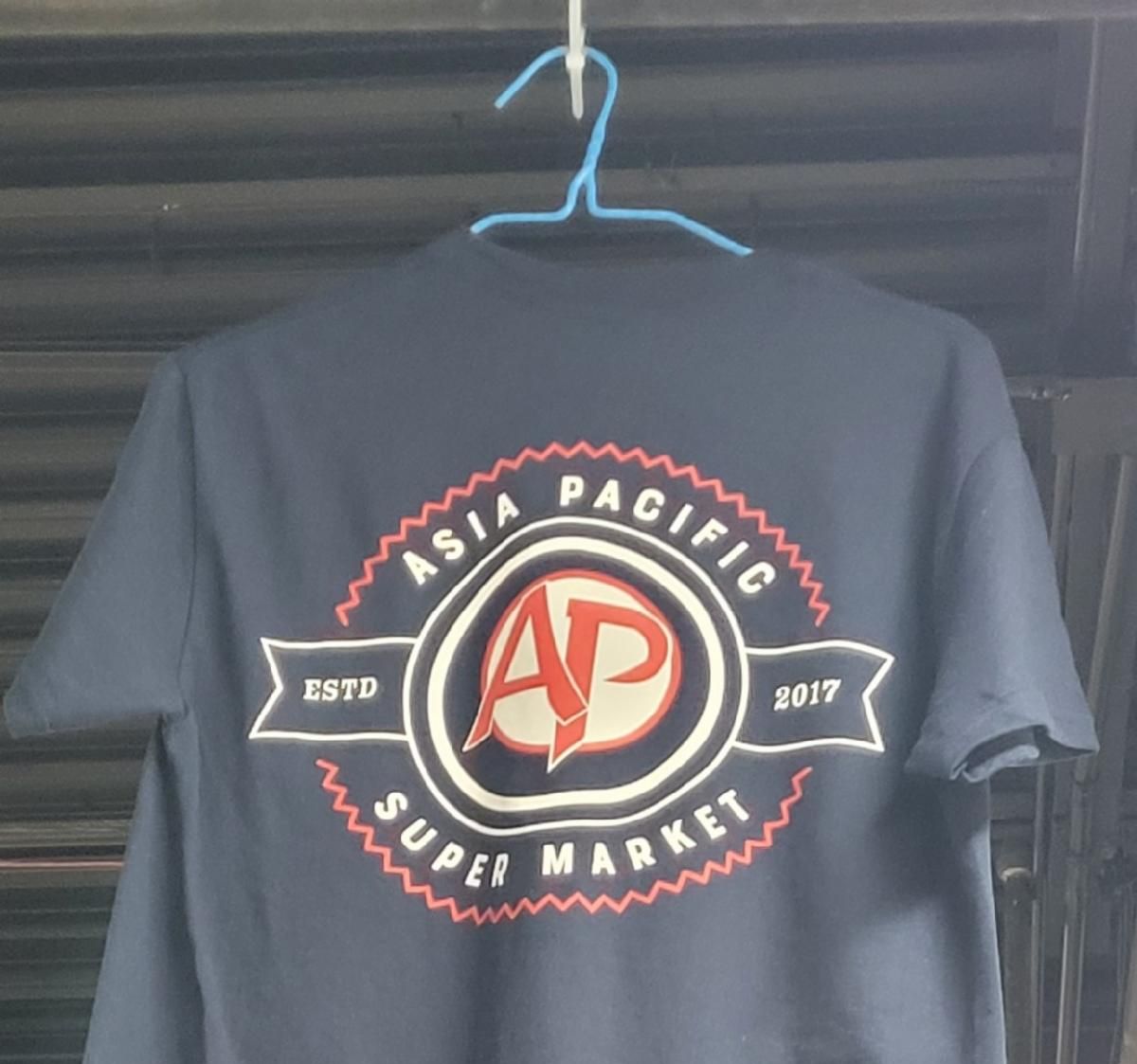
Robert Reid - Seen by my wife Jane at an Asian restaurant in the suburbs of Greenville, South Carolina.
BEST OF THE WEEK — FIRST WINNER
AP shows itself best of class in election coverage Super Tuesday
| |
|
In the run-up to Super Tuesday, The Associated Press showed why it’s at the top of the class when it comes to elections coverage.
One example is the quick, smart and accurate work of Serena Hawkins, data scientist for AP’s Decision Team. As Super Tuesday neared, the AP had an issue on its hands: how will it call races that night when it would have no VoteCast poll — but the TV networks had their exit polling, which could have put the AP at a competitive disadvantage?
That’s when Hawkins got to work. In just two weeks, she researched, developed, tested and deployed a new approach to race calling that allowed the AP to declare Donald Trump and Joe Biden winners in several states with a very small return of counted votes. Hawkins found that by looking at a state’s history of voting, it is possible to know if the first vote count updates of the night are so overwhelmingly in favor of one candidate that it’s not possible that future vote updates will change the outcome.
Put another way, if the first three or four vote updates favored Trump by an 80% to 20% margin, regardless of how many votes made up that percentage margin, what is the likelihood that lead will hold once all the votes are counted? Hawkins found a way to answer that question with confidence.
That new model, used by the AP on Super Tuesday, put AP’s race calls ahead in states where the TV networks didn’t have a poll, and only a few minutes behind in states where they did — and with no errors in its calls. This all matters because AP’s race calls are the definitive source for who has won and lost on election night, used by The New York Times, The Washington Post, The Wall Street Journal, NPR, PBS Newshour, Apple News and Google search — to name a few.
Read more here.
BEST OF THE WEEK — SECOND WINNER
AP leads on abduction of hundreds of children in Nigeria, securing first confirmation
|  | |
In one of the largest school kidnappings since the 2014 abduction the Chibok girls in Borno state, gunmen terrorizing northwestern Nigerian communities stormed a school in Kaduna state and seized nearly 300 children as they were about to begin the day’s learning, marching them into nearby forests before security forces could reach the town.
Local media in Nigeria began reporting the incident on Thursday, all using “locals say” vague attribution to locate and explain the incident, with details varying.
Certain that something serious had happened, correspondent Chinedu Asadu quickly set out to confirm the news to AP standards. The school is in an area with almost no mobile phone network access. Asadu’s effort paid off when he finally reached the chairman of the local government to confirm the incident, the location and get the first on-the-record estimate of how many children were abducted, hours before the school revealed the details to the state government.
As Asadu worked on the reporting, photographer Sunday Alamba reached out to local journalists who had worked with AP in the past who might be able to provide visuals and reporting from the dangerous area overrun by the bandits. A stringer was able to join the armed convoy of the state governor who visited the village in the late afternoon, and in the short time available took the first photos and videos from the scene, along with soundbites from officials. AP’s first video and photos moved many hours ahead of key competitors.
Read more here.
| Connecting wishes Happy Birthday | |
|
Your copy should address 3 key questions: Who am I writing for (audience)? Why should they care (benefit)? What do I want them to do (call-to-action)?
Create a great offer by adding words like "free," "personalized," "complimentary," or "customized." A sense of urgency often helps readers take action, so consider inserting phrases like "for a limited time only" or "only 7 remaining!"
| |
|
By Eric Deggans
The first question I have for Amy Chozick, an executive producer and co-creator of the new Max series The Girls on the Bus, is a simple one.
Why is this fiction?
After all, the series is inspired by elements from Chozick's 2018 book, Chasing Hillary, which she wrote after covering Hillary Clinton's presidential campaign for The New York Times.
So why is the Max show, centered on four female political journalists, set in a fictional world with made-up politicians and media outlets, instead of exploring the very real challenges Clinton faced while running for president against Donald Trump in 2016?
"I felt, just as a writer, fatigue in writing about real life," says Chozick, who also covered Clinton and Barack Obama for The Wall Street Journal. "I think the country feels fatigue....[Also] politics is dark and divisive. And I think our show is a light dramedy....I almost want it to be an escape. That was sort of our goal; this alternate reality that is fun, light, kind of escapist."
Read more here. Shared by Richard Chady.
-0-
How Trump’s Allies Are Winning the War Over Disinformation (New York Times)
By Jim Rutenberg and Steven Lee Myers
In the wake of the riot on Capitol Hill on Jan. 6, 2021, a groundswell built in Washington to rein in the onslaught of lies that had fueled the assault on the peaceful transfer of power.
Social media companies suspended Donald J. Trump, then the president, and many of his allies from the platforms they had used to spread misinformation about his defeat and whip up the attempt to overturn it. The Biden administration, Democrats in Congress and even some Republicans sought to do more to hold the companies accountable. Academic researchers wrestled with how to strengthen efforts to monitor false posts.
Mr. Trump and his allies embarked instead on a counteroffensive, a coordinated effort to block what they viewed as a dangerous effort to censor conservatives.
They have unquestionably prevailed.
Waged in the courts, in Congress and in the seething precincts of the internet, that effort has eviscerated attempts to shield elections from disinformation in the social media era. It tapped into — and then, critics say, twisted — the fierce debate over free speech and the government’s role in policing content.
Read more here. Shared by Sibby Christensen.
-0-
First Amendment Supreme Court Cases: 2023-2024 Term (Freedom Forum)
BY KEVIN GOLDBERG
When questions arise about whether First Amendment rights have been violated, the Supreme Court is the final authority. Its rulings interpret how these rights apply in real-life situations.
In this post, we highlight First Amendment Supreme Court cases of the 2023-2024 term. It will be updated with additional information and analysis as the term progresses.
Free speech and social media are the overarching theme of the 2023-2024 Supreme Court term.
The court will consider questions including:
How do you prove that you are being punished in retaliation for using your First Amendment right to petition the government?
Does the government violate the First Amendment when it pressures others not to do business with a company based on that company’s politics?
When does the government cross the line when talking to social media companies about moderating the content on their platforms?
Read more here. Shared by Sibby Christensen.
-0-
Revisiting WEHCO Media’s tablet program (Editor and Publisher)
Bob Sillick | for Editor & Publisher Magazine
Implementing new revenue streams, from events to newsletters to podcasts to philanthropy — and even T-shirts — has been the goal of many news publishers for several years. Some don’t require much investment, while others require a major commitment in money and staff time. Some have worked, and others haven’t.
Distributing iPads to drive digital subscriptions is one of the most ambitious projects that several newspapers have attempted. WEHCO Media, Inc. is one of the few that launched a successful program and has maintained it for six years. WEHCO, an acronym for Walter E. Hussman Company, operates daily and weekly newspapers, magazines and cable television companies in Arkansas and five surrounding states.
Walter E. Hussman, Jr., retired publisher of the Arkansas Democrat-Gazette and current chairman of WEHCO Media, Inc., recognized printing and delivering a daily newspaper had become too expensive. The challenge, however, was how to retain longtime loyal readers. Reducing the paper to a few days per week or becoming a weekly would likely result in losing many of those readers.
Distributing iPads and asking people to convert to a digital subscription was a bold, unproven solution. However, Hussman successfully built WEHCO Media to its current regional prominence by being bold. History has already proved he was likely the best person to make this work.
Read more here.
The Final Word
How Much Should You Tip? 5 People Share Their Habits (Time)
BY WILL HENSHALL
If you feel like you’re being asked to tip more often than ever, you’re not alone. A November report by the Pew Research Center found that 72% of Americans say that tipping is expected in more places today than it was five years ago. From self-service kiosks to fast casual restaurants to grab-and-go cafes, options to tip are everywhere. To better understand tipping culture, TIME asked five people to track their spending over the course of a week, and share what they tipped on and why.
Gig workers and waitstaff often rely on tips to make a living. But Americans increasingly feel that tipping culture has gone too far. Another survey by consumer financial services company Bankrate found that around two in three U.S. adults have a negative view about tipping, and that 41% of U.S. adults think businesses should just pay their employees better, so that they don’t have to rely so heavily on tips.
Tipping is thought to have its roots in ancient Rome, but in its modern form it’s believed to have originated in Tudor England. In the 19th century, when wealthy Americans returned from travels in Europe, they began tipping out of a desire to appear aristocratic. At first, the practice was strongly opposed by most diners, who argued that it was contrary to the American ideal of a society without stratification by social class. But tipping stuck, in part because business owners stood to benefit, as the practice shifts some of the burden of paying servers onto customers.
Read more here.
| |
Today in History - March 18, 2024 | |
|
Today is Monday, March 18, the 78th day of 2024. There are 288 days left in the year.
Today's Highlight in History:
On March 18, 1942, President Franklin D. Roosevelt signed an executive order authorizing the War Relocation Authority, which was put in charge of interning Japanese-Americans, with Milton S. Eisenhower (the younger brother of Dwight D. Eisenhower) as its director.
On this date:
In 1766, Britain repealed the Stamp Act of 1765.
In 1922, Mohandas K. Gandhi was sentenced in India to six years' imprisonment for civil disobedience. (He was released after serving two years.)
In 1925, the Tri-State Tornado struck southeastern Missouri, southern Illinois and southwestern Indiana, resulting in some 700 deaths.
In 1937, in America's worst school disaster, nearly 300 people, most of them children, were killed in a natural gas explosion at the New London Consolidated School in Rusk County, Texas.
In 1940, Adolf Hitler and Benito Mussolini met at the Brenner Pass, where the Italian dictator agreed to join Germany's war against France and Britain.
In 1963, the U.S. Supreme Court, in Gideon v. Wainwright, ruled unanimously that state courts were required to provide legal counsel to criminal defendants who could not afford to hire an attorney on their own.
In 1965, the first spacewalk took place as Soviet cosmonaut Alexei Leonov went outside his Voskhod 2 capsule, secured by a tether.
In 1974, most of the Arab oil-producing nations ended their 5-month-old embargo against the United States that had been sparked by American support for Israel in the Yom Kippur War.
In 2002, Brittanie Cecil died two days short of her 14th birthday after being hit in the head by a puck at a game between the host Columbus Blue Jackets and Calgary Flames; it was apparently the first such fan fatality in NHL history.
In 2016, police in Brussels captured Europe's most wanted fugitive, Salah Abdeslam, who was the prime suspect in the deadly 2015 Paris attacks.
In 2017, Chuck Berry, rock 'n' roll's founding guitar hero and storyteller behind such classics as "Johnny B. Goode," "Sweet Little Sixteen" and "Roll Over Beethoven," died at age 90.
In 2018, a self-driving Uber SUV struck and killed a pedestrian in suburban Phoenix in the first death involving a fully autonomous test vehicle; Uber suspended its autonomous vehicle testing program in Arizona, California, Pittsburgh and Toronto after the crash.
In 2020, the U.S. and Canada agreed to temporarily close their shared border to nonessential travel in the early days of the coronavirus pandemic.
In 2022, Vladimir Putin appeared at a huge flag-waving rally at a Moscow stadium and lavished praise on his troops fighting in Ukraine, three weeks into the invasion that led to heavier-than-expected Russian losses on the battlefield and increasingly authoritarian rule.
Today's Birthdays: Composer John Kander is 97. Actor Brad Dourif is 74. Jazz musician Bill Frisell is 73. Alt-country musician Karen Grotberg (The Jayhawks) is 65. Movie writer-director Luc Besson is 65. Actor Geoffrey Owens is 63. Actor Thomas Ian Griffith is 62. Singer-songwriter James McMurtry is 62. TV personality Mike Rowe is 62. Singer-actor Vanessa L. Williams is 61. Olympic gold medal speedskater Bonnie Blair is 60. Actor David Cubitt is 59. Rock musician Jerry Cantrell (Alice in Chains) is 58. Rock singer-musician Miki Berenyi is 57. Actor Michael Bergin is 55. Rapper-actor-talk show host Queen Latifah is 54. Former White House Chief of Staff Reince Priebus is 52. Actor-comedian Dane Cook is 52. Country singer Philip Sweet (Little Big Town) is 50. Rock musician Stuart Zender is 50. Singers Evan and Jaron Lowenstein are 50.
| |
Got a story or photos to share? | |
|
Connecting is a daily newsletter published Monday through Friday that reaches more than 1,800 retired and former Associated Press employees, present-day employees, and news industry and journalism school colleagues. It began in 2013. Past issues can be found by clicking Connecting Archive in the masthead. Its author, Paul Stevens, retired from the AP in 2009 after a 36-year career as a newsman in Albany and St. Louis, correspondent in Wichita, chief of bureau in Albuquerque, Indianapolis and Kansas City, and Central Region vice president based in Kansas City.
Got a story to share? A favorite memory of your AP days? Don't keep them to yourself. Share with your colleagues by sending to Ye Olde Connecting Editor. And don't forget to include photos!
Here are some suggestions:
- Connecting "selfies" - a word and photo self-profile of you and your career, and what you are doing today. Both for new members and those who have been with us a while.
- Second chapters - You finished a great career. Now tell us about your second (and third and fourth?) chapters of life.
- Spousal support - How your spouse helped in supporting your work during your AP career.
- My most unusual story - tell us about an unusual, off the wall story that you covered.
- "A silly mistake that you make"- a chance to 'fess up with a memorable mistake in your journalistic career.
- Multigenerational AP families - profiles of families whose service spanned two or more generations.
- Volunteering - benefit your colleagues by sharing volunteer stories - with ideas on such work they can do themselves.
- First job - How did you get your first job in journalism?
- Most unusual place a story assignment took you.
Paul Stevens
Editor, Connecting newsletter
paulstevens46@gmail.com
| | | | |