|
|
|
Connecting
March 8, 2024
Click here for sound of the Teletype
| |
|
Colleagues,
Good Friday morning on this March 8, 2024,
Words to remember and live by as we end this week:
| |
Ten years ago in early April, our colleague Kathy Gannon was with photographer Anja Niedringhaus when an Afghan policeman opened fire at the car in which the two Associated Press journalists were riding. Anja was killed, Kathy was badly wounded but came back to head AP operations in Afghanistan and Pakistan before retiring in 2022.
Kathy shares these words: “My brother, Robert, always used to say: ‘We do the best we can with what we have at the time. Sometimes we can move mountains and sometimes the best we can do is to move one foot in front of the other, but it’s the best we can do at the time. We can’t do more than that.’
“It helped me through many times. After the shooting as we were racing to the nearest hospital in Khost. I didn’t think I would make it and I remember thinking ‘I really did the best I could with what I had at the time. It might not always have seemed the greatest but it was the best I could do at the time.’
“It helped. It made me less afraid, helped me to breathe, to accept whatever came next.”
ANOTHER JURY SUMMONS: From Linda Deutsch: “Well, this is kind of creepy. After writing about my long-ago jury duty and not having been called again for at least the past 20 years, I received a summons in the mail this week. Obviously, I am exempt because of my age but it felt like the courthouse computers are somehow hooked into Connecting.”
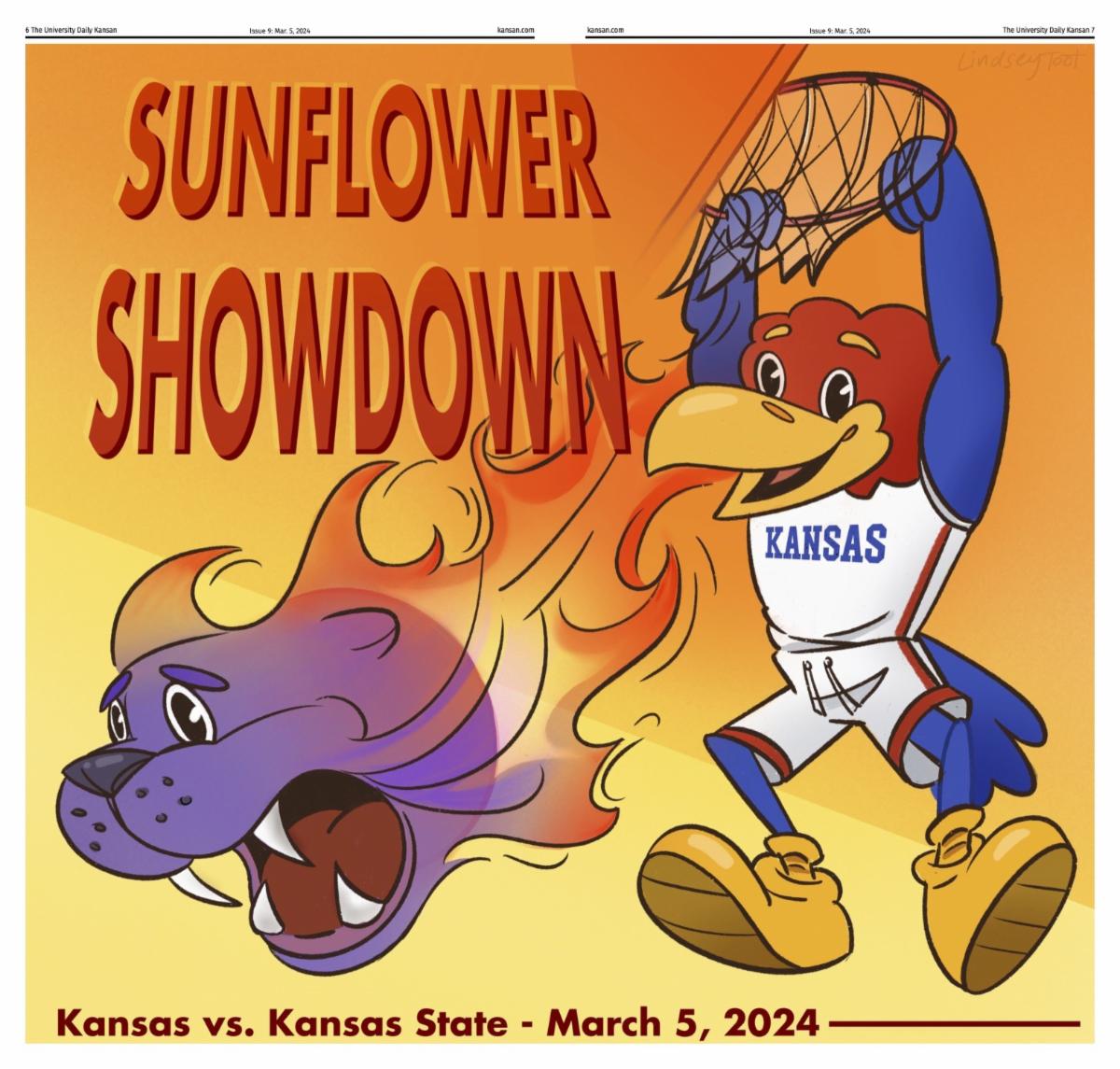
The Kansas Jayhawk in me is showing as we lead today’s issue with my story on a unique use of the printed newspaper. Throughout the school year, the University Daily Kansan is produced online only - except for the 18 days a season when the men’s basketball team plays in Allen Fieldhouse. Read on.
And remember, fellow Luddites, how could this tradition be carried out with an iPhone or an iPad?
Have a great weekend – be safe, stay healthy, live each day to your fullest.
Paul
Is the print newspaper dead? Not in the home arena of the Kansas Jayhawks
| 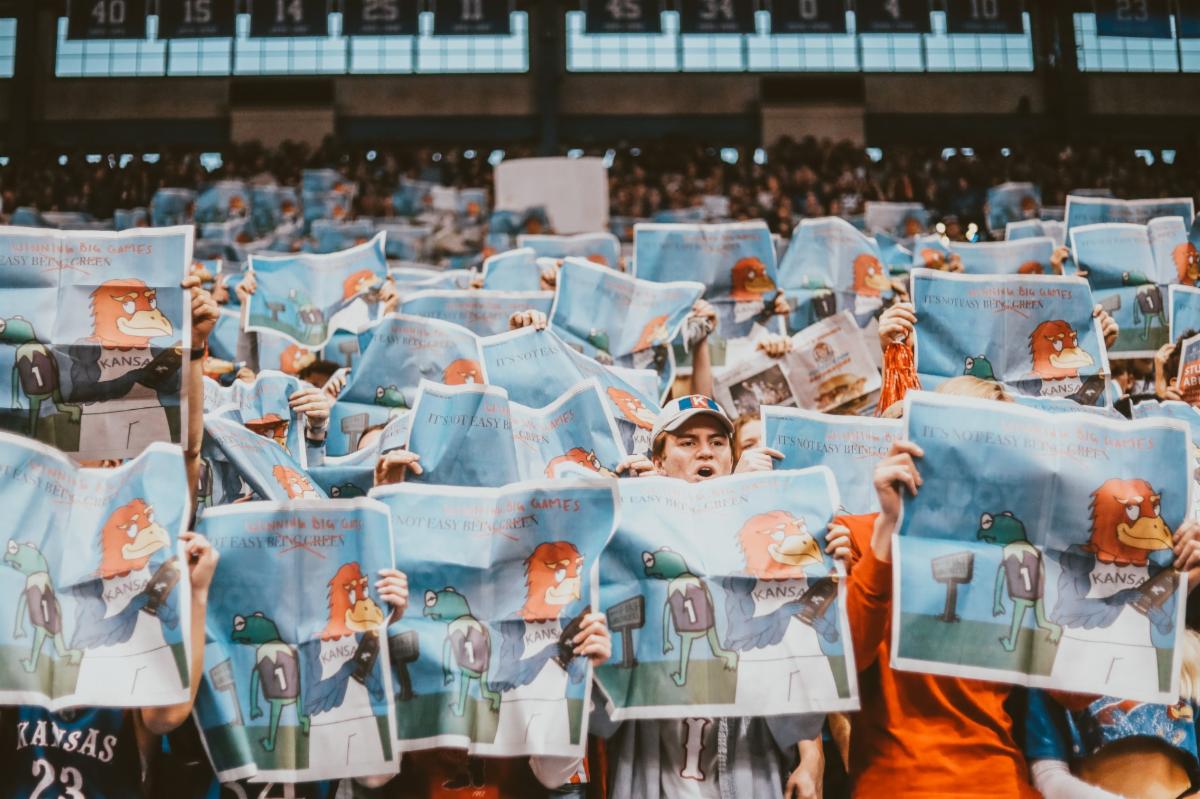 | 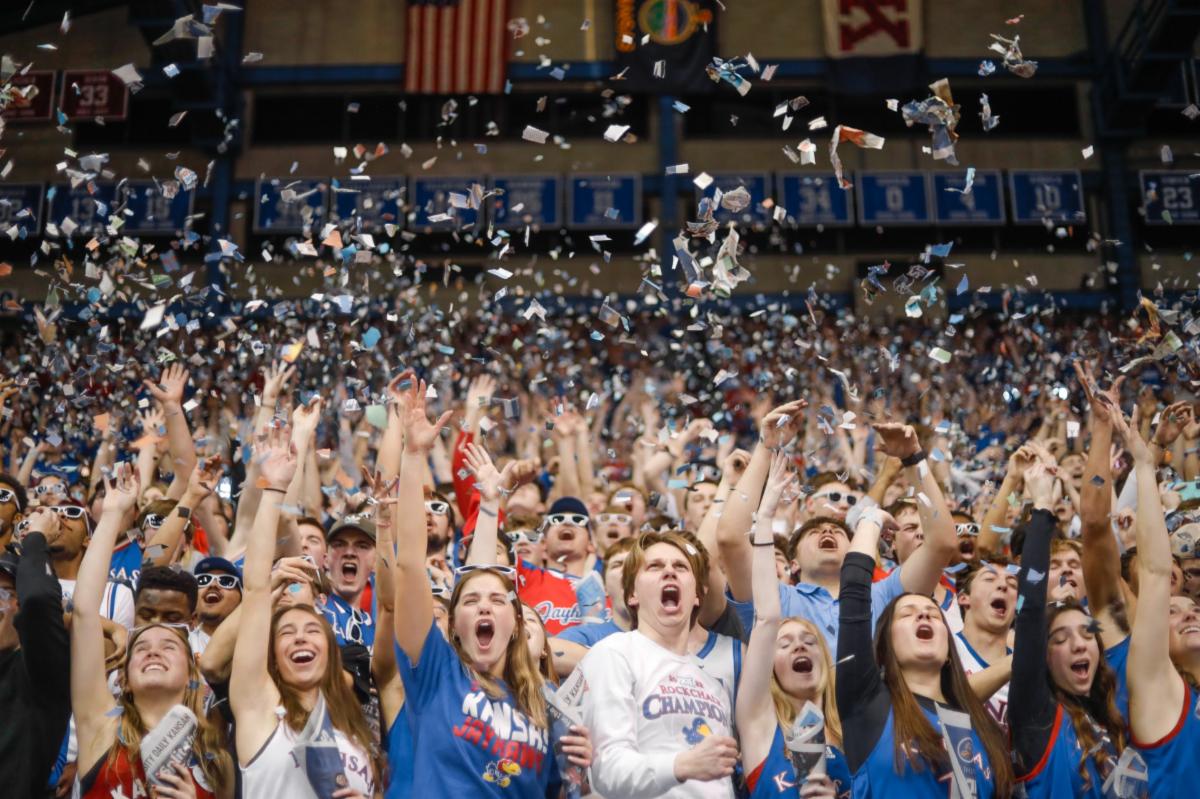 | |
University Daily Kansan photos
BY PAUL STEVENS
Who says print is dead?
Certainly not the 2,000 to 4,000 students at the University of Kansas who put posters from the printed edition of the University Daily Kansan on display for each home game of the men’s basketball team in venerable Allen Fieldhouse.
And then tear them to pieces.
Here’s how it works:
Copies of the Kansan, the university’s daily newspaper, are handed out to students entering the fieldhouse. When the starting lineup of the opposing team is introduced, students feign total disinterest by holding the newspaper in front of their faces, shaking them after each player is introduced. Then, when introductions of the Jayhawk players begin, students shred the posters and fling the debris into the air along with a loud roar.
It’s a tradition that had its roots – oh Holy Jayhawk, hold your breath – IN MISSOURI!, according to KU alum Joel Zeff of Dallas – a 1990 graduate of the William Allen White School of Journalism and Mass Communication - who lays claim to starting the tradition. Zeff is a national keynote speaker and author.
“I was a freshman in 1986, living in the JRP (Joseph R. Pearson) dorm,” he said. “I was in the dorm room of Andre Stillman, looking at his high school yearbook. There was a photo of people holding up newspapers at a game. I think he went to St. Joseph Central in Missouri. I asked him about the photo. He explained that at basketball games when the opposing team was announced, students would hold up newspapers to act out that they were bored and reading the paper. When they announced the home team, they would rip up the newspapers.”
Zeff said he told his friend that they needed to do this at the next KU game. It was the fall of 1986.
“Living in a men’s dorm, you usually walked to the game with 10-15 other people. Going to the game at Allen was different back then. We would ‘save’ seats for our friends. We would have two or three rows behind the basket closest to the KU bench. When the game started, there might be 25 people or more that were all friends or friends of friends. We had grabbed a bunch of Kansans and handed them out and explained what we were doing. It caught on really quick. We would go to every game and bring our newspapers, and hold them up. Other people in the section started doing it as well. We would pass out as many papers as we could. Sometimes people would just be holding up one half of a newspaper sheet just to participate. The tradition grew every year. And it really got big after we left in the 90s.”
As the tradition continued, full-color posters were inserted into the game-day Kansan and for the students who created the posters, it was an honor.
In a 2018 YouTube video on the tradition, KU senior Jacob Hood, then the creative director of the Kansan, said he brainstormed visitor-teasing quips with his staff before every men’s basketball home game. The best zinger inspired an illustration that Hood either oversaw or drew himself. That drawing becomes a poster included in the UDK. He said in the video, “We try to keep our toe on the line of what’s too much. We’ve actually made a few of the coaches on the visiting teams pretty upset with some of our posters.”
| |
|
Poster from last home game
Nick Jungman, director of strategy for the Kansan, said the basketball issues “are basically the last vestige of the Kansan in print. We typically print one issue for every two games.
“We print enough to distribute 2,000-4,000 at every game. It’s a full paper. We did 12 pages for every edition this season. The central spread is always a full-color poster by students, usually making provocative commentary about our opponents. The students keep that spread intact, and that’s the shield they hold in front of their faces and shake while the opposing team is introduced. They’ve usually turned one other spread into a cone that holds the confetti they’ve made from the third spread. And that confetti gets tossed in the air after the Jayhawks are introduced.
“We don’t distribute anywhere else, except by request. It is paid for through advertising. We pre-sell full-season full-page packages to select advertisers (this year, KU Athletics and Sporting KC; in the past, KU Endowment, the regional Wendy’s franchisee). We’re going to open that up to more occasional advertisers next year.
“The advertising barely covers the printing this year, but I think we can do better at that. The main benefit from my perspective is that it makes the UDK a central part of the essential KU experience of watching a Jayhawks game. You can’t buy that kind of marketing. It creates a lot of goodwill toward the Kansan, which we need all of we can get.”
A winding career road
Harry Moskos - It was interesting to read what Kent Walz shared Thursday about the death of Becky (Barber) Trefren, former editor of the Grants Daily Beacon in New Mexico. It was her father, Jim Barber, who hired me away from the Albuquerque Tribune as the Daily Beacon’s first editor when he merged two separate weekly papers in Grants into a five-day daily. Then it was the AP that hired me away from the Beacon to join its Albuquerque bureau and then to become bureau chief in Honolulu. Then the Tribune lured me to come back to Albuquerque as its city editor and then managing editor before Scripps named me as editor in El Paso, Texas, and then Knoxville, Tennessee. Upon reaching Scripps’ then mandatory retirement age for editors, I returned to work for Kent Walz at the Albuquerque Journal.
John Flesher honored by Great Lakes Commission
| 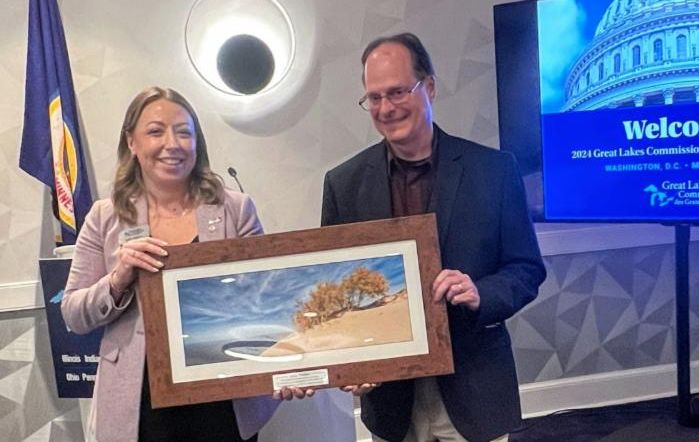 | |
John Flesher with Erika Jensen, executive director of the Great Lakes Commission, who presented him an award during the commission's semiannual meeting in Washington on Tuesday.
John Flesher, who retired in August 2023 after 42 years with AP, was honored this week by the Great Lakes Commission, which represents the eight U.S. states and two Canadian provinces adjacent to the lakes. During a March 5 ceremony at the commission's semiannual meeting in Washington, D.C., Flesher received a plaque featuring a photo of Sleeping Bear Dunes National Lakeshore near Traverse City, Michigan, where he was based as a correspondent for three decades. It reads, "In recognition of your significant service and contributions to journalism and the Great Lakes."
Flesher began covering Great Lakes news while serving as Michigan regional reporter in the Washington bureau from 1989-92 and continued after transferring to Traverse City. He reported on invasive species such as zebra mussels and sea lamprey; toxic algae; rising and falling water levels; shipwreck hunting and more. Eventually given the title of AP Environmental Writer, he was awarded a Ted Scripps Fellowship in Environmental Journalism at the University of Colorado for 2002-03, and was appointed to AP's Global Environmental Beat Team when it was formed in 2009. As a team member, he helped cover national stories including the Deepwater Horizon oil spill in the Gulf of Mexico, Midwestern floods and Western wildfires. Yet his focus remained the Great Lakes, including more recent threats from PFAS contamination and climate change.
In remarks to the commission and others in attendance, he emphasized that his role was not to advocate. "I'm a journalist, a reporter, who pursues facts and tries to present them in an interesting and unbiased way. I'm a storyteller, and I've enjoyed the marvelous privilege of earning a living by telling the story of the Great Lakes. Whenever anyone asks me what the biggest story I've covered is, I say simply, 'the Great Lakes.' Not just one particular event one one particular day, for the Great Lakes story is a continuing one, day in and day out, year in and year out."
Covering Nixon was never dull
| 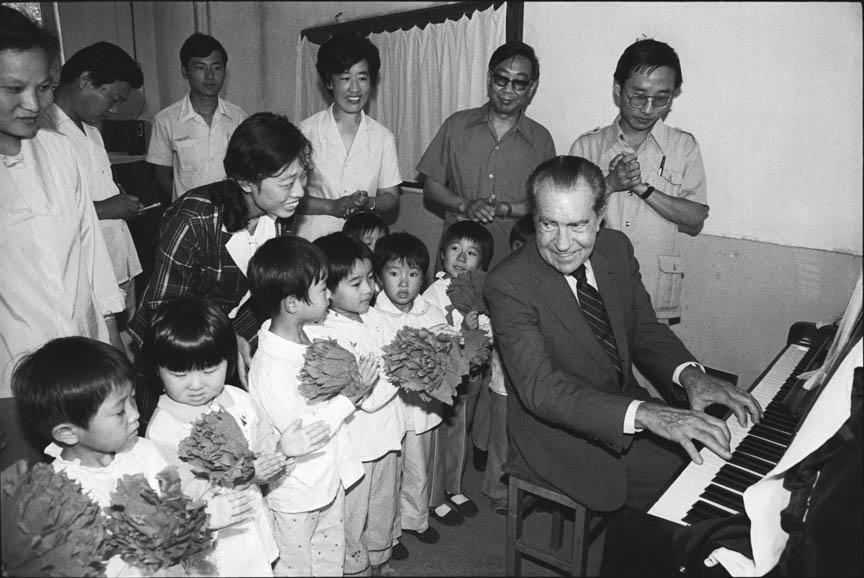 | |
Neal Ulevich - Doug Pizac's Nixon image (in Thursday’s Connecting) reminded me that covering the former president was rarely dull. Disgraced at home but still a hero in Chinese eyes for his rapprochement with Beijing, Nixon visited China once more in 1985. As usual his hosts laid on routine events such as a visit to a local commune. When tots danced to piano music played by a teacher, Nixon took over the keyboard and played Old McDonald Had a Farm and Happy Birthday. I staffed the event. The opposition thought it too dull to attend, so the picture was mine alone.
Old technology
| 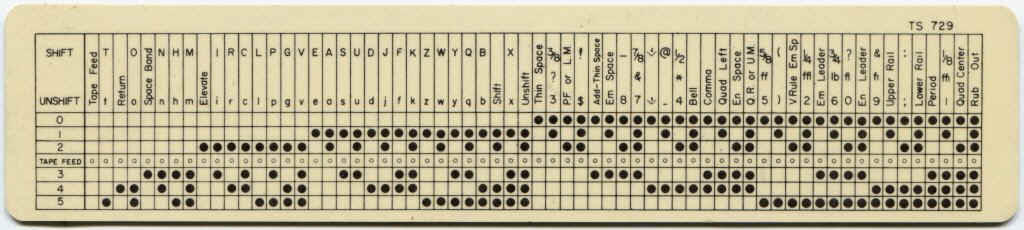 | |
Steve Graham - The code chart published in the March 6 issue of Connecting is the Baudot code (Named after Émile Baudot, who invented the system in 1897) that we called "five-level" or "five-bit" because characters were defined by five bits and could only produce case-less characters.
Since typesetting was done by hand in those days, the lack of upper- and lower-case letters didn't really matter.
In the U.S., however, the typesetting process was becoming automated and in 1929 (according to the Encyclopedia Britannica) the Teletypesetter system was developed.
Thus, an extra bit was added to Baudot code (and another row of holes in the paper tape) which not only added the ability to use upper- and lower- case letters, but also the ems, ens and thins, etc. necessary to typesetting. We called it "six-bit"or "TTS"
The TTS system persisted in American newspapers into the 1990s and perhaps beyond. Our efforts to have domestic newspaper members modernize is yet another story.
But as Robert Wielaard pointed out, Europe, where much hand typesetting persisted due to labor agreements, stuck with Baudot.
South China Karst
|  | Zhang Wanli, the wife of retired AP newsman Patrick Casey, shot this last week in the South China Karst, a UNESCO World Heritage Site that's located in Yunnan Province. The World Heritage designation protects a diversity of landscapes, including tower, pinnacle and cone karst and other geological phenomena such as giant dolines and table mountains. | Connecting wishes Happy Birthday | |
|
Stories of interest
Is journalism disappearing? These top educators have a lot to say about that (NPR)
By Fernando Alfonso III
As I left my meeting with the head of the journalism department, my fingers were frozen together, a physical phenomenon that happens in times of great stress or happiness.
I had just been offered a chance to redesign a course called Media Management and Entrepreneurship, a class that hadn't been taught at the University of Kentucky in roughly seven years.
Over the following weeks, I jotted down the names of guest speakers I planned to have (Owen Thomas, Drew Curtis and Gabriel Dunn would visit) and the themes I wanted to address. There were three companies I knew I had to expose my students to each semester:
Read more here. Shared by Richard Chady.
-0-
"Journalists are not criminals," Roman's sign reads, but exactly that's what he was sentenced for (The Barents Observer)
By Olesia Krivtsova
Considering the two years spent in pre-trial detention, Roman Ivanov will be deprived of his freedom for approximately five years if the ruling on Wednesday is not overturned in an appeal.
The court ruling sentence is one year less than the prosecution requested, SOTAvision reports in Telegram.
Roman Ivanov was charged after reports he made about the war in Ukraine, published in the media outlet RusNews as well as in a Telegram channel. The journalist wrote about war crimes committed by the Russian army in the Ukrainian city of Bucha, citing a UN report as well as The New York Times.
In his final statement, before the verdict was pronounced, Ivanov said, kneeling:
“I want to apologize to all Ukrainians whom our country has brought sorrow.”
When asked by the judge if he understood the verdict, the journalist said: “This verdict is to you” [referring to the judge].
Read more here.
-0-
Nikon to Acquire RED in Surprise Announcement (Fstoppers)
by Greg Sheard
In a surprise announcement this morning, Nikon announced that they are set to acquire US cinema camera manufacturer RED. With RED due to become a wholly owned subsidiary of the Japanese camera giant, this will surely make Nikon a force to be reckoned with, not only in the photography world but also in the filmmaking world.
It is no secret that Nikon has been behind their rivals in recent years regarding video. Sony, Canon, and other manufacturers have long had a strong video game in the hybrid space, but Nikon just could not seem to find that balance until recent years. The launch of the Z8 and Z9 has seen a massive improvement for Nikon, and combining that with this acquisition, Nikon could be onto a winner.
The move is still due to be finalized as it is subject to a Membership Interest Purchase Agreement with James Jannard, its founder, and Jarred Land, its current President.
Read more here. Shared by Doug Pizac.
And…The Endless Possibilities Now That Nikon Has Acquired Cinema Camera Manufacturer RED. Click here.
| |
Today in History - March 8, 2024 | |
|
Today is Friday, March 8, the 68th day of 2024. There are 298 days left in the year.
Today’s highlight in history:
On March 8, 1971, in the first of three fights between Muhammad Ali and Joe Frazier, Frazier defeated Ali by decision in what was billed as “The Fight of the Century” at Madison Square Garden in New York.
On this date:
In 1618, German astronomer Johannes Kepler devised his third law of planetary motion.
In 1817, the New York Stock & Exchange Board, which had its beginnings in 1792, was formally organized; it later became known as the New York Stock Exchange.
In 1948, the Supreme Court, in McCollum v. Board of Education, struck down voluntary religious education classes in Champaign, Illinois, public schools, saying the program violated separation of church and state.
In 1965, the United States landed its first combat troops in South Vietnam as 3,500 Marines arrived to defend the U.S. air base at Da Nang.
In 1971, silent film comedian Harold Lloyd died in Beverly Hills, California, at age 77.
In 1983, in a speech to the National Association of Evangelicals convention in Orlando, Florida, President Ronald Reagan referred to the Soviet Union as an “evil empire.”
In 1988, 17 soldiers were killed when two Army helicopters from Fort Campbell, Kentucky, collided in mid-flight.
In 1999, baseball Hall of Famer Joe DiMaggio died in Hollywood, Florida, at age 84.
In 2000, President Bill Clinton submitted to Congress legislation to establish permanent normal trade relations with China. (The U.S. and China signed a trade pact in November 2000.)
In 2004, Iraq’s Governing Council signed a landmark interim constitution.
In 2008, President George W. Bush vetoed a bill that would have banned the CIA from using simulated drowning and other coercive interrogation methods to gain information from suspected terrorists.
In 2014, Malaysia Airlines Flight MH370, a Boeing 777 with 239 people on board, vanished during a flight from Kuala Lumpur to Beijing, setting off a massive and ultimately unsuccessful search.
In 2016, Sir George Martin, the Beatles’ urbane producer who guided the band’s swift, historic transformation from rowdy club act to musical and cultural revolutionaries, died at age 90.
In 2017, many American women stayed home from work, joined rallies or wore red to demonstrate how vital they were to the U.S. economy, as International Women’s Day was observed with a multitude of events around the world, including the Day Without a Woman in the U.S.
In 2022, President Joe Biden announced that the U.S. would ban all Russian oil imports, toughening the toll on Russia’s economy in retaliation for its invasion of Ukraine as a humanitarian crisis unfolded in the port city of Mariupol.
Today’s birthdays: Jazz musician George Coleman is 89. Actor Sue Ane (correct) Langdon is 88. College Football Hall of Famer Pete Dawkins is 86. Songwriter Carole Bayer Sager is 80. Actor-director Micky Dolenz (The Monkees) is 79. Pop singer Peggy March is 76. Baseball Hall of Famer Jim Rice is 71. Jazz musician Billy Childs is 67. Singer Gary Numan is 66. NBC News anchor Lester Holt is 65. Actor Aidan Quinn is 65. Actor Camryn Manheim is 63. Actor Leon is 63. Country-rock singer Shawn Mullins is 56. Neo-soul singer Van Hunt is 54. Actor Andrea Parker is 54. Actor Boris Kodjoe is 51. Actor Freddie Prinze Jr. is 48. Actor Laura Main is 47. Actor James Van Der Beek is 47. R&B singer Kameelah Williams (702) is 46. Actor Nick Zano is 46. Rock singer Tom Chaplin (Keane) is 45. Rock musician Andy Ross (OK Go) is 45. Actor Jessica Collins is 41. R&B singer Kristinia (kris-teh-NEE’-ah) DeBarge is 34.
| |
Got a story or photos to share? | |
|
Connecting is a daily newsletter published Monday through Friday that reaches more than 1,800 retired and former Associated Press employees, present-day employees, and news industry and journalism school colleagues. It began in 2013. Past issues can be found by clicking Connecting Archive in the masthead. Its author, Paul Stevens, retired from the AP in 2009 after a 36-year career as a newsman in Albany and St. Louis, correspondent in Wichita, chief of bureau in Albuquerque, Indianapolis and Kansas City, and Central Region vice president based in Kansas City.
Got a story to share? A favorite memory of your AP days? Don't keep them to yourself. Share with your colleagues by sending to Ye Olde Connecting Editor. And don't forget to include photos!
Here are some suggestions:
- Connecting "selfies" - a word and photo self-profile of you and your career, and what you are doing today. Both for new members and those who have been with us a while.
- Second chapters - You finished a great career. Now tell us about your second (and third and fourth?) chapters of life.
- Spousal support - How your spouse helped in supporting your work during your AP career.
- My most unusual story - tell us about an unusual, off the wall story that you covered.
- "A silly mistake that you make"- a chance to 'fess up with a memorable mistake in your journalistic career.
- Multigenerational AP families - profiles of families whose service spanned two or more generations.
- Volunteering - benefit your colleagues by sharing volunteer stories - with ideas on such work they can do themselves.
- First job - How did you get your first job in journalism?
- Most unusual place a story assignment took you.
Paul Stevens
Editor, Connecting newsletter
paulstevens46@gmail.com
| | | | |