|
|
|
Connecting
June 17, 2024
Click here for sound of the Teletype
| |
|
Colleagues,
Good Monday morning on this June 17, 2024,
| |
|
A true professional, a great human being and mentor…
“They won’t even remember me in a few years…” (WRONG!)
Mr. Alabama AP…
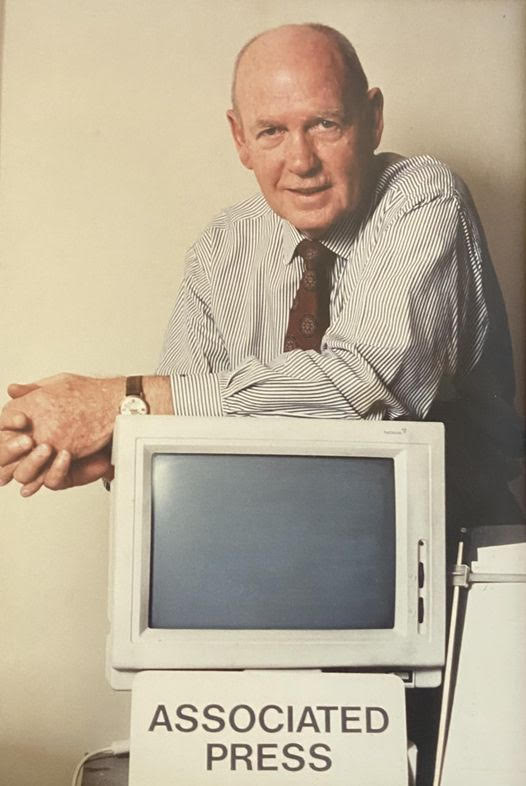
We lead today’s Connecting with memories of our colleague Hoyt Harwell, longtime Birmingham correspondent for The Associated Press who died last Wednesday at the age of 93.
A "Celebration of a Happy Life" service will be held today at Shades Crest Baptist Church, 452 Park Avenue, Hoover, with visitation at 10 a.m. and service at 11. A private family graveside service will follow at Jefferson-Currie Memorial Funeral Home and Gardens Cemetery in Hoover. The family asks that in lieu of flowers, please consider making a donation to the Shades Crest Baptist Church Building Fund. Click here for his obituary.
AP WORLD ANNUALS – Our colleague Shirley Christian writes: I am trying to find new homes for most of my 2,000 books, including the AP World annuals from 1966 through 1977 (for some reason 1973 is missing). If anyone in Connecting land would like any or all of them, please contact me. I’ll be happy to send them for the cost of postage. Shirley’s email - christianshirley66@gmail.com
Here's to a great week – be safe, stay healthy, live each day to your fullest.
Paul
Hoyt Harwell - 'more than a journalist, an incredible human being'
| |
|
Hoyt with Alabama's football legendary coach Bear Bryant
Bob Ingle - Hoyt Harwell was more than a journalist, he was an incredible human being with a unique ability to communicate, treating people as individuals, making them feel special.
He was even-tempered and devoid of ego with a sense of humor and ability to tell entertaining stories of how things came to be.
Assigned to Birmingham between Atlanta and Seattle, it was a time of professional growth for me. That was due in large measure to Harwell’s knowing what each staff member could do and encouraging it.
Because of his connections to the Baptists when Billy Graham decided to go to Northern Ireland, then a dangerous place to be, Harwell got the global exclusive but he assigned me to interview Graham. Not a fan of Graham going in, I found him to be refreshingly open. He didn’t dodge questions and was humble. After the interview, Harwell asked, “What do you think of him now?” I have nothing but respect.
Harwell sent me to interview Milburn Stone, Gunsmoke’s “Doc”, after his heart surgery, another exclusive. And there were the Sunday conversations with Gov. George Wallace.
He knew I didn’t like covering sports but I did take his dictation from Alabama games. And I wrote the Southeastern College football roundup. He was kind and supportive with gentle suggestions on improvements.
A true professional, a great human being and mentor, Harwell was so influential in my career when my first book hit the NY Times Best Seller List I sent him a note of thanks.
He could have assigned himself and taken credit for AAA wire exclusives but he didn’t roll like that. Harwell promoted careers of younger staffers. He was a friend and a coach.
I am saddened by his passing but so grateful our paths crossed.
-0-
Jay Reeves - I still remember what Hoyt Harwell told me at his going-away dinner after he retired in early 1993 and I was named to follow him as the AP correspondent in Birmingham, Ala.
“They won’t even remember me in a few years,” Hoyt said.
That was one of the few occasions I recall Hoyt Harwell ever being wrong.
Hoyt had what it took to succeed in a one-person AP bureau, and he’s still remembered for doing just that. His prose was succinct and accurate, and he was dependable, friendly and helpful - traits that made him revered by both the cooperative’s members and his colleagues.
No one could dictate a postgame football story better than Hoyt, and he had an inner calm that served him well during breaking news events. That was never more true than in 1988, when a mentally unstable gunman entered a private school in Tuscaloosa and took everyone hostage. The perpetrator asked to see an AP reporter, and Hoyt agreed to go inside. After listening to the man explain his reasons for the takeover, Hoyt helped secure the release of nine students and a teacher. And, of course, he filed the wire once he was done.
Years after retirement, Hoyt developed a devoted following on Facebook, where he often shared quips, puns and ‘dad jokes.’ Not long before he died, Hoyt asked: “Help me remember: Was Jeremiah a bullfrog or a prophet?”
Hoyt spent 26 years as the Birmingham correspondent, and I held the job for 29 years before retiring in 2022. Even late in my career, news industry veterans and sources sometimes asked me about Hoyt. Nope, Mr. Harwell, you’re not forgotten.
-0-
Peggy Walsh - Hoyt Harwell was Mr. Alabama AP when I joined AP in Atlanta, which as a hub bureau oversaw Alabama.
Over my 10 years there, he and Kendall Weaver were my Alabama teachers. I learned everything from them.
My favorite memory of Hoyt highlighted his sources and incredible depth of Alabama knowledge.
Bear Bryant, at the time and now, one of the most celebrated coaches in college football, retired in 1982 as his health and Alabama's football record declined. He was in his late 60s.
By then I was news editor so Hoyt and I talked about Hoyt writing a preparedness obit. I really pushed about the immediacy, truthfully annoying Hoyt in the process. I told him I just had a feeling.
We smoothed that over and talked frequently. The preparedness was in hand ready to go when needed.
Hoyt checked his Bryant family sources frequently. One day he learned Bryant had been taken to the hospital in Tuscaloosa, home of the Crimson Tide.
He called me and my gut reaction was get there. He agreed and quickly took the one-hour drive.
He arrived to the first announcement that Bryant had died of a massive heart attack. He was the only one there.
Bryant died only one month after he retired.
After the bulletin and preparedness were filed, Hoyt covered reaction, updates and the miles of people who lined highways in Bryant's honor.
He called me when things quieted down and laughingly said "if you get a feeling about anything else, let me know." We've laughed about it many times over the years.
That's just one of many of Hoyt's great works. It was an honor to work with him.
Remembering your first bureau
Tim Litsch - I started with AP on January 4, 1970, the first workday of the year, and the decade. I started in New York City, but at 475 Tenth Avenue, not 50 Rock, a distinction with a definite difference! In late 1971, I bid into Miami, where I spent the next 30 years, as a tech, and as ACOC.
-0-
Marty Steinberg - I started with AP in the Baltimore bureau in 1981, but I had tried to get hired about two years earlier. I was rejected.
At the time, I was a clerk (later known as editorial assistant) on the city desk of my hometown paper, The Philadelphia Inquirer. I’m not sure how I did on the AP writing test, but the Philly bureau’s Herb Pelkey told me I didn’t have enough experience as a reporter on a daily newspaper.
Despite the setback, my supervisors at the Inquirer encouraged me to pursue a news career. They sent recommendations to Jon Katz, then managing editor of the Baltimore News American.
It worked! Katz hired me, and I started 100 miles down I-95 in March 1979.
Katz was revamping the afternoon Hearst daily, hoping to attract an audience beyond its dwindling numbers of blue-collar readers.
Down the hall from the newsroom was the small office of UPI, whose staffers included Jim Rowley. He and I developed a friendship before he jumped to AP’s Baltimore bureau.
Unfortunately, Katz’s efforts to turn the News American around eventually proved unsuccessful. As the paper declined, I was anxious to find a new job in Baltimore, but I didn’t want to try out with The Sun. I also ruled out UPI because it, too, was in decline.
One day in 1981, as a UPI staffer walked through the News American newsroom, a bell rang in my head: “Jim Rowley!” So I called Jim at AP. He told me there was an opening, and he put me in touch with Bureau Chief John Woodfield. John liked that I was a local reporter with sources and experience, so he withdrew an offer he had made to someone else and hired me. I worked in the AP Baltimore bureau for 2 1/2 years before transferring to NY GEN in 1984.
| |
|
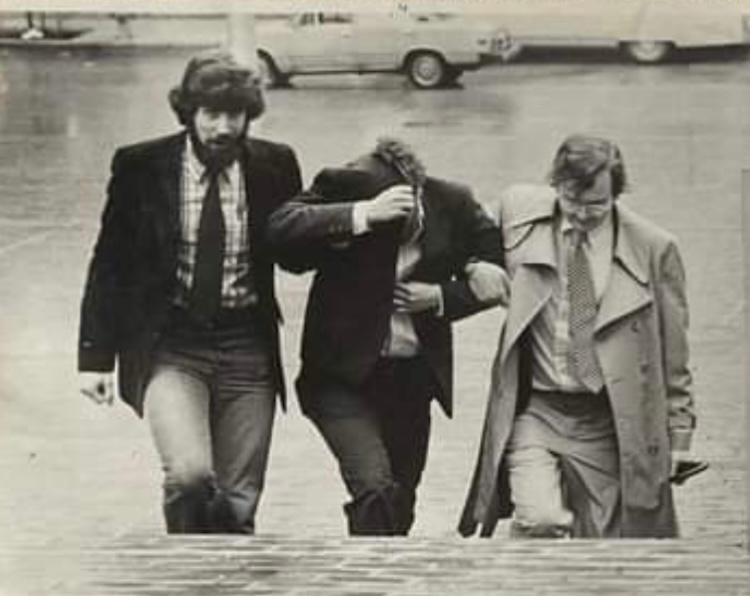
While heading to a hearing in the late 1970s for former Gov. Marvin Mandel, Jim Rowley (r) and I "pose" as FBI agents. We are escorting our “suspect ,” then-Baltimore News American and later AP staffer Steve Braun on the steps of the Baltimore federal courthouse.
-0-
Hal Bock - I had the distinction of being hired by sports editor Ted Smits three times.
In 1960 I was recommended to Smits by the chairman of the journalism department at NYU and hired to work on the Olympic desk. My job was the agate summaries and the desk was composed of Jim Kensil, Don Weiss and Jack Hand, three of the best journalists I have ever worked with. I kept my mouth shut and my eyes and ears open and I learned a lot in those six weeks.
After returning from Army service, I was hired again in 1962 as a vacation relief staffer and this time I got to contribute to the report, an exciting step up. There was no staff opening at the end of summer and so my third chance didn't come until November 1963, three weeks before the assassination. Six months later. I was told to write a letter to General Manager Wes Gallagher discussing my work and goals. I talked about my two temporary stints and then used the word “permanently” which Smits edited out.
He was wrong. I was permanent. I stuck around for 40 years.
BEST OF AP — FIRST WINNER
INDIA ELECTION LIVE BLOG PROVIDES COVERAGE OF THE VOTE COUNT IN THE WORLD’S LARGEST DEMOCRACY
|  | |
Narendra Modi, right, is sworn-in as the Prime Minister of India by President Droupadi Murmu, left, at the Rashtrapati Bhawan, in New Delhi, India, Sunday, June 9, 2024. The 73-year-old leader is only the second Indian prime minister to retain power for a third term. AP PHOTO / MANISH SWARUP
By Mallika Sen, Yirmiyan Arthur, Sheikh Saaliq, Krutika Pathi, David Rising, Jayakumar Madala
The idea for a Live Blog for India’s election results germinated in March, with a series of conversations between Entertainment News Editor Mallika Sen in New York and Deputy News Director for Photography and Storytelling Yirmiyan Arthur in India.
After a chat with the India team, the team began the groundwork, prepping posts that would include already published election stories, while planning for spot posts that would keep the blog buzzing through the day.
The long campaign and voting coverage provided a wealth of insightful content, including profiles, explainers, photos, digital videos and analysis from across India that the blog could use. Arthur coordinated with the India team who would send text, photos and video feeds for the blog on the day.
On June 4, the live blog kicked off just as votes began to be counted. Arthur worked closely with the digital team in India, with Engagement editor for Digital audiences Jayakumar Madala providing the crucial push on AP platforms in the early hours.
The rest of the digital team pitched in with their expertise and sharp attention to detail as the blog picked up pace with a steady stream of spot feeds coming from Sheikh Saaliq, David Rising, Krutika Pathi and others, while also feeding The Latest for our traditional customers.
Read more here.
BEST OF AP — SECOND WINNER
SETTLERS CITED FOR WEST BANK VIOLENCE SAY SANCTIONS AGAINST THEM HAD NEARLY NO EFFECT
| 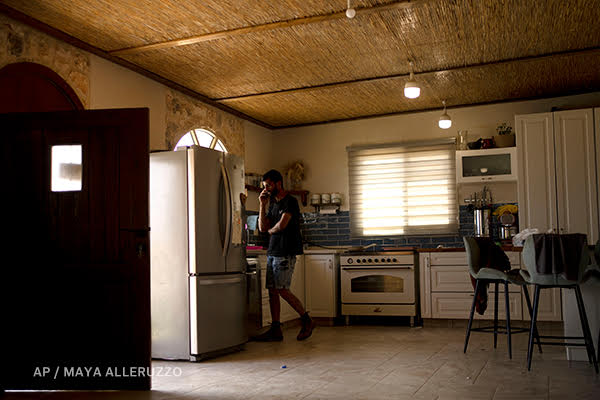 | |
Israeli settler Yinon Levi speaks on his phone in the kitchen at his farm in the West Bank settlement outpost of Meitarim, Sunday, May 12, 2024. Levi was sanctioned by the United States; he said he had trouble paying bills for weeks but then could access money again. AP PHOTO / MAYA ALLERUZZO
By Sam Mednick, Julia Frankel and Maya Alleruzzo
Through dogged reporting, Sam Mednick, Julia Frankel and Maya Alleruzzo secured first-of-a-kind interviews with two sanctioned settlers who said that U.S. sanctions meant to hurt them have had little effect. They also spoke to Palestinians who said they were affected by settler violence.
In an unprecedented move this year, the United States sanctioned a handful of Israeli settlers and entities in the West Bank to reduce surging violence against Palestinians since the war erupted on Oct 7. Others — the U.K., Canada and the European Union — swiftly followed suit.
The sanctions, meant as a deterrent, have been called no more than an “annoyance” by the settlers, as violence and land grabs continue, including by those sanctioned.
Until The Associated Press investigated the story, there was minimal reporting, if any, on the impact of these sanctions.
Read more here.
| |
Connecting wishes Happy Birthday | |
|
AP classes, by the year...
(EDITOR'S NOTE: This is a listing of Connecting colleagues who have shared with me the year and the bureau where they started with the AP. If you would like to share your own information, I will include in later postings. Current AP staffers are also welcomed to share their information.)
1951 - Norm Abelson (Boston)
1953 – Charles Monzella (Huntington, WVa)
1955 – Henry Bradsher (Atlanta), Paul Harrington (Boston), Joe McGowan (Cheyenne)
1958 – Roy Bolch (Kansas City)
1959 – Charlie Bruce (Montgomery)
1960 – Claude Erbsen (New York), Carl Leubsdorf (New Orleans)
1961 – Peter Arnett (Jakarta, Indonesia), Warren Lerude (San Diego)
1962 – Paul Albright (Cheyenne), Malcolm Barr Sr. (Honolulu), Myron Belkind (New York), Kelly Smith Tunney (Miami)
1963 – Hal Bock (New York)
1964 – Rachel Ambrose (Indianapolis), Larry Hamlin (Oklahoma City), Ron Mulnix
1965 – Bob Dobkin (Pittsburgh), Harry Dunphy (Denver), John Gibbons (New York), Jim Luther (Nashville), Larry Margasak (Harrisburg)
1966 – Mike Doan (Portland, OR), Mike Short (Los Angeles), Marty Thompson (Seattle), Kent Zimmerman (Chicago)
1967 – Adolphe Bernotas (Concord), Lou Boccardi (New York), Linda Deutsch (Los Angeles), Don Harrison (Los Angeles), Doug Kienitz (Cheyenne), Bruce Lowitt (Los Angeles), Chuck McFadden (Los Angeles), Martha Malan (Minneapolis), Bill Morrissey (Buffalo), Larry Paladino (Detroit), Michael Putzel (Raleigh), Bruce Richardson (Chicago), Richard Shafer (Baltimore), Victor Simpson (Newark), Michael Sniffen (Newark)
1968 – John Eagan (San Francisco), Joe Galu (Albany), Peter Gehrig, Charles Hanley (Albany), Jerry Harkavy (Portland, Maine), Herb Hemming (New York), Brian King (Albany), Samuel Koo (New York), Karren Mills (Minneapolis), Michael Rubin (Los Angeles), Rick Spratling (Salt Lake City)
1969 - Ann Blackman (New York), Ford Burkhart (Philadelphia), Dick Carelli (Charleston, WVa), Dennis Coston (Richmond), Daniel Haney (Portland, Maine), Mike Harris (Chicago), Brad Martin (Kansas City), David Minthorn (Frankfurt), Cynthia Rawitch (Los Angeles), Bob Reid (Charlotte), Mike Reilly (New York), Bill Winter (Helena)
1970 – Richard Boudreaux (New York), Richard Drew (San Francisco), Bob Egelko (Los Angeles), Steve (Indy) Herman (Indianapolis), Tim Litsch (New York), Lee Margulies (Los Angeles), Chris Pederson (Salt Lake City), Brendan Riley (San Francisco), Larry Thorson (Philadelphia)
1971 – Harry Atkins (Detroit), Jim Bagby (Kansas City), Larry Blasko (Chicago), Jim Carlson (Milwaukee), Jim Carrier (New Haven), Chris Connell (Newark), Bill Hendrick (Birmingham), John Lumpkin (Dallas), Kendal Weaver (Montgomery)
1972 – Hank Ackerman (New York), Mike Graczyk (Detroit), Lindel Hutson (Little Rock), Brent Kallestad (Sioux Falls), Tom Kent (Hartford), Nolan Kienitz (Dallas), Andy Lippman (Phoenix), Lew Wheaton (Richmond)
1973 - Jerry Cipriano (New York), Susan Clark (New York), Norm Clarke (Cincinnati), Joe Galianese (East Brunswick), Merrill Hartson (Richmond), Mike Hendricks (Albany), Tom Journey (Tucson), Steve Loeper (Los Angeles), Tom Slaughter (Sioux Falls), Jim Spehar (Denver), Paul Stevens (Albany), Jeffrey Ulbrich (Cheyenne), Owen Ullmann (Detroit), John Willis (Omaha)
1974 – Norman Black (Baltimore), David Espo (Cheyenne), Robert Glass (Philadelphia), Steve Graham (Helena), Elaine Hooker (Hartford), Sue Price Johnson (Charlotte), Dave Lubeski (Washington), Lee Mitgang (New York), Marc Wilson (Little Rock)
1975 – Peter Eisner (Columbus), David Powell (New York), Eileen Alt Powell (Milwaukee)
1976 – Judith Capar (Philadelphia), Dick Chady (Albany), David Egner (Oklahoma City), Marc Humbert (Albany), Chuck Wolfe (Charlotte)
1977 – Robert Burns (Jefferson City), Charles Campbell (Nashville), Dave Carpenter (Philadelphia), Ken Herman (Dallas), Mike Holmes (Des Moines), Scott Kraft (Jefferson City), Peter Leabo (Dallas), Kevin LeBoeuf (Los Angeles), Ellen Nimmons (Minneapolis), Dan Sewell (Buffalo), Estes Thompson (Richmond)
1978 - Doug Pizac (Los Angeles), Charles Richards (Dallas), Steve Wilson (Boston)
1979 – Scotty Comegys (Chicago), Brian Friedman (Des Moines), Sally Hale (Dallas), Phillip Rawls (Nashville), Linda Sargent (Little Rock), Robert Wielaard (Brussels)
1980 – Jeff Barnard (Providence), Bill Kaczor (Tallahassee) Mitchell Landsberg (Reno), Kevin Noblet (New Orleans), David Speer (Jackson), Hal Spencer (Providence), Carol J. Williams (Seattle)
1981 – Paul Davenport (Phoenix), Dan Day (Milwaukee), John Flesher (Raleigh), Len Iwanski (Bismarck), Ed McCullough (Albany), Mark Mittelstadt (Des Moines), Roland Rochet (New York), Lee Siegel (Seattle), Marty Steinberg (Baltimore)
1982 – Dorothy Abernathy (Little Rock), Tom Cohen (Jefferson City), John Epperson (Chicago), Ric Feld (Atlanta), Nick Geranios (Helena), Robert Kimball (New York), Bill Menezes (Kansas City), David Ochs (New York)
1983 – Scott Charton (Little Rock), Sue Cross (Columbus), Diana Heidgerd (Miami), Cliff Schiappa (Kansas City), Rande Simpson (New York), Dave Skidmore (Milwaukee)
1984 - Wayne Chin (Washington), Jack Elliott (Oklahoma City), Kelly P. Kissel (New Orleans), Joe Macenka (Richmond), Eva Parziale (San Francisco), Cliff Schiappa (Kansas City)
1985 - Betty Kumpf Pizac (Los Angeles)
1986 – Joni Baluh Beall (Richmond), Dave DeGrace (Milwaukee), Alan Flippen (Louisville), Jim Gerberich (San Francisco), Howard Goldberg (New York), Mark Hamrick (Dallas), Tom Coyne (Columbia, SC)
1987 – Donna Abu-Nasr (Beirut), Dave Bauder (Albany), Beth Harris (Indianapolis), Lynne Harris (New York), John Rogers (Los Angeles)
1988 – Peg Coughlin (Pierre), Kathy Gannon (Islamabad), Melissa Jordan (Sioux Falls)
1989 – Charlie Arbogast (Trenton), Ron Fournier (Little Rock)
1990 – Dan Perry (Bucharest), Sean Thompson (New York)
1991 – Lisa Pane (Hartford), Bill Sikes (Buffalo)
1993 – Jim Salter (St. Louis)
1996 – Patricia N. Casillo (New York)
1997 - Pamela Collins (Dallas), Madhu Krishnappa Maron (New York), Jennifer Yates (Baltimore)
2000 – Gary Gentile (Los Angeles)
| |
|
Stories of interest
Incoming Post editor tied to self-described ‘thief’ who claimed role in his reporting (Washington Post)
By Isaac Stanley-Becker, Sarah Ellison, Greg Miller and Aaron C. Davis
LONDON — The alleged offense was trying to steal a soon-to-be-released copy of former prime minister Tony Blair’s memoir.
The suspect arrested by London police in 2010 was John Ford, a once-aspiring actor who has since admitted to an extensive career using deception and illegal means to obtain confidential information for Britain’s Sunday Times newspaper. Facing potential prosecution, Ford called a journalist he said he had collaborated with repeatedly — and trusted to come to his rescue.
That journalist, according to draft book chapters Ford later wrote recounting his ordeal, was Robert Winnett, a Sunday Times veteran who is set to become editor of The Washington Post later this year.
Winnett moved quickly to connect Ford with a lawyer, discussed obtaining an untraceable phone for future communications and reassured Ford that the “remarkable omerta” of British journalism would ensure his clandestine efforts would never come to light, according to draft chapters Ford wrote in 2017 and 2018 that were shared with The Post.
Read more here. Shared by Valerie Komor, Peggy Walsh, Scott Charton, Michael Rubin, Richard Chady.
-0-
Washington Post Publisher and Incoming Editor Are Said to Have Used Stolen Records in Britain (New York Times)
By Justin Scheck and Jo Becker
The publisher and the incoming editor of The Washington Post, when they worked as journalists in London two decades ago, used fraudulently obtained phone and company records in newspaper articles, according to a former colleague, a published account of a private investigator and an analysis of newspaper archives.
Will Lewis, The Post’s publisher, assigned one of the articles in 2004 as business editor of The Sunday Times. Another was written by Robert Winnett, whom Mr. Lewis recently announced as The Post’s next executive editor.
The use of deception, hacking and fraud is at the heart of a long-running British newspaper scandal, one that toppled a major tabloid in 2010 and led to years of lawsuits by celebrities who said that reporters improperly obtained their personal documents and voice mail messages.
Mr. Lewis has maintained that his only involvement in the controversy was helping to root out problematic behavior after the fact, while working for Rupert Murdoch’s News Corporation.
Read more here. Shared by Michael Rubin, Dennis Conrad, Richard Chady, Valerie Komor, Adolphe Bernotas.
Click here for NPR story, New 'Washington Post' chiefs can’t shake their past in London. Shared by Sylvia Wingfield
-0-
Opinion Brits are dominating American journalism — and British journalism, too (Washington Post)
By Erik Wemple
When The Washington Post’s CEO and publisher, Will Lewis, first met with staffers in November, he was asked to compare British and American journalism. “American journalism at the level of The Washington Post … is better,” said Lewis, a Brit who has worked at the Financial Times, the Daily Telegraph and News International, a group of Rupert Murdoch properties. “There’s just no two ways about it.”
What, then, explains the one-way nature of British-American trade in editorial talent? As noted just about everywhere in recent weeks, U.S. journalism has seen a fresh influx of British editors and executives, following in a tradition that famously includes New York magazine titans Tina Brown and Anna Wintour. There’s Lewis at The Post; Mark Thompson, formerly of the BBC and the New York Times, at CNN (chairman and CEO); Emma Tucker, former editor of the Sunday Times, at the Wall Street Journal (editor in chief); John Micklethwait, former editor in chief of the Economist, at Bloomberg (editor in chief); Keith Poole, a veteran of the Sun and the Daily Mail, at the New York Post (editor in chief of the New York Post Group); Joanna Coles, a British magazine executive, at the Daily Beast (chief creative and content officer).
Now for the list of U.S. journalists atop brand-name British outlets. Uh
Read more here. Shared by Myron Belkind.
| |
Today in History – June 17, 2024 |  | |
Today is Monday, June 17, the 169th day of 2024. There are 197 days left in the year.
Today’s Highlight in History:
On June 17, 1994, after leading police on a slow-speed chase on Southern California freeways, O.J. Simpson was arrested and charged with murder in the slayings of his ex-wife, Nicole, and her friend, Ronald Goldman. (Simpson was later acquitted in a criminal trial but held liable in a civil trial.)
On this date:
In 1775, the Revolutionary War Battle of Bunker Hill resulted in a costly victory for the British, who suffered heavy losses.
In 1885, the Statue of Liberty arrived in New York Harbor aboard the French ship Isere (ee-SEHR’).
In 1930, President Herbert Hoover signed the Smoot-Hawley Tariff Act, which boosted U.S. tariffs to historically high levels, prompting foreign retaliation.
In 1963, the U.S. Supreme Court, in Abington (Pa.) School District v. Schempp, struck down, 8-1, rules requiring the recitation of the Lord’s Prayer or reading of Biblical verses in public schools.
In 1967, China successfully tested its first thermonuclear (hydrogen) bomb.
In 1972, President Richard Nixon’s eventual downfall began with the arrest of five burglars inside the Democratic headquarters in Washington, D.C.’s, Watergate complex.
In 2008, hundreds of same-sex couples got married across California on the first full day that gay marriage became legal by order of the state’s highest court.
In 2009, President Barack Obama extended some benefits to same-sex partners of federal employees.
In 2012, Rodney King, 47, whose 1991 videotaped beating by Los Angeles police sparked widespread outrage and who struggled with addiction and repeated arrests, died in Rialto, California, in an apparent accidental drowning.
In 2013, the U.S. Supreme Court ruled 7-2 that states can’t demand proof of citizenship from people registering to vote in federal elections unless they get federal or court approval to do so.
In 2017, the jury in Bill Cosby’s sexual assault case declared itself hopelessly deadlocked, resulting in a mistrial for the 79-year-old TV star charged with drugging and groping a woman more than a decade earlier; prosecutors immediately announced they would pursue a second trial. (That trial resulted in Cosby’s conviction, but Pennsylvania’s highest court later overturned it.)
In 2019, Iran announced that it was breaking compliance with the international accord that kept it from making nuclear weapons; the announcement meant that Iran could soon start to enrich uranium to just a step away from weapons-grade levels. The Trump administration followed Iran’s announcement by ordering 1,000 more troops to the Middle East.
In 2021, the Supreme Court, in a 7-2 ruling, left intact the entire Affordable Care Act, rejecting the latest major Republican-led effort to kill the national health care law known as “Obamacare.”
Today’s Birthdays: Actor Peter Lupus is 92. Movie director Ken Loach is 88. Singer Barry Manilow is 81. Former House Speaker Newt Gingrich is 81. Comedian Joe Piscopo is 73. Actor Mark Linn-Baker is 70. Actor Jon Gries (gryz) is 67. Rock singer Jello Biafra is 66. Movie producer-director-writer Bobby Farrelly is 66. Actor Thomas Haden Church is 64. Actor Greg Kinnear is 61. Actor Kami Cotler is 59. Olympic gold medal speed skater Dan Jansen is 59. Actor Jason Patric is 58. Actor-comedian Will Forte is 54. Latin pop singer Paulina Rubio is 53. Tennis player Venus Williams is 44. Actor Arthur Darvill is 42. Actor Jodie Whittaker is 42. Actor Manish Dayal is 41. Country singer Mickey Guyton is 41. Actor Marie Avgeropoulos is 38. Rapper Kendrick Lamar is 37. NHL forward Nikita Kucherov is 31. Actor KJ Apa is 27.
| |
Got a photo or story to share? | |
|
Connecting is a daily newsletter published Monday through Friday that reaches more than 1,800 retired and former Associated Press employees, present-day employees, and news industry and journalism school colleagues. It began in 2013. Past issues can be found by clicking Connecting Archive in the masthead. Its author, Paul Stevens, retired from the AP in 2009 after a 36-year career as a newsman in Albany and St. Louis, correspondent in Wichita, chief of bureau in Albuquerque, Indianapolis and Kansas City, and Central Region vice president based in Kansas City.
Got a story to share? A favorite memory of your AP days? Don't keep them to yourself. Share with your colleagues by sending to Ye Olde Connecting Editor. And don't forget to include photos!
Here are some suggestions:
- Connecting "selfies" - a word and photo self-profile of you and your career, and what you are doing today. Both for new members and those who have been with us a while.
- Second chapters - You finished a great career. Now tell us about your second (and third and fourth?) chapters of life.
- Spousal support - How your spouse helped in supporting your work during your AP career.
- My most unusual story - tell us about an unusual, off the wall story that you covered.
- "A silly mistake that you make"- a chance to 'fess up with a memorable mistake in your journalistic career.
- Multigenerational AP families - profiles of families whose service spanned two or more generations.
- Volunteering - benefit your colleagues by sharing volunteer stories - with ideas on such work they can do themselves.
- First job - How did you get your first job in journalism?
- Most unusual place a story assignment took you.
Paul Stevens
Editor, Connecting newsletter
paulstevens46@gmail.com
| | | | |