|
|
|
Connecting
Aug. 20, 2024
Click here for sound of the Teletype
| |
|
Colleagues,
Good Tuesday morning on this Aug. 20, 2022,
We asked in Monday’s Connecting to keep our colleague Linda Deutsch in your thoughts and prayers, in her fight with cancer, and many of you responded with notes to me asking for her postal address. I trust Linda heard from many more via her Lcdeutsch@yahoo.com address. (Drop me a note if you would like her postal address.)
One of them, Kathryn Loomans, said, “It’s funny how, even though I never worked side-by-side with Linda and some of our other AP ‘wireside’ greats, much less assign or edit their work, I allow myself a certain pride of association. Or should I say Association. I’m sure I’m not alone in that.”
May you add two other colleagues to those who you put in your thoughts and prayers:
Larry Laughlin, retired AP bureau chief for Northern New England, is under hospice care at home for Parkinson’s/dementia, and his wife Cheryl invites colleagues to come visit him at the Laughlin home in Concord, N.H. Or you may drop him a note through Cheryl – Cherylmlaughlin@gmail.com. (If you'd like a postal address, drop me a note.) Larry began his AP career in Providence and served as news editor in Richmond before he was appointed COB in Concord. (Shared by Adolphe Bernotas)
Bill Saul, former Los Angeles AP newsman in the mid-1970s, died earlier this month, according to colleague Michael Rubin, who added, “Terrific reporter, writer, great person to work with and know for these many years.” His obituary is presented to you in today’s Connecting.
Here’s to a great day – be safe, stay healthy, live it to your fullest.
Paul
More of your memories of Chicago 1968 Democratic convention
Chris Connell - I quit my first job in journalism, a summer internship at the Home News of New Brunswick, N.J., a few weeks early to fly to Chicago to cover the antiwar protests in the streets during the convention for my college paper, the Princetonian. I couldn't get credentials, not even to enter the headquarters hotel, the Hilton, on Boul Mich across from Grant Park. On Tuesday night I covered a raucous, forbidden protest miles away in Lincoln Park that police routed with tear gas and billy clubs. It was far from the television cameras downtown but almost a dress rehearsal for what happened in Grant Park two nights later. While fleeing the noxious cloud, I got trapped in an alley with a couple of the protestors by a club-swinging cop, intent on inflicting some street justice. Don't think showing him my 'Prince' pass would have excused me. One kid immediately escaped by scaling an eight-foot fence at the rear of the alley and, much to my surprise, I managed to follow his example. Completely lost and now alone, I found my way back downtown using the spotlight in the sky above Hugh Hefner's Playboy Mansion as my compass. Thanks, Hef.
-0-
Charlotte Porter - I was 13 when the Democratic National Convention in Chicago rolled around. I had already spent a couple days that summer making signs for Eugene McCarthy, and like many other kids had been galvanized by the assassinations of Bobby Kennedy and Martin Luther King Jr.
I watched gavel-to-gavel coverage on CBS, which was my network of choice in those days and for many years to follow. I'll never forget that handsome young reporter Dan Rather denouncing Mayor Daley's "thugs," or being mesmerized as Julian Bond took the podium to accept a no-chance vice presidential nomination.
20 years later, I was the news editor in Atlanta when the DNC came to town. During a tour of the arena, I looked over and spotted Julian Bond sitting there in conversation with someone, and I fought with myself for a long time over whether I should go over to him and tell him how much he had meant to me in 1968. I did not.
The photographs David Douglas Duncan took on Chicago's streets mesmerized me for years to follow, and when the book of transcripts of the Chicago Eight trial came out, I took Abby Hoffman's advice and liberated it from the drugstore book rack. I must say, however, I was usually a very law-abiding kid.
For some kids my age, Woodstock was the marker; for me it was Chicago 1968. What an amazing, exhausting decade.
Phil Donahue’s daughter Mary Rose was once an AP Indy employee
| 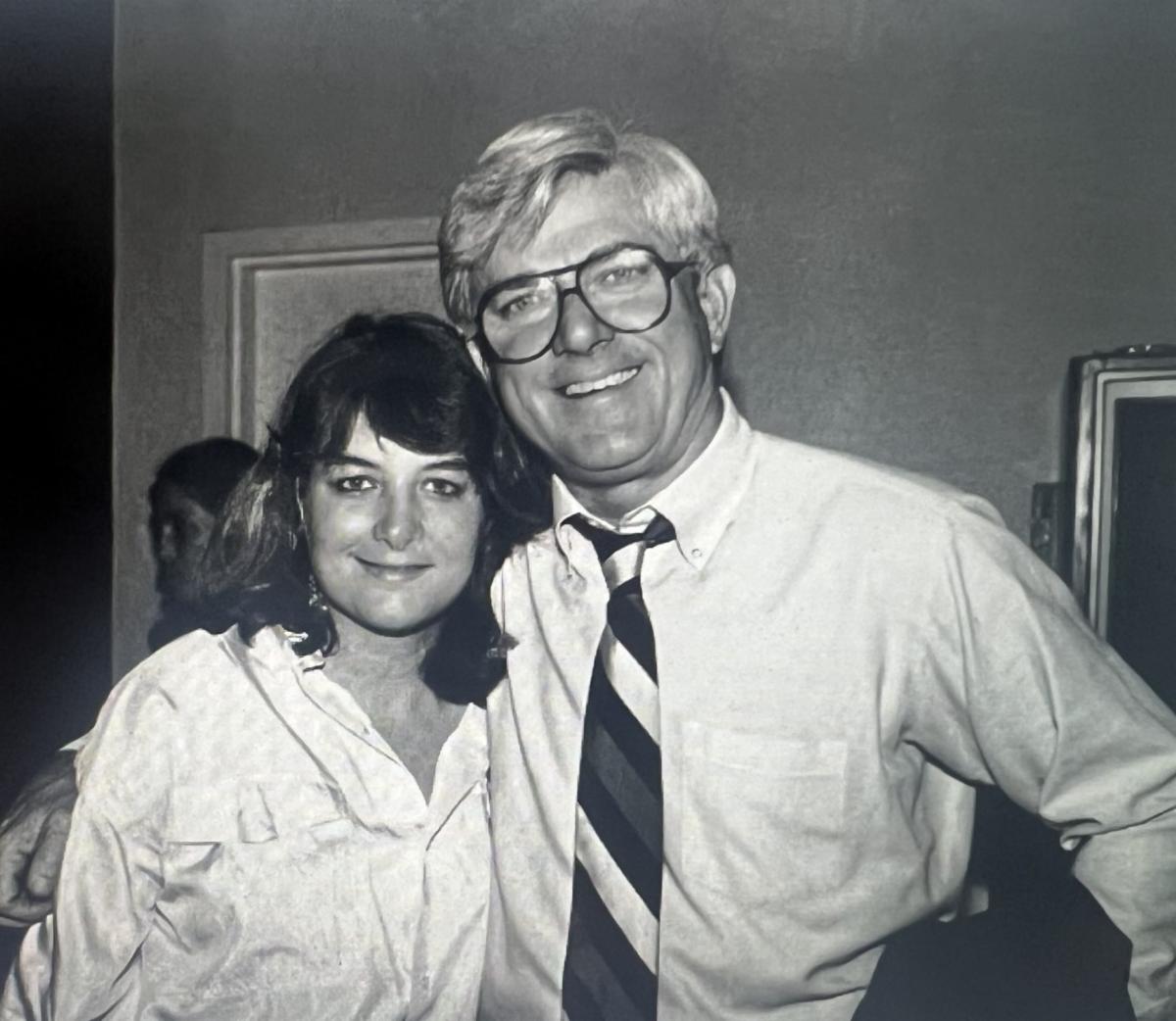 | |
Phil Donahue poses with his daughter, Mary Rose Donahue, in 1986. AP Photo
Andy Lippman - News of Phil Donohue's death reminded me of the time I hired his daughter Mary Rose, as a clerk in the Indianapolis bureau.
Mike Short, then COB in Boston, called me and told me that he had someone who might be interested in the clerk's job but did not want to have her dad's name influence the hiring.
So, when she came out for an interview, I at first didn't bring up her dad. During lunch, I was talking about how the AP was a big family, "kind of like her family."
She looked at me and smiled, and I told her, "I know Mary Rose and your secret is safe with me.”
I hired her, and for weeks, no one connected her with her dad. She did a terrific job.
One day, a call came in for Mary Rose but she wasn't there. The caller told an Indianapolis staffer, “Would you tell her that her stepmother that Marlo Thomas called (or something to that effect)”
Needless to say, her secret was no secret any more, but the bureau handled the news well.
Mary Rose went on to another job after working for us, but easily could have become a staffer in another bureau.
A remembrance of the remarkable life of Bill Saul, tsigesv
| 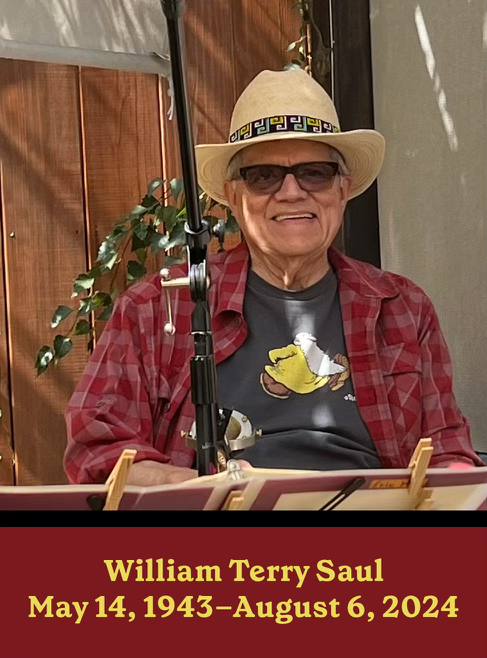 | |
Oakland, CA—William Terry Saul, tsigesv, a Cherokee and Choctaw elder who was an accomplished journalist, musician, photographer and educator, as well as a loving family man and steadfast friend, passed away Aug. 6, 2024, in Palo Alto, CA, after a battle against cancer. He was 81. (The Cherokee word “tsigesv” is added to the name of a deceased loved one—similar to “the late” in English.)
Born in Vinita, Oklahoma, he grew up in Bartlesville, where he graduated from high school. Bill, a Cherokee Nation citizen, and his wife, Suzanne, an artist also born and raised in Oklahoma, met at Oklahoma University and married in Cushing, Oklahoma. They came to California in 1967, he embarking on a career in journalism and she becoming an art teacher in the Glendale, California school system. They were married for 59 years and had two children, John and Terri.
Both Terri and John—as well as Terri’s partner, Josh Michels, their kid, Lydia with her partner, Uriah, and a family friend, Paul—were with Bill and Suzanne as he neared the end of his life. He also is survived by his brother, J.B. Saul, and nephew, Jhawn Glyn Saul, who both live in Muskogee, Oklahoma, and by cousin Patta Butcher, a Choctaw artist residing in Norman, Oklahoma.
Bill always honored his Native heritage, and was part of the San Francisco Bay Area community of Cherokees, often participating in tribal picnics and cultural events. His family’s ceremonial stomp grounds are in White Oak, Oklahoma at the Shawnee Cultural Center. His father, Chief (Carl) Terry Saul, tsigesv, was a Choctaw Nation painter, commercial artist, muralist, and director of the art program at Bacone College in Muskogee. Terry Saul’s works are part of collections such as the Gilcrease Museum, Fred Jones Jr. Museum of Art, and the Philbrook Museum of Art. Bill’s mother, Anna Laura (Petersen) Saul, tsigesv, a citizen of the Cherokee Nation, was a nurse at Claremore Indian Hospital in Claremore, Oklahoma.
After obtaining a Master of Journalism from UCLA, Bill worked as a journalist for the Glendale (CA) News-Press and the Los Angeles bureau of The Associated Press, where he covered a wide range of stories and mentored other journalists. He subsequently worked in public relations at ABC Television and the Walt Disney Company before teaching photojournalism in high school. Bill had recently completed a yet-to-be-published manuscript in honor of Chief Terry Saul “The Thunderbird Chief: Collected letters of Anna Laura Saul,” notes to home from combat in WWII.
Bill, also known as Dobro Bill and Sweet Willie Saul, a lifelong music lover, learned how to play the dobro as an adult, and became proficient enough to play and sing with multiple generations of his family, and in groups in Los Angeles and the San Francisco Bay Area, where he and Suzanne moved after retiring. A beloved member of the Bay Area “HOOT!” family of musicians, his dobro accompaniment and incredibly broad song repertoire was in demand (as his Used to be Strangers bandmate said “every lick and every lyric”). He requested country and blues music during his final hours, saying one of his last words “Dobro!” as he tapped his foot to old-time tunes.
A backyard musical memorial will be held on December 1, 2024, in Oakland for friends, family, and fellow musicians. Please send donations in lieu of flowers to the Native American Health Center, in Oakland (https://www.nativehealth.org/donate/); and the Scleroderma Research Foundation, (https://support.srfcure.org/give/588615/#!/donation/checkout).
His photo of Norm Jewison now a Canadian postage stamp
| 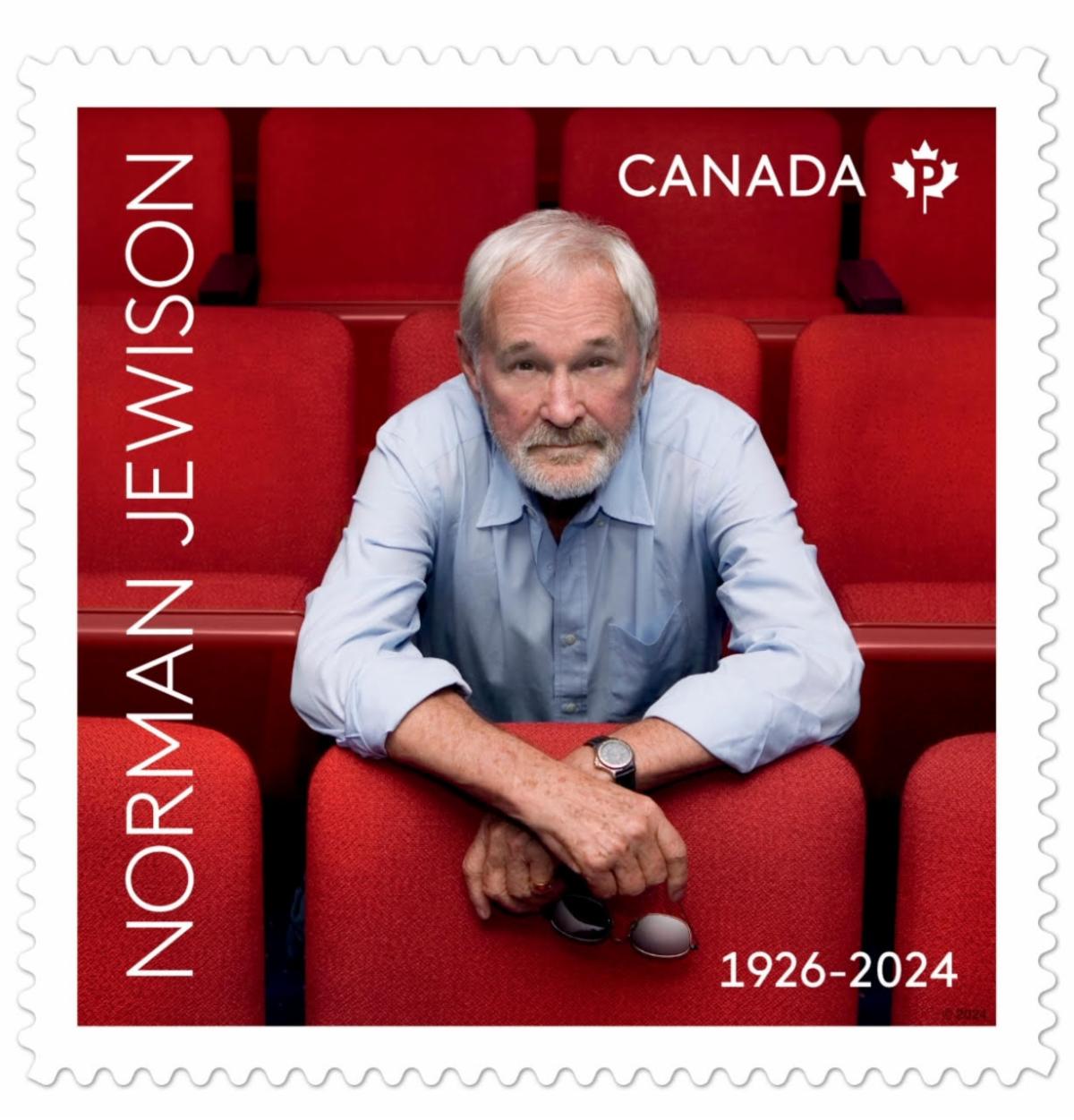 | |
Peter Bregg - I left AP in July 1989 to return to Canada in Toronto to work for Canada’s weekly newsmagazine, Maclean’s. Our company launched a Canadian edition of HELLO! in 2006.
Before retiring in 2009 I shot this photo of director Norm Jewison in 2007, (In the Heat of the Night (1967), Fiddler on the Roof (1971) and Moonstruck (1987) and many others.
This past month it has come out on a postage stamp in Canada.
He personally chose this photo before passing away this past January.
AP sighting
Dick Lipsey - Here is an AP sighting from Geoffrey Cox, Countdown to War: A Personal Memoir of Europe, 1938-40.
Geoffrey Cox (1910-2008) was a New Zealand-born Rhodes Scholar at Oxford and foreign and war correspondent with British newspapers including the Daily Express, which had a circulation over two million in the 1930s. He covered the Spanish Civil War and was a correspondent in Vienna, Prague, and Paris in the run-up to World War II, in Finland during the Russian invasion, and in Belgium when the German army invaded in May 1940. Though Cox was 30 and was married with two young sons, he enlisted in a New Zealand army unit in Britain after the fall of France and served in Greece, Crete, and other locations. He was a close friend of Eric Sevareid.
“In the afternoon [of 9 May] I drove northwards through Antwerp towards the Dutch border to see what signs there might be of extra preparedness against invasion. I went with Bob Okin, of the Associated Press of America, and his lovely Spanish wife Pepita. He had married her during the Civil War, and was deeply worried for her safety, should the Germans overrun Europe, for she had been ardently anti-Franco.”
[In Brussels on 10 May] “When dark fell I came out of the hotel with Okin to get dinner at a nearby restaurant. … It was like being thrust into a dark, narrow canyon. In one more country in Europe the lights had gone out.”
Cox escaped from France after the armistice and returned to England. “A month later I was marching along a Surrey road in battle dress and steel helmet, with familiar New Zealand voices around me, a rifle slung on my shoulder, and live ammunition in my webbing pouches.”
The only internet reference to Bob Okin (cq) of AP that I could find was from a brief newspaper account on the 80th anniversary in 2017 of the Hindenburg crash:
"Word went out as Robert Okin of The Associated Press telegraphed the news one minute later, according to AP Archives."
He was apparently sent to cover the Spanish Civil War at some point after this.
The punctuation in the excerpt is as written. Cox is not to be confused with a recent British politician of the same name.
This is a fascinating, well-written book by a reporter who was on the scene at crisis points before and in the early stages of World War II. I hope it's usable. It seemed to require a lot of context since Cox is not well-known.
Seeing the sights of Canada
| 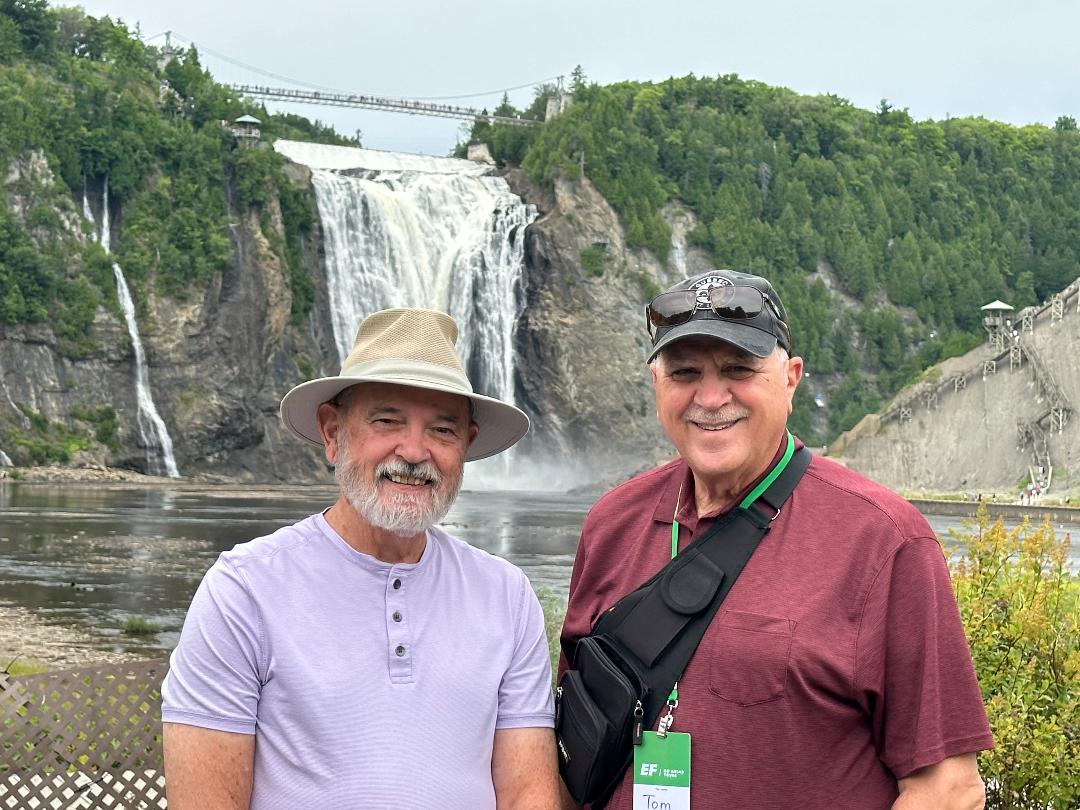 | |
Two Connecting members, Michael Embry (left) and Tom Throne, and their wives, Mary and Pam, respectively, recently meet and joined a 23-person Canadian trip, visiting the sights in Toronto, Ottawa, Quebec and Montreal.
Embry, former Lexington, Ky., AP correspondent and sportswriter, spends his retirement years traveling, reading, and as a novelist. He also had stints at Louisville, Milwaukee and New York during his nearly 18 years with AP.
Throne spent more than 40 years working for newspapers in Kansas, Missouri and Arkansas. He spends his retirement traveling, reading and participating in the Bella Vista Rotary Club. He is a 2018 inductee of the Kansas Newspaper Hall of Fame.
They are pictured at Montmorency Falls near Quebec. Montmorency Falls is 100-feet taller than Niagara Falls.
| |
Connecting wishes Happy Birthday | |
|
Stories of interest
ABC News names longtime producer Karamehmedovic as network news division chief (AP)
NEW YORK (AP) — Veteran producer Almin Karamehmedovic, who’s been the top behind-the-scenes executive at “World News Tonight” since 2014, has been named ABC News president, the network announced on Monday.
He replaces Kim Godwin, who retired after three years in May.
(A Mediaite story said “Karamehmedovic cut his teeth at the Associated Press, where he served as a globe-trotting field producer.”)
Godwin faced some internal strife, in part, because she was an outsider: she came to ABC News from an executive role at CBS. Karamehmedovic, by contrast, has worked at ABC News since he was a freelance video editor based in London in 1998.
He covered many international stories for ABC News before moving to the U.S. in 2008 and taking over as executive producer of “Nightline.”
“Almin has devoted his career to ABC News, mastering every role and elevating excellence in journalism by connecting with viewers in a very meaningful and profound way,” said Debra O’Connell, the Disney News Group and Networks president who will be his boss.
Read more here. Shared by Doug Pizac.
-0-
We Were There: The 1968 Democratic Convention (History.com)
By DORIS KEARNS GOODWIN
“It was a dismal time,” my husband Dick recalled one morning in 2016, after opening an overflowing box of materials he had saved from the 1968 Democratic Convention in Chicago. Inside, we found delegate guides, memos, newspaper clippings, voter surveys and a splintered police club—a gruesome symbol of the violent encounters between police and anti-Vietnam war protesters that would doom Democratic election hopes and ultimately help to christen the successful “Law and Order” campaign of Richard Nixon.
On a personal level, that box brought back vivid memories of our experiences at the convention: on my side, a surprise phone call from then-President Lyndon Johnson—and on Dick’s, a moving candlelit procession and a harrowing police encounter.
The ’68 convention boxes were among some 300 boxes of letters, diaries, documents and memorabilia that Dick had carted around for 50 years. Once he turned 80, he had finally decided to examine these boxes, which turned out to be a veritable time capsule of the Sixties.
Over the course of that tumultuous decade, he had worked as senior adviser and speechwriter to two presidents—John F. Kennedy and Lyndon B. Johnson—as well as to two influential hopefuls: Senator Eugene McCarthy and former attorney general, Robert F. Kennedy. After Bobby died, McCarthy had asked Dick to take charge of the process of drafting a peace plank for the convention platform, to codify the party's political will to end the Vietnam War.
Read more here. Shared by Paul Albright.
| |
AP classes, by the year...
(EDITOR'S NOTE: This is a listing of Connecting colleagues who have shared the year and the bureau where they started with the AP. If you would like to share your own information, I will include it in later postings. Current AP staffers are also welcome to share their information.)
1951 - Norm Abelson (Boston)
1953 – Charles Monzella (Huntington, WVa)
1955 – Henry Bradsher (Atlanta), Paul Harrington (Boston), Joe McGowan (Cheyenne)
1957 - Louis Uchitelle (Philadelphia)
1958 – Roy Bolch (Kansas City)
1959 – Charlie Bruce (Montgomery)
1960 – Claude Erbsen (New York), Carl Leubsdorf (New Orleans)
1961 – Peter Arnett (Jakarta, Indonesia), Strat Douthat (Charleston. WVa), Warren Lerude (San Diego), Ed Staats (Austn)
1962 – Paul Albright (Cheyenne), Malcolm Barr Sr. (Honolulu), Myron Belkind (New York), Dave Mazzarella (Newark), Peggy Simpson (Dallas), Kelly Smith Tunney (Miami)
1963 – Hal Bock (New York), Jeff Williams (Portland OR)
1964 – Rachel Ambrose (Indianapolis), Larry Hamlin (Oklahoma City), John Lengel (Los Angeles), Ron Mulnix (Denver), Lyle Price (San Francisco), Arlene Sposato (New York), Karol Stonger (Indianapolis), Hilmi Toros (New York)
1965 – Bob Dobkin (Pittsburgh), Harry Dunphy (Denver), John Gibbons (New York), Bob Greene (Kansas City), Jim Luther (Nashville), Larry Margasak (Harrisburg), Rich Oppel (Tallahassee)
1966 – Shirley Christian (Kansas City), Mike Doan (Portland, OR), Edie Lederer (New York), Nancy Shipley (Nashville), Mike Short (Los Angeles), Marty Thompson (Seattle), Nick Ut (Saigon), Kent Zimmerman (Chicago)
1967 – Dan Berger (Los Angeles), Adolphe Bernotas (Concord), Lou Boccardi (New York), Linda Deutsch (Los Angeles), Don Harrison (Los Angeles), Frank Hawkins (New York), Doug Kienitz (Cheyenne), David Liu (New York), Bruce Lowitt (Los Angeles), Chuck McFadden (Los Angeles), Martha Malan (Minneapolis), Bill Morrissey (Buffalo), Larry Paladino (Detroit), Michael Putzel (Raleigh), Bruce Richardson (Chicago), Richard Shafer (Baltimore), Victor Simpson (Newark), Michael Sniffen (Newark), Kernan Turner (Portland, Ore)
1968 – Lee Balgemann (Chicago), John Eagan (San Francisco), Joe Galu (Albany/Troy), Peter Gehrig (Frankfurt), Charles Hanley (Albany), Jerry Harkavy (Portland, Maine), Herb Hemming (New York), Brian King (Albany), Samuel Koo (New York), Karren Mills (Minneapolis), Michael Rubin (Los Angeles), Rick Spratling (Salt Lake City), Barry Sweet (Seattle)
1969 - Ann Blackman (New York), Ford Burkhart (Philadelphia), Dick Carelli (Charleston, WVa), Dennis Coston (Richmond), Mary V. Gordon (Newark), Daniel Q. Haney (Portland, Maine), Mike Harris (Chicago), Brad Martin (Kansas City), David Minthorn (Frankfurt), Cynthia Rawitch (Los Angeles), Bob Reid (Charlotte), Mike Reilly (New York), Doug Tucker (Tulsa), Bill Winter (Helena)
1970 – Richard Boudreaux (New York), Sibby Christensen (New York), Richard Drew (San Francisco), Bob Egelko (Los Angeles), Steve (Indy) Herman (Indianapolis), Tim Litsch (New York), Lee Margulies (Los Angeles), Chris Pederson (Salt Lake City), Brendan Riley (San Francisco), Larry Thorson (Philadelphia)
1971 – Harry Atkins (Detroit), Jim Bagby (Kansas City), Larry Blasko (Chicago), Jim Carlson (Milwaukee), Jim Carrier (New Haven), Chris Connell (Newark), Bill Gillen (New York), Bill Hendrick (Birmingham), John Lumpkin (Dallas), Kendal Weaver (Montgomery)
1972 – Hank Ackerman (New York), Bob Fick (St. Louis), Joe Frazier (Portland, Ore.), Terry Ganey (St. Louis), Mike Graczyk (Detroit), Denis Gray (Albany), Lindel Hutson (Little Rock), Brent Kallestad (Sioux Falls), Tom Kent (Hartford), Nolan Kienitz (Dallas), Andy Lippman (Phoenix), Ellen Miller (Helena), Mike Millican (Hartford), Bruce Nathan (New York), Ginny Pitt Sherlock (Boston), Lew Wheaton (Richmond)
1973 - Jerry Cipriano (New York), Susan Clark (New York), Norm Clarke (Cincinnati), Marty Crutsinger (Miami), Jim Drinkard (Jefferson City), Joe Galianese (East Brunswick), Merrill Hartson (Richmond), Mike Hendricks (Albany), Tom Journey (Tucson), Steve Loeper (Los Angeles), Jesus Medina (New York), Tom Slaughter (Sioux Falls), Jim Spehar (Denver), Paul Stevens (Albany), Jeffrey Ulbrich (Cheyenne), Owen Ullmann (Detroit), Suzanne Vlamis (New York), John Willis (Omaha), Evans Witt (San Francisco)
1974 – Norman Black (Baltimore), David Espo (Cheyenne), Dan George (Topeka), Robert Glass (Philadelphia), Steve Graham (Helena), Tim Harper (Milwaukee), Elaine Hooker (Hartford), Sue Price Johnson (Charlotte), Dave Lubeski (Washington), Janet McConnaughey (Washington), Lee Mitgang (New York), Barry Shlachter (Tokyo), Bud Weydert (Toledo), Marc Wilson (Little Rock)
1975 – Peter Eisner (Columbus), Jim Limbach (Washington), Bill McCloskey (Washington), David Powell (New York), Eileen Alt Powell (Milwaukee)
1976 – Brad Cain (Chicago), Judith Capar (Philadelphia), Dick Chady (Albany), Steve Crowley (Washington), David Egner (Oklahoma City), Marc Humbert (Albany), Steven Hurst (Columbus), Richard Lowe (Nashville), Mike Mcphee (Boston), John Nolan (Nashville), Charlotte Porter (Minneapolis), Chuck Wolfe (Charlotte)
1977 – Bryan Brumley (Washington), Robert Burns (Jefferson City), Charles Campbell (Nashville), Carolyn Carlson (Atlanta), Dave Carpenter (Philadelphia), Jim Drinkard (Jefferson City), Ken Herman (Dallas), Mike Holmes (Des Moines), Brad Kalbfeld (New York), Scott Kraft (Jefferson City), John Kreiser (New York), Peter Leabo (Dallas), Kevin LeBoeuf (Los Angeles), Jim Limbach (Washington), Ellen Nimmons (Minneapolis), Dan Sewell (Buffalo), Estes Thompson (Richmond), David Tirrell-Wysocki (Concord)
1978 – Tom Eblen (Louisville), Ruth Gersh (Richmond), Monte Hayes (Caracas), Doug Pizac (Los Angeles), Charles Richards (Dallas), Reed Saxon (Los Angeles), Steve Wilson (Boston)
1979 – Jim Abrams (Tokyo), Brian Bland (Los Angeles), Scotty Comegys (Chicago), John Daniszewski (Philadelphia), Frances D’Emilio (San Francisco), Pat Fergus (Albany), Brian Friedman (Des Moines), Sally Hale (Dallas), Susana Hayward (New York), Jill Lawrence (Harrisburg), Warren Levinson (New York), Barry Massey (Kansas City), Phillip Rawls (Nashville), John Rice (Carson City), Linda Sargent (Little Rock), Joel Stashenko (Albany), Robert Wielaard (Brussels)
1980 – Alan Adler (Cleveland), Christopher Bacey (New York), Jeff Barnard (Providence), Mark Duncan (Cleveland), Bill Kaczor (Tallahassee), Mitchell Landsberg (Reno), Kevin Noblet (New Orleans), Jim Rowley (Baltimore), David Speer (Jackson), Hal Spencer (Providence), Carol J. Williams (Seattle)
1981 – Paul Davenport (Phoenix), Dan Day (Milwaukee), John Flesher (Raleigh), Debra Hale-Shelton (Little Rock), Len Iwanski (Bismarck), Ed McCullough (Albany), Drusilla Menaker (Philadelphia), Kim Mills (New York), Mark Mittelstadt (Des Moines), Roland Rochet (New York), Lee Siegel (Seattle), Marty Steinberg (Baltimore), Bill Vogrin (Kansas City)
1982 – Dorothy Abernathy (Little Rock), Al Behrman (Cincinnati), Tom Cohen (Jefferson City), John Epperson (Chicago), Ric Feld (Atlanta), Nick Geranios (Helena), Howard Gros (New Orleans), Robert Kimball (New York), Rob Kozloff (Detroit), Bill Menezes (Kansas City), David Ochs (New York), Cecilia White (Los Angeles)
1983 – Donna Cassata (Albany), Scott Charton (Little Rock), Sue Cross (Columbus), Mark Elias (Chicago), David Ginsburg (Washington), Diana Heidgerd (Miami), Sheila Norman-Culp (New York), Carol Esler Ochs (New York), Jim Reindl (Detroit), Amy Sancetta (Philadelphia), Rande Simpson (New York), Dave Skidmore (Milwaukee)
1984 – Owen Canfield (Oklahoma City), Wayne Chin (Washington), Jack Elliott (Oklahoma City), Kelly P. Kissel (New Orleans), Joe Macenka (Richmond), Eva Parziale (San Francisco), Walt Rastetter (New York), Keith Robinson (Columbus), Cliff Schiappa (Kansas City), David Sedeño (Dallas), Andrew Selsky (Cheyenne), Patty Woodrow (Washington)
1985 – Beth Grace (Columbus), Betty Kumpf Pizac (Los Angeles)
1986 – Joni Baluh Beall (Richmond), David Beard (Jackson), Tom Coyne (Columbia, SC), Dave DeGrace (Milwaukee), Alan Flippen (Louisville), Jim Gerberich (San Francisco), Howard Goldberg (New York), Mark Hamrick (Dallas), Sandy Kozel (Washington), Arlene Levinson (Boston), Robert Meyers (London), David Morris (Harrisburg)
1987 – Donna Abu-Nasr (Beirut), Dave Bauder (Albany), Chuck Burton (Charlotte), Beth Harris (Indianapolis), Lynne Harris (New York), Steven L. Herman (Charleston, WVa), Elaine Kurtenbach (Tokyo), Rosemarie Mileto (New York), John Rogers (Los Angeles)
1988 – Chris Carola (Albany), Peg Coughlin (Pierre), Kathy Gannon (Islamabad), Steve Hart (Washington), Melissa Jordan (Sioux Falls), Bill Pilc (New York), Kelley Shannon (Dallas)
1989 – Ted Bridis (Oklahoma City), Charlie Arbogast (Trenton), Ron Fournier (Little Rock)
1990 – Frank Fisher (Jackson), Dan Perry (Bucharest), Steve Sakson (Baltimore), Sean Thompson (New York)
1991 – Amanda Kell (Richmond), Santiago Lyon (Cairo), Lisa Pane (Hartford), Ricardo Reif (Caracas), Bill Sikes (Buffalo)
1992 – Kerry Huggard (New York)
1993 – Jim Salter (St. Louis)
1995 – Elaine Thompson (Houston), Donna Tommelleo (Hartford)
1996 – Patricia N. Casillo (New York)
1997 – J. David Ake (Chicago), Martha Bellisle (Carson City), Pamela Collins (Dallas), Madhu Krishnappa Maron (New York), Jim Suhr (Detroit), Jennifer Yates (Baltimore)
1998 – Alan Clendenning (New Orleans), Guthrie Collin (Albany)
1999 – Melinda Deslatte (Raleigh)
2000 – Gary Gentile (Los Angeles)
2004 - Jim Baltzelle (Dallas)
2005 – Ric Brack (Chicago)
2006 – Jon Gambrell (Little Rock)
| Today in History - Aug. 20, 2024 |  | |
Today is Tuesday, Aug. 20, the 233rd day of 2024. There are 133 days left in the year.
Today in history:
On Aug. 20, 1968, the Soviet Union and other Warsaw Pact nations invaded Czechoslovakia to crush the “Prague Spring” liberalization movement.
Also on this date:
In 1858, Charles Darwin’s theory of evolution was first published, in the “Journal of the Proceedings of the Linnean Society”.
In 1862, the New York Tribune published an open letter by editor Horace Greeley calling on President Abraham Lincoln to take more aggressive measures to free enslaved people and end the South’s rebellion.
In 1866, President Andrew Johnson declared the official end of the Civil War.
In 1882, Tchaikovsky’s “1812 Overture” had its premiere in Moscow.
In 1910, a series of wildfires swept through parts of Idaho, Montana and Washington, killing at least 85 people and burning some 3 million acres.
In 1920, the American Professional Football Conference was established by representatives of four professional football teams; two years later, with 18 teams, it would be renamed the National Football League.
In 1940, exiled Communist revolutionary Leon Trotsky was attacked in Coyoacan, Mexico by assassin Ramon Mercader. (Trotsky died the next day.)
In 1964, President Lyndon B. Johnson signed into law the Economic Opportunity Act, a nearly $1 billion anti-poverty measure.
In 1986, postal employee Patrick Henry Sherrill went on a deadly rampage at a post office in Edmond, Oklahoma, shooting 14 fellow workers to death before killing himself.
In 1989, 51 people died when the pleasure boat Marchioness sank in the River Thames (tehmz) in London after being struck by a dredger.
In 2012, after 80 years in existence, Georgia’s Augusta National golf club (home to the Masters Tournament) invited former Secretary of State Condoleezza Rice and South Carolina financier Darla Moore to become its first female members; both accepted.
In 2023, Tropical Storm Hilary struck Baja California, killing three and causing $15 million in damage.
Today’s Birthdays: Boxing promoter Don King is 93. Former U.S. Senator and diplomat George Mitchell is 91. Former U.S. Rep. Ron Paul, R-Texas, is 89. Broadcast journalist Connie Chung is 78. Rock singer Robert Plant is 76. Country singer Rudy Gatlin is 72. Singer-songwriter John Hiatt is 72. Actor-director Peter Horton is 71. TV weather presenter Al Roker is 70. Actor Joan Allen is 68. Movie director David O. Russell is 66. Rapper KRS-One (Boogie Down Productions) is 59. Actor Colin Cunningham is 57. Actor Billy Gardell is 55. Rock singer Fred Durst (Limp Bizkit) is 54. Actor Ke Huy Quan is 53. Baseball Hall of Famer Todd Helton is 51. Actor Amy Adams is 50. Actor Misha Collins (TV: “Supernatural”) is 50. Actor Ben Barnes is 43. Actor Andrew Garfield is 41. Actor-singer Demi Lovato is 32.
| Got a photo or story to share? | |
Connecting is a daily newsletter published Monday through Friday that reaches 1,900 retired and former Associated Press employees, present-day employees, and news industry and journalism school colleagues. It began in 2013. Past issues can be found by clicking Connecting Archive in the masthead. Its author, Paul Stevens, retired from the AP in 2009 after a 36-year career as a newsman in Albany and St. Louis, correspondent in Wichita, chief of bureau in Albuquerque, Indianapolis and Kansas City, and Central Region vice president based in Kansas City.
Got a story to share? A favorite memory of your AP days? Don't keep them to yourself. Share with your colleagues by sending to Ye Olde Connecting Editor. And don't forget to include photos!
Here are some suggestions:
- Connecting "selfies" - a word and photo self-profile of you and your career, and what you are doing today. Both for new members and those who have been with us a while.
- Second chapters - You finished a great career. Now tell us about your second (and third and fourth?) chapters of life.
- Spousal support - How your spouse helped in supporting your work during your AP career.
- My most unusual story - tell us about an unusual, off the wall story that you covered.
- "A silly mistake that you make"- a chance to 'fess up with a memorable mistake in your journalistic career.
- Multigenerational AP families - profiles of families whose service spanned two or more generations.
- Volunteering - benefit your colleagues by sharing volunteer stories - with ideas on such work they can do themselves.
- First job - How did you get your first job in journalism?
- Most unusual place a story assignment took you.
Paul Stevens
Editor, Connecting newsletter
paulstevens46@gmail.com
| | | | |