|
|
|
Connecting
April 19, 2024
Click here for sound of the Teletype
| |
|
Colleagues,
Good Friday morning on this April 19, 2024,
When Connecting posed the question of whether our colleague Gene Herrick was the last Associated Press journalist to cover the Korean War, it struck a chord with our colleague Charlie Hanley – who has done extensive research of the war over the years.
(Hanley teamed with AP journalists SangHun Choe and Martha Mendoza to win the 2000 Pulitzer Prize in Investigative Reporting for revealing, with extensive documentation, the decades-old secret of how American soldiers early in the Korean War killed hundreds of Korean civilians in a massacre at the No Gun Ri Bridge.)
| |
Hanley located Jim Becker, who early in his career with the AP covered the major league baseball debut of Jackie Robinson before being assigned to coverage of the Korean War. Becker, 97, lives in Hawaii and was interviewed by Hanley for our lead story in today’s issue.
In view of Becker’s vision problems, any Connecting colleagues who would like to get in touch with Jim could do so through Charlie – cjhanley@att.net – who notes there is a terrific person in Honolulu who will read messages to him.
Which reminds me of a conversation I had with Gene Herrick’s longterm partner Kitty Hylton in a phone conversation after his death. “I want to make sure people who wrote Gene know how much their reaching out meant to him,” she said. “He got so many notes from Connecting friends, up through the final week of his life. They meant so much to him.”
So when we occasionally let you know of someone who might be buoyed by a note of support or concern from a colleague, please know that it is so appreciated and a great use of your time to do so.
Here’s to a great weekend – be safe, stay healthy, live each day to your fullest.
Paul
AP’s ‘last man standing’ from the Korean War
| 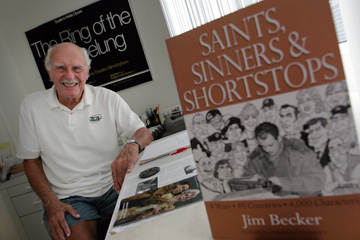 | |
Photo by RICHARD WALKER / RWALKER@STARBULLETIN.COM
Charlie Hanley -- When Jim Becker looks back on his journalism career at the AP and beyond, he himself sounds amazed at its globe-spanning variety and his good fortune right from the start, when this 20-year-old walked into 50 Rock in 1946, fresh from the war and the Army, and landed a reporting job. “I lied about my age,” he now confesses.
Within four years he was in Korea, joining a formidable band of AP brothers covering a dirty, vicious war. Today – to answer the question raised by Connecting editor Paul Stevens upon the death of Gene Herrick last week – Jim is almost certainly the last of that Pulitzer-winning band to remain standing.
And sounding great at 97 (“98 in August”), his voice strong, his humor infectious, his memory remarkably sharp and richly detailed.
When Paul in Tuesday’s Connecting wondered “Was Gene the last?”, I knew I had to work on an answer, since I’d done deep research on the Korean War over the years, including interviewing Jim Becker in 1999.
With help from old AP friends Dave Briscoe (ex-Honolulu COB) and Christine Donnelly (now with the HNL Star-Advertiser), I tracked Jim down to his retirement residence in Oahu.
It was the old Star-Bulletin in 1966 that lured Jim away from the AP and to a columnist’s role in the new state of Hawaii. He clearly made an impression in “HULA,” eventually becoming chairman of the Hawaiian Public Television Broadcast Authority and president of the Hawaiian Historical Society.
In his first AP years, he was a writer in Newsfeatures who sometimes pitched in with Sports, including on April 15, 1947, at Ebbets Field, for Jackie Robinson’s major-league debut. He ran Robinson’s locker-room quotes up to a senior writer in the press box. Jim believes he’s now also the “last reporter standing” from that historic day.
The AP sent the talented Becker to Korea in the fall of 1950, a few months after war broke out. He was there for the retreat of General Ridgway’s U.S. troops from Seoul in early January 1951, and then for the recapture of the Korean capital from the Chinese in March. He recalled that he and a platoon of fellow reporters and a few GIs crossed the Han River by boat into an abandoned city, to forever claim they had “liberated” it.
He continued reporting from the war front well into 1953, the year of the truce -- to my knowledge the longest any APer covered the Korean War.
From there he was assigned to the Tokyo buro as a “fireman,” covering some of the biggest Asia stories of the 1950s, including the Taiwan Strait Crisis of 1954-55 and interviewing Chiang Kai-shek. Next came Honolulu AP as buro chief, then back to the foreign service, as buro chief in Manila, then New Delhi, and finally Saigon in the early ‘60s, where “I had Roy Essoyan and Fred Waters on my staff.”
When Lyndon Johnson, as vice president, visited Vietnam in 1961, he sought out a reporter to get the “straight story.”
“When I told him I saw them blow China by backing a corrupt leader (Chiang), and now they were doing the same in Vietnam, he exploded. He called me – I’ll never forget it – a ‘no-good, stupid sonofabitch.’’’
Going full circle, Becker next returned to 50 Rock, now full time in Sports. The newly minted Mets of 1962 were no 1947 Dodgers (pennant winners), but he had fun. “I was the guy who dubbed him ‘Marvelous Marv,’” the moniker that stuck for the Mets’ error-prone first baseman Marv Throneberry.
Jim Becker was so well respected within the AP that in 1972, six years after he left, he was summoned from Honolulu by Wes Gallagher to help report on the Munich Olympics as a freelancer. Then, on the morning of Sept. 5, he was awakened early by a colleague to find the Olympic village in a state of siege. “I spent the next 36 hours on the typewriter,” reporting on the massacre of Israeli athletes by Palestinian terrorists.
Failing eyesight today keeps Jim from writing or reading. But, luckily, in 2006 Macmillan’s Celadon Press published Saints, Sinners and Shortstops, a Becker memoir that, judging from the reviews, is a wonderful read.
So long, Gene…
Norm Abelson - Sometimes a particular loss is felt more deeply than one expected. So it is for me with Gene Herrick's death.
It marks not only the loss of a great guy, but also leaves us bereft of his first-person perspectives on major current events, reflected against his venerable background.
Many attributes have already been on Connecting by those much closer to Gene. I first began to see the measure of the man when he told me there were times in Korea when he put down his camera to assist front-line medics carrying wounded comrades back to safety.
I can't count myself as a long-time friend. Gene was someone I came to know fairly recently, as a Connecting buddy and fellow member of its '90s roll-call. I'll especially miss our back-and forth kidding about age - he was later in his 90s than I, and thus claimed senior status.
Some folks are special. Gene was among them. I wish I had known him better.
Covering former Gov. Bob Graham
Carl P. Leubsdorf - I never regularly covered Graham but, in 1986, I made a trip in Florida with him when he was running successfully for the Senate. I have two indelible memories of that trip. One was that we had no longer been seated in the small plane he was using than Graham whipped out one of those small, color-coded notebooks in which he recorded every detail of his life, in this case the precise moment of our takeoff and landing. It was a quirky side of Graham that often appeared in profiles of him and suggested to some it might be a problem for him as a national candidate. (Still, I think if Al Gore had picked him over Joe Lieberman in 2000, there would have been no question about who carried Florida--and won the election.)
We were headed for the Miami area where Graham was doing a fundraiser in Coconut Grove with his good friend, Jimmy Buffett. After Buffett went through his standard repertoire, Graham went up on stage with him and the two sang a revised version of "Margaritaville" entitled "Tallahasseeville." It brought the house down, and I was told that it became a standard Graham shtick, especially at annual gatherings of the Tallahassee press corps. It may have been the most fun I ever had at a fundraiser except when the Beach Boys did one in Florida for George H.W. Bush during his 1980 primary campaign.
-0-
|  | |
David Powell - The passing of Bob Graham, the former Florida governor and senator, brought back many memories from my years in the AP’s Tallahassee bureau. By chance, I met him at a long-gone Cuban restaurant on my first day in town in 1976, when he was just a wealthy but ambitious state senator from Miami. He and his family were deadly serious about his ambition to be governor, an office that his father narrowly lost in 1944. So, the story goes, they set aside $1 million to bankroll Bob’s campaign, a pittance today but quite impressive in those days. It bought him the best political advice in the business.
I had a seat on his campaign plane during that 1978 run for governor, the one in which he famously worked 100 ordinary jobs that he called “Workdays.” It was derided by opponents and reporters but turned out to be a brilliant stratagem, devised largely by his television consultant Robert Squire. The underlying idea was that by working these jobs, he would build credibility with voters, diminish his wealth as an issue, and give Squire great video for TV ads. Equally important, workdays sent a cultural message that made him the candidate of conservative North Florida, because another Democratic candidate from Miami had tied up the South Florida vote.
As correspondent, I covered his first term. Much has been written about his friendship with Jimmy Buffett. One early episode was when Graham—who had been arguing for tough new drug penalties—held a press conference with Buffett to start a citizens’ group to save the endangered manatee. With Buffett looking on, I asked the governor how he could honor someone whose songs glorified the use of illegal drugs. Deadpan, he replied: “David, you obviously don’t understand those songs. They’re about the hopelessness and despair of drug use.” We got a lot of laughs about that in later years.
The repartee was always first-rate. In his 1982 re-election campaign, I was on his plane again. Coming back to Tallahassee after a week on the campaign trail, my wife Vicki planned to pick me up at the airport. The state air pool said they didn’t know when the governor would arrive, so she waited in her car on the tarmac. After we were on the ground, Bob saw me walking toward her and followed. My wife mentioned that the state air pool hadn’t known when he would arrive, and he instantly replied: “That’s because I always travel incognito when I’m with your husband.”
After I went to law school and began practice in Tallahassee, our paths crossed occasionally. If it was a public event, Bob always told his version of the Buffett press conference story, embellished with imaginary details that always got a laugh. In 2018, he was one of the last interviews for my oral history book on Cuban exiles. He was recovering from the flu and obviously felt poorly but insisted on doing the interview until I stopped it and told him to go home and to bed. We agreed we would resume later but never did.
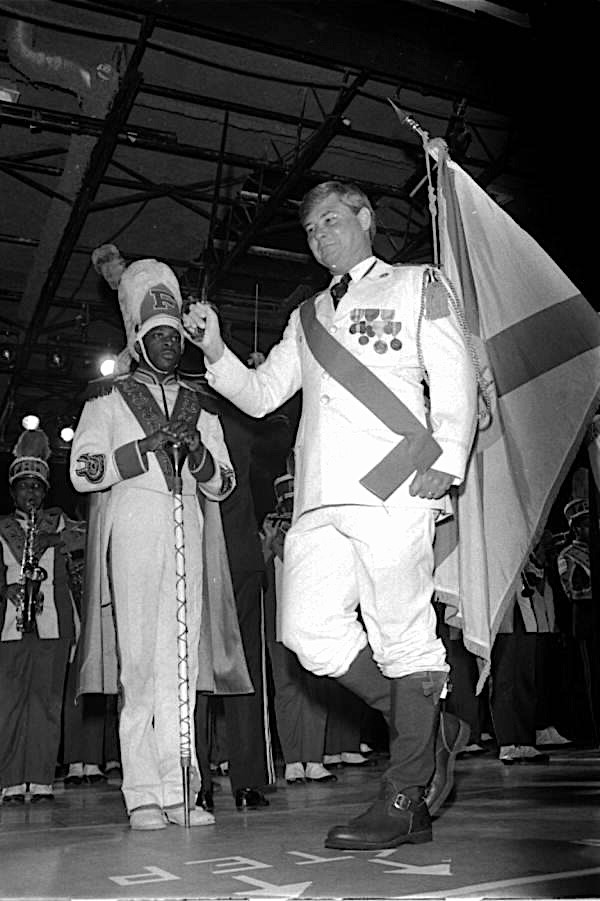
I will remember him as an admirable public servant, one of the finest I have ever known, not without faults, but always well-motivated and trying to make life better for everyone in Florida. I especially appreciated his self-deprecating humor, perhaps best demonstrated at the 1986 Press Corps Skits in his last year as governor just as he was preparing to run for the Senate. He strutted on-stage in a white dress uniform, backed up by the Florida A&M University marching band. Taking a cue from the Haitian dictator Francois Duvalier, he pronounced himself “Governor for Life.” I shall miss him. RIP, Bob Graham.
Your reviews of movie ‘Civil War’
David Briscoe - TO ALL JOURNALISTS AND FOLLOWERS OF THE NEWS: In case you thought otherwise, the movie CIVIL WAR is an artfully horrible depiction of journalism in an age of chaos. It's about people we all have known in circumstances we all have seen coming. It's about getting the right photo and the right quote from the right person at the right moment. It's about the naivetè of the young and the rage and bravery of the old in a profession itself a huge part of the chaos. It's about the mental and physical dangers faced by real reporters and real photographers. It's also about what could happen to our country if the wrong man is elected president. It's about guns and fire and bombs. It's about the collapse of a country's law enforcement, the judicial system and the country itself. It's about real people, real Americans, real rebellion and real piles of real bodies in real cities. I hated what it shows about my country. But I really think everybody I know needs to see it and feel it and understand what really could happen if too many of us chose to ignore what it says. And if Gettysburg really was "beautiful," the way one of our presidential candidates believes it was, then this movie about another Civil War is just damn gorgeous.
-0-
Mike Doan - I walked out of the movie after the first hour. Reporters were gleefully snapping photographs while being shot at. They climbed through windows from a moving car into another moving car. Dialogue and acting were lame. There were meaningless stretches. I’m told the ending was good. So I’ll see that—when it’s on TV.
-0-
Tim Harper - I, too, am glad I watched "Civil War" (in an actual theater, no less -- it was deafening) but wouldn't want to see it again. As movie legend Paul Schrader said, it was disturbing in a different way than many dystopian tales that show us what the world might be in the future; "Civil War" showed us what the world can be NOW. My biggest problem with the story was that the journalists never seemed to act like journalists. They never filed. The guy who was supposed to be the writer never showed a pen or notebook or recorder, and never took a note. I don't want to spoil the ending, but the journalism part of that was pretty disappointing, too. I'll be curious about what other Connectors think.
-0-
Lee Margulies - As you no doubt know, Frank Bruni is a columnist for the New York Times. He also writes a newsletter for NYT subscribers who choose to get it, which is a combination of something he may have written for publication and other personal observations. In the latter vein, here’s something that came to my mailbox from him today. I’m quite certain Connecting readers will enjoy it, however you choose to work it in:
Frank Bruni - Before I went to see “Civil War” last weekend, I must have read more than a dozen reviews and feature stories about it, but I somehow didn’t fully register that journalists were at the center of the movie.
Yes, it’s a hellish vision of the United States gone to bloody pieces, and it’s concerned above all with what could happen if we didn’t keep our rivalries, recriminations and automatic weapons in check. But it’s told through the eyes and actions of four journalists trying to make their way from New York to Washington and chronicling the mayhem and corpses en route.
And it asks two familiar, arguably tired questions about the writers and photographers who routinely come face to face with the worst of human nature. Do we become scarily numb to it? So that we in fact lose a bit of our own humanity, unable to take proper moral and emotional inventory of what we see?
Interestingly, another popular, enduring question about journalists — one that Donald Trump’s defenders constantly raise — is almost the opposite of that one. Are we too invested, our rooting interests warping our coverage of events? Do we fail to take our own biases and beliefs out of the equation?
My answers to the above are as muddled and unsatisfying as much of the rest of life.
I have indeed met fellow journalists who are all scar tissue and stone — though I can’t say for sure that they weren’t that way at the start. I have met as many journalists who are achingly vulnerable, their unflagging sensitivity the very engine of their efforts.
I know journalists who are intensely ethical about — and committed to — identifying and adjusting for any prejudices they might harbor. I know journalists whose convictions are simply too deep and strong to allow that.
And I know journalists whose careerism overrides all of those dynamics.
Journalists: We’re people, not abstractions. Like everybody else.
Our profession is an essential, honorable one, and I believe that it includes a disproportionate share of civic-minded idealists. But of course, it attracts all kinds. And the movies that seek grand truths about us are on a fool’s errand. There are many truths about us, only some of them grand.
| Connecting wishes Happy Birthday | |
|
Stories of interest
Judge in Trump case orders media not to report where potential jurors work (AP)
BY DAVID BAUDER AND LARRY NEUMEISTER
NEW YORK (AP) — The judge in Donald Trump’s hush money trial ordered the media on Thursday not to report on where potential jurors have worked and to be careful about revealing information about those who will sit in judgment of the former president.
Judge Juan Merchan acted after one juror was dismissed when she expressed concerns about participating in the trial after details about her became publicly known.
The names of the jurors are supposed to be a secret, but the dismissed juror told Merchan she had friends, colleagues and family members contacting her to ask whether she was on the case. “I don’t believe at this point I can be fair and unbiased and let the outside influences not affect my decision-making in the courtroom,” she said.
Merchan then directed journalists present in the courthouse not to report it when potential jurors told the court their specific workplaces, past or present. That put journalists in the difficult position of not reporting something they heard in open court.
Read more here.
-0-
U.S. Envoy to Russia Visits Jailed WSJ Reporter Evan Gershkovich (Wall Street Journal)
By Ann M. Simmons
The U.S. ambassador to Russia visited Evan Gershkovich, the Wall Street Journal reporter who has been in custody in Moscow awaiting trial for more than a year, as negotiations continue behind closed doors to secure the American’s release.
The U.S. Embassy in Moscow said Thursday that Lynne Tracy met with Gershkovich at the notorious Lefortovo Prison in Moscow, where he is being held on an allegation of espionage that he, the Journal and the U.S. government strongly deny.
“Despite the continued wait for the start of his trial, Evan remains in good spirits, buoyed by the continued messages of support,” the embassy said in a message posted on the social media platform X, adding the hashtag that journalism is not a crime.
The Journal said in a statement that “every day Evan remains in prison increases the urgency for his release. We are appreciative of the Ambassador’s continued support to monitor and ensure his well-being.”
Russia’s Federal Security Service, or FSB, detained Gershkovich, who was accredited to work as a journalist by Russia’s Foreign Ministry, on March 29 last year while he was on a reporting assignment in the Russian city of Yekaterinburg. Russian investigators haven’t publicly presented evidence to back up their allegation against the 32-year-old reporter. Russia has said that it is acting in accordance with its laws.
Read more here. Shared by Dennis Conrad.
-0-
NPR needs a serious critique not a politically charged parting shot (Guardian)
Margaret Sullivan
It took only days from Uri Berliner’s publishing his fiery essay about his employer, NPR, to his suspension, to his resignation in a blaze of bad-faith glory.
“You knew the martyrdom was coming,” was how journalist Issac Bailey put it.
And that’s a shame, because every news organization – National Public Radio included – could benefit from more self-scrutiny, more openness to criticism, more willingness to change.
Berliner’s critique made some points worth pondering as he professed how much he loved the place he had worked for decades but with which he had become disillusioned. He called for a diversity of viewpoints to accompany – or counter – NPR’s pursuit of other forms of diversity.
Read more here.
-0-
Caitlin Clark Gets Apology From Reporter After Viral Press Conference Gaffe: ‘I’m Part of the Problem’ (TV Line)
BY REBECCA IANNUCCI
Basketball phenom and recent WNBA recruit Caitlin Clark has received an apology for an uncomfortable moment during her Indiana Fever press conference on Wednesday.
In an interaction that quickly went viral after Clark’s introductory presser with her new team, Indianapolis Star reporter Gregg Doyel began his question to Clark by giving her the same heart-hands gesture she often flashes to the crowd during basketball games.
“You like that?” Clark asked upon seeing the gesture, to which Doyel responded, “I like that you’re here.”
“I do that at my family after every game, so it’s pretty cool,” Clark answered, prompting this reply from Doyel: “OK, well, start doing it to me, and we’ll get along just fine.”
Read more here.
| |
AP Today in History - April 19, 2024 |  | |
Today is Friday, April 19, the 110th day of 2024. There are 256 days left in the year.
ON THIS DATE IN HISTORY
On April 19, 1993, the 51-day siege at the Branch Davidian compound near Waco, Texas, ended as fire destroyed the structure after federal agents began smashing their way in; about 80 people, including two dozen children and sect leader David Koresh, were killed. Then on the same date in 1995, Timothy McVeigh, seeking to strike at the government he blamed for the Waco deaths, destroyed the Alfred P. Murrah Federal Building in Oklahoma City, killing 168 people. (McVeigh was convicted of federal murder charges and executed in 2001.)
1775 — The American Revolutionary War began with the battles of Lexington and Concord.
1865 — A funeral was held at the White House for President Abraham Lincoln, assassinated five days earlier; his coffin was then taken to the US Capitol for a private memorial service in the Rotunda.
1897 — The first Boston Marathon was held; winner John J. McDermott ran the course in two hours, 55 minutes and 10 seconds.
1912 — A special subcommittee of the Senate Commerce Committee opened hearings in New York into the Titanic disaster.
1943 — During World War II, tens of thousands of Jews in the Warsaw Ghetto began a valiant but ultimately futile uprising against Nazi forces.
1977 — The Supreme Court, in Ingraham v. Wright, ruled 5-4 that even severe spanking of schoolchildren by faculty members did not violate the Eighth Amendment ban against cruel and unusual punishment.
1989 — Forty-seven sailors were killed when a gun turret exploded aboard the USS Iowa in the Caribbean.
2005 — Cardinal Joseph Ratzinger of Germany was elected pope in the first conclave of the new millennium; he took the name Benedict XVI.
2012 — Levon Helm, drummer and singer for The Band, died in New York City at age 71.
2013 — Dzhokhar Tsarnaev, a 19-year-old college student wanted in the Boston Marathon bombings, was taken into custody after a manhunt that had left the city virtually paralyzed; his older brother and alleged accomplice, 26-year-old Tamerlan, was killed earlier in a furious attempt to escape police.
2015 — Freddie Gray, a 25-year-old Black man, died a week after suffering a spinal cord injury in the back of a Baltimore police van while he was handcuffed and shackled. (Six police officers were charged; three were acquitted and the city’s top prosecutor eventually dropped the three remaining cases.)
2017 — Fox News Channel’s parent company fired Bill O’Reilly following an investigation into harassment allegations, bringing a stunning end to cable news’ most popular program.
2018 — Raul Castro turned over Cuba’s presidency to Miguel Mario Diaz-Canel Bermudez, the first non-Castro to hold Cuba’s top government office since the 1959 revolution led by Fidel Castro and his younger brother Raul.
2022 — Russia assaulted cities and towns along a boomerang-shaped front hundreds of miles long and poured more troops into Ukraine in a pivotal battle for control of the country’s eastern industrial heartland of coal mines and factories.
2023 — A Pennsylvania grand jury accused nine men with connections to the Jehovah’s Witnesses of child sexual abuse.
TODAY’S BIRTHDAYS - Actor Elinor Donahue is 87. Rock musician Alan Price (The Animals) is 82. Actor Tim Curry is 78. Pop singer Mark “Flo” Volman (The Turtles; Flo and Eddie) is 77. Actor Tony Plana is 72. Former tennis player Sue Barker is 68. Motorsports Hall of Famer Al Unser Jr. is 62. Actor Tom Wood is 61. Former recording executive Suge Knight is 59. Singer-songwriter Dar Williams is 57. Actor Kim Hawthorne (TV: “Greenleaf”) is 56. Actor Ashley Judd is 56. Singer Bekka Bramlett is 56. Latin pop singer Luis Miguel is 54. Actor Jennifer Esposito is 52. Actor Jennifer Taylor is 52. Jazz singer Madeleine Peyroux is 50. Actor James Franco is 46. Actor Kate Hudson is 45. Actor Hayden Christensen is 43. Actor vis 43. Actor-comedian Ali Wong is 42. Actor Victoria Yeates is 41. Actor Kelen Coleman is 40. Actor Zack Conroy is 39. Actor Courtland Mead is 37. Retired tennis player Maria Sharapova is 37. NHL forward Patrik Laine is 26.
| Got a photo or story to share? | |
|
Connecting is a daily newsletter published Monday through Friday that reaches more than 1,800 retired and former Associated Press employees, present-day employees, and news industry and journalism school colleagues. It began in 2013. Past issues can be found by clicking Connecting Archive in the masthead. Its author, Paul Stevens, retired from the AP in 2009 after a 36-year career as a newsman in Albany and St. Louis, correspondent in Wichita, chief of bureau in Albuquerque, Indianapolis and Kansas City, and Central Region vice president based in Kansas City.
Got a story to share? A favorite memory of your AP days? Don't keep them to yourself. Share with your colleagues by sending to Ye Olde Connecting Editor. And don't forget to include photos!
Here are some suggestions:
- Connecting "selfies" - a word and photo self-profile of you and your career, and what you are doing today. Both for new members and those who have been with us a while.
- Second chapters - You finished a great career. Now tell us about your second (and third and fourth?) chapters of life.
- Spousal support - How your spouse helped in supporting your work during your AP career.
- My most unusual story - tell us about an unusual, off the wall story that you covered.
- "A silly mistake that you make"- a chance to 'fess up with a memorable mistake in your journalistic career.
- Multigenerational AP families - profiles of families whose service spanned two or more generations.
- Volunteering - benefit your colleagues by sharing volunteer stories - with ideas on such work they can do themselves.
- First job - How did you get your first job in journalism?
- Most unusual place a story assignment took you.
Paul Stevens
Editor, Connecting newsletter
paulstevens46@gmail.com
| | | | |