logo
Hey Crew,

This week's contents:

Info on ESP RAW DVD 180
Boxing/Rough & Tumble Fighting/The Single-Underhook/A Double Wristlock Jamboree

In this week's Video Clip we use the good ol' Far-Arm Breakdown to set-up the mighty useful Reverse-Lever Choke/Neck-Crank. Big thanks to Felix Bernatchez of Kris Iatskevich's mighty crew for the use of the neck!
 
[ Rough & Tumblers, preview of the upcoming RAW. Ever wonder why fisticuffs was called fisticuffs? We'll be going into great depth to work this hand-saving work.]
 
This week's feature article is a lengthy historical look at why we might stand bass-ackwards when choosing a combat stance.
Read on!


Our newest Paladin DVD Boxing Like the Champs has been released, details below...


And last, but not least, check out the ESP RAW Subscription service info. You can save yourself some money on this volume of RAW ($5.50 to be exact) and pick up 3 more volumes of RAW absolutely free. And become a member of the Vale Alliance absolutely free.

Thanks everyone and have a great weekend!
Sincerely,

Mark Hatmaker
Extreme Self Protection
ESP RAW 180
 
Boxing/Rough & Tumble/Dirty-Boxing/Catch-Jitsu

ESP RAW 180 is another jam-packed omnibus volume, we cover Boxing, Rough & Tumble, Dirty Boxing, and some Catch-Jitsu.
Here's a little of what's included.

BOXING -We'll analyze the two primary ways to throw a jab to the body. Pay close attention to these as you will see similar mechanics coming up in our historical Bowie knife-work.

On the Rough & Tumble side of things we'll start our examination of "blading" or "chopping."
  • We'll detail the 6-Primary Targets and...
  • Hit 10 Power Drills to let fly this beast from all angles.
Continuing our Clinch-Work which is a must have for submission grappling, street, MMA, and a huuuuge part of Rough & Tumble we begin taking apart the Underhook Control.
  • We'll drill 3 Transitions to Underhook from the Outside and...
  • Two Transitions from Inside the Clinch itself to get you out of the pummeling run-around.
On the CATCH-JITSU  side of things we'll keep delving deeper and deeper into Double-Wristlock territory with how many submissions18. 
That's right, 18 submissions making this mighty useful workhorse even more usefuler.

There you have it, 4 Pragmatic Sectors of old School Combat and 41Tactics & Drills.

[Be advised-there will be a lag in shipping from October 7-16 as the ocean requires me to sea-kayak, swim with dolphins, and in general enjoy myself.]

ESP RAW 180 can be had this month for $32 (S & H included--Domestic & International) at the end of the month the price goes to $42 Domestic/$52 International.  (Of course, it's only $26.50 for the RAW Crew.)

undefined

To pay only $26.50 for this DVD + receive 3 other RAW DVDs for free and gain free membership to the Vale Alliance, subscribe to our  ESP RAW DVD Service.

Kittens, Hoplites, & Combat Stances
Mark Hatmaker

Do you have a kitten?

If so, go play with it, dangle something in front of it, activate its play-fighting mode. Watch it bat at the stand-in enemy with a forepaw.

If you don't have a kitten, perhaps a dog?

Go play with it. Rile him up a bit and toss a toy on the ground watch him pin that toy with a forepaw and go to work with the jaws.
No dogs, no kittens in the house? How about a toddler?

If you have an 18-36-month-old human around the house go play with them. Roll a ball with them and watch them pick it up or roll it back.

No kitties, no dogs, no toddlers? Well, let's have you try something.
While reading this, look around a pick up the nearest small object within your reach.

Now that we've all played with our pets, or our kids, or at the very least picked up a stapler or some such thing, we can repeat these activities and pay attention to the handedness of all entities.

The kitten will bat primarily with a dominant paw.

The dog will pin its mock-prey to the ground primarily with a  dominant paw. [Incidentally, dogs will also wag their tails a bit more on their paw-dominant side.]

The toddler will have begun ballparking on a dominant handedness in the 18-39-month period.

And you, well, you already knew which is your dominant hand.
What am I wanting you to divine in all this?

Let's look at how each of these animals [self-included] positioned the body in the use of the dominant hand.

When kittens bat their paws, or adult cats fight that dominant paw is primarily to the fore, not concealed behind a tri-legged stance and held aloft to the rear.

The dog reaches and pins with the dominant paw to the fore.

The toddler advances with the dominant side forward.

There's a good chance that when you picked up something you chose something from your dominant side as opposed to reaching across your body with the dominant hand.

In coordinated, precision tasks humans, more often than not, position themselves with the dominant side forward.

It is only with power-related tasks that we see a reversal of stance, that is placing the dominant side to the rear. We see this reversal in swinging an ax, throwing a ball, throwing a spear, and...we often see it in combat sports, where what is called the "orthodox" stance is placing your dominant hand to the rear.

Now why is this?

The first thought, with our minds already anchored on power from the preceding paragraph, we might assume that "Well, I really wanna wind up and make it count."

And that may be true in some cases, but consider this-your dominant side is already stronger and more coordinated than your sub-dominant side. This being the case, why do we not just as easily assume that putting power and coordination to the fore and the weaker hand to the rear allowing the weaker hand to gain power by dint of travel and wind-up to be more wisely orthodox?

I wager that what we are seeing with dominant hand to the rear is a cultural artifact. One based on weapons training.

If we look at early warfare, we'll use hoplites for this example, we see warriors wielding sword or spear in the dominant hand, and shield or buckler in the sub-dominant hand. The buckler is to the fore allowing the warrior to make coordinated and strong offense from behind this protection.

These sword and shield tactics ran deep in early warfare and it easy to see a translation from this weapon combat stance to the unarmed combat stance.

Much pugilistic research indicates that early "boxing" or any early throwing of hands for that matter mimicked the sword and buckler stance and in much of the tactics the lead arm used to ward off blows or to stiff-arm for distance with the rear-hand providing the power.

It is not until the era of Mendoza that we begin to really hear tales of the lead hand doing some major work and begin developing the jab. [Although the dominant hand is still to the rear.]

Now what was occurring in the Mendoza era that might have spurred this greater use of the lead hand, dominant or otherwise?
I wager we are, again, looking at an influence from weapons culture.

Sword and buckler culture gradually gave way to sword culture with personal sword without shield being the primary mode of defense.  Once this development began, and metallurgy allowed for lighter blades requiring less power to swing, the dominant hand to the fore began to hold sway. [We do see some holdovers with manuals using the cloak spun around the forearm as a sort of bucker stand-in, but for the most part, once the buckler is gone, stances switched.]

It seems that pugilism noticed the value of lead hand attacks and parries and adapted these tactics but the stance shift never really followed.

I know this is all historical conjecture, but it has a ring of probability to it that might make us consider that if we train dominant hand to the rear, we might be simply perpetuating an artifact from the hoplite era.

And perhaps, we might have much to learn from kittens and dogs, and toddlers.


Video Clip of the Week
Far-Arm Breakdown to Reverse Lever Choke

October Deal

Hey Crew!
Just got word that our latest Paladin video "Boxing like a Champ: Winning Tips, Tricks, and Tactics from Past Masters" has been released, as of-RIGHT NOW!
It's 155 minutes of old-school fun!
Oh, I'm mighty pleased with this one, Crew! So much old school meanness!
 
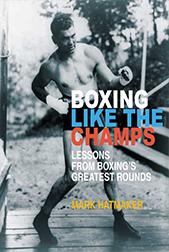
This is a Video Companion volume to our book "Boxing Like the Champs" it includes some of that material plus some extra meanness for our evil edification.
 
It retails for $39.95 + S & H but for the release-launch...
 
We'll selling for $39.95 even No Shipping & Handling Inside the United States.
$39.95 US:  undefined
 
$49.95 International:  undefined
 
If you want to add a copy of the book "Boxing Like the Champs" we'll just make that a $10 Add-On in the States and $12 International.
Boxing Like the Champs Book/DVD Combo US $49.95:  undefined

Boxing Like the Champs Book/DVD Combo International Shipping $61.95:  undefined
 
While we're tossing deals, if you're a RAW Subscriber and you want to order, Message Me and we'll knock off 15%.
 
Not a RAW Subscriber,  but want to come aboard? Well, Subscribe and then I'll set you up with the Members Deal.
 
Brief Look at Contents:
  • Building Dempsey's Fist
  • Kid Chocolate's Clinch Jab
  • Johnny Dundee's Leaping Hook
  • Jose Napoles Buttery Lead Hand
  • Eder Jofre's Library of Tricks including the Devastating Crunch Hook
  • Frank Erne's Two-Point Feinting & Long Uppercut
  • Freddie Welsh's Pinpoint Jab
  • Kid McCoy's Corkscrews
  • Sandy Sadler's Slashes and Fist-Toe Connection
  • Tommy Loughran's Fencing Fists
  • Billy Conn's Hit & Run and the Rock & Roll
  • Pancho Villa's Hook-Jab and "Double-Left"
  • Sonny Liston's Hammer Hook
  • Building Stanley Ketchel's Fearsome Power
  • Battling Nelson's Scissors Punch
  • Resurrecting the Pivot-Punch
  • And mucho more!
To become a RAW Subscriber and receive Vale Alliance membership absolutely free, as well as take advantage of the members deal click the RAW Subscription button on the RAW Crew page.

To join the Vale Alliance or for even more details about what you'll receive as a member click here.


Copyright © 2017. All Rights Reserved.

Hatmaker Combat Sports | 865-679-1223 | E-mail | Website