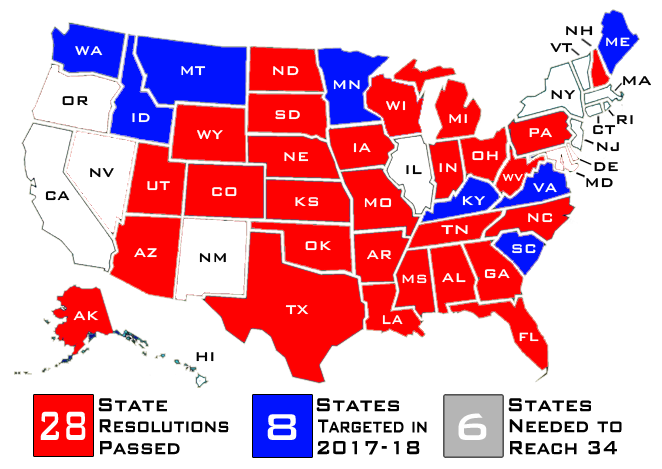
In the last two weeks of March, 2018, the Mississippi Legislature killed all seven pieces of Article V legislation presented in committee. In an article in
Mississippi Today, Kayleigh Skinner reported on the debate surrounding the use of the state-led convention method for proposing constitutional amendments.
In support of one these measures, Republican Representative Dan Eubanks referenced the staggering national debt, accumulated through "improper and imprudent" spending. Speaking in opposition to the use of a convention of states was Democratic Representative Bryant Clark. "You said you're trying to prevent runaway spending, but you might," he suggested, "be opening Pandora's Box at this particular time in our nation."
Given the unfamiliarity of many Americans with the Article V state convention process, the suggestion that it might be unpredictable has been a powerful tool for opponents of the method. And rather than sort through the diverse and passionate opinions on the subject, many Americans simply ask, "Why not just stick with what we know works?"
The answer is that
Article V was not designed simply to address
how the Constitution could be successfully amended, it was also designed to address
who could amend. And in the balance of amendment power instituted by the congressional and state convention methods, the founders intended that the states would be able to propose amendments Congress might rather overlook. The need for a balanced federal budget requirement is a prime example of the self-interest of Congress preventing a necessary amendment.
Over the last fifty years, the United States Congress has periodically tried to control deficit spending. Unfortunately, these attempts have all been ineffective over time. From the Byrd Amendments to Gramm-Rudman-Hollings, the Debt Ceiling, and PAYGO, each law was softened, overturned or ignored as soon as its fiscal consequences became inconvenient. More recently, Congressman Bob Goodlatte has introduced a balanced budget amendment in the U. S. House of Representatives. In fact, he has introduced it every year since 2007, without success. The BBA fails to make progress because Congress will not limit its own power to spend.
Since there are circumstances under which the states have both the authority and the best opportunity to address a needed constitutional change, the question then becomes whether there are unique vulnerabilities in the state-initiated amendment process. In a word, the answer is no.
Congress has the same power to propose amendments any time it is in session. There are no limitations on what subjects Congress can address. The nation's protection from dangerous amendments Congress might propose is the requirement that a three-fourths majority of states must ratify any amendment.
Exactly the same proposal powers and ratification requirements are given, under Article V, to both Congress and a convention of states. Neither is authorized to make any unilateral changes to the Constitution; they may only make amendment proposals. And while constitutional language does not limit an Article V convention to a single subject or specified subjects, the states have chosen to do this themselves. Some argue, however, that because the Constitution does not mandate that a convention be limited in scope, it cannot be limited.
Here's how
Michael Rappaport, Darling Foundation Professor at the University of San Diego School of Law and Director of the Center for the Study of Constitutional Originalism responds to that concern. He contends:
"The Constitution says that the states may apply for 'a convention for Proposing amendments.' Is a convention limited to a subject 'a convention for proposing amendments'? Of course, it is. Thus, a limited convention is one of the conventions for which the states can apply." Rappaport believes that the concern about a "runaway convention" exists because of a failure to follow the Constitution's original intent. He says, "If the original meaning were widely accepted, states could feel free to apply for a limited convention without fear of a runaway convention."
State legislatures that have passed topic-specific Article V legislation have demonstrated that they believe the conventions they have called for will be limited to the specific subjects they address. Wisconsin, for example, wrote their
state resolution to call for "a convention for proposing amendments, for the limited purpose of requiring the federal government to operate under a balanced budget..."
State legislative leadership in almost half of the twenty-eight states with BBA Applications has gone even further in passing legislation that defines the selection process and the requirements of commissioners to a convention of states. These requirements institute commissioner recall and replacement, in the unlikely event of a rogue individual who might introduce or consider a subject outside the convention's call. Sworn oaths to uphold the single-subject limitation and criminal penalties for violation are written into most of these laws or resolutions. None of that make would make sense, if legislators from those states did not believe conventions could be limited.
To some, the proof that conventions are likely to venture beyond their scope of authority, is the outcome of the 1787 Constitutional Convention that created our form of government. It always surprises me that those who make this argument want to both suggest that the current generation is not fit to revise the work of great men like our founders, and at the same time accuse the authors and signers of the Constitution of being a collection of rogue delegates at a runaway convention.
That is certainly not the universal opinion of scholarship on this issue. For a detailed description of the authority given to the 1787 Delegates by the states, I would recommend Professor Robert Natelson's summary of the scope of the Constitutional Convention, entitled,
Yes, the Constitution was adopted legally
.
The concerns recently expressed in the Mississippi Legislature are sincerely held by many in this country. These concerns have answers. And the questions are worth pursuing because the role of the states in proposing amendments to the U.S. Constitution provides an important balance to federal overreach. The Article V state convention process is necessary to safely address limited subjects about which the states are concerned. Instead of opening Pandora's Box, an Article V BBA convention could begin to close the lid on the unintended (but predictable) economic consequences that will result if congressional deficit spending is not brought under control.