|
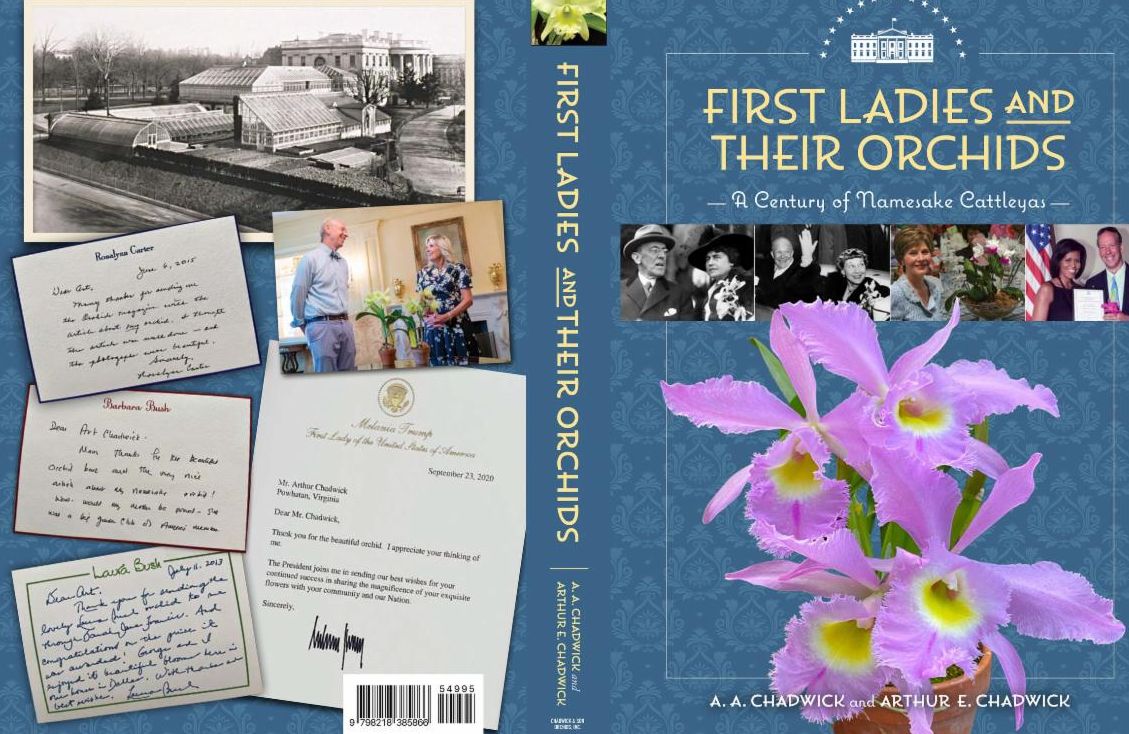
One might assume that a book about every U.S. First Lady and her namesake cattleya since 1914 might be a formal, staid affair. Nothing could be further from the experience of reading the Chadwicks’ artfully written and beautifully illustrated First Ladies and Their Orchids. It’s laugh-out-loud funny at many turns. Beyond each FLOTUS and her flower, the book also details the incredible scope of 19th and 20th century orchid breeding programs. It is additionally an evocative visual history of the Chadwick Orchid dynasty, and valuable at that.
Readers will appreciate the thoughtful, intricate layers of the Chadwicks’ strikingly documented process of retroactively naming orchids for First Ladies. The crosses were only made from cattleyas that would have been available in the historical moment in which the First Lady was in the White House, and the hybrids chosen to be named additionally followed the fashion and artistic trends of that time. As primarily a historical reference guide, the book uses previous and popular names of orchids over accepted scientific naming today. It is also a great gift of this orchid naming project, and of this book, that the named hybrids reveal the lineage of these cattleya hybrids and provide a deep but not overly-technical overview of diverse cattleya species. For instance, one of Lc. Eleanor Roosevelt’s parents is Lc. C. G. Roebling, both of whom were respected builders of a new America in their time. And I think we must assume that it was a pointed choice of Manda’s in 1929 that Bc. Empress of Russia and Bc. British Queen are in the lineage of Blc. Mrs. Herbert Hoover—all powerful women in difficult times, tying together international heads of state in one flower.
The book also offers fascinating details of dozens of orchid houses throughout the 20th century-- to my knowledge never before collected in one place. This is cherished information for the orchid afficionado and history buff alike. Just a few of the most fascinating moments include details of early orchid hybridization and culture of young seedlings (we have it so easy these days!), the surprising difficulty and humor of attempting to contact each First Lady (or her descendants) to present them with the flowers, the recipe for fermented sheep manure “tea” that was used as cymbidium fertilizer, and the fact of single cattleya corsages in the 1940s selling for US$20 (approximately US$450 today).
This book will be of great use to the cattleya specialist, but nonetheless valuable for general orchid enthusiasts and anyone who loves horticultural history. It also serves as a perfect follow-up to the first Chadwick father-and-son book, The Classic Cattleyas, as the reader hears the late Art Chadwick’s delightful narrative voice throughout. In a moment when it seems U.S. political partisanship is more rancorous than ever, taking a moment to celebrate the nation’s shared history in flowers and First Ladies—with a deft comedic touch—is refreshing indeed.
Erica Hannickel is the author of Orchid Muse: A History of Obsession in Fifteen Flowers (W.W. Norton & Company, 2022) and has published several articles in Orchids (email erica.m.hannickel@gmail.com).
|