December 2023 - Catch up on the latest news from CAARI! | |
|
Dear William,
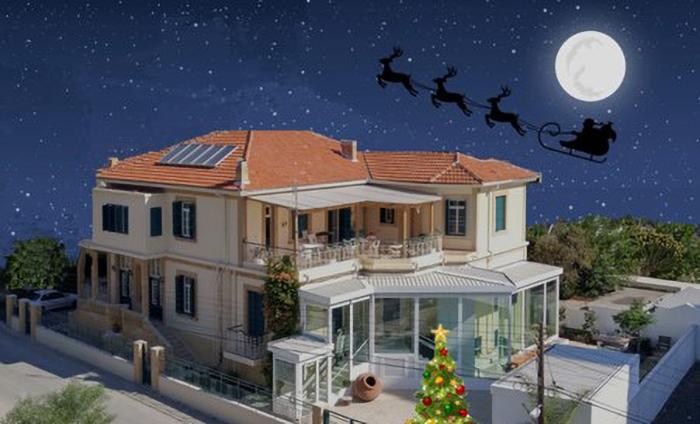
December brings the great seasonal feasts of shared celebration, and here at CAARI, residents will converge in festive mutual enjoyment to share the Christmas tree and then the delectable Vasilopita or Saint Basil’s cake prepared by Director Lindy Crewe’s spouse, chef-extraordinaire Dr. Manolis Melissaris. He has just taken over the running of the Cyprus Museum café, so you can look forward to savoring his fare when you’re here!
Following Dr. Crewe’s Message from the Director, our Newsflash recounts the fellowship experiences of three of CAARI’s residents this fall. Dr. Frederick Whitling, whose late October lecture on the Swedish Cyprus Expedition many of us heard, writes about his role as CAARI’s Scholar in Residence. The Scholar in Residence is a Fellow with the additional responsibility of helping to sustain the sense of community that a resident faculty provides in a university. We believe it is a role vital to CAARI’s collaborative atmosphere. Dr. Bryan Burns then shares the insights offered by his time as a CAARI/CAORC Fellow, when he was able to examine personally both the quotidian artifacts and the imposing architectural sites on Cyprus that are relevant to his forthcoming book on Mycenaean archaeology. In closing, Dr. Aaron Hollander offers a riveting glimpse into his work as a CAARI/CAORC Fellow on his forthcoming book about the cult of Saint George on Cyprus. Vivid insight into the ineradicable vitality of Saint George’s veneration here exists right across the street from CAARI itself. It is a true privilege to have an introduction to it by CAARI’s own “St. George man.”
| |
|
Message from CAARI’s Director
Dear friends and supporters of CAARI,
It has certainly been a very busy autumn in Cyprus, with so many events, conferences and lectures, both online and live. We were able to hold our CAARI events in hybrid format and, as you will read in Frederick Whitling’s Newsflash piece, we have all appreciated the opportunity for discussion with colleagues. If you missed Frederick’s lecture you can find it on our Youtube Channel. We were also fortunate to have a CAARI site visit to Akaki in October to see the amazing Roman mosaics excavated by Fryni Hadjichristofi of the Department of Antiquities, as they were exposed briefly for photography and conservation. We are grateful to Fryni for taking the time to give us a talk on the extraordinary hippodrome and muse scenes.
I have recently returned from the American Society of Overseas Research (ASOR) annual meeting held in Chicago, where I took part in an intense four days of papers and board meetings. This was the first ASOR meeting I had physically attended since the start of the pandemic and it was wonderful to be able to meet with everyone in person again, rather than the online experiences of recent years. The Cyprus session was well-attended and packed with excellent papers. We heard about recent excavations at sites from the Neolithic to Roman periods, delivered by both senior scholars and graduate students. I especially enjoyed the paper delivered by CAARI trustee Charles Stewart on ‘Orienting the Classical Canon: The Kourion Harpocrates-Apollo’s Contribution to Art History.’ This male infant sculpture was recently excavated at Kourion by the Kourion Urban Space Project (KUSP), directed by Tom Davis and Laura Swantek.
| |
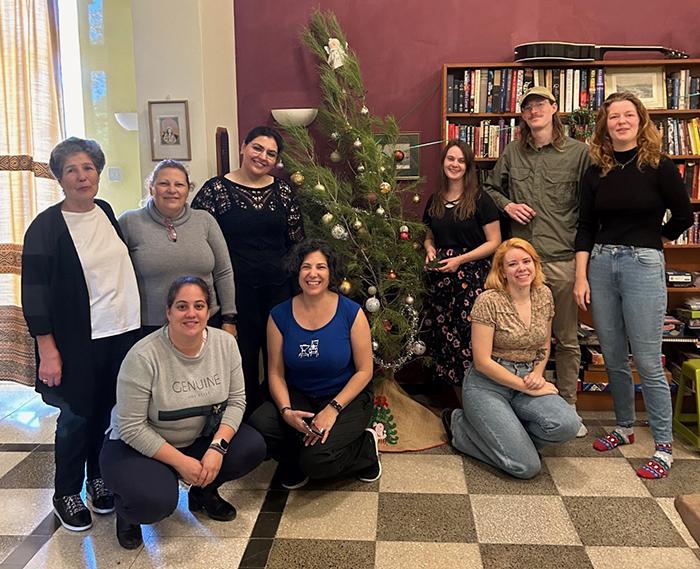
The upstairs tree decorating committee: CAARI staff (and Anthoulla’s mum, Mary) with resident CAARI students here for the ‘Life at the Furnace: Copper smelting ecosystems in the north-western Troodos (LAF)’ survey project of the University of Copenhagen directed by Kristina Winther-Jacobsen. | |
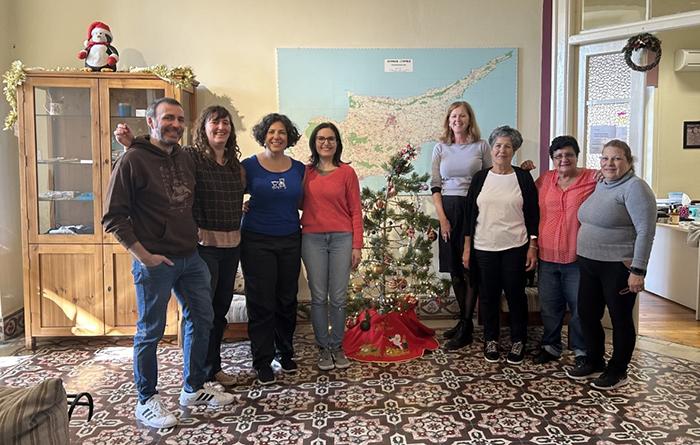
Here at CAARI, we are gearing up for the holidays, as you can see from our tree decorating photos. Decoration was followed by lunch for staff and researchers at Vathoulla’s favourite local eatery: To Steki, of course! | |
The downstairs tree decorating committee: CAARI staff with CAARI library researchers Enrico de Benedictus and Cassie Donnelly, along with Peltenburg Fellow Francesca Meneghetti and our own Vathoulla Moustoukki (and Anthoulla’s mum, Mary again!) | |
|
I remind all our readers that the CAARI senior fellowship applications are still open and you have until 8 January to apply. Do take a look on our website and see if you may be eligible or forward this newsletter to your students or colleagues who might be interested. We look forward to seeing our new cohort of fellows in the coming year but do remember to book early for a room at CAARI as we are already filling up for some of 2024.
With very best wishes for a peaceful holiday season with friends and family,
Lindy Crewe, PhD
Director, CAARI
| |
|
WWW.CAARI.ORG/SUPPORT
Zuzana Chovanec
CAARI Development Chair
As we enter the season of reflection and giving, we see no better time to express our thanks for the many wonderful friends who have supported CAARI, its programs, and its fellows throughout the year. We are grateful for all those who have responded generously to the needs of the library and the grounds, but in particular all those who have been steadfast in their support of CAARI’s graduate fellowships. We take pride in all the accomplishments of our fellows, whom we could not support as we do without you. We invite all friends of CAARI to share in these achievements by donating to the fellowship funds. Consider giving the gift that keeps on giving by arranging a monthly donation – small or large – in the coming year.
WWW.CAARI.ORG/SUPPORT
or
| |
|
CAARI
11 Andrea Dimitriou Street
Nicosia 1066
Cyprus
| |
|
CAARI
209 Commerce Street
Alexandria, VA 22314
USA
| |
|
Revisiting the Swedish Cyprus Expedition as a CAARI Scholar in Residence
Dr. Frederick Whitling
Independent Scholar
CAARI Scholar in Residence
| |
|
I am indeed grateful for the opportunity to stay at CAARI as scholar in residence (September–November 2023). My stay at the institute has enabled continued work on a history of archaeology book project on the Swedish Cyprus Expedition (1927–1931), which is based on primary research and examines the endeavor from various perspectives, including culture politics, law, funding and organization. The Autumn of 2023 marks the one hundredth anniversary of the first time that the Swedish archaeologist Einar Gjerstad, the leader of the later Swedish expedition, set foot on Cyprus. In 1923–1924, Gjerstad crisscrossed much of the island on a bicycle and on the back of a mule, and excavated at four sites during his stay. This provided the material for his doctoral dissertation and sowed the seeds for the Swedish Cyprus Expedition.
The four members of the expedition carried out excavations all over the island, at more than twenty individual archaeological sites. The overall ambition was to establish a thorough chronology in Cypriot archaeology. Crown Prince Gustaf Adolf, later King Gustaf VI Adolf of Sweden, was chairman of the Swedish Cyprus Committee, which was established in the spring of 1927 for the organization of the Swedish expedition. He visited Cyprus in October 1930 in connection with the division of its finds and also took part in the excavations. The activities of the Cyprus committee and the Cyprus collections (Cypernsamlingarna) in Sweden lasted until 1954, when the Museum of Mediterranean and Near Eastern Antiquities (Medelhavsmuseet) was founded in Stockholm, incorporating the Cyprus collections.
CAARI provides a pleasant and stimulating research environment, and the role of scholar in residence is rewarding. It presents an independent framework in which to carry out scholarly work, with occasional social interaction in the residence and informal conversations about scholarly and project-related issues and aspects. The weekly Wednesday coffee meetings have also been beneficial in this regard. I hope to have provided at least a little inspiration and insight for my fellow researchers!
| |
|
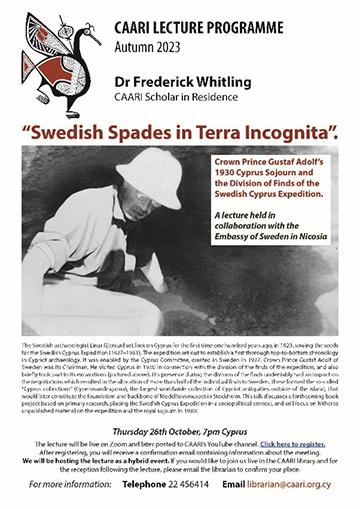
Apart from a relatively brief work-related visit to Sweden, my stay at CAARI was interrupted only by two separate excursions, focusing on some of the sites excavated and places visited by the Swedish expedition almost a hundred years ago. During my period in residence, I gave a talk in the autumn CAARI lecture program, on 26 October 2023, entitled “Swedish Spades in Terra Incognita. Crown Prince Gustaf Adolf’s 1930 Cyprus Sojourn and the Division of Finds of the Swedish Cyprus Expedition.” This was a pleasant opportunity to present work carried out during my stay at the institute, as well as to receive some feedback for the continuation of the project. Before leaving Nicosia, I took part in a workshop at the Cyprus Museum on 4 November 2023, following an invitation to join an interdisciplinary group for a theatre-based project on the Swedish Cyprus Expedition and for its approaching centenary in 2027.
My stay at CAARI has been backed financially by a grant contribution from the Swedish Royal Academy of Letters (Stiftelsen Gösta och Susi Enboms donationsfond), which I should hereby like to gratefully acknowledge. My time at CAARI enabled further research and writing, as well as receiving reactions regarding the project and valuable feedback in numerous pleasant encounters and stimulating conversations. It has been a pleasure to rekindle earlier contact networks in Cyprus, as well as to expand these circles with new connections and new friends.
| |
|
Mycenaean Connections with Late Bronze Age Cyprus
Dr. Bryan Burns
Wellesley College
CAARI/CAORC Research Fellow
| |
|
I am currently writing an introductory book on Mycenaean archaeology and am keen to underscore that the development of Bronze Age Greece cannot be understood in isolation from its Mediterranean contacts. Whether analyzing palatial economies or artistic developments or even the essential artifacts and commodities of life, we see that long-distance exchange provided essential stimulus and opportunities. My time as a CAARI fellow has enabled me to balance my perspective, developed through years of excavation in Boeotia, by directly assessing Cypriot adoptions of Mycenaean artifacts and inspiration. I was fortunate to spend the month of October on Cyprus, strengthening my knowledge about the diversity of communities active during the Late Bronze Age with evidence for Mycenaean connections.
Given the obvious importance of maritime travel and trade, I prioritized study of coastal sites, including a number that have been associated with the idea of Mycenaean migration during the disruptions dated ca. 1200 BCE. Changes across Cyprus at this time, from the new use of clay bath tubs to the reorganization of worship at major sites like Kition, have been tied to an influx of new Aegean arrivals following the collapse of Mycenaean palaces. The original excavators at the key sites of Maa-Palaikastro and Pyla-Kokkinokremos attributed the establishment of these short-lived coastal sites to a Mycenaean colonization movement.
| |
Figure 1: Cyclopean perimeter walls of Maa-Palaikastro | |
It was great to make my own in-person assessment of the topography and architecture at the sites of Maa-Palaikastro (Figure 1), north of Paphos, and Pyla-Kokkinokremos on the bay of Larnaca. Each of these sites was established towards the end of the thirteenth century BCE, with a circuit of stone walls defining their strategic position above a natural harbor. Although both sites have been described as fortified, the constructions surrounding the natural elevation of each is remarkably different. Furthermore, the new and on-going excavations at Pyla bolster recent scholarship assessing the regional context of both sites, demonstrating that Cypriot connections and material culture far outnumber Mycenaean elements. More broadly, it’s clear that both Aegean imports and that the local manufacture of Mycenaean-style pottery clearly precede the “crisis years” of 1200. | |
|
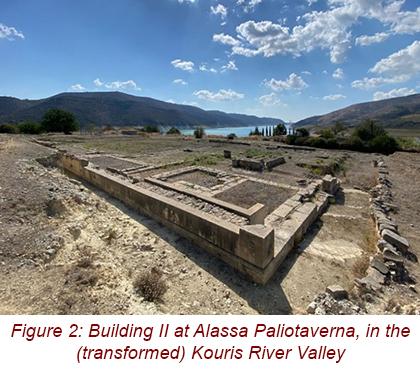
I was also able to further my appreciation for the larger network on Bronze Age sites that reached from the coast to administrative centers and industrial zones further inland. I was able to visit several of the ashlar building complexes that are positioned along river valleys stretching into the foothills of the Troodos range. The architectural design, storage capacity, and positioning of structures speak to the economic power centralized at places like Kalavasos-Ayios Dhimitrios and Alassa- Paliotaverna (Figure 2). Making my way up the pass from coastal zones into the mining areas above underscored the efforts required by ancient populations to access, transform, and distribute the island’s “natural” resource of copper.
I’m eager to return to Cyprus in the near future, to further explore contexts for artifacts sharing a clear iconographic similarity with those of the Mycenaean mainland and also the history of excavations reshaped by the island’s political division. I’m grateful to members of the CAARI community – administrative staff, current residents, and associated scholars – for showing me the way to archaeological, recreational, and culinary opportunities.
| |
|
Deep Roots and Intercultural Imaginaries on St. George’s Hill, Nicosia
Dr. Aaron T. Hollander
Graymoor Ecumenical & Interreligious Institutes
CAARI/CAORC Research Fellow
| |
|
The following is excerpted and adapted from Dr. Hollander’s forthcoming book, Beautiful Struggle: Hagiography and Liberation on the Island of Saints (Fordham University Press, 2025). All names of individuals whose words appear in the text are pseudonyms.
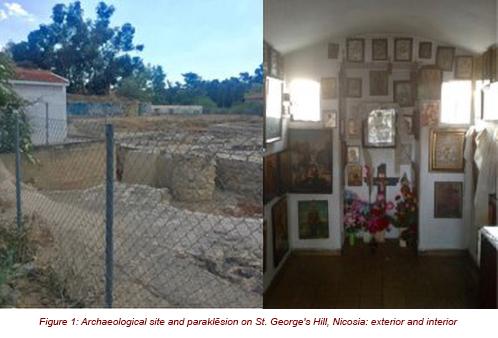
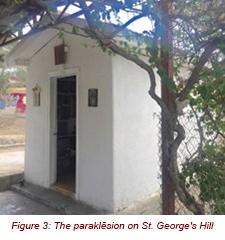
On a dusty hill in Nicosia, about half a kilometer outside the old Venetian walls of Cyprus’ now-divided capital city—and just across the street from CAARI—stands a small white building with a roof of ruddy shingles. It is little more than a shack (Figure 1), perched above an open archaeological site known as St. George’s Hill. Approaching the shack from the busy street below, I wind up a tight staircase and under some low-hanging trees, one of which is adorned with rags, ribbons, and other tokens left by visitors.
Only a sun-bleached icon of St. George laminated to a brick pillar on the street below indicates that there is anything above. Approaching the shack, I pass a sign for the nearby toilets (which draw their own share of pilgrims) and a few bowls of cat food, left out for the local fauna by the people who look after the site.
| |
The tiny building is a shrine (paraklēsion) dedicated to St. George—the name suggesting a primary function of paraklēsis, supplication or petition. Inside, the stubby aisle of a room smells powerfully of incense and flowers. It is covered in icons of diverse sizes and styles, most of which represent St. George, though images of the Panagia (the “all-holy” mother of Christ) and other saints share the space. Two tables covered in aluminum foil display candles, matches, an oil lamp, bottles of olive oil left by devotees; on the floor lie bouquets of flowers and wax effigies, some in the shape of body parts, some in the shape of human babies. The south wall contains an alcove locked with a plexiglass window behind which gleams an icon of St. George with a | |
 |  | golden cover, festooned with coins and votive tabs (Figure 2). On any given day, especially at rush hour when the road is well-trafficked, the shrine sees a stream of visitors. While living at CAARI, I witnessed many of these visitors duck into the site with a distinctly contemporary pace and style: driving up beside the small staircase, they hop out with their cars still running, make a quick circuit of the shrine, venerate the icons in turn, hop back in their cars, and continue onward. On one visit to the site, I meet a man in his sixties who has worked near St. George’s Hill for decades. Introducing himself as Charalampos—“like Saint Charalampos!” he adds, winking and making the sign of the cross—he relates the story of the shrine’s construction with enthusiasm. The marvelous golden icon had been discovered in a pile of rubble, he maintains, after the Anglican church that once stood on the hill was found to have unstable foundations and was demolished in 1889. The English church had been constructed only four years earlier, in 1885, not long after the British administrative takeover of Cyprus, but, in Charalampos’ words, “there was a great earthquake and the whole floor of the church cracked down the middle!” Charalampos punctuates the story with sound effects and gestures showing how he imagined the shape and width of the crack. Because of the saint? I ask him. He gives an exaggerated shrug of his shoulders and a sly grin. “Well, we don’t know…”
Before the Anglican church, so far as evidence yields, St. George’s Hill had lain still for some three hundred years, before which it was (perhaps) the site of a monastery of St. George demolished in preparation for the Ottoman invasion. The record thins as it recedes into history, but does not evaporate: excavations have revealed the remains of Byzantine buildings on the site from well before the first British occupation of the island (that of Richard the Lionheart in 1191), and possibly as far back as the fourth century; below that, Roman and Hellenistic layers appear to have housed a temple of a ram-headed god, “a protector of animals and a local Cypriot deity” associated with agriculture and healing. The latest excavations suggest that the hill had been used by the pre-Hellenic kingdom of Ledras, and even before that, had been settled well into prehistory.
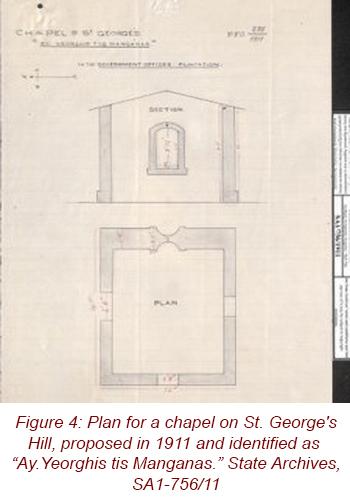
St. George’s Hill is only one of the thousands of shrines, chapels, churches, wells, and trees dedicated to St. George on Cyprus; like most, it is tightly entangled with the intercultural history and imagination of Cyprus from the present day back into antiquity. The current modest paraklēsion was built in 1952 on land belonging to the British colonial government, after a group of Nicosia locals had petitioned the government for permission “to put up a small building over the altar known as Ay Yorghi … below the site of the English Church which was removed.” [Cyprus State Archives, SA1-756/11] The request was first made in 1911, but the British colonial administration was unsympathetic to the devotional reclamation of the site. Permission to build was denied in 1911, and again in 1921: “I am of opinion,” writes one official in his memo, “that it would be undesirable to grant permission for any structure to be erected at this place. The shrine seems to be readily accessible at the present time. I think the best course is to forget to reply.” [State Archives, SA1-701/21] Nevertheless, some form of
| |
|
devotional space has occupied the hill ever since (Figure 3), invoking especially St. George’s aspect as a healer and rescuer—“religious associations from time immemorial.” [State Archives, SA1-1712/52] Two of my interlocutors now in their sixties remembered from childhood seeing the site filled with babies’ shoes, reflecting an old tradition of St. George assisting lame children. Another recalled the site being known as “St. George of the Captives” (Agios Georgios tōn Aichmalōtōn) during World War II, when the wives of soldiers, especially of prisoners of war, would come to beg the saint for their loved ones’ safe return. These two associations reveal a saint intervening in an intercultural society’s struggles with diverse crises and dominating powers, both material and spiritual. As we see here in miniature, St. George’s primary relationship to his Orthodox Christian devotees is that of a liberator—whether from illness, of man or beast, or from captivity in war.
Although the chief excavator of the archaeological site, Dr. Despo Pilides, has called for caution in identifying the site too precisely, the hill has long been associated with the medieval monastery of Agios Geōrgios tōn Manganōn (St. George of the Arsenal)—a famously wealthy monastery that was expanded at the expense of the queen of Cyprus, Helena Palaiologina, in order to accommodate refugee monks who had fled the fall of Constantinople in 1453. The name of the monastery derives, Kostas Papageorgiou suggests, from the Arsenal in Constantinople—a double association with the military aspect of St. George and with the district of Constantinople from which the refugee monks had come. The monastery was evacuated and demolished in 1567 while Nicosia was being fortified in preparation for war with the Ottomans—fitting, given the military associations of the monastery, but ultimately a doomed effort, as emblematized by the Ottoman use of St. George’s Hill for a fort from which to engage in besieging the city.
| |
|
The early twentieth-century Cypriots who wished to build a chapel on St. George’s Hill for their miraculous icon referred in their proposal to this ruined monastery, given its historical and symbolic significance (see Figure 4). Yet even before the chapel was finally built in 1952, the icon had its stream of visitors whose petitions on the site had an imaginative resonance with the plight of those refugees from occupied Constantinople. Along with those seeking deliverance from illness, the shrine attracted people praying for captive soldiers in World War II, and three decades later, people fearing the worst came to St. George on behalf of the refugees from twentieth-century Famagusta, Morphou, Kyrenia, Karpasia—if anyone could bring the missing persons of 1974 to safety, it would be St. George Swift-to-Help, St. George the Liberator of Captives, St. George of the Arsenals of War.
This brief glimpse of entangled history and memory at St. George’s Hill, itself just one fuzzy thread of a much larger tapestry of hagiographical spaces, narratives, images, and practices, begins to indicate the many faces, the deep roots, indeed the near omnipresence of St. George in Cyprus. My forthcoming book crisscrosses this tapestry in order to tell the story of a Greek Orthodox community whose innumerable ways of mediating holiness in their lives—including the social processes by which their hagiographical media are produced and consumed—come to constitute a lived theology that is emblematized in the protective presence and inspirational narratives of St. George. In their material and discursive representations of St. George, Orthodox Christian Cypriots both promote and enact a struggle with forms of cultural, political, religious, and spiritual power that dominate, distort, or otherwise work to the detriment of the Orthodox Church and the will of God. By way of hagiography, Orthodox Cypriots not only struggle against (resistance) but at the same time struggle for (rectification)—for the deliverance and indeed the sanctification of the land, the state, and the soul of Cyprus. It is St. George who, among the saints, is associated most consistently and vigorously in Cyprus with such liberative struggle. And his presence emblazons the very hill facing CAARI.
| |
|
To All CAARI’s Friends and Supporters
Cyprus is a site of almost limitless richness: in its long testimony to eastern Mediterranean cultural evolution, as evidenced by Bryan Burns; in its significance in the history of archaeological practice, as shown by Frederick Whitling; or or the living vitality of its deeply-rooted cultural identity, as demonstrated by Aaron Hollander. CAARI’s mission is to help promote and preserve this legacy. We send our sincerest thanks to ALL who join in giving CAARI the funds to sustain our mission.
| |
Annemarie Weyl Carr
Vice President, CAARI Board
| | | | | |