August 2023 - Catch up on the latest news from CAARI! | |
|
Dear William,
It’s summer and life at CAARI is at full throttle. Above all, after three years’ suspension due to the pandemic, CAARI’s Summer Archaeological Workshop was held again on June 17. This was its 39th year, and it reemerged with exceptional energy. Both the program of presentations and the available seats in the auditorium were absolutely packed. This Newsflash focuses above all on the Workshop, presented in an engaged and fast-paced review by Caroline Barnes, past CAARI Fellow and doctoral student at the University of British Columbia. As she makes clear, the event itself was fast-paced and full of fresh, exciting insights. The formal presentations were followed by hospitality in CAARI’s garden. We cannot convey thanks enough to the generous friends whose gifts enabled the garden’s radical excavation against water seepage and ensuing restoration in time for the Workshop. It looked great and was the festive setting for a final, loving celebration of Vathoulla Moustoukki’s retirement after 42 years of unfailing service to CAARI.
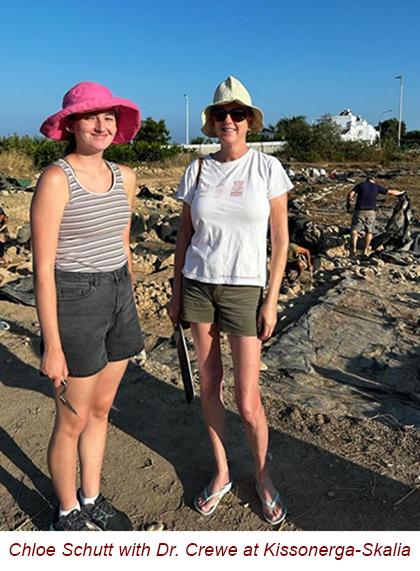
Caroline Barnes’ report is followed by the report of a yet younger contributor. Seventeen-year-old Chloe Schutt, determined to become an archaeologist, volunteered over the summer with both Dr. Lindy Crewe’s dig at Kissonerga-Skalia and CAARI itself. She offers an overview of her experiences and insights during this time, bringing a viewpoint few of us are young enough to share and all the more valuable as such.
Remember that we are devoting an entire special issue of the CAARI Newsflash to our professional research on the archaeology of food and our personal experiences of food on Cyprus. We invite your contribution to it. Help us archive your memories of the meals you have shared with friends and colleagues on Cyprus, the recipes you enjoyed on your digs, or the research you have done on food in the Cypriot past! To archive your memories, recipes or research, please send your contribution to Laura Swantek (lswantek@asu.edu).
After all of these positive reports, we will conclude with a more somber one, registering the passing of Dr. Pavlos Flourentzos, prolific scholar and Director of the Department of Antiquities Cyprus from 2004-2009.
| |
|
Message from CAARI’s Director
Dear friends and supporters of CAARI,
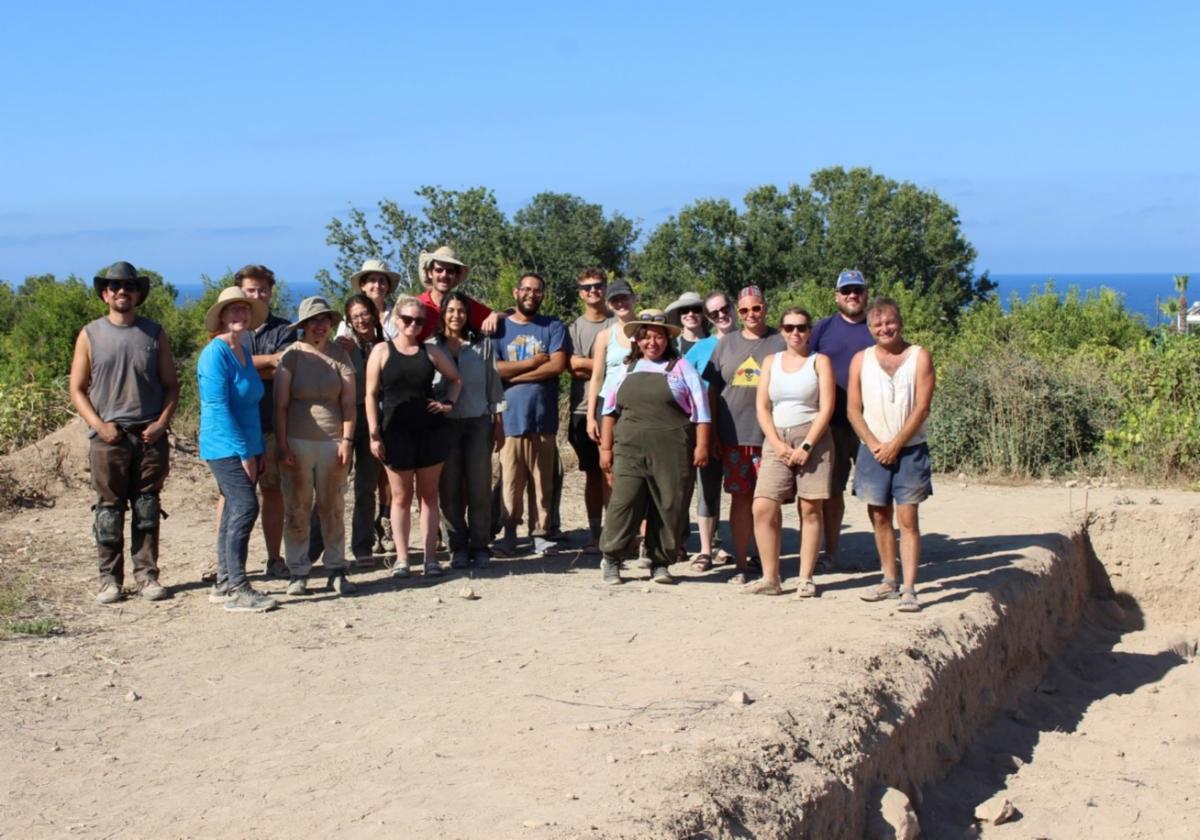
I have just finished the fieldwork season at Kissonerga-Skalia, digging in the sweltering heatwave that Cyprus, as well as the entire region, is currently enduring. We all hope that it passes soon and that the devastating fires are extinguished quickly. Despite the heat, the team did a great job and we revealed more of our complex dating to the transition to the Late Bronze Age, including a new oven-like feature that measures nearly four meters across! Backfill day is always fun and you can see here the team on the last morning proudly standing next to the freshly covered trench, awaiting our attention next summer.
| |
The Kissonerga-Skalia 2023 excavation team at site on our last day | |
|
As Caroline Barnes outlines in her piece on the CAARI Annual Summer Archaeological Workshop, it was a great day of papers and a super fun evening party in honor of Vathoulla. We were all so thrilled to be able to catch up in person after so many years away. Our thanks go out to Caroline for capturing the day for the Newsflash. I also want to add my thanks to our fabulous intern over the summer, Chloe Schutt, who has written a piece about her experiences for this Newsflash. She certainly has it in her to become an excellent archaeologist!
Now we have the slow days of August ahead. We will use the quiet time in Nicosia to start planning and getting organized for what will doubtless be a full autumn. We have already lined up our first two speakers and, whether you will join us in person or online, you can look forward to hearing about the latest discoveries at Nea Paphos from Professor Ewdoksia Papuci-Wladyka and about the involvement of the Crown Prince of Sweden with the early 20th century work of the Swedish Cyprus Expedition from Dr Frederick Whitling.
With very best wishes for the remaining summer holidays,
Lindy Crewe, PhD
Director, CAARI
| |
|
WWW.CAARI.ORG/SUPPORT
Zuzana Chovanec
CAARI Development Chair
The return of the annual Summer Archaeological Workshop is a potent reminder of the many friends who continue to help sustain CAARI and its mission. A special thanks to all those who assisted in making the CAARI garden once again a welcoming space where old friends reunite, and new connections are made. We are also reminded of the innovative scholarship that CAARI's fellowships enable. Sustaining the fellowships is vital to both CAARI itself and the broader field of eastern Mediterranean studies. Interest in the archaeology and heritage of Cyprus is as keen as ever, as seen in CAARI volunteer Chloe Schutt's heartfelt recounting of her experience.
All of us can recall the excitement of our first introductions to archaeology - what it was that drew us in - and how important it was to have the research resources and funding to pursue those dreams. Help CAARI to continue to play a vital role in making those dreams a reality by supporting our library and fellowships programs. Don't discount the power of a small gift!
| |
CAARI
11 Andrea Dimitriou Street
Nicosia 1066
Cyprus
| |
CAARI
209 Commerce Street
Alexandria, VA 22314
USA
| |
|
CAARI’s Summer Archaeological Workshop Returns,
Celebrating its 39th Year
Caroline Barnes
The University of British Columbia
| |
|
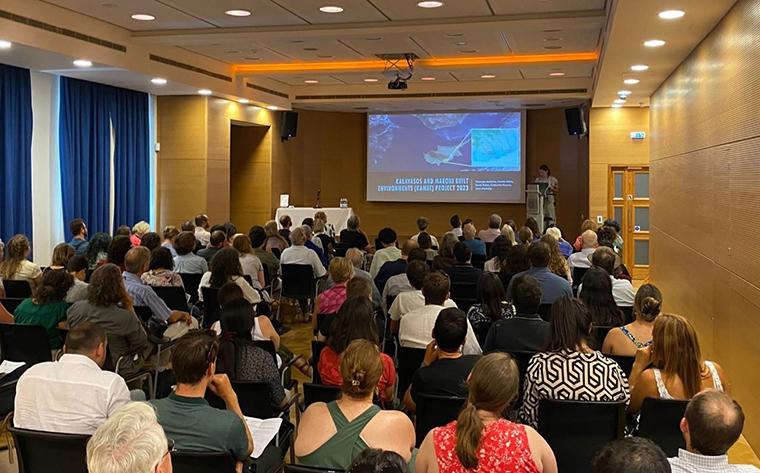
The Annual CAARI Archaeological Workshop returned for its 39th meeting on Saturday, 17 June 2023. After a three-year hiatus due to the Covid-19 pandemic, attendance and spirits were high as the morning session began at the Bank of Cyprus Cultural Foundation on Phaneromeni Square in Nicosia. CAARI Director Dr. Lindy Crewe welcomed the large audience, and mentioned that it might even be the biggest CAARI workshop in the gathering’s tenure! Dr. Athanasios Vionis, Director of the Archaeological Research Unit (ARU) at the University of Cyprus, and Dr. Giorgos Georgiou, the Curator of Monuments of the Department of Antiquities Cyprus, also gave welcoming speeches in their roles as representatives of the event’s two collaborators, the Department of Antiquities Cyprus and the Archaeological Research Unit.
| |
Not an empty seat to be seen at the Summer Archaeological Workshop! | |
|
In the words of the day’s first presenter, Dr. Diane Bolger, we quickly jumped “forward into the past” with her presentation on the preliminary results from the Western Cyprus Survey Project. Following Dr. Bolger, former CAARI Director Dr. Andrew McCarthy presented his team’s work at the diachronic site of Prasteio-Mesorotsos, which entered its final full season of excavation this summer. Dr. Victor Klinkenberg spoke next about on-going excavations at the Chalcolithic site of Chlorakas-Palloures. A highlight of the talk was the meticulously constructed 3D model that pieced together thousands of sherds scattered in pot spreads from one of the site’s roundhouses. Next, Dr. Kathryn Grossman gave an overview of survey work and excavations by the Makounta-Voules Archaeological Project near the island’s northwestern Chrysochous Bay. Dr. Ethymia Alphas followed with a presentation on the rescue excavations of several Early to Middle Cypriot tombs at Alambra-Kato Lakkos. Further insight into the Middle Cypriot came from Dr. Luca Bombardieri’s overview of work at Erimi, and from Dr. Mara Horowitz, whose team broke ground just this year at Kalavasos-Laroumena and Arkhangelos. And just before the morning’s first break, devoted to coffee, Dr. Peter Fischer treated us all to a presentation on the recent finds from tombs at Hala Sultan Tekke. From Mycenaean and Egyptian imports, to local wares, cylinder seals, and gold diadems, the riches of the Late Bronze Age community were on impressive display.
After a quick refreshment in the Bank of Cyprus’ lobby, the second morning session began with Dr. Lindy Crewe’s presentation of excavations at Kissonerga-Skalia, a site which is as perplexing as it is fascinating. Dr. Catherine Kearns then summarized the interdisciplinary and multi-site work of the Kalavasos and Maroni Built Environments (KAMBE) project. Their excavations this year focused on the Late Bronze Age sites of Maroni-Vournes and Kalavasos-Ayios Dhimitrios and the Archaic site of Kalavasos-Vounaritashi. A short break from site reports came from Dr. Anna Spyrou, who discussed her research on the history of cattle hybridization and domestication on Cyprus, aptly named ARETI (Animals Resilient in Time). On behalf of Dr. Konstantinos Kopanias, Dr. Artemis Georgiou gave an overview of recent excavations at Palaepaphos-Marchello, followed by Dr. Kyriaki Tsirtsi’s summary of her comparative macro and micro botanical analyses of dietary practices from three Bronze Age sites. Afterwards, Dr. Maria Iacovou brought us back to Palaepaphos, yet this time to Laona. More mysteries of the site’s enigmatic tumulus were revealed this year as the team unearthed a magnificent rampart leading to the palace at Hadjiabdullah. Yet, as Dr. Iacovou jested, any discovery of a burial chamber will have to wait another year. Next, Dr. Vasiliki Kassianidou took us eastward to the Vasilikos Valley to discuss the mining practices of Asgata and Kalavasos. The two-year long project investigated ancient metallurgy and will conclude this September, just in time for the new museum of mining to open in Asgata! The session wrapped up with a talk by Dr. Thomas Landvatter about excavations at the Hellenistic site at Pyla-Vigla. Dr. Landvatter also chaired the third and final session, which began with three presentations of recent work in and around Paphos. First, Dr. Efstathios Raptou summarized the importance of settlement at Yeroskipou-Pachyammos, followed by Anthoulla Vassiliades, who presented for Dr. Craig Barker on the Australian team’s work at the theater of Nea Paphos. Our Paphian tour concluded with an overview of excavations at Yeronisos Island-Maniki Harbor by Dr. Joan Breton Connelly, which included an exciting glimpse into a Hellenistic-Roman tomb.
| |
|
We would be remiss to not acknowledge the role of the Cyprus Institute in facilitating the work of many of the day’s presenters, but particularly those of the third session. This included Dr. Artemios Oikonomou, who spoke about his analysis of the glass assemblage at Amathous, and Dr. Sturt Manning, whose study of dendrochronology has yet again proved integral to understanding the island’s history. In one featured case study, Dr. Manning rectified the date of wood from the Paphos Gate; originally dated to the British period, dendro analysis confirmed that some of the gate’s wood was cut as early as 1447! With the Medieval period in mind, Dr. Polina Christofi presented next on the refurbishment of the Medieval monastery of Agia Napa, which revealed two previously unknown, earlier phases of the complex. Next, Dr. Angelos Hadjikoumis went on to discuss his zooarchaeological work as a post-doctoral fellow at the Cyprus Institute. The audience was perhaps most especially moved when Dr. Hadjikoumis spoke about the remains of a dog buried at the Paphos Gate, who met a violent end likely during the Ottoman takeover of Nicosia. Finally, the workshop concluded with a presentation by Dr. Athanasios Vionis on the preliminary results of the Settled and Sacred Landscapes of Cyprus (SeSaLaC) Project. Not only did the project set an exemplary model for community engagement with local archaeology, but its survey results revealed some 20 sites — perhaps one of which will be the topic of a future CAARI workshop presentation!
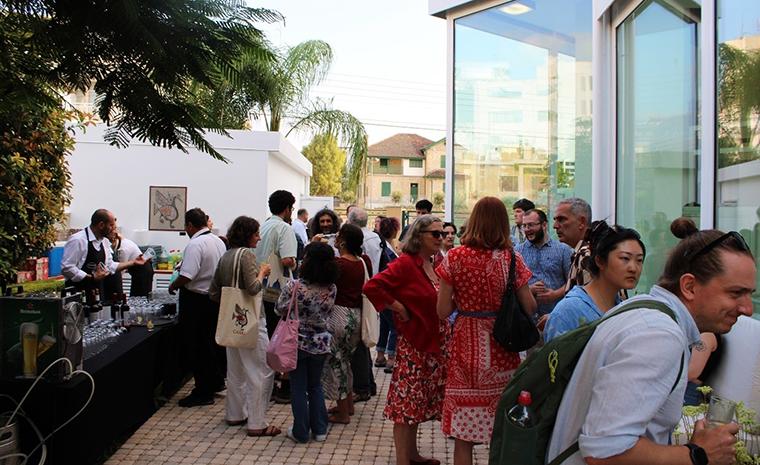
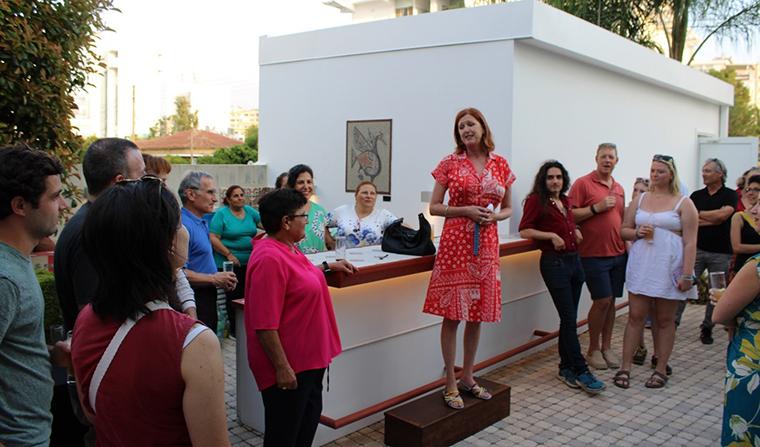
In the evening, conference attendees gathered back at CAARI’s courtyard for the much-deserved celebration of Vathoulla Moustoukki’s retirement.
| |
In CAARI’s garden, Dr. Lindy Crewe speaks on Vathoulla Moustoukki’s long and loving service to CAARI | |
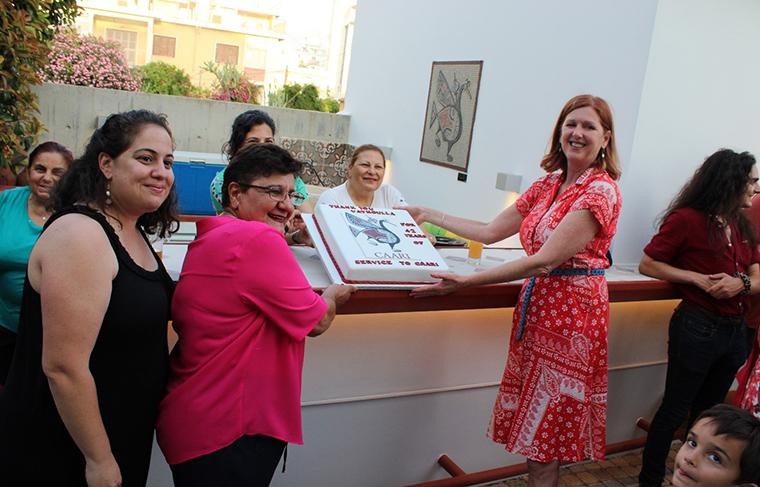
Amongst colleagues and friends, Vathoulla’s invaluable contributions to CAARI were celebrated with brandy sours and chocolate cake. | |
|
CAARI’s staff - Katerina Mavromichalou, Vathoulla Moustoukki, (behind her) Anthoulla Vassiliades, Photoulla Christodoulou, and Director Lindy Crewe - present the cake celebrating Vathoulla’s 42 years of dedicated service
| |
|
A Dream Come True: A High School Student’s Experience Volunteering at CAARI
Chloe Schutt
Senior, Coronado High School, California
| |
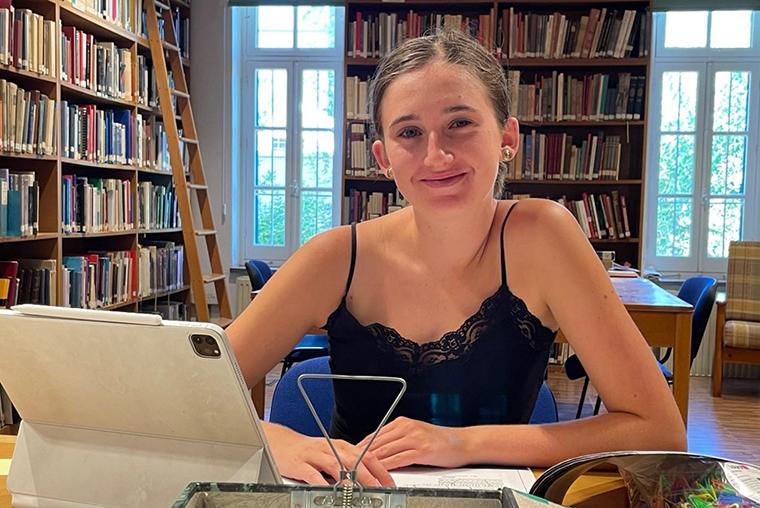
Working in CAARI’s library | |
|
This summer, I was honored to volunteer at CAARI’s Cyprus office in Nicosia as a student intern. I am a Cypriot-American high school student from Coronado, California who is extremely passionate about history and archaeology. Ever since I was little, I have traveled to Cyprus to see my mom’s family, and visited archaeological sites showcasing the island’s rich heritage. Since I live far away, it is difficult at times to understand the complex history of Cyprus. However, my work with CAARI introduced me to the field of archaeology and to the amazing professionals working in Cyprus. After this internship, I feel a stronger connection to Cyprus.
My work started at the CAARI office in Nicosia, where Dr. Crewe and her dog Darcey gave my family and me a warm welcome and a tour of the center. We then met Ms. Katerina Mavromichalou, CAARI’s Executive Assistant, Ms. Vathoulla Moustoukki, CAARI’s Executive Assistant Emerita, and Ms. Anthoulla Vassiliades, the Librarian at CAARI, who showed me the CAARI Library. I first worked in the Photocopy Room, where the offprints and copies of newsletters are stored. Currently, the CAARI library is transitioning from an old online catalogue system with limited capabilities to a new online database that will include all the journals and other printed materials. My job was to check the original cards with the journals, then record the information on a spreadsheet. I also re-recorded the CAARI Fellows and Fulbright Scholars list from the 2013-2018 editions of this newsletter. Ms. Vassiliades later had me document information on the “Cyprus Fieldwork” off-prints (printings from larger publications) into an online catalog. While sifting through these documents, I read about the discoveries of Cypriot archaeological sites. Once one knows the history behind a place, the relationship between its past and its modern discovery becomes much clearer.
| |
|
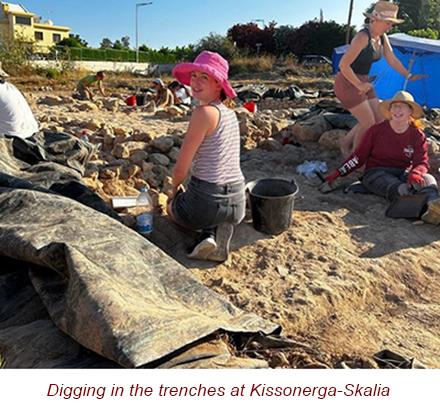
The highlight of my internship was visiting the dig site at Kissonerga-Skalia. The site,
located 8 km from Paphos, dates from the Early Bronze Age (ca. 2500 B.C./B.C.E.) to the start of the Late Bronze Age (ca. 1600 B.C./ B.C.E.). Unfortunately, because of recent building developments, the area available for excavation is limited to a small plot comprising a complex of industrial installations. Dr. Crewe has led expeditions on the site since 2007. Seeing students and archaeologists digging at the site made me feel both excited and intimidated. A kind graduate student named Harriet explained her job and then asked me if I wanted to join her to dig. Grabbing a trowel and a brush, I knelt on the earth and began to brush carefully. Suddenly, a small piece appeared - pottery!! I carefully placed the find in an artifact bag. Digging under the hot sun was exhausting, but I was too overjoyed to notice. I even used a sieve when my bucket was full of dirt. Over the two hours I worked at Kissonerga-Skalia, I found multiple pottery shards, animal bones, tiny shells, and even flakes of chipped stone. One can only wonder who was living there thousands of years ago.
| |
|
Overall, I had an amazing experience volunteering at CAARI. During my time here, I learned so much about Cyprus’s history. CAARI was not only a place where I could express my love for archaeology, but was a place built on integrity. I was included in everything, from sorting samples in the shed to the tradition of Wednesday coffee. This experience was a dream come true for me. Thank you to CAARI’s staff for giving me this opportunity, especially to Dr. Crewe. I am so grateful that my work here has further connected me with my roots, and I look forward to returning to CAARI as I continue my studies.
| |
|
Dr. Pavlos Flourentzos (1947-2023)
Annemarie Weyl Carr
Southern Methodist University; CAARI Vice President
On July 23, 2023, the Cypriot press announced the passing of Dr. Pavlos Flourentzos, prolific scholar of Cyprus’ archaeology, especially of the Bronze Age, and from 2004 - 2009 the director of the Department of Antiquities Cyprus. Dr. Flourentzos was a dedicated, widely recognized spokesperson for Cypriot archaeology on the international stage. A native of Famagusta, he went for his graduate education to the Charles University in Prague, receiving his Master’s degree there in archaeology and art history and his doctorate with a dissertation on classical archaeology. He joined the Department of Antiquities in 1973, in time becoming its assistant director and then director. He authored over 50 publications, including six books in Greek and/or English; his Cypriot Heritage was published in six languages. His books’ subjects demonstrate his wide-ranging interests, embracing medieval and Renaissance as well as the ancient material that was his passion. He read papers in many archaeological conferences and symposia, lectured in universities and learned societies in Europe and America, and served as the general secretary and after 2005 as the president of the Cyprus Committee of the International Council of Museums (ICOM). He was a member of the Society of Antiquaries of London, became a Corresponding Member of the German Archaeological Institute in Berlin in 2005, and in 2007 was awarded the medal of the University of Warsaw.
At CAARI, Dr. Flourentzos was best known as a dedicated attendee of all lectures and conferences. His support was steady and appreciated. In 2005, when Dr. Tom Davis was its director, CAARI sponsored a two-week tour of the United States for Dr. Flourentzos. In the words of Dr. Ellen Herscher, then CAARI’s Vice President, “this tour continues CAARI’s ongoing mission of maintaining close ties with the Department of Antiquities, and it also furthers our efforts to promote Cypriot archaeology in U.S. academia and to foster increased awareness of CAARI among the Cypriot-American community.” Four of CAARI’s trustees arranged lectures for Dr. Flourentzos at their universities--at Columbia, Harvard, Davidson, and Cincinnati--and the tour concluded at the annual meeting of ASOR in Philadelphia, where Dr. Flourentzos also read a paper. Busy as he was, he enjoyed the tour greatly.
CAARI’s community convey their condolences to the family and friends of Dr. Flourentzos on his passing.
| |
|
A Closing Message to Each Reader
In closing, let me convey my sincere thanks to our many friends and supporters who sustain CAARI’s vital work. CAARI’s mission is above all to promote and disseminate significant research on the archaeology, history, and culture of Cyprus and the eastern Mediterranean region. The eastern Mediterranean is a region of abiding importance in our world. Thank you to all who help CAARI sustain the concerted, conscientious investigation of its history.
| |
Annemarie Weyl Carr
Vice President, CAARI Board
| | | | | |