|
The California Asphalt Pavement Association
Vol. 17, Issue 21 || May 20, 2024
| |
|
Dear Russell,
This weekly report contains news and information of interest to the asphalt pavement industry, customers and agency partners in California. Please feel free to distribute this newsletter to others who may be interested in asphalt pavements. To subscribe to the newsletter click HERE. To provide feedback or story ideas click HERE. Having difficulty viewing this newsletter? View as Webpage
| |
Pilot program to look at gas-tax alternative underway | |
While much attention in recent years has been paid to how funds from Senate Bill 1 (SB1), the $50 billion Road Repair and Accountability Act of 2017, will be spent to fix roads, another looming issue is lurking in the background: what ultimately will replace the workhorse fuel-tax model that has paid for road repairs in California more more than a century? With the advent of more fuel-efficient vehicles, including electric vehicles (EVs), fuel tax revenue is expected to enter a long period of decline, which will bring with it a road-repair crisis.
SB1 envisioned that fuel taxes as a way to pay for transportation were nearing the twilight of their life, and tacked on a nominal fee to the registrations for electric vehicles as a nod to how they were not paying their fair share compared to gas- and diesel-powered vehicles. Legislation has also mapped out research and pilot programs to evaluate various alternatives to the gas tax model. These generically have been called "road charge" programs and have been tested on a limited basis.
The latest pilot project underway in California is seeking volunteers to participate in a program to pay a fee based on the number of miles they travel, and report it to the state. The state is offering an incentive for those who participate in the program of up to $400.
Unlike previous report-only pilots, this one will collect payments. Gas-tax credits will be issued to each participant at the end of the study period for gas taxes paid so it should be a zero-sum proposition financially for those who volunteer for the program.
Transportation California, a coalition of pro-transportation organizations, including CalAPA, has identified the expected gas-tax revenue decline as one of its top policy priorities. The pilot, which is expected to last six months, will require drivers to pay road charges each month and take two surveys to share their experiences with the program.
To learn more about the California Road Charge Program, click HERE. Details about the 2024 Road Charge Collection Pilot program are HERE.
| |
NAPA releases annual survey on RAP usage | |
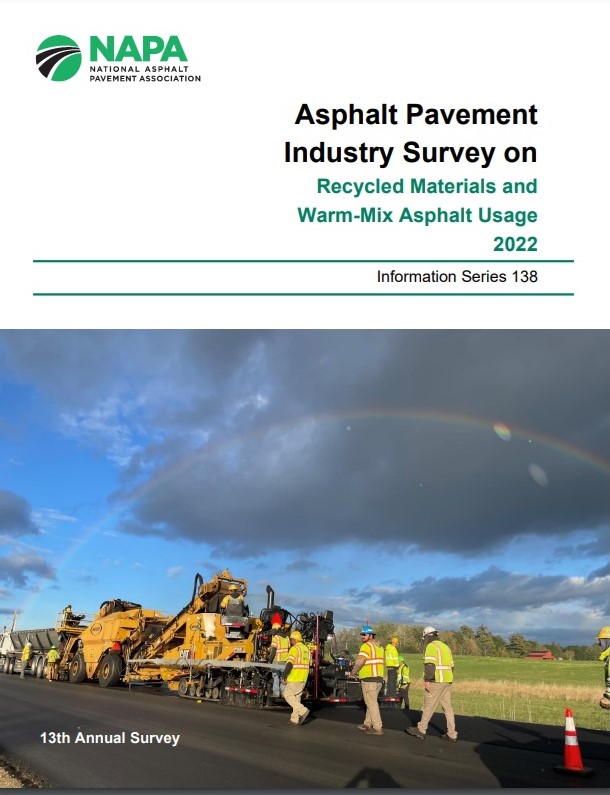
About 93% of used asphalt pavement was recycled back into new pavements, with the remainder going toward other civil construction uses, according to the latest national survey of Reclaimed Asphalt Pavement released last week by the National Asphalt Pavement Association. The free report, IS-138, can be downloaded HERE.
NAPA has been collecting data since 2009 on the asphalt pavement industry’s use of recycled materials and warm-mix asphalt via an annual survey of asphalt mix producers to determine the nationwide usage of RAP, recycled asphalt shingles (RAS) and WMA technologies. Reported totals are annually published in a report, “Asphalt Pavement Industry Survey on Recycled Materials and Warm-Mix Asphalt Usage.“
In the latest report, released May 13, 235 companies from all 50 states and the District of Columbia shared the 2022 production totals from 1,305 asphalt mix plants. In total, asphalt mixture production increased by 2% from 2021 to 441.9 million tons.
Since NAPA began collecting data in 2009, the use of RAP tonnage has increased by 75.2%, while total asphalt mixture tonnage has increased 23.3%. RAP usage during the 2022 paving season reduced the need for an estimated 26.9 million barrels of asphalt binder and more than 93 million tons of aggregate. RAP storage for future use also reduced the needed landfill space by 68.2 million cubic yards.
The report found manufacturers also kept 641,000 tons of unprocessed RAS out of landfills nationwide, as RAS usage increased by 7 percent over 2021 totals, reducing the need for 740,000 barrels of asphalt binder.
The usage of warm-mix asphalt technologies decreased by 1.6 % from 2021, with decreased WMA tonnage in the commercial and residential sector leading the decline. Still, the 175 million tons of WMA mix, representing slightly less than 40% of the market, resulted in reduced greenhouse gas emissions on a scale equal to the annual emissions of 40,000 passenger vehicles, the report found.
Additional information on other industry sustainability and climate efforts, including its net-zero carbon commitment, can be found HERE.
| |
Beverly Yu joins CalAPA's Capitol lobbying firm | |
|
Beverly Yu has joined CalAPA's Capitol lobbying firm, Carpenter Garcia Sievers, LLC, bringing with her a wealth of lobbying experience that includes legislative work, engagement with agencies and expertise in workforce development.
She joins the team of partners Mike Carpenter, Eloy Garcia and Jeff Sievers, and legislative assistant, Irida Ayrapetyan. The firm has represented CalAPA at the Capitol since 2013 and recently was named by the Sacramento Business Journal as one of the state's top Capitol lobbying firms.
Prior to her current job, Yu led the legislative, budget and regulatory agenda for the State Building and Construction Trades Council of California, which represents a half-million workers in the construction industry. She also lobbied for UDW/AFSCME, which represents more than 135,000 in-home supportive services providers and 20,000 family child care providers in 45 counties throughout California. Before embarking on her advocacy career, Yu worked for four Capitol offices, including for Assemblymembers Jimmy Gomez, Paul Fong, Rich Gordon and the Assembly Chief Clerk. In 2021 she was recognized by the National Association of Asian Pacifics in Politics and Public Affairs 40 under 40. She holds an undergraduate degree from the University of California, Davis, and a Masters of Studies in Law from the University of Southern California.
Yu's arrival, and workforce expertise, comes as CalAPA has launched a workforce-focused charitable organization, the California Asphalt Research & Education (CARE) Foundation. The Foundation board met last week. More information about the CARE Foundation can be found HERE.
To learn more about CalAPA's Advocacy Program on behalf of the asphalt pavement industry, click HERE. The Carpenter Garcia Sievers website is HERE.
| |
|
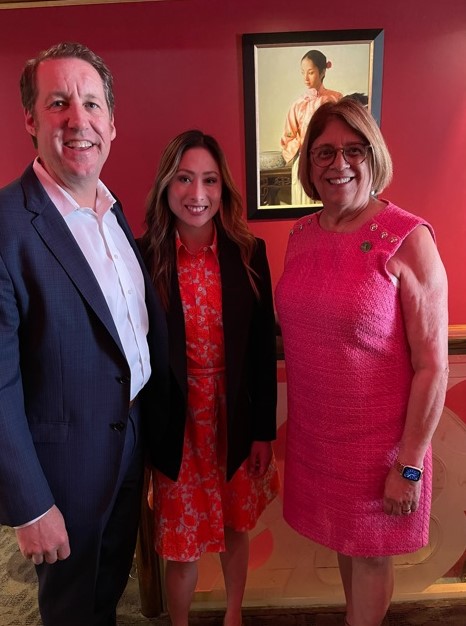
Jeff Sievers (left) and Beverly Yu (center) with CalAPA's lobbying firm Carpenter Garcia Sievers are pictured with Assembly Majority Leader Cecilia Aguiar-Curry (right) at a CalAPA-sponsored event May 15 in Sacramento.
| |
|
Caltrans advertises to fill key state pavement engineer position | |
|
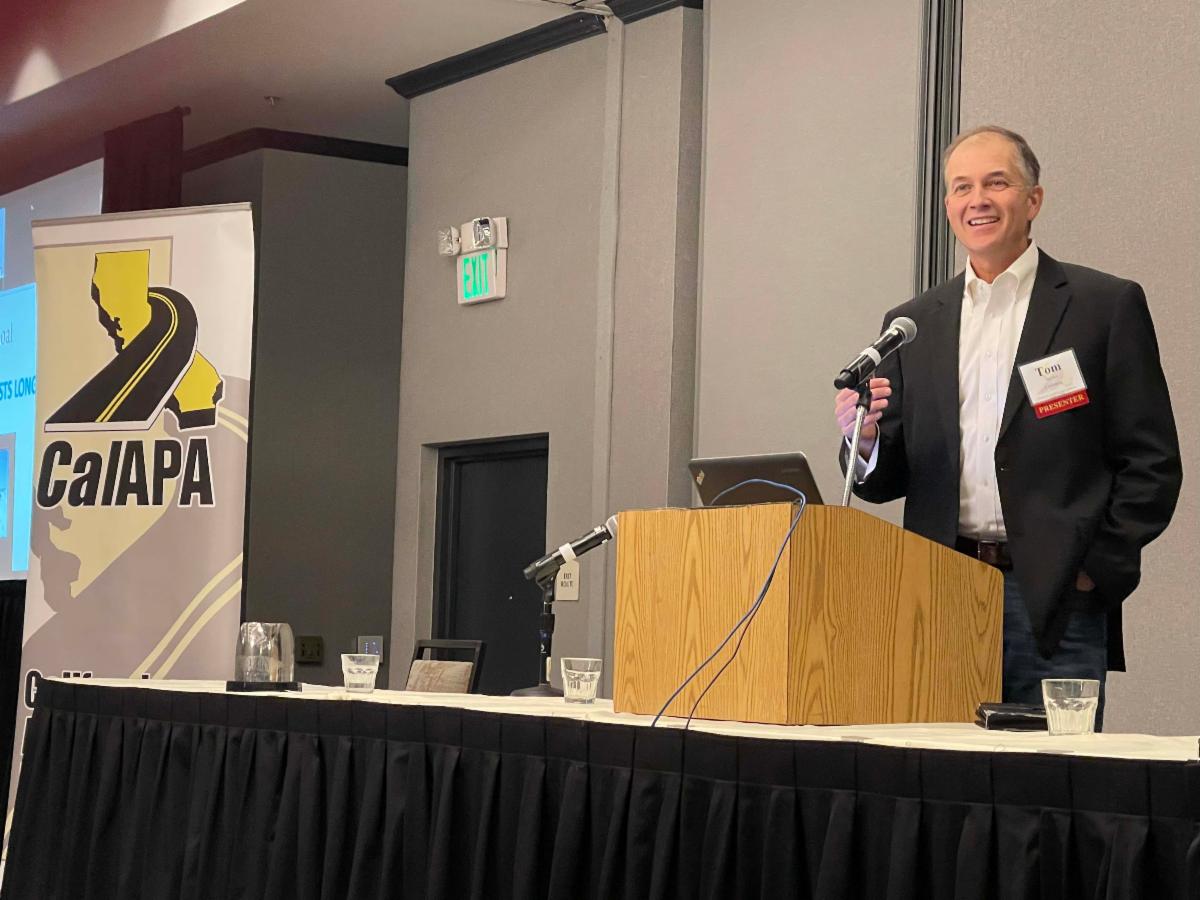
The California Department of Transportation (Caltrans) has officially begun seeking applicants to fill the department's top pavement job to replace Tom Pyle (pictured speaking at a CalAPA event), who announced he is retiring at the end of next month.
The official title of the position is Deputy Division Chief for the Division of Maintenance overseeing the pavement program. The position also comes with the title "State Pavement Engineer." The civil service classification is Principal Transportation Engineer.
The official duty statement identifies various leadership core competencies required for the position, including change commitment, risk appetite, self-development/growth, conflict management, relationship building, organizational awareness, communication, strategic perspective and being results-driven. The deadline to apply for the job is June 5. Details about the position can be found HERE.
The position is important to the asphalt pavement industry in California as the Caltrans state pavement engineer wields enormous influence on design standards and project delivery, and also serves in a leadership capacity on the joint Caltrans-industry Pavement & Materials Partnering Committee, which oversees specification changes. Asphalt covers 95% of paved surfaces in California, and Caltrans is the single largest consumer of asphalt in the Golden State.
A previous Asphalt Insider article about Pyle's retirement announcement is HERE.
| |
Welcome aboard: Fraser Consulting Services | |
CalAPA is pleased to welcome its newest associate member, Fraser Consulting Services.
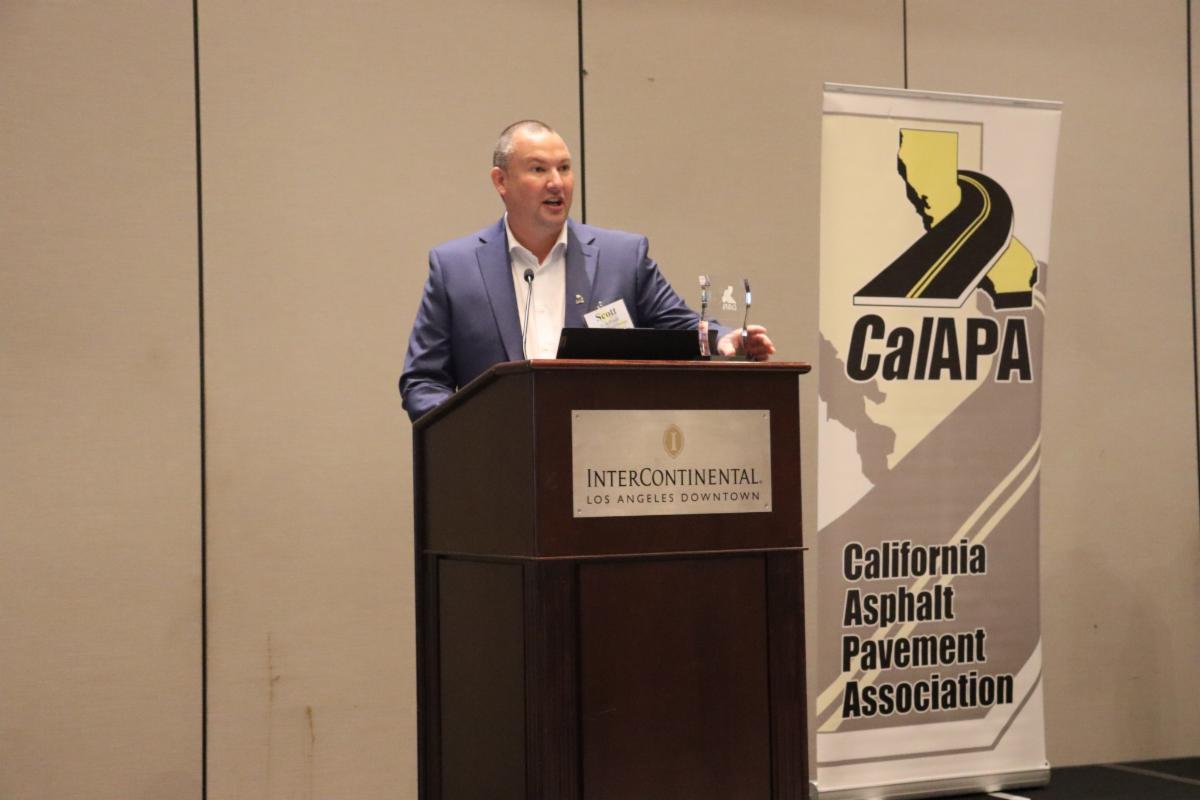
Fraser Consulting Services, based in Orange County, offers consulting services to the asphalt industry, with expertise in asphalt plant operations and facility optimization, mix design, QC/QA, recycling, regulatory compliance, safety, work force development, asphalt placement and evaluation, equipment maintenance and retrofit strategies, failure analysis and community engagement. Company principal Scott Fraser (pictured) has 20 years of experience in the industry, including service as a CalAPA committee member, Board of Directors member and officer, including serving as board chairman. He is also chairman of the CalAPA-created charitable organization, the California Asphalt Research & Education (CARE) Foundation, which supports various workforce recruitment and development initiatives as well as the Women of Asphalt California Chapter activities.
For more information, contact Fraser at (714) 715-2437, or via e-mail at: scottfraser@fraserconsultingservices.com .
| |
|
Each week we highlight a word, acronym or other term commonly used in the asphalt pavement industry in California.
SUBGRADE STABILIZATION: Modification of roadbed soils by admixing with stabilizing or chemical agents that will increase load-bearing capacity, firmness, and resistance to weathering or displacement.
| |
Paving Pointer of the Week | |
Each week we highlight a key point or best practice of interest to asphalt paving crews, inspectors and others working in the field. We welcome suggestions. More tips can be found in our "Asphalt Parking Lot Construction Checklist" HERE. Information on the CalAPA "Quality Paving Certificate" program is HERE.
SUBSOIL: Is the base layer/subsoil firm and unyielding under the pressure of repeated construction trucks? Is the soil dry enough to support heavy construction? Can the soil hold its shape under loaded trucks? If the site is wet, postpone until the site is sufficiently dry and can be proof rolled and uniform stability is obtained.
| |
|
Each week we highlight a term that is specific to climate-change issues related to the asphalt pavement industry. This feature is intended to raise awareness of the asphalt industry's climate-change initiatives and the specialized terminology that goes with them. More information on "The Road Forward" asphalt industry climate initiative can be found HERE.
CARBON OFFSETS: Purchasing of carbon credit to comply with emission caps.
| |
|
"Tension is who you think you should be. Relaxation is who you are."
– Chinese proverb
| |
|
We hope you enjoy CalAPA's Asphalt Insider newsletter. We are committed to providing you with the most up-to-date information on technical issues, regulation, news, analysis, people, events and trends in California that is of interest to the asphalt pavement industry and our various agency partners. To subscribe to the newsletter, click HERE. For comments, questions or to suggest a story idea, click HERE.
Sincerely,
Russell W. Snyder, CAE
Executive Director
The California Asphalt Pavement Association (CalAPA)®
| |
The "Asphalt Insider" is an official publication of the California Asphalt Pavement Association. For more information or to inquire about membership, call (916) 791-5044, or click HERE to contact us. Copyright © 2024 California Asphalt Pavement Association -- All Rights Reserved. The CalAPA name (No. 5,621,794) and logo (No. 5,621,795) are registered trademarks with the U.S. Patent & Trademark Office. | | | | |