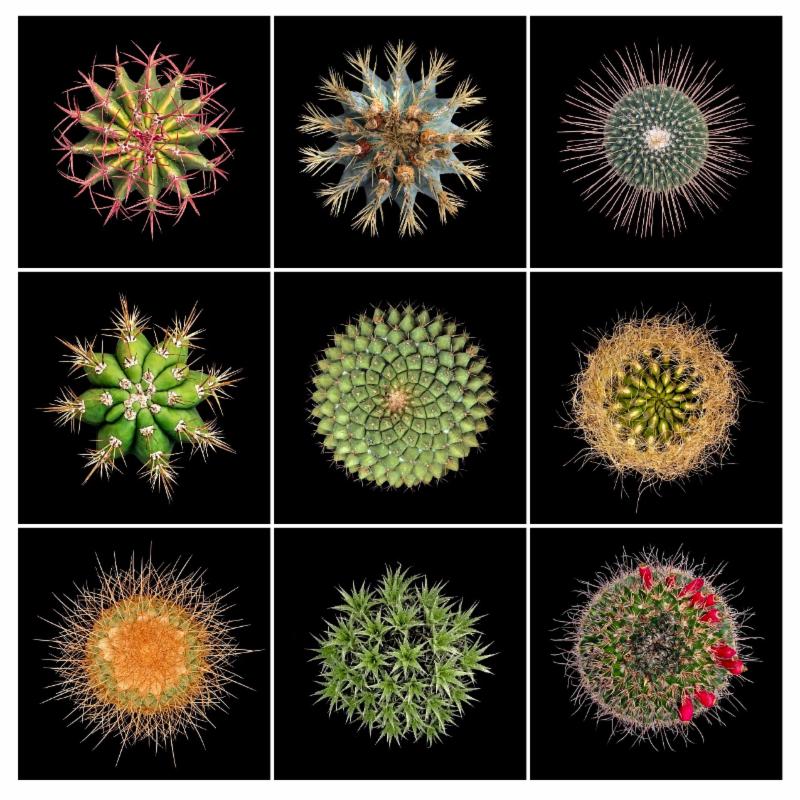
In 2001 I photographed a saguaro cactus at night from an overhead perspective. After numerous failed attempts, I was able to align the spines of the plant in such a way that it’s symmetry was revealed. The resulting pattern resembles a snowflake.
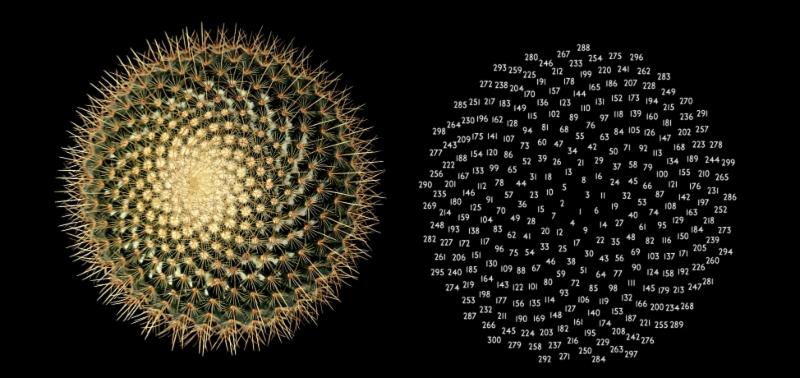
Recently I began thinking about other structural similarities found in nature. For example, the comparative pattern of a spiral galaxy and a spiral tubercle and spine pattern of a cactus. This interest inspired me to return to photographing cactus with an intent of isolating the plant in black background for the purpose of highlighting it’s bio-symmetry.
I want to make a photo that illustrates a close-up intimacy with the plant. The paradox in this is that the cactus by its own spiny nature defies intimacy.
As I processed the images in Photoshop, I discovered that the shadows cast from the textural patterns were of special interest. My curiosity got the best of me and I had to research why the
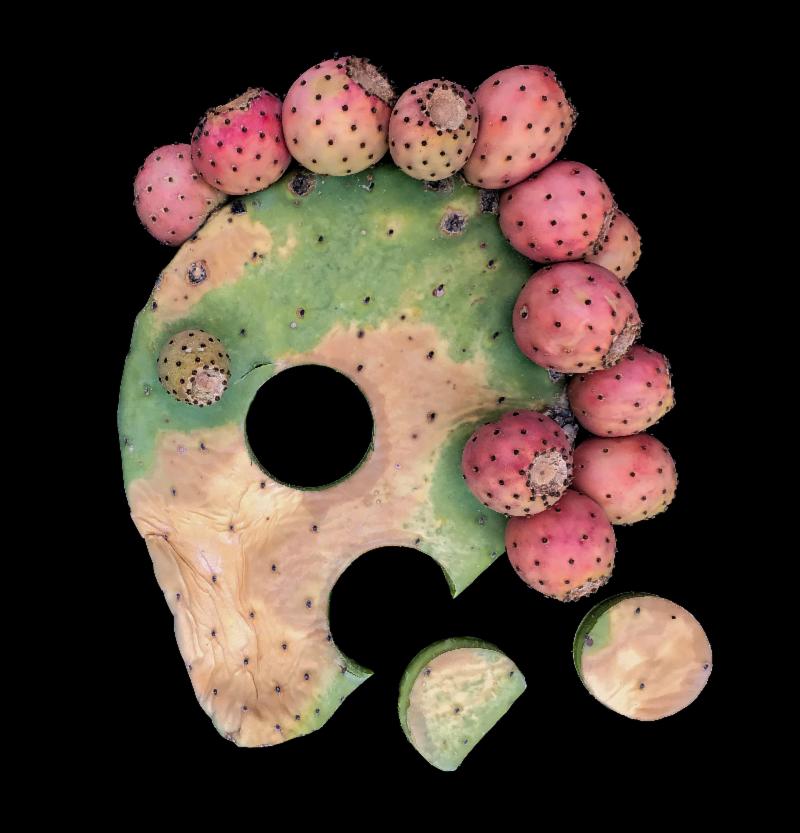
plant produced these shapes. To my delight and surprise, I learned that the shape of the cactus or succulent for all intents and purposes is simply a complex and beautiful water container. The patterns have evolved to allow the plant to regulate its temperature.
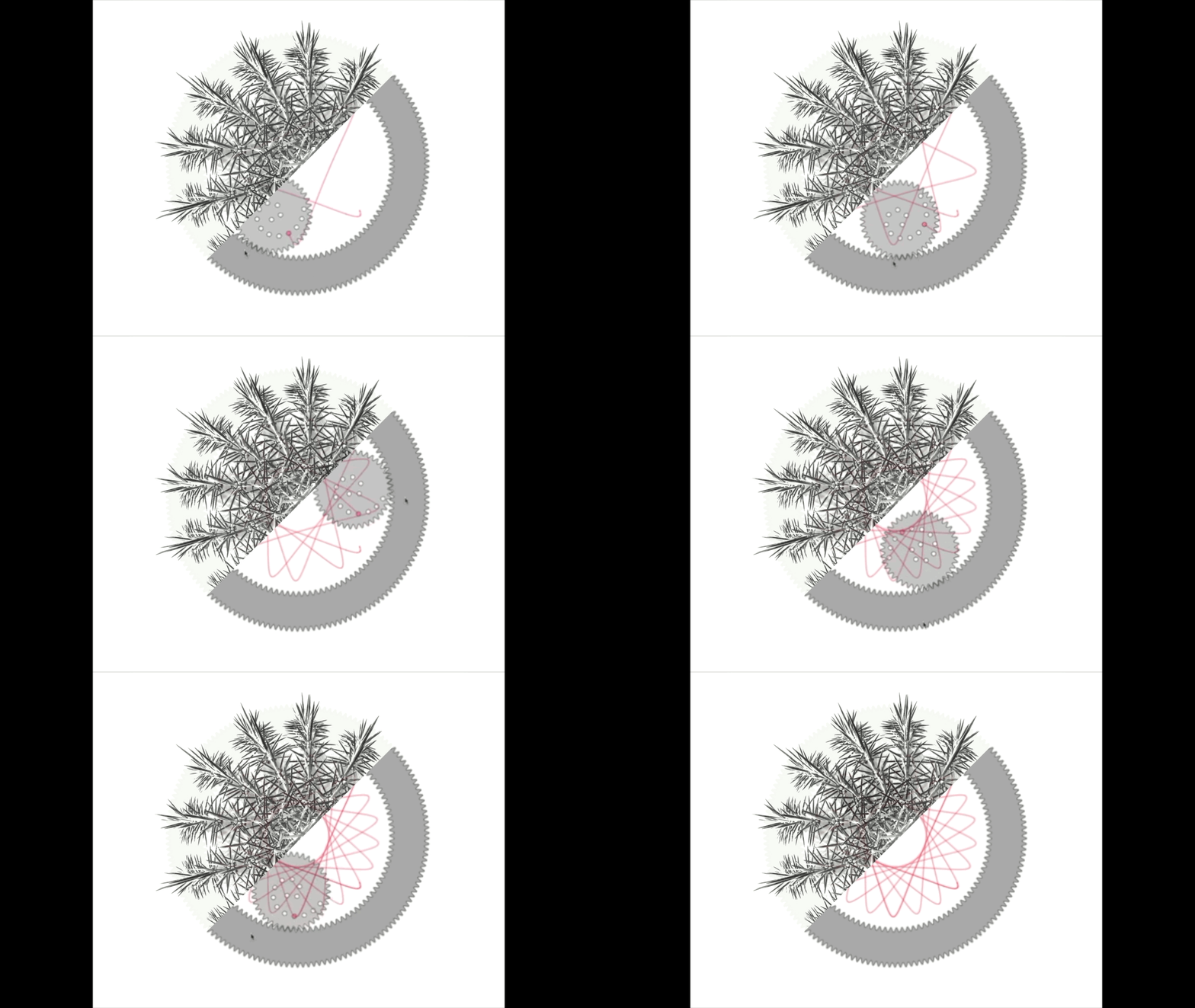
While editing photos, I continually encountered imperfections. These anomalies could dominate the image based on their ability to disrupt the patterned balance of the image. As a solution I would attempt to repair these portions of the pattern by cutting and pasting selections from other areas of the image. This proved to be a sporadically effective solution. One day in a fit of frustration while attempting to repair particularly stubborn area of a photo, I resorted to a radical solution. I cut the subject in half, then I discarded the bad half and copied and pasted the good half mirroring the other side. The result was much more natural looking than I anticipated. I began to wonder about the perception of symmetry, in particular something I read that indicated humans prefer slight asymmetry in faces. To study this, I started to pay attention to the reactions of images I received from the samples I posted on social media. So far my findings indicate that people prefer the (Spherical Symmetry) reconstructed images over the natural images. Now as I make editing choices, I keep in mind these three basic forms of symmetry.....
● Radial symmetry: The organism looks like a pie. ... Rotational symmetry, also known as radial symmetry in biology, is the property a shape has when it looks the same after some rotation by a partial turn. An object's degree of rotational symmetry is the number of distinct orientations in which it looks the same.
● Bilateral symmetry: There is an axis; on both sides of the axis the organism looks roughly the same.
● Spherical symmetry: If the organism is cut through its center, the resulting parts look the same.