The Business Transition & Valuation Review
December 5, 2017
Next issue: Tuesday, December 19
|
|
In this issue
Lead Commentary:
More on Advisors - and Facilitators
& 6 news commentaries that discuss U.S. Manufacturing, the M&A market, CEO advice, China digital advances, Canada/China trade, Canada/U.S. trade
|
|
|
|
More on Advisors - and Facilitators
|
Synopsis
: Following from
Eureka, no one blames the Advisors
(last issue) this commentary reviews what constitutes being a facilitator, and advisor, and an expert. It discusses the experts in the context of opinion subjectivity and the importance of careful expert selection when seeking expert advice.
|
|
|
YOUR THOUGHTS ON LEAD COMMENTARY 'MORE ON BUSINESS TRANSITION ADVISORS'?
|
|
Very Informative and useful
|
|
|
|
|
Not informative and useful
|
|
|
|
|
|
|
Want commentary on a
business transition or valuation topic?
Write to me at icampbell@ircpost.com. I will write a commentary on your suggested topic, or find someone better equipped than me to write one.
|
|
|
|
Please forward this Newsletter email to a colleague, friend or client interested in Business Transition and Valuation
|
|
Comment: This is a McKinsey Harvard Business Review article every medium-sized and small manufacturing business owner – and the advisors to those owners – needs to read.
For some time I have saying – where until now I am not aware of anyone else commenting similarly – that industry consolidation is creating larger and larger companies with greater and greater competitive advantage. This article makes the following statement:
“Without the breathing room to invest in new equipment and technologies, smaller manufactures may be up to 40% less productive than large companies – a gap so sizable that it drags down the entire sector’s performance. In some instances, the end results were firm closures and lost jobs. Many of the small and midsize manufacturers that did manage to survive kept going by cutting costs, which has led to stagnant wage growth.”
Perhaps if business owners and their advisors focus on this and other relevant ‘new business normal’ influences two things will happen:
1. business owners will be more receptive to the notion that they need to begin now to plan for business transition.
2. their advisors will be better able to convince them of that.
|
|
Comment: This article reports on U.S. merger and activity, saying that it is “on pace (in 2017) to clear $1 trillion for the fourth year in a row”.
Robert W. Baird & Co., a U.S. investment bank involved in M&A advisory, is reported as saying it thinks 2018 could be even better given:
1. expected continued growth in the number of private-equity backed companies, which it says has grown by over 30% in the six years ended 2017. This where it is said there are over 7,000 private-equity backed companies in the U.S.
2. strong Chinese buyer participation.
3. a very competitive market place.
The article does not discuss the significance of this business combination activity in the context of it promoting larger companies and a resultant more competitive environment for smaller companies. Private company business owners and their advisors clearly need to increasingly focus on long-term business viability and business transition planning and execution - see previous commentary.
|
|
Comment: This article fits with a commentary I recently wrote on the importance of curiosity. This where a CEO is quoted as saying “my best advice is to take advice”. She goes on to say it is important to ask others about their experiences, how they way alternative courses of action, and how they pick paths forward.
The important messaging is that advice is something one ‘can take’, rather than something one ‘must take’.
Perhaps the most important messaging – not found in the article - is that it is important to measure the potential of employees in part on:
1. their curiosity level, higher than lower typically being better.
2. whether they seek advice from others, and how well they integrate that advice into their decision making processes.
|
|
Comment: This article claims China currently is the global leader in consumer-oriented digital technologies, and that:
1. China accounts for over 40% of global transactions.
2. is among the top three countries attracting venture capital to 3D printing, artificial intelligence, autonomous vehicles, drones and robotics.
3. currently running a trade surplus in digital services of U.S.$15 billion (with a ‘b’) per year.
The second statement is hardly surprising, the first and third statements more interesting.
An important business transition and valuation observation has to do with the extent and timing of what arguably is an ongoing economic power shift in China’s favor. Whether or not that is a valid observation, China’s seemingly increasing economic strength is one more factor that should resonate with developed country business owners and their advisors as a further good reason to begin planning for and executing business transition now and not later.
|
|
No technology news articles are included in this issue.
|
|
Our information/reference book receives
|
|
|
Comment: Canada recently entered into an important trade agreement with the European bloc. Not surprising, presumably for good reasons other than the ongoing NAFTA talks Canada is reported to be in discussion with China in the context of trade and trade agreements - although news later on December 4 reported that no schedule had been reached on when more formal talks and negotiations would take place.
Given its resources base Canada is important on a world scale. The U.S. currently is by far Canada’s most important trading partner. The Canadian government is only doing its job by pursuing other trade agreements – and perhaps even more importantly with the ongoing NAFTA renegotiations.
The article’s author, who appears to have extensive relevant experience, says that from China’s standpoint “a bilateral agreement with Canada would open new doors to North America and pave way to the Free Trade Agreement of Asia Pacific (FTAAP)”.
There can be little doubt China and others are focused on Canada’s resources. I don’t know if Mr. Trump is a fan of old sayings. If he is he might consider the old saying “one might not like what they wish for”.
|
|
Comment
: Every US state’s most important international trading partners. Reading time 5 minutes, or longer if interested. Business Insider, November 15, 2017.
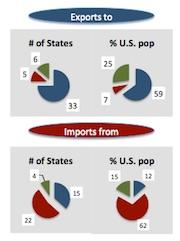
Comment: This article includes two U.S. state maps, showing by state: (1) the country each state exports the most to, and (2) the country each state imports the most from. The article does not take the second – and arguably the more important – step to relate State exports and imports by state population. I did that. The chart shows the results for U.S. State exports to, and imports from Canada (blue), China (red) and Mexico (green). State population statistics are based on a U.S. 2013 census.
Note that exports to Canada are first in 33 states that are home to 59% of the U.S. population. Note, as might be expected, that China is the largest importer for 22 states that are home to 62% of the U.S. population. Consider how important Canada is as an export customer to the U.S., and how China dominates as an importer to the U.S. Begging the question of impact on U.S. inflation - which I suggest can't be overlooked - one might think Mr. Trump and his merry men and women might be looking more China than Canada as they contemplate 'America first' Trade policies.
|
|
No financial markets news articles are included in this issue.
|
|
Ian R. Campbell
is the principal contributor to this Newsletter. He has given business valuation and transition advice to both public and private company owners for over 45 years. Other contributors are experts in business transition or specific disciplines relevant to business transition and valuation.
|
|
Newsletter content ('Content') does not constitute individualized business transition, valuation, technology, economic or investment advice. The ideas, views and opinions expressed in the Content are solely those of the authors/contributors. Provided 'as is', Content may change without prior notice, may be incomplete, inexact, incorrect or jurisdiction specific. It is used at the reader's own risk.
|
|
Copyright © 2017 Transitus Publishing Inc. All Rights Reserved.
|
|
|
|
|
|
|