By Jefferson Scholar-in-Residence
Dr. Andrew Roth
| |
|
‘Americans & Their Games’ (Part IIIA)
Freedom’s Faultlines: African Americans
& Sports in American History
| |
|
What light does sports shed on the African American experience?
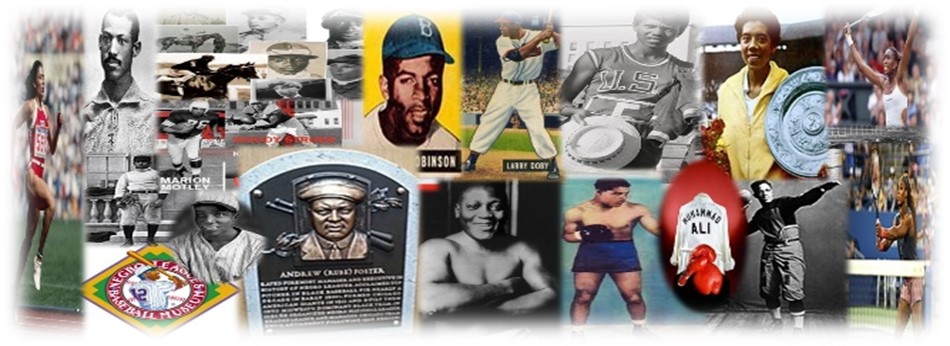
Who were Oliver Lewis and James “Jimmy” Winkfield? Frank Grant and Moses “Fleetwood” Walker?
Who was the “Galveston Giant”?
Who were the first African Americans to play professional football?
Everyone knows, or almost everyone knows, Jackie Robinson’s story, but who was Larry Doby, Earl Lloyd, and “Sweetwater” Clifton?
Although we’ll meet them again in Part IV “Women and Sports,” who were the Tennessee State “Tigerbelles”?
***
Beginning in 1619, the African American experience is too rich, too vast for a simple Book Note. This week and next, using The American Tapestry Project’s “Freedom’s Faultlines” as a lens – those stories of people first excluded from the promises of America’s foundational values struggle to be included by appealing to those very values – we’ll discover the intimate and profound role sports played in African Americans’ quest to be included in the American Dream.
Beginning in antebellum America, we’ll briefly examine African Americans’ sporting experience during slavery. In the immediate post-Civil War Era, we’ll discover a brief blossoming of sports success in baseball and horse racing only to see it devalued and segregated after Reconstruction’s end in the late 1870s and the rise of Jim Crow America. During the Jim Crow Era, which can be said to have spanned the entire period between, to somewhat arbitrarily pick dates, the first Black Codes in 1866-1867 and the great civil rights acts of the 1960s, we’ll discover how African Americans created their own sporting culture. Lastly, we’ll examine sports’ role in the Civil Rights Movement of the mid-20th century beginning with the integration of the NFL in 1946.
As you might suspect, the sporting experience of African Americans during slavery was stunted by the demands of the slave owners. . The authors of Sports in American History note that slaves had “to entertain their masters as jockeys in horse races, and they sometimes worked as horse trainers or as boxers or as wrestlers in rough physical contests wagered upon by their owners. Slaves themselves gambled at bowling, cards, and dice games, although Southern legislatures tried to ban such activities by the 1830s.” [1] Regardless of the dictates and restrictions of their owners, “slaves took pride in their physical prowess.” [2]
Two experiences, however, stand out. At a time when few white Americans of European ancestry could swim – you might recall that Benjamin Franklin was one of them – he invented swimming fins and taught his friends to swim – African Americans brought with them from Africa their swimming skills. As the authors of Sports in American History observe, “Slaves used their swimming ability in the rivers and ponds on or near plantations for both competitive and practical purposes.” [3] Regarding competition, slaves organized swimming competitions among themselves that were frequently won by women. These competitions served two purposes – they created a sense of community among the slaves, and they served as a means to garner prestige within the community.
Of more lasting consequence than swimming, male slaves became an integral part of the Southern colonists’ quarter horse and thoroughbred racing culture. Horse racing was the premier sport in Southern plantation culture. For the planters, it was a source of great pride and the focus of a lavish social and gambling culture. As “gentlemen,” the planters were themselves great horsemen. Their riding skill was an essential component of their identity. The care and maintenance of their horses, however, they left to their slaves. The slaves themselves became expert trainers and riders. At the horse racing meets that were a major part of Southern colonial culture, while the owners socialized with their peers, drinking and wagering on the races’ outcomes, it was the slaves who were the jockeys. Victorious jockeys and trainers became celebrities within and without the slave culture. Their skill earned them preference and a slightly easier and more stable existence.
In the immediate post-Civil War era there was a brief blossoming of Black political and social culture before a resurgent white supremacy during what became known as The Redemption pushed it aside. In sporting America, that occasioned two phenomena about which most Americans are unaware – the excellence of African American jockeys and trainers and the presence of African Americans in professional baseball before they were banned in the late 1880s.
| |
|
Modeled after The Derby at Epsom Downs in England, the Kentucky Derby was founded in 1875 by Meriwether Lewis Clark, Jr., the grandson of William Clark of “Lewis and Clark” fame. The winner of the first ever Kentucky Derby was Aristides, ridden by Oliver Lewis and trained by Ansel Williams. Lewis and Williams were African Americans. The photo accompanying this paragraph shows Lewis aboard the triumphant Aristides. African American jockeys won seven of the first eight Kentucky Derbies and 15 of the first 28. Among the jockeys who won those derbies were Willie Simms, James Perkins, Alonzo “Lonnie” Clayton – the youngest to win at 15 – William Walker, Isaac Murphy, and James “Jimmy” Winkfield.
| |
|
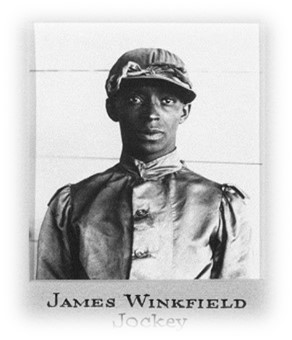
One of the greatest, maybe the greatest, of those jockeys was James “Jimmy” Winkfield. Born in 1882 the 17th child of his sharecropper parents, Winkfield started riding at age 7, became a stable boy at 15, and started riding professionally at 16. He finished third in his first Derby in 1900, then won back-to-back Derbies in 1901 and 1902 and finished second in 1903. He is one of only six jockeys ever to win back-to-back Kentucky Derbies. [4] He is the last African American to win the Kentucky Derby. In his career, he won over 2,600 stakes races.
In the late 1890s and early 1900s, with anti-Black attitudes on the rise, Winkfield, as did all Black jockeys, became the focus of abuse. White riders protested their presence and lobbied to get Black jockeys banned as an economic downturn caused racing dates to be cancelled. Black jockeys were assaulted by white riders who used their whips to crowd the Black jockeys into the rails. Winkfield received death threats from the Ku Klux Klan. Sickened by the increasing racism, Winkfield left the United States in 1904 to ride professionally in Poland and Russia.
For the next 50 years, his life reads like a movie script. In 1904, he won the “Tsarist Triple Crown” – the Moscow, St. Petersburg, and Warsaw derbies. During the next 10 years he was Russian national champion, rode in Austria and Germany for a Polish prince, and earned over 100,000 rubles per year. [6] In 1919, living in Odessa, he escaped the Russian Revolution by fleeing to Poland with almost 200 thoroughbreds. Having made his way to Paris, in 1920 he continued his racing career winning the “Prix du President de la Republique.” He met and married an exiled Russian aristocrat. He retired in 1930 to breed and train horses on a property he bought in the French countryside. [7]
In 1941, now fleeing the Nazis, he returned to America. Confronted by American racial discrimination, he was reduced to working as a stable hand. By the early 1950s, he was back in France and had rebuilt his racing stable. But it was a small operation compared to what he had before World War II. In 1960, he returned to the United States for medical care. Invited by Sports Illustrated to a pre-Derby banquet in segregated Louisville, he and his daughter were denied entry because they were Black. After an awkward wait and an argument, Sports Illustrated got them admitted. [8] Winkfield returned to Europe. He died in France in 1974.
Winkfield was finally inducted into the National Racing Museum and Hall of Fame in 2004. [9]
In 1921, Henry King was the last Black jockey to ride in the Kentucky Derby for 79 years until Marlon St. Julien finished seventh in 2000. [10]
***
Most people, if asked “Who was the first African American to play professional baseball?” would answer “Jackie Robinson.” They would be wrong, because just as in horse racing, during Reconstruction America there was a brief flurry of African Americans in the newly emerging sport of professional baseball.
| |
|
The honor of being the first African American professional baseball player belongs to Bud Fowler, who in 1878 at the age of 14 played for an all-white professional team in New Castle, Pennsylvania. Fowler was born John Jackson in 1858 and grew up in Cooperstown, New York. He played, as was typical of the era, under an assumed name; hence, the “Fowler” which he adopted in 1878. [11] Regardless of your ethnicity, professional baseball of that era was at times a vagabond game. If you happened to be African American, that was especially true. Between 1878 and 1904 when Fowler played in the newly emerging Negro Leagues, he played for teams all across the American heartland from New Castle, Pennsylvania to Niles, Ohio to Keokuk, Iowa in the Western League to Pueblo, Colorado, to a laundry list of teams and towns. He was elected to the National Baseball Hall of Fame in 2022.
Other great Black players of that era included Smoky Joe Williams, Frank Grant, and Moses “Fleetwood” Walker. Grant is generally considered to be the greatest African American player of the 19th century. As his profile at the Society for American Baseball Research states, “He was the best Black player of the century, with the glove and with the bat. In today’s vernacular, he was a power hitter, often leading his team and league in slugging and extra-base hits. He could also fly, stealing numerous bases and covering more ground in the infield than perhaps anyone of his era, white or Black.” [12] Playing for the Buffalo Bisons, Grant was only Black player before the 1940s to play for the same team three years in a row. [13] He was elected to the National Baseball Hall of Fame in 2006.
Ty Cobb, no friend of the Black man, once said of Smoky Joe Williams that he was “a sure 30 game winner in the major leagues.” [14] That was in the days before exotic statistics like WHIP (Walks and Hits per Innings Pitched) came into existence and winning 30 games in a season marked one as the elite-of-the-elite. No one has done it since Denny McLain in 1968. Williams played for the New York Lincoln Giants and later the Homestead Grays before retiring in 1933. [15] Williams entered the National Baseball Hall of Fame in 1999.
Of that trio, however, Walker is the most well-known because he was the last Black player to play professional “major league” baseball until Jackie Robinson played for the Brooklyn Dodgers in 1947. Walker played for the Toledo Blue Stockings. In 1883, Cap Anson, one of the great white players of the era and a major force in founding the National League, threatened to pull his team from a game against Walker’s Blue Stockings. Over the next several years Anson repeated his threats until in 1887 he declared his teams would not play against the Newark Little Giants if either Walker or pitcher George Stovey played. To make a longish and unpleasant story short, the other teams, some reluctantly, backed Anson and instituted a ban against all African American players in professional baseball. With this “gentlemen’s agreement” in place, by 1889 all Black players were gone from major league baseball and the high minor leagues. The ban was reasserted in the 1920s by Major League Baseball Commissioner Kenesaw Mountain Landis. [16]
In that Jim Crow era, until the creation of the Negro Major Leagues in the early-20th century, African American players were reduced to “barnstorming” to earn any semblance of a living from their baseball skills. In “barnstorming,” a group of players would form an informal team – sometimes they had sponsors – and go from town to town playing local amateur or semi-professional teams. Barnstorming lingered into the 1930s and 1940s when Black teams would sometimes “barnstorm” with white major leaguers during the winter to earn extra money. Although the film is set in the 1930s, the James Earl Jones, Billy Dee Williams, and Richard Pryor movie “The Bingo Long Traveling All-Stars and Motor Kings” captures the flavor of the entire era.
***
| |
Aside: What is meant by the phrase “Jim Crow”? The Compromise of 1877 gave the Presidential election to Republican Rutherford B. Hayes, whose supporters brokered a deal with Southern Democrats to give Hayes the presidency in return for a promise to remove all federal troops from the South. This effectively ended Reconstruction. Free from federal authority, southern states began to pass and enforce laws creating racial segregation. These laws remained in force until the great Civil Rights Acts of the 1960s. They were upheld by the infamous 1896 Supreme Court decision in Plessy v. Ferguson, which established the legality of “separate but equal” facilities in everything from public transportation to housing to education to residential restrictions. In short, the Jim Crow laws, sometimes known as Black Codes, created segregated America. The phrase “Jim Crow” comes from 19th century minstrel shows. It was a derogatory term describing African Americans. It became the default phrase describing the condition of African Americans in the late-19th and early-20th centuries. It was uttered as an epithet demeaning and denigrating African Americans. The segregation of professional baseball illustrates the entire cultural phenomenon. | | | |
|
***
In the late-19th century, while colleges were developing intercollegiate football and professional baseball was on the rise, another sport captured the American sporting public’s attention. Boxing was a somewhat tamer version of its more primitive progenitor – bareknuckle fighting. Although its roots are ancient, in America bareknuckle fighting arose in the “tavern culture” of the mid-19th century. “Tavern culture” is 21st century sports bars’ great-great-great grandfather. In the male-dominated taverns of the time, males gathered to drink beer and whiskey, talk sports, place bets, and watch fights. The greatest bareknuckle fighter was the son of Irish immigrants – John L. Sullivan. He was, some assert, the first great American sports hero. [16] Boxing, and baseball, we’ll discover in “Sports and The Immigrant’s Tale,” were major pathways into American culture for generations of immigrants of many ethnicities.
Boxing, wearing gloves and following the Marquis of Queensberry’s rules supplanted bareknuckle fighting as a more civilized form of sparring when Sullivan lost to “Gentleman” Jim Corbett in New Orleans in 1892. [17] The wearing of gloves, limited rounds, and specific rules forbidding eye gouging, headbutting, etc., gave the new sport a more civilized veneer.
| |
|
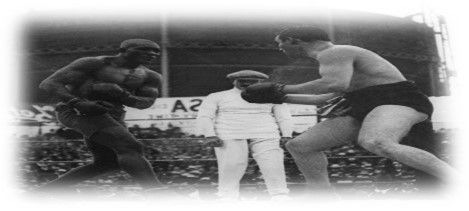
It all began on Boxing Day, 1908, in Sydney, Australia when Johnson defeated a white man, the reigning heavyweight champion Tommy Burns. Prior to beating Burns, Johnson could not get opponents to fight him because of racism. He pursued Burns for two years egging him on to a championship fight. After Johnson beat Burns, there was a public outcry to find a white man who could beat Johnson. Johnson made himself a target for white racists because of his flashy, unapologetic lifestyle, his penchant for dating white women, and, finally, for marrying a white woman.
An avowed white supremacist, novelist Jack London sought a “great white hope” to fight, to defeat, and to reclaim from Johnson the heavyweight title for the white race. The great boxing promoter of the era, Tex Rickard, saw the opportunity for a massive payday. He organized a bout between Johnson and former heavyweight champion James J. Jeffries, who came out of retirement for the fight, to be held in Reno, Nevada on July 4, 1910.
It was called “The Fight of The Century.”
Johnson totally dominated Jeffries, whose corner ‘threw in the towel’ in the 15th round. Jeffries later said he couldn’t have beat Johnson in his prime; John L. Sullivan said, “Johnson won deservedly, fairly, and convincingly.” [20]
After the fight, there were race riots throughout America. More aggravating for white Americans than Johnson’s victories in the boxing ring was his penchant for white women, of whom he married three. In 1912, Johnson was arrested for violating the Mann Act, which was a federal statute prohibiting the transporting of a woman across state lines for illicit purposes. It was aimed at reducing “trafficking” women for prostitution. The woman with Johnson at the time was his wife Lucille Cameron. Because they were married, the case fell apart. But in 1913 Johnson was charged again for violating the Mann Act. This time he was convicted by an all-white jury even though the woman was his wife. [21]
Johnson fled to Europe.
Later, hoping to have the charges dropped and be permitted to return to the United States, he agreed to fight another heavyweight title fight in Havana, Cuba against Jess Willard. Johnson lost. There have been repeated rumors that he threw the fight to ingratiate himself with American authorities. No one has been able to establish the truth of the allegations; Willard is generally thought to have won the fight legitimately. Regardless, when Johnson returned to the United States, he served a year in prison in 1920-21. In 2018, President Donald Trump issued Johnson a posthumous, full pardon. [22]
Johnson’s life has been the subject of numerous books, a Broadway production and film starring James Earl Jones The Great White Hope, and a Ken Burns documentary Unforgivable Blackness.
Why?
Because, boxing aside, Johnson’s life crystallizes the issue of race in America. Johnson did the two things no Black man was permitted to do in Jim Crow America – he beat a white man “fair and square,” and he married white women. And still, bearing the scars of white America’s reprisals for daring to step outside Jim Crow’s segregated boundaries, Johnson fought his last boxing match in November 1945 raising funds for U.S. War Bonds. He died in an automobile accident in 1946 in North Carolina after being refused service at an all-white diner and driving away angry and distracted. [23]
Next week Rube Foster, the Negro National Leagues, the NFL integrates, Larry Doby and Stachel Paige come to Cleveland, the Tennessee State Tigerbelles, Bill Russell, Jim Brown, Tommie Smith, Bear Bryant and Sam Cunningham, why did Laura Ingraham tell LeBron James “to shut up and dribble,” and why, in 2023, is Patrick Mahomes, whose mother is white, always called “a Black quarterback”? We’ll end with an anecdote about me, Floyd Patterson, and Willie Mays.
| |
-- Andrew Roth, Ph.D.
Scholar-in-Residence
The Jefferson Educational Society
This content is copyrighted by the Jefferson 2022.
| |
|
Intro Photo Credits
“African American Sports Collage,” Andrew Roth created May 23, 2023.
“Oliver Lewis aboard Aristides” at blackmericaweb.com available at Little Known Black History Fact: Oliver Lewis Kentuck (blackamericaweb.com)accessed May 29, 2023.
“James ‘Jimmy’ Winkfield” at james winkfield - Bing images accessed May 29, 2023.
“Bud Fowler” in Wikipedia, the free encyclopedia available at Bud Fowler - Bud Fowler - Wikipedia accessed May 29, 2023.
“Jack Johnson1.jpg” at Wikimedia Commons available at File:Jack Johnson1.jpg - Wikimedia Commons accessed May 29, 2023.
“Tommy Burns v. Jack Johnson” at NITV available here accessed May 29, 2023.
End Notes
-
Gems, Gerald R., Linda J. Borish, and Gertrud Pfister. Sports in American History: From Colonization to Globalization. 2nd Ed. (Champaign, IL: Human Kinetics, 2017), p.20.
- Ibid.
- Ibid., p. 21.
-
Forde, Pat. “The Wild Life of the Last Black Jockey to Rule the Kentucky Derby,” in Sports Illustrated (Feb. 21, 2023) available at Jimmy Winkfield: The life of last Black jockey to win the Kentucky Derby - Sports Illustrated accessed May 29, 2023.
-
Winkler, Lisa. “The Kentucky Derby’s Forgotten Jockeys,” Smithsonian Magazine (April 23, 2009) available at The Kentucky Derby’s Forgotten Jockeys | History| Smithsonian Magazine accessed May 29, 2023.
-
“James Winkfield,” Encyclopedia Britannica available at James Winkfield | American jockey | Britannica accessed May 29, 2023.
- Ibid.
-
Winkler, cited above.
-
Forde, cited above.
-
Winkler, cited above.
-
McKenna, Brian. “Bud Fowler,” Society for American Baseball Research available at Bud Fowler – Society for American Baseball Research (sabr.org) accessed May 29, 2023.
-
McKenna, Brian. “Frank Grant,” Society for American Baseball Research available at Frank Grant – Society for American Baseball Research (sabr.org) accessed May 29, 2023.
- Ibid.
-
Coates, John M. “Smoky Joe Williams,” Society for American Baseball Research available at Smoky Joe WIlliams – Society for American Baseball Research (sabr.org) accessed May 29, 2023.
-
Lowenfish, Lee. “The Gentlemen’s Agreement and the Ferocious Gentleman Who Broke It,” Society for American Baseball Research available at The Gentlemen’s Agreement and the Ferocious Gentleman Who Broke It – Society for American Baseball Research (sabr.org) accessed May 29, 2023.
-
Kingseed, Wyatt. “John L. Sullivan: Last Bare-Knuckled Champion,” at HistoryNet (Dec. 17, 2019) available at John L. Sullivan: Last Bare-Knuckled Champion (historynet.com) accessed May 29, 2023.
-
Gems, et. al., cited above, p. 134.
-
“Jack Johnson (boxer),” Wikipedia, the free encyclopedia available at Jack Johnson (boxer) - Wikipedia accessed May 29, 2023.
- Ibid.
- Ibid.
-
Jentsch, Eric W. “Jack Johnson, the First Black Heavyweight Boxing Champion,” Smithsonian Magazine (Feb. 22, 2022) available at Jack Johnson, the First Black Heavyweight Boxing Champion | Smithsonian Voices | National Museum of American History Smithsonian Magazine accessed May 29, 2023.
-
Eligon, John and Michael D. Shear. “Trump Pardons Jack Johnson, Heavyweight Boxing Champion,” The New York Times (May 24, 2018) available at Trump Pardons Jack Johnson, Heavyweight Boxing Champion - The New York Times (nytimes.com) accessed May 29, 2023.
-
Clark, Kim, “Two champs meet” , U.S. News & World Report (Jan. 9, 2005) available at Ken Burns and boxing champion Jack Johnson - US News and World Report (archive.org) accessed May 29, 2023.
| |
JES Mission: The Jefferson was founded to stimulate community progress through education, research, and publications. Its mission also includes a commitment to operate in a nonpartisan, nondenominational manner without a political or philosophical bias. As such, the Jefferson intends to follow the examined truth wherever it leads and is neither liberal nor conservative, Democratic nor Republican in philosophy or action. Our writers’ work reflects their own views. | | | | |