 |
|
|

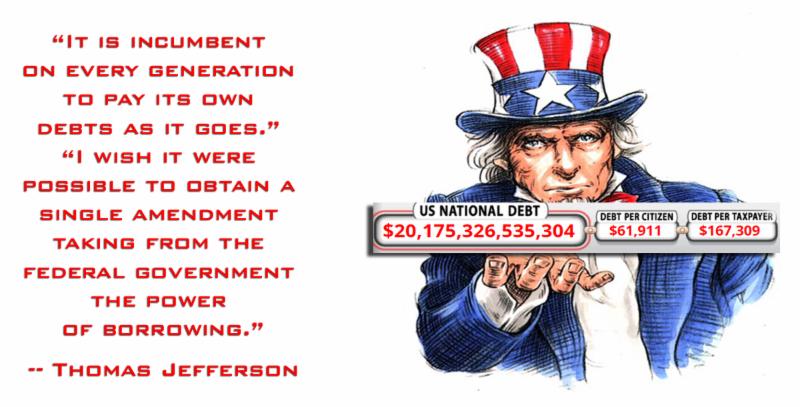
On September 6th, through a political atmosphere where bi-partisanship has been elusive, Senator Charles Schumer saw what he referred to in the New York Times as "a ray of hope for both parties." Schumer and fellow Democratic congressional leaders had just negotiated an agreement with President Trump to raise the national debt limit and fund government expenditures for the next three months. Two days later, in surprising majorities, the Republican-dominated houses of congress both approved that deal. With money flowing again, the build-up of postponed transactions was finally relieved and the national debt figure swelled by more than $300 billion in a single day.
$300 billion is a difficult number to imagine, in practical terms. How much more incomprehensible the $20 trillion which is now our national obligation. Paul Laxalt, former Governor of Nevada, once famously remarked, "[Deficits are] a yawner. We, as Republicans, have talked about deficits and balanced budgets since the days of Roosevelt, and the people simply haven't listened, because they can't relate to those huge numbers." But another Governor, John Kasich of Ohio, argues that rather than being a "yawner," these latest debt-figures need to be a wake-up call.
Kasich elaborated on that thought in his guest post that was published in the September 18 edition of Forbes magazine. Gov. Kasich said, "...And the wake-up message is this: by exceeding the previous statutory debt limit and for the first time surpassing an un
fathomable $20,000,000,000,000, it's the most alarming sign yet that our federal government is letting spending and debt put our ability to grow the economy at risk. As we've so often seen around the world, countries with the highest levels of government debt, in proportion to their economic output, struggle with weak growth and stagnant wages.
"We simply cannot allow that to happen here, watching our national debt continue to grow while it strangles America's economic growth and productivity, increases interest rates and the cost of interest payments, gobbles up resources we need for essential public services and infrastructure, all while it pushes us closer and closer to a fiscal crisis. Our growing debt also makes it increasingly difficult to respond to unforeseen events, such as recessions and natural disasters. Former chairman of the Chiefs of Staff, Admiral Michael Mullen, has even warned us: 'The most significant threat to our national security is our debt.'"
However, for decades, Americans
have continued to helplessly watch the federal government produce increasingly irresponsible budgets, heavily funded by debt. The exigencies of re-election, apparently, do not allow enough congressional representatives to see past the present, to the time when credit can no longer be stretched further. But in the conclusion of his guest post in Forbes, Kasich presents a solution. He proposes the use of Article V, the only constitutional mechanism that can circumvent a short-sighted congress. He writes:
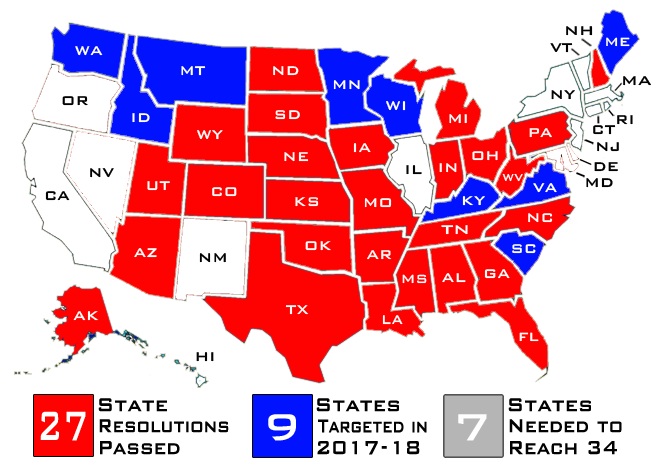
"The U.S. Constitution offers an opportunity for grassroots action, empowering the states to trigger needed change. Through this procedure, if 34 states call for a convention to pass an amendment to require a balanced federal budget, and that amendment is then approved by 38 states, we can finally bring fiscal accountability to the federal level... Admittedly this state-initiated approach sets a high bar, and for good reason. But today a total of 27 states are on board, with just seven more states needed to call a convention and trigger the fiscal responsibility our federal government so desperately needs."
Read Kasich's entire Forbes article at
:
https://www.forbes.com/sites/realspin/2017/09/18/the-record-surge-in-our-national-debt-is-an-urgent-wake-up-call-for-american-families/?c=0&s=trending#396e7afd1365
|

Amid the 105 degrees of their famous "dry heat," the Arizona Legislature recently hosted a Balanced Budget Amendment Planning Convention. Called to advance plans for a future Article V Amendatory Convention, the four-day event was declared a complete success by those in attendance and many who follow this critical issue.
September 12, 2017 will go down as a milestone for those concerned about decades of reckless federal spending and Congress' lack of interest in doing anything about it. The convention began with 72 delegates officially commissioned by the leadership of their respective state houses from 19 states. In addition, five other states had unofficial (non-voting) delegations to observe the proceedings.
The delegates focused on the rules and other plans needed for a future Article V Convention. By the close of business, the gathering had successfully adopted rules designed to ensure that a future Article V event would be properly focused on drafting and proposing a practical amendment. (The heart of these rules: one-state-one-vote, mandates to keep the subject limited to the call and a simple majority for most votes.)
Additional measures were instituted to start planning now for this future Article V Convention. The BBA Planning Convention established a powerful resource for states, the Phoenix Correspondence Commission (PCC). The commission, made up of members appointed by state legislatures, will act as a single point of contact for Congress on all Article V matters. The commission will track active applications, make recommendations as to "time and place" for a convention and other related duties. Further recommendations were adopted to maximize transparency and limit outside influences.
States were strongly encouraged to: (1) extend their ethics rules to the actions of commissioners appointed, (2) pass the resolution calling for a balanced budget amendment, if they had not done so already, (3) enact delegate authorizing legislation at the earliest opportunity, and (4) appoint a commissioner to the Phoenix Correspondence Commission (PCC) to communicate on all matters related to Article V.
The convention also featured a sobering speech by Ken Cuccinelli, former Attorney General of Virginia, at the opening night dinner, sponsored by the BBA Task Force. Talking about America's debt problem, Cuccinelli described a coming "tipping point" that may occur within five years. "It could begin with a few foreign lenders suddenly stopping their purchase of U.S. Treasury notes. This could quickly spiral into a severe deterioration of major markets. Next would likely be massive, across the board cut-backs in government services. Just like in parts of Europe, the ensuing panic and societal disruptions would create widespread hardship in most communities. Within days, food and fuel shortages and exploding civil unrest could easily overtake many parts of the country." However, he suggested this economic pain and hardship could be avoided through constitutional restrictions on federal spending and debt.
All across America, surveys have shown that 70% of voters support the call for a BBA and clearly understand that we cannot kick this can down road much further. Delegates in Phoenix agreed that the states have the power to fix America's national debt problem by utilizing Article V to propose an amendment and avoid the pending crisis, if done quickly.
"Immediate action to secure the remaining seven BBA state resolutions," stated Delegate Hal Wick of South Dakota, "will allow an Article V Convention to address this subject as early as August, 2019. Once ratified, it is projected that only a 1% reduction in federal spending over a decade could put the country back on solid financial ground. But the real work ahead," he continued, "will be in paying off this massive debt, which is likely to take several generations."
In summary, the delegates at the Phoenix BBA Planning Convention succeeded in their goal of moving toward a permanent solution to the national debt problem. By creating workable rules and planning well in advance, a future Article V Convention will be able to proceed with the business of developing a strong proposed amendment. As a constructive liaison between states and Congress, the ongoing work of the Phoenix Correspondence Commission will allow the various states to act with a collective voice to further their common Article V interests. Significantly, the Phoenix Planning Convention also demonstrated that a multi-state gathering could be properly organized, restrict itself to the subject and effectively accomplish the specified objectives. Phantom concerns of a "run-away" convention can now finally be put to rest.
|
|
|
A Video Presentation on the History of State Conventions
|
|
|
|
|
Convention Secretary David Guldenschuh's Closing Remarks on the Significance of the Phoenix Convention
|
With national debt figures surging, America's economic prospects have never looked so daunting. Time is surely running out to reverse course before the consequences become very painful for this nation. But at the same time,
progress at the Arizona Article V BBA Planning Convention and the general resolve among many state legislators to require sustainable fiscal policy in Washington through a convention of the states offers great hope. It will not get done, however, without valuable partners like you. Thank you for your support.
|
Let's Make the Article V BBA a Reality!
DONATE TODAY
The BBA Task Force, a 501(c)(4) non-profit, non-  partisan organization, was founded to help facilitate the proposal and ratification of a balanced budget amendment to the U.S. Constitution. We have 27 of the 34 state resolutions necessary to call an Article V Convention for the limited purpose of proposing a Balanced Budget Amendment. We also have legislative sponsors in 9 additional states, which puts us within striking range of the needed 34!
To help us with a financial gift, please click on the donate button to contribute online, or mail your donation to: Balanced Budget Amendment Task Force, 2740 SW Martin Downs Blvd. #235, Palm City, FL 34990. (Donations are not tax-deductible.)
VOLUNTEER TODAY 
To help us by donating your time and effort, please click on the volunteer button. We need grassroots activists in our target states to call, email, and visit their state legislators. If you live in one of the 9 blue states below, please volunteer.
|
|
|
|