 | |
Deaf History Month celebrates the contributions, culture, and heritage of Deaf, DeafBlind, and Hard of Hearing People.
Who are the Deaf, DeafBlind, and Hard of Hearing Communities?
While its members share certain experiences, the communities are highly diverse. Deaf, DeafBlind, and Hard of Hearing people are not all the same, and not all of them identify with Deaf Culture. Though some individuals fully embrace all aspects of Deaf Culture and community, others may identify only marginally or not at all. Identity is a highly personal process that is always evolving, depending on life experiences, educational background and communication preferences.
Values, Behaviors and Traditions of Deaf Culture include the following…
- A reliance on eyesight, including the use of a visual language and visual strategies
- Valuing the sign language of the region and supporting sign language use in educational settings
- A high degree of networking and deep connections within the Deaf, DeafBlind, and Hard of Hearing Communities
- Use of technology to overcome traditional communication barriers
- Maintaining cultural traditions through social activities
- Promoting Deaf Culture through art forms such as drawing, film, literature, storytelling, painting and poetry
| |
|
Did you know...
American Sign Language is a fully developed, complex language with its own grammar and syntax and its origins can be traced back to French Sign Language, which was brought to the United States by Laurent Clerc, a deaf educator, and Thomas Gallaudet, a hearing educator, in the early 19th century.
| |
|
On April 15, 1817, America’s first public school for the deaf was opened: American School for the Deaf in Connecticut.
image from https://www.ceasd.org/american-school-for-the-deaf/
| |  |
|
On April 8, 1864, Gallaudet University (the first institution of higher education for the Deaf and Hard of Hearing) was officially founded.
image from https://gallaudet.edu/about/
| | |
|
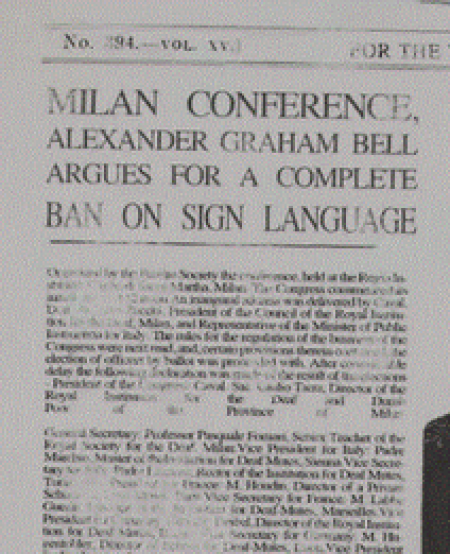
September 1880: The 2nd International Congress on Deaf Education in Milan, Italy, declares oralism (teaching speech and speechreading) to be superior to manual education (using sign language) and passes a resolution to ban sign language in educational settings.
2010: A formal apology was made by the board at the 21st International Congress on Education of the Deaf in Vancouver, BC, Canada, acknowledging the ban as "an act of discrimination and violation of human and constitutional rights."
image from https://deafhistory.eu/index.php/component/zoo/item/1880
| | |
|
In the 1960's, the Deaf Rights Movement gained momentum, with activists advocating for recognition of sign language, deaf culture, and bilingual education (using both sign language and spoken language) for deaf individuals.
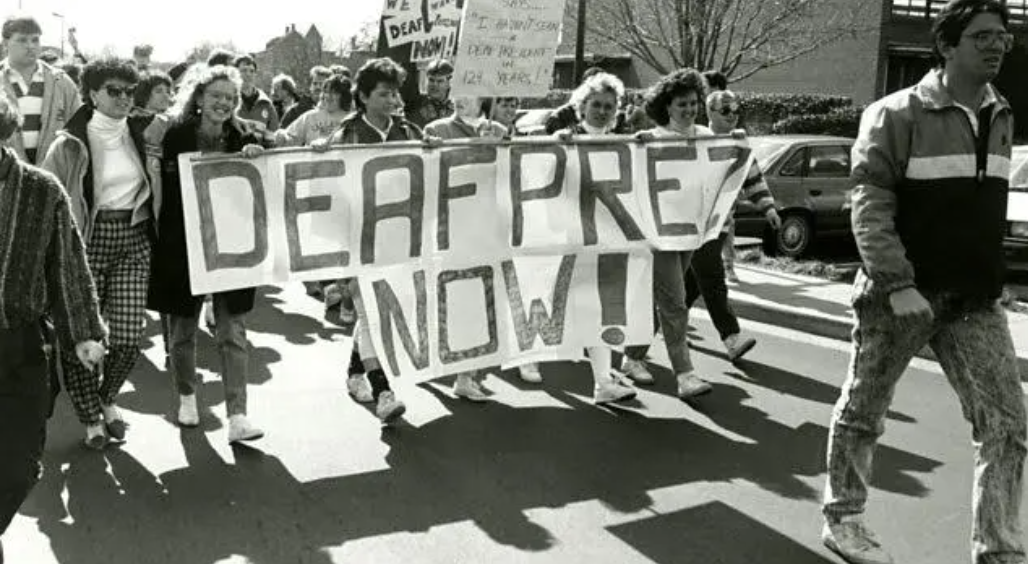
In 1988, the Deaf President Now movement began at Gallaudet University, with many coming together to demand the Board appoint the University's first Deaf President.
image from https://aslwonder.com/deaf-history-events/
| | |
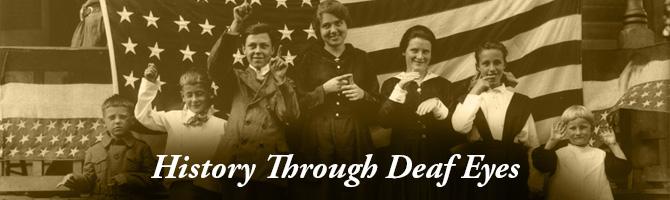
History Through
Deaf Eyes
image from https://gallaudet.edu/museum/exhibits/history-through-deaf-eyes/
| |
|
Gallaudet University created the “Deaf Eyes” project to bring deaf history to the public and expand understanding of U.S. history.
Click on the links below to learn more!
Watch the Film!
Explore the Exhibit Online!
| | | |
Register for a Sign Language Class
Adult Classes
CHS offers adult sign language classes both in person and through Zoom. We offer Beginner, Intermediate, and Advanced level classes. Click here for class schedules and registration information.
Custom Classes & Tutoring
CHS offers classes for companies and organizations. We make sure that we also adjust our curriculum based on your needs. For example, we can add banking signs, residential living signs, medical signs, and more!
If you're looking for one-on-one support, CHS has sign language tutors ready to create lesson plans to meet your needs. Tutoring packages come in 10-hour packages. Contact us to discuss your specific needs.
| |
Read Books by Deaf, DeafBlind, and
Hard of Hearing Authors
| |
|
Fiction/Young Adult Books
- True Biz by Sara Novic
- Give Me A Sign by Anna Sortino
- The Whispering Dark by Kelly Andrew
- The Silence Between Us by Alison Gervais
- Show Me a Sign by Ann Clare LeZotte
| |
|
Memoir/Nonfiction
- Deaf Utopia by Nyle DiMarco
- I’ll Scream Later by Marlee Matlin
- Haben: The Deafblind Woman Who Conquered Harvard Law by Haben Girma
- Being Seen: One Deafblind Woman’s Fight to End Ableism by Elsa Sjunneson
- Sounds Like Home: Growing Up Black and Deaf in the South by Mary Herring Wright
| |
The Chicago Hearing Society office is located at: 2017 N Mendell St, 3rd Floor, Chicago, IL 60614. Free street parking available. Our staff use American Sign Language, as well as speak English and Spanish. For questions, appointments and information, please contact us. | | | | |