Your Monthly News & Updates | |
|
|
To all of you who support our efforts, I cannot thank you enough.
March was (as always) an exciting month at the Society with considerable progress toward the continuing long term preservation of our collection. First, we were able to invest a new fire detection system which will automatically alert the fire department in the event of any issue. Second, we rearranged portions of the old bank safe so that we could move a rather sizable collection of handwritten journals into the safe for protection. And, third, we submitted an application for a grant to purchase new fireproof cabinets (fingers crossed) as our existing fireproof cabinets are full.
As we look forward to April, you will not be surprised to learn that we are busy preparing for Medfield History Weekend. I cannot even begin to express my gratitude for the efforts of Chris McCue Potts to ensure that the town comes together to celebrate our rich history in this way. At the museum, we have a very exciting exhibit planned for you. Tucked away in the safe, we have a rather nice collection of artwork from John A.S. Monks. Together with a handful of related artifacts, we look forward to sharing this special exhibit with you.
To top off the month, we have submitted the next edition of our Medfield Magazine for publication. We want to be sure that we have the magazine back in time for History Weekend. This edition contains feature stories on Jim James from Park Street Books as well as an expanded history of the Baptist Church. Members will be able to collect their copy during the weekend! Looking forward to sharing it with you!
See you History Weekend!
| |
|
PeggySue Werthessen
President
| |
Hatmaking and 19th Century Medfield | |
|
Monday, Apr 1
7:30 pm
First Parish Unitarian Universalist Church
26 North Street, Medfield
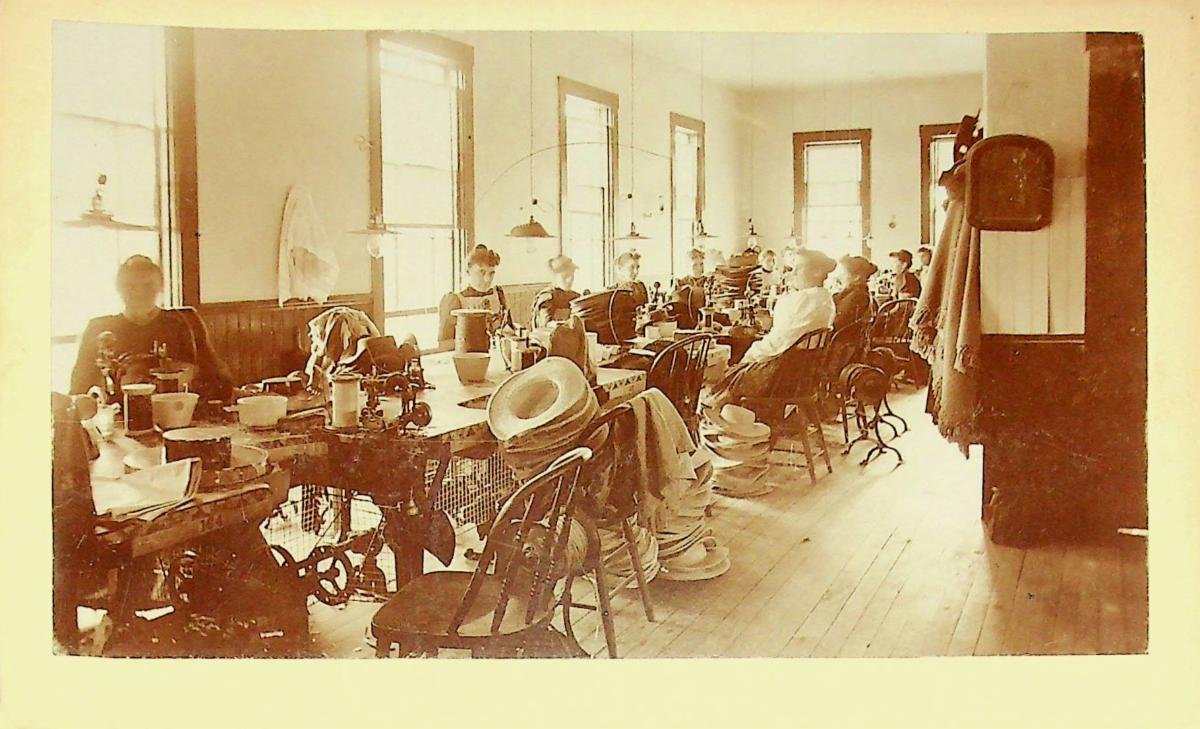
Join us at our upcoming April program where society president PeggySue Werthessen will delve into the fascinating history of the hat factories that played a pivotal role in driving the Medfield economy during the 19th century.
Discover how the hat industry, starting with the tale of Betsey Metcalf, significantly transformed Medfield from a modest community of 745 inhabitants in 1800 to a bustling town of nearly 3,000 a century later.
In addition to exploring the evolution of the hat industry, we'll also touch upon other industrial endeavors that helped fuel the local economy during this time.
Don't miss out on this incredible opportunity to learn about Medfield's rich history! The presentation is free and open to the public.
| |
|
Fri, Apr 26 - Sun Apr 28
Fri evening, Sat 10am - 4pm, Sun 1 pm - 4 pm (w/exceptions)
Various Medfield establishments and historic sites
| |
|
A special alert for readers of The Portal and Medfield Historical Society supporters before the big promotion begins…
Tickets are now available for Medfield History Weekend 2024!>>
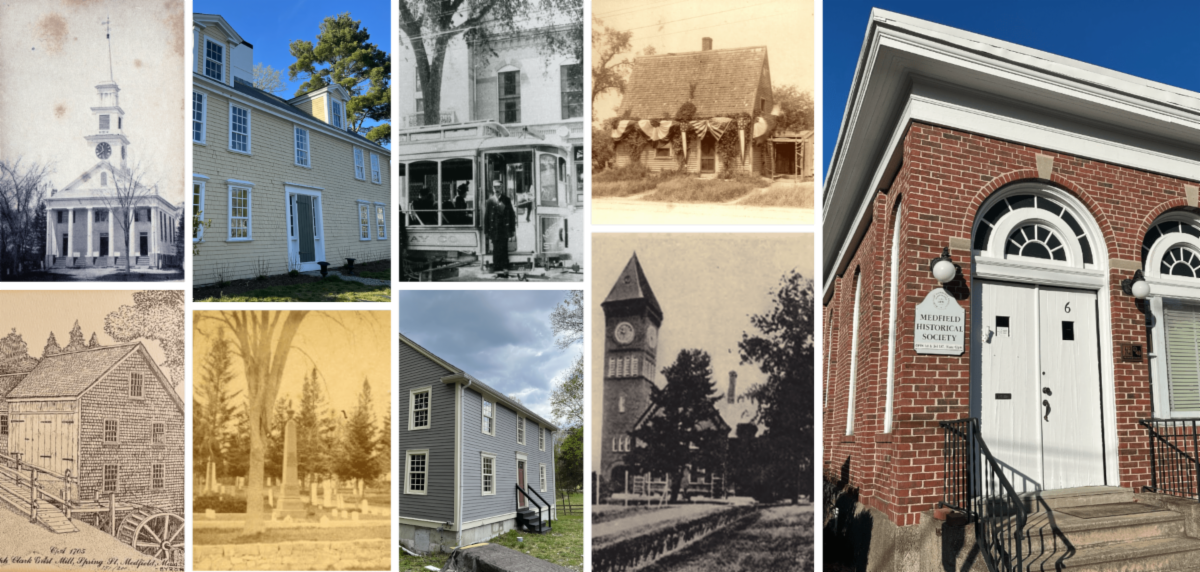
Highlights for the weekend include: Narrated Old Town Trolley tours, Town Clock/Steeple tours, walking tours of historic Vine Lake Cemetery and Medfield State Hospital, and a children’s scavenger hunt. The town’s most historic sites, including Dwight-Derby House, Kingsbury Grist Mill, Lowell Mason House, Medfield Historical Society Museum and Peak House Heritage Center, will offer featured attractions all weekend. Hannah Adams will also have a presence at Medfield Public Library, and Medfield TV and MEMO are involved, as well.
|  | |
Of special note…
An event to kick off Medfield History Weekend will be held from 7 to 8:30 pm, Friday, April 26 at the Zullo Gallery. The gathering will provide of review of weekend festivities, while also celebrating the Zullo’s recent 35th anniversary. Visitors will have the chance to preview the popular Student-Faculty Exhibit, and look ahead to the exciting May augmented-reality exhibit, “Evolution of a Small Town” that draws on historic inspiration. The Zullo at 456A Main Street, is housed in a circa 1900 building in the Town Center Historic District.
Medfield History Weekend is funded in part by a grant from Medfield Cultural Council, a local agency supported by Mass Cultural Council, a state agency.
| |
Sound Engineer Johnny Dalton Presents History of Sound Recording | |
|
by David Temple
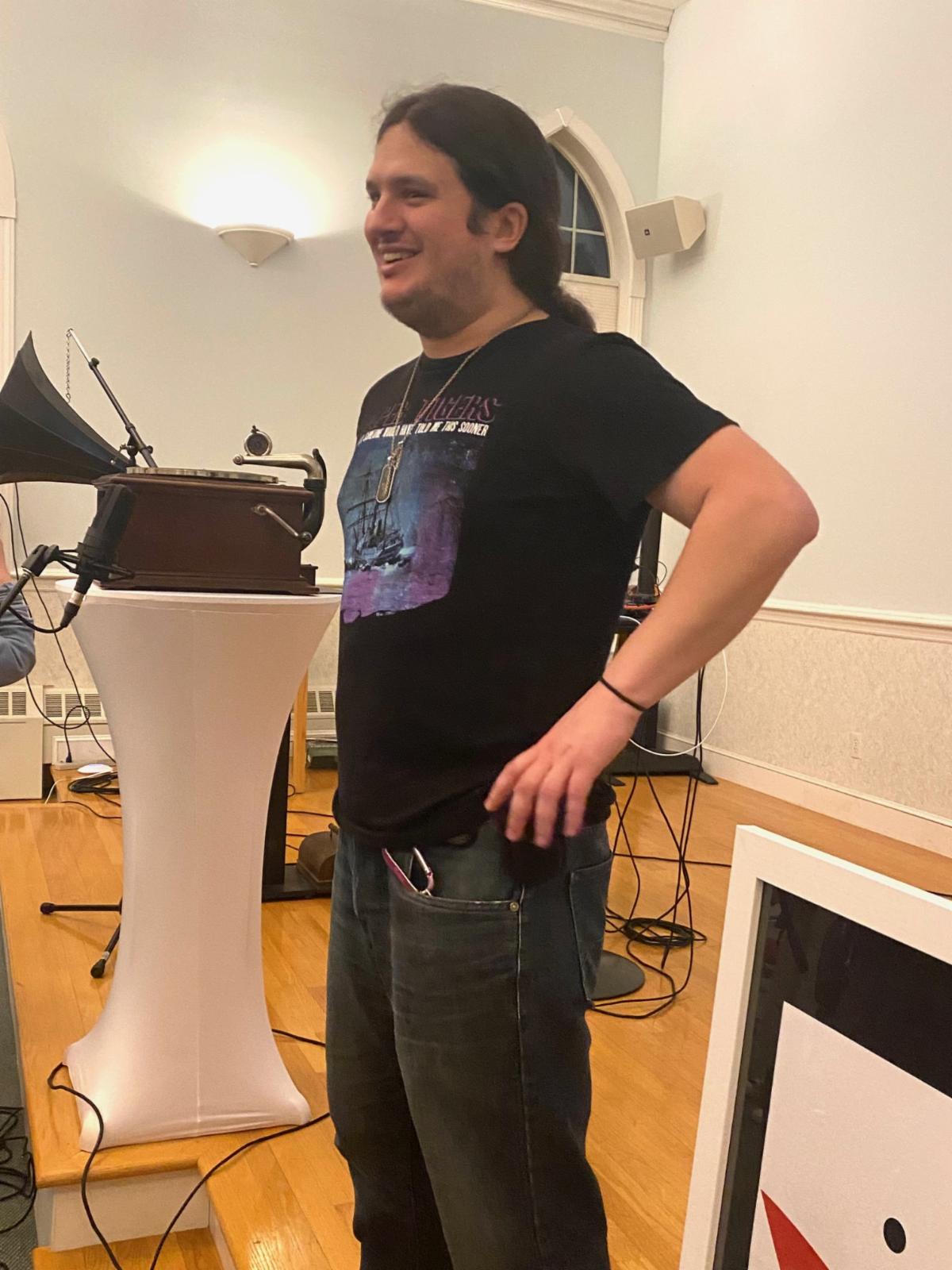
Some 60 people turned out on March 4 to hear an entertaining and engaged Johnny Dalton, sound engineer, show and tell about key developments in the 166-year history of sound recording. Dalton graduated from Medfield High School in 2013 and established KungPow! Recording and Mastering in 2017.
Johnny introduced his subject by noting that, although Edison is popularly assumed to have invented sound recording, the first sound recording device, the phonautograph, was patented in 1857 by a Frenchman, Edouard-Leon Scott de Martinville.
The phonautograph consisted of a horn (think of a traffic cone) with a small diaphragm attached across the narrow end, with a stiff boar’s bristle firmly implanted in the diaphragm.
| |
Johnny speaking about key developments in the history of sound recording. Photo credit: Colleen Sullivan | |
|
De Martinville spoke or sang into the wide end of the horn, and the soundwaves would be concentrated onto the diaphragm, which would make the bristle vibrate and etch the squiggles onto a rotating cylinder coated with lampblack.
Thus soundwaves were first recorded in 1857. There was a catch – there was no way to turn the etched squiggles back into something audible – not until 2008, when scientists at Berkeley National Laboratory converted them into a digital audio file using IRENE technology. What did they hear? DeMartinville singing a French folk song called Au Clair de la Lune.
Click here to read more >>
|
|
School Life in Medfield 200 Years Ago | |
by David Temple/William Tilden | |
|
From the earliest days, America’s Puritan settlers prioritized education. Parents were responsible for assuring their children could read (especially so they could read the Bible) and write, and all towns were required to set up schools. Boston Latin School was founded in 1635; Harvard in 1636. Dedham in 1644 authorized the first tax-funded public school, taught by Ralph Wheelock, whose salary was £20 per year. Wheelock founded Medfield in 1651 and was appointed schoolmaster here in 1655; the school was supported partly by taxes and partly by tuition.
For much of the 18th and 19th centuries there were schoolhouses in the center of town on Pleasant Street, on North Street near School Street, and on South Street, near High Street.
| |
|
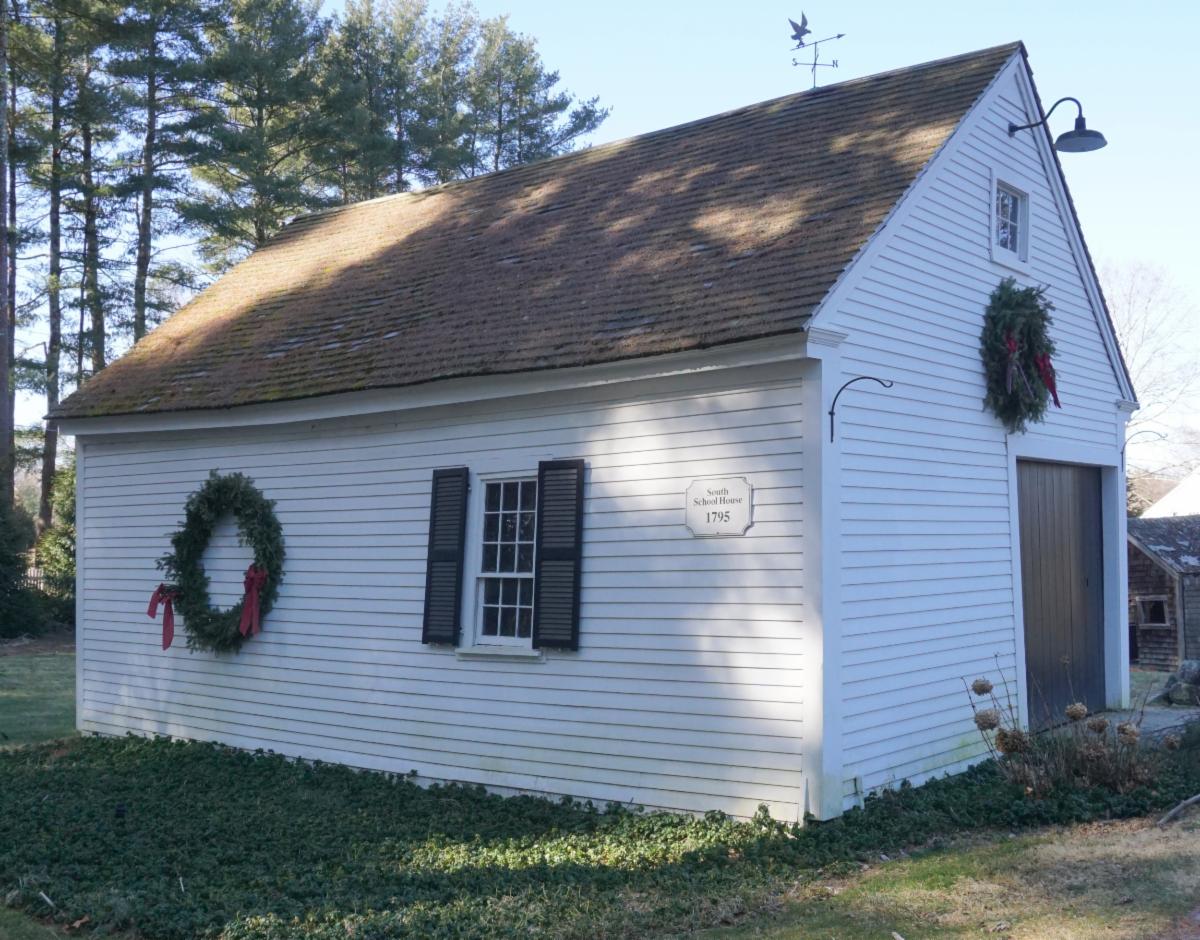
There were two South schoolhouses, both of which survive. The older one (shown in the photo below) was built about 1795 and was moved about 1855 to its present location, next to a handsome 1835 Greek Revival house at 205 South Street, where the old school is used as a garage. The other schoolhouse is now a private home at 15 High Street. | |
|
From a series of articles called Sixty Years Ago, written around the turn of the 20th century, Medfield historian William S. Tilden wrote in 1898 about the south schools and what life was like therein.
THE SOUTH SCHOOLHOUSE [circa 1840]
This was the institution of learning for the south part of the town, 60 years ago. It was removed to its present location in 1855 [and is still there].
The older part of this building was erected about 1796 and consisted of a single room, with a door opening directly to the outside world, a huge chimney and fireplace at one end and long benches for the children to sit on. Sometimes as many as 75 children, of ages from five to 20, were crowded in this room.
Click here to read more>>
| |
Lucy Bran House Meets New Owners | |
|
by Christine McCue Potts
The moment a “For Sale” sign appears on a historic home in Medfield, concerns about its fate begin to circulate around town. This was certainly the case with the Lucy Bran house, circa 1730, at 661 Main St., even though it's located in a historic district that gives it an extra level of protection.
Worries were recently lifted when during a regular Saturday opening of the Historical Society museum, in walked Joey Thibeault. About a month after purchasing the Lucy Bran house with his husband, Felipe Flores Beltranena, Thibeault stopped into the museum eager to learn more about his new abode after just a month of ownership. Thibeault became an instant celebrity among the museum helpers eager to assist with his research, and especially after learning that he grew up in town and attended Medfield Public Schools.
In addition to affordability factors, Thibeault said the couple was immediately attracted to the historical character of the house, and its legacy as home to the last Native American in Medfield. While repairs are on the horizon, (and possible conversion of the beehive oven into a pizza hearth), he expressed no intention of causing irreparable damage to the historic home and streetscape of the Main Street landmark, noting he wants to be a good steward. His Blake Middle School "house project" in which students once built small replicas of historic Medfield homes as a class requirement, plus time spent in the North Bennet Street School carpentry/woodworking program, has also given Thibeault appreciation for the architectural significance of the house.
| 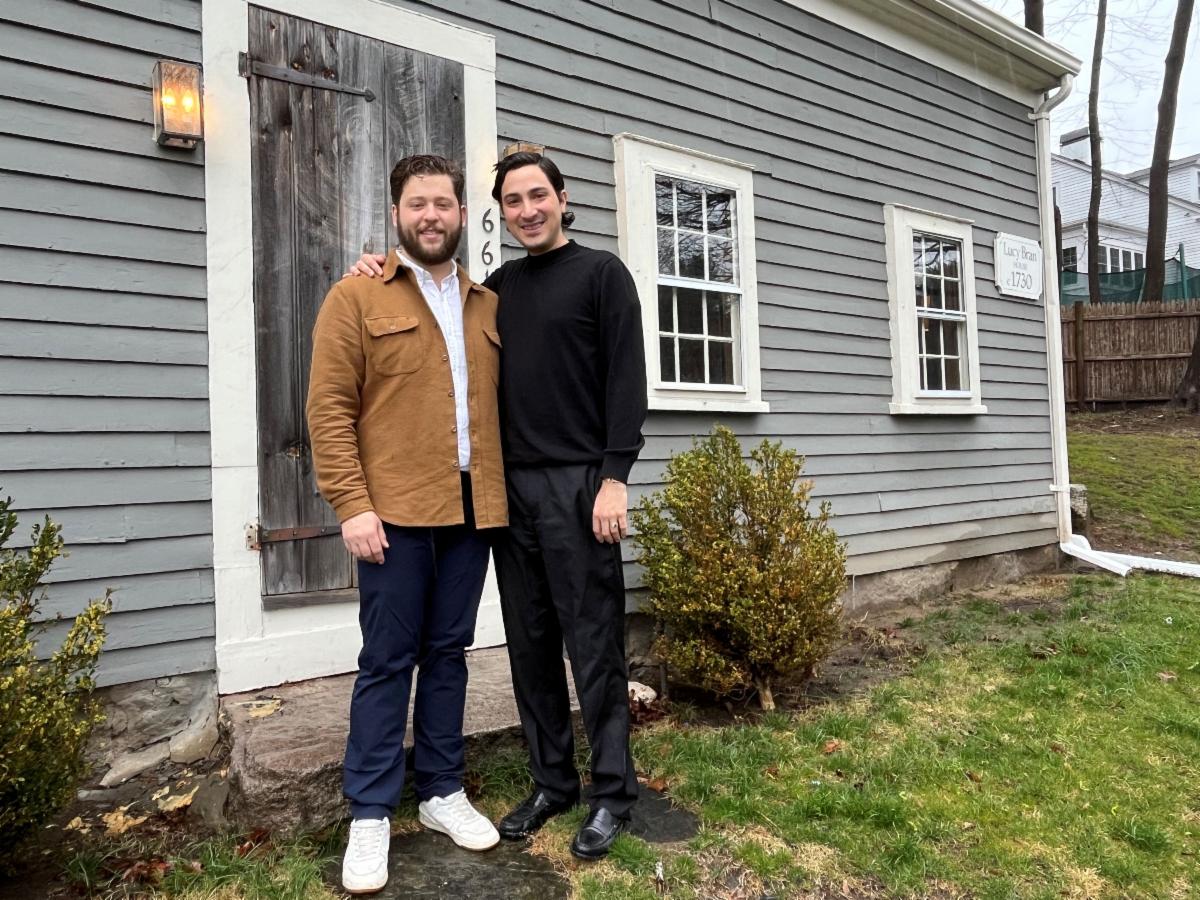 | Joey Thibeault and Felipe Flores Beltranena, the new owners of the Lucy Bran house. | |
Much has been studied and written over the years about the Lucy Bran house, making the task of research for Thibeault and Society volunteers relatively easy. Among the records is a historical compilation created by long-time resident and historian Rob Gregg, available on the Medfield Historical Society website.
While Lucy Bran died in 1837 and is buried in an unmarked grave at Vine Lake Cemetery, her legacy and historic house live on. In addition to being depicted in the 1889 painting, “Roadside Cottage,” by Dennis Miller Bunker and exhibited at the Museum of Fine Arts in Boston, new families have cared for the house over many decades.
As noted by Town Historian Richard DeSorgher in a 2011 Patch article, “A fire a number of years ago did considerable damage to the house, but under great expense and careful restoration by Brad and Betsy Phipps, the house was historically restored and saved. Brad was also instrumental in helping West Main Street approve the Metcalf Historic District to preserve the neighborhood’s historic character and protect their property values.”
The Phipps were stewards of the Lucy Bran house for nearly 30 years before selling it to Thibeault and Beltranena.
“It’s cool in 2024 to own something historical in the town where I grew up, and to imagine what it was like many years before,” said Thibeault. “It’s our responsibility now to take care of it.”
| |
People and Places of the Past | |
The Cliffords of Medfield | |
|
by Richard DeSorgher
Editor’s note: This story is excerpted from Richard DeSorgher’s “This Old Town: On the Banks of the Charles." To purchase book, see full story.
| |
|
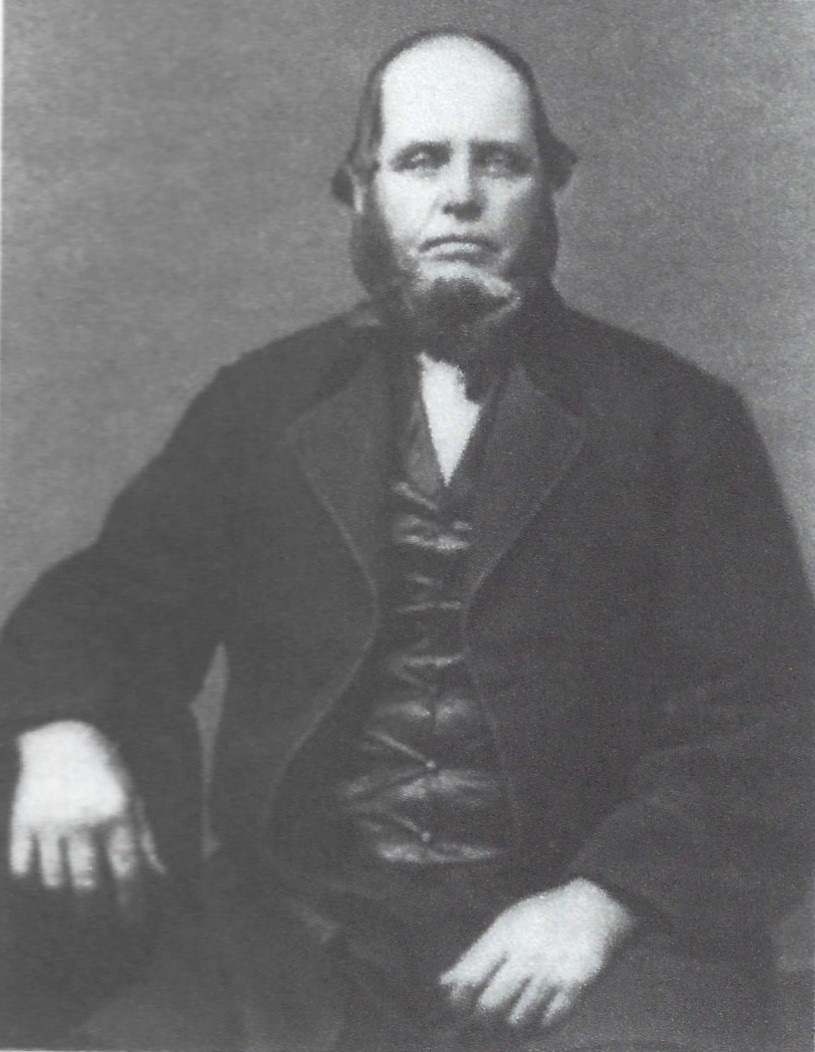
From 1868 when Oliver and Elizabeth Clifford moved their family to Medfield until the death of their daughter Ellen in 1919, the Clifford name was a well-known and important piece of the fabric of Medfield. They acquired substantial wealth and built homes and multi-unit rental houses throughout the town.
Oliver Hamblin Clifford was born in 1809 in Brookfield, Vermont. He came to Medfield as a young man and in 1835 married Elizabeth Mason, a descendant of Medfield’s second minister, Rev. Joseph Baxter and of Thomas Mason, one of Medfield’s original 13 settlers. After marriage, they settled in East Medway (now Millis) where Oliver started a farm and carried on a productive meat market business. In Medway, Oliver and Elizabeth gave birth to their four children, Joseph Clark, born in 1839, Alfred, born in 1845, Ellen, born in 1845 and Elizabeth, born in 1854.
| |
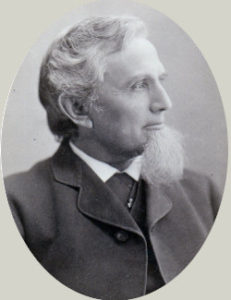
Oliver Clifford
Credit: Fritz Clifford | |
|
In 1868, Oliver and Elizabeth moved to Medfield. Here, Oliver became a developer and an investor. He served as a selectman in 1871, 1872 and in 1882. He built the first house on the newly laid out Spring Street in 1872, now #5-7 Spring Street.
The Greek Revival-style house with brick foundation was built for him and here he lived with his family. (In 1988, the Spring Street house was converted into four townhouse condominiums. The Medfield Zoning Board of Appeals approved the variance stipulating that the developer work with the Medfield Historical Commission in preserving the exterior of the house. Because of that cooperation, the Medfield historical Commission awarded the developer, William Nutile, its annual Preservation Award for his effort in preserving the house’s history while turning it into condominiums, showing that such historic structures do not have to be torn down but can be saved and preserved while still economically viable to the developer.)
Oliver then had built the Clifford Block on #8-14 Green Street, two multi-unit houses on Adams Street, #24 and #26-28, and a multi-unit block on #58-60 Harding Street (now demolished). These multi-unit houses filled the need for rental property for the seasonal workers in the prosperous hat factory on North Street (now Montrose School).
Click here to read more >>
| | | | |