|
This past Friday, a select group of Hawaii-based museum and archive professionals had the unique opportunity to attend a Disaster Planning and Response Workshop, led by the Smithsonian Cultural Rescue Initiative (SCRI), in partnership with the Hawai’i Museums Association and the East-West Center Arts Program. It was an abbreviated form of the SCRI’s training on dealing with disasters starting with understanding the types of danger your museum/archive/etc. might be in, to charting out a plan to mitigate those dangers. Given recent events on Maui, one of the dangers we centered on was fire.
While most of the morning sessions focused on identifying dangers and working to avoid them, the afternoon sessions covered what to do after the danger has happened. How do we respond? In my case, imagine that something terrible has happened in our NVMC archive. What do I do now? One of the most basic instructions they gave us is one I have difficulty with. If something were to happen in our archive and I was able to access the room, my first reaction would be to rush in and grab whatever I could to “rescue” it. While this may work in my favor, this is not a good idea for several reasons. I could possibly cause more damage to the archive items by handling them without knowing the full extent of the emergency and, the bigger problem, I could put myself in danger by just rushing in. No one will want to rename our archive the “Melanie N. Agrabante Memorial Archive.” Particularly if my demise was caused by my own foolishness.
On Saturday, the group gathered again for an open hour with the SCRI team, in which we bounced all kinds of questions off them, including wanting to hear of their personal experiences. Individual members of the team have responded to emergencies such as flooding in Haiti, earthquakes in Panama, and the destruction in Mosul caused by ISIS. This talk was followed by a panel discussion with the community organizers of the Maui Arts and Cultural Center exhibition “Sense of Place/Place of Sense.”
Sunday, I was back at the NVMC, this time with Deidre, as the SCRI team stopped in for a visit and a personal look at our operation. They toured our exhibit on the 100th Infantry Battalion and I opened the archive for them to get a better look at exactly what I’m trying to protect by attending workshops such as theirs. What’s the best part of having professionals like this group tour your facility? Free advice and consultations! Our archive is young in comparison to the other organizations in the workshop such as the Hawai’i State Archives, Bishop Museum, Iolani Palace, Ali’iolani Hale, and, from Maui, the Lahaina Restoration Foundation, Maui Historical Society, and A&B Sugar Museum, just to name a few. Having received a wealth of simple and very practical advice from this team, I’m confident that we’ll be able to craft a plan to keep our archive and the treasures stored within protected to the best of our ability for the foreseeable future.
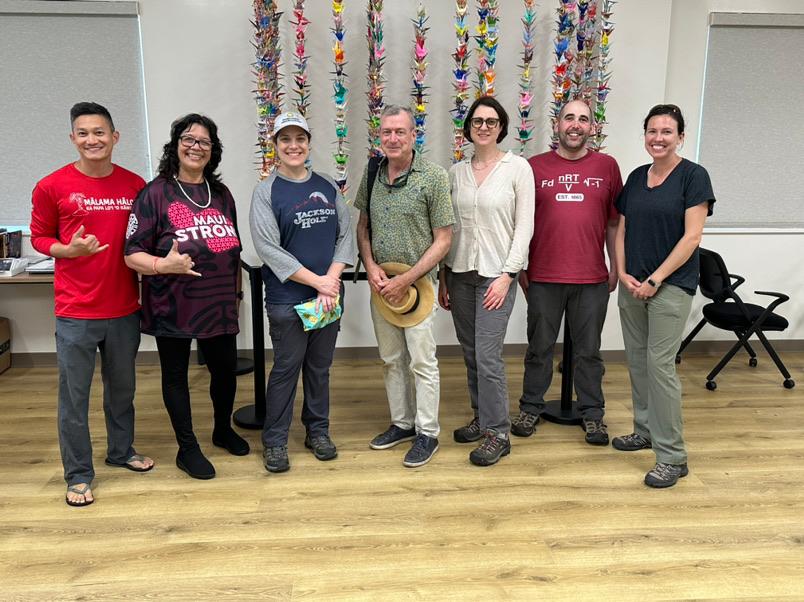
Picture (l – r): Eric Chang (Arts Program Manager, East-West Center), Melanie Agrabante (Research Archivist, Nisei Veterans Memorial Center), Stacy Bowe (Training Program Manager, SCRI), Kent Severson (Conservator in Private Practice), Katie Wagner (Senior Book Conservator, Smithsonian Libraries and Archives), Adam Rogers (Associate Director for Fire Protection Engineering, Georgetown University), and Katelynn Averyt (Disaster Response Specialist, SCRI)
|