|
I’m lost for words…
Well, almost.
The must-read HSJ is reporting an ICB is being ‘sanctioned’ by NHSE because hospitals within the ICB’s purview have ‘too many staff’.
I assume the 'too many" will be culled…
… good-bye and thank you for your service.
Pause for a moment… think about the madness of a system that…
… has money for associate and assistant doctors, to assist doctors that we cannot afford to employ....
... has enough people on NHS waiting lists, if stood side-by-side, would stretch from London to Tehran…
... and is busy sacking the very people that might help to do something about it.
There is no level of sane management, rational, grown-up thinking or soundness of mind that could account for, explain or sanction this self-inflicted mayhem.
It is hard to understand the thinking at the top of the shop… that is, if there is thinking beyond a frantic scramble to balance the books regardless of the damage it might do to organisational performance, morale and productivity.
Describing it as ‘Bean-counter management’ gives it comedic, childish feel and falls short of properly describing the consequential damage that it can do.
A more sophisticated definition might be ‘short-term- management’…
… an approach where decision-making is heavily influenced by the desire to achieve immediate financial results, often at the expense of long-term strategic goals.
This can involve prioritising cost-cutting, meeting targets, or improving financial ratios, sometimes leading to decisions that undermine the organisation’s future performance, innovation capacity, and overall productivity.
We are left with the question; what are our priorities?
Streeting, before the election, gave the impression that there would be an all-out push on waiting lists, overtime, bust-a-gut to get it done… taxing non-doms within and inch of their lives and we could all relax, watching the numbers come down.
It’s not happening. There’s been no prioritisation and this HMG is content to blame the previous HMG… and sacking staff is now their priority.
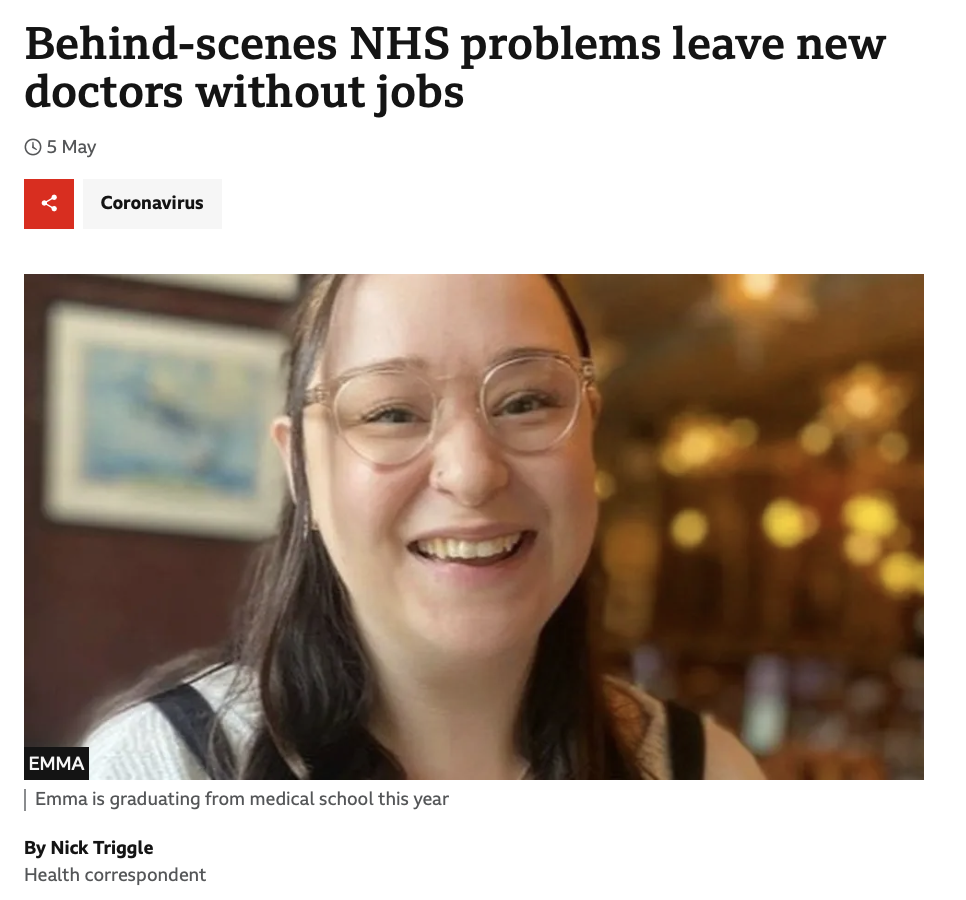
The upshot? For the first time I can remember… applications to join both medical school and nurse uni-courses, are down.
Yesterday, I met my past...
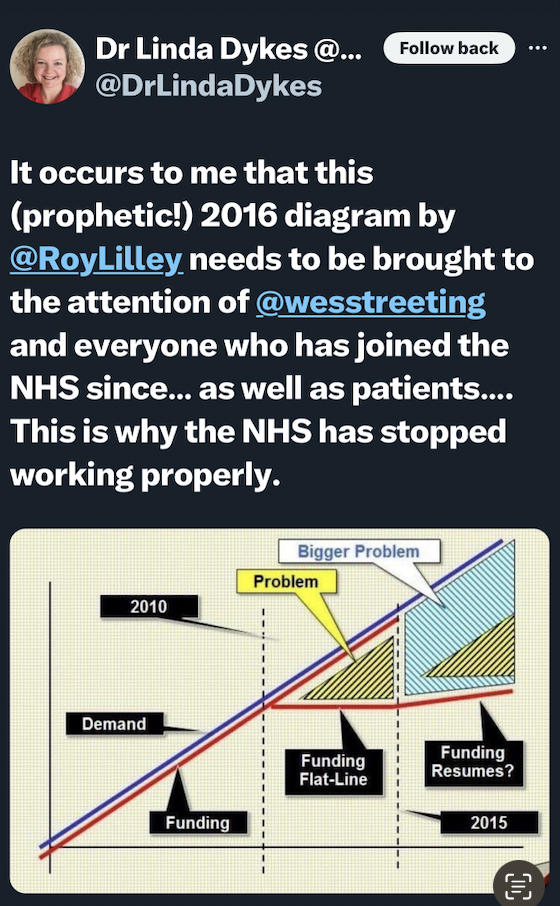
... on Twitter (I just can’t call it X), Dr Linda Dykes dug out a PowerPoint slide I made in 2016. It’s reproduced below.
It was towards the end of Osborne’s austerity… I used to talk about the big, blue, trapezium of death! Have a look and you'll see why.
It turns out I was more right than I thought!
Now, I fear the difficulties will be exacerbated because the NHS is in the hands of lunatics, I can’t think of any other way to describe the DH.
Their cover story is, ‘the NHS is broken’ so expect nothing.
The NHS is not broken and we are entitled to expect a lot more than nothing.
Now, everything's on hold. Waiting for the Darzi report. It can only say; we haven’t invested in people, skills, capital and innovation and are now paying the price…
… and if I may make so bold, a word of advice to the Lord Darzi…
… the solution isn’t another reorganisation which will be an unwanted distraction, (although reducing the number of ICBs would cut costs and give NHSE a better handle on what’s going on) neither do we want another go at polyclinics.
They back-fired before because;
-
‘Swiss cheese’… moving services means moving the revenues from hospitals with fixed overheads, who are then left with holes in their balance sheet.
-
The public were worried it would mean the end of ‘their local GP’... and they were right.
-
Investment in infrastructure, land acquisition and resources. The costs were high, especially as it was in a period of financial constraint… just like now.
-
Insufficient evidence to support the effectiveness of polyclinics improving healthcare outcomes.
-
Mismatch with NHS’ strong tradition of ‘local’, community-based healthcare, particularly through the GP system. The polyclinic model emphasised centralisation and scale.
So don’t do it again… thank you!
In over 50yrs of NHS watching, I’ve seen enough reorganisations to know they have two outcomes...
They cost a fortune and don’t make a dam-of-difference,
Or...
They cost a fortune and do a lot of damage.
The blunt truth is…
... all that matters is the right number of well-trained, happy people who sit in front of poorly, worried and anxious people and make it right for them.
The only times when the NHS has performed really well were when it was adequately and regularly funded. When it wasn't, it didn't...
… and that’s all there is to it.
|