Network News
Now Accepting Applications for the Advisory Committee
| |
We need your help! Please share this opportunity widely (PDF flyer attached)
CYSHCNet is seeking a diverse, active group of people from a variety of disciplines and organizations, as well as lived-experience partners.
Our aim? To better reflect our population of families, patients, clinicians, and stakeholders and make our research better.
We’re interested in hearing from children and youth with special health care needs (CYSHCN) and anyone who supports them.
This includes:
- People with lived experience, such as youth, family members, and caregivers
- Academic researchers who work with CYSHCN across disciplines
- Clinicians of various disciplines who work with CYSHCN
- State or federal employees employed in the CYSHCN field
- Anyone with expertise in CYSHCN field
What you need to know:
- The Advisory Committee meets quarterly on Zoom.
- The total time commitment for a year is ~12 hours (2-year commitment requested).
- Those with lived experience as a CYSHCN or are a “lived experience partner” (i.e., someone who cares for a child with a special health care need), receive $600/year for participating.
- Clinicians or those otherwise employed in the CYSHCN field are invited to participate as a volunteer.
- Experience in one of the following areas is helpful but not required: caregiving, dissemination, research, policy work, health care financing, program development, clinical care for CYSHCN, legal skills, public relations, or communications.
Applications are due to Charlene Shelton on Aug. 10, 2023. The website includes a downloadable packet of information and the application.
Download an informational flyer to print and/or email to your contacts!
| |
New Network Study
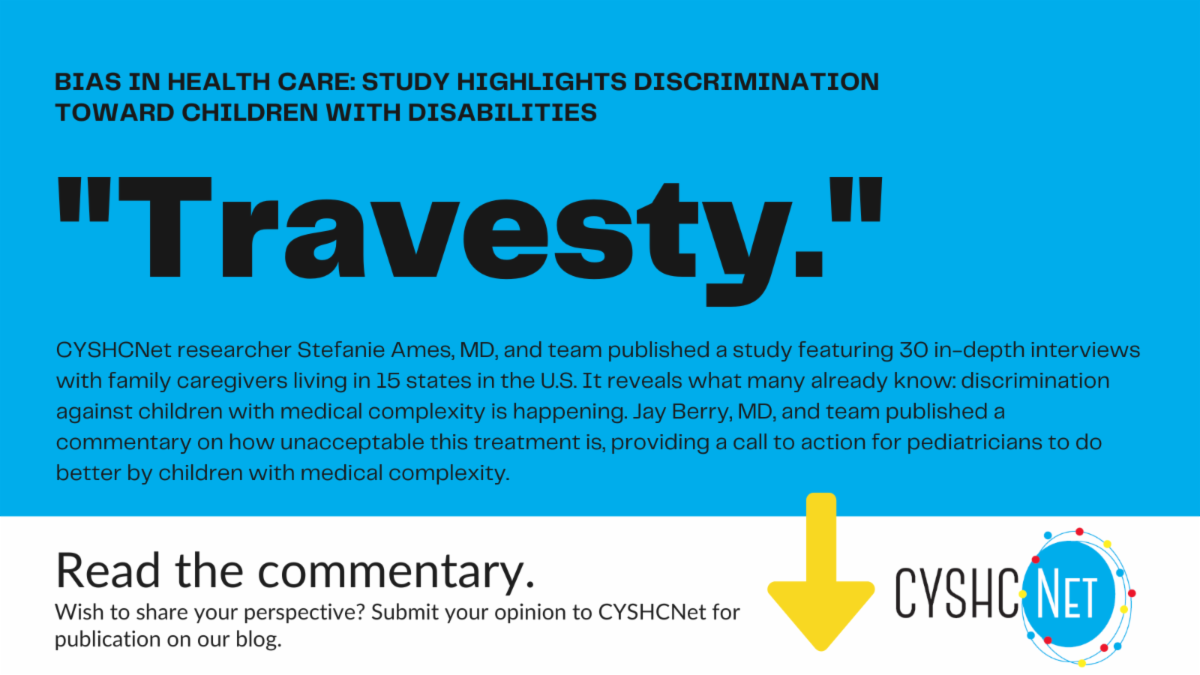
Disability, Discrimination, and Children with Medical Complexity
“Our goal was the validate families' experiences and bring awareness to the issue. Recognizing the problem is the first step." ~Stefanie Ames, MD
| |
Disability-based discrimination in health care is happening, and it can result in low quality of care, limited access, and negative health consequences. A new study from CYSHCNet researcher Stefanie Ames, MD, MS, looks at the themes children with medical complexity and their families face, asking the question of clinicians: How can knowing these perceived manifestations improve health care for children with disabilities? | |
New Resources
Primary Data Center Adds New Templates and Resources to Website
| |
|
The CYSHCNet Primary Data Center (PDC) provides resources to promote network projects that collect primary data (e.g., data not already collected for other research) on topics prioritized by CYSHCN and their families. These resources include tools to make work easier for study teams conducting multi-site research, protocols and procedures to make studies more consistent across the network, and data that research teams can use to jump-start network studies.
The website includes downloadable templates such as Scope of Work, Project Summary, Budget Justification, and more. To request examples of funded grant proposals, or to request a consultation with the Primary Data Center Advisory Council, please email Dr. Amanda Gatewood, PDC Science Manager.
| |
Annual Meeting 2023
Thank You To Everyone Who Participated
We've posted the Zoom recording and associated documents on the website. We've protected it via password. Email Carie to request it!
| |
Network News
Share this Link to Help Others Engage with the National Research Agenda
| |
CYSHCNet developed an interactive learning platform based on our national research agenda on health systems. It describes and provides guidance on how to implement elements of the national health systems research agenda developed by CYSHCNet in 2019-21. It is easy to navigate and provides answers to the challenges you may face, tips on organizing the study, and examples of potential projects. | |
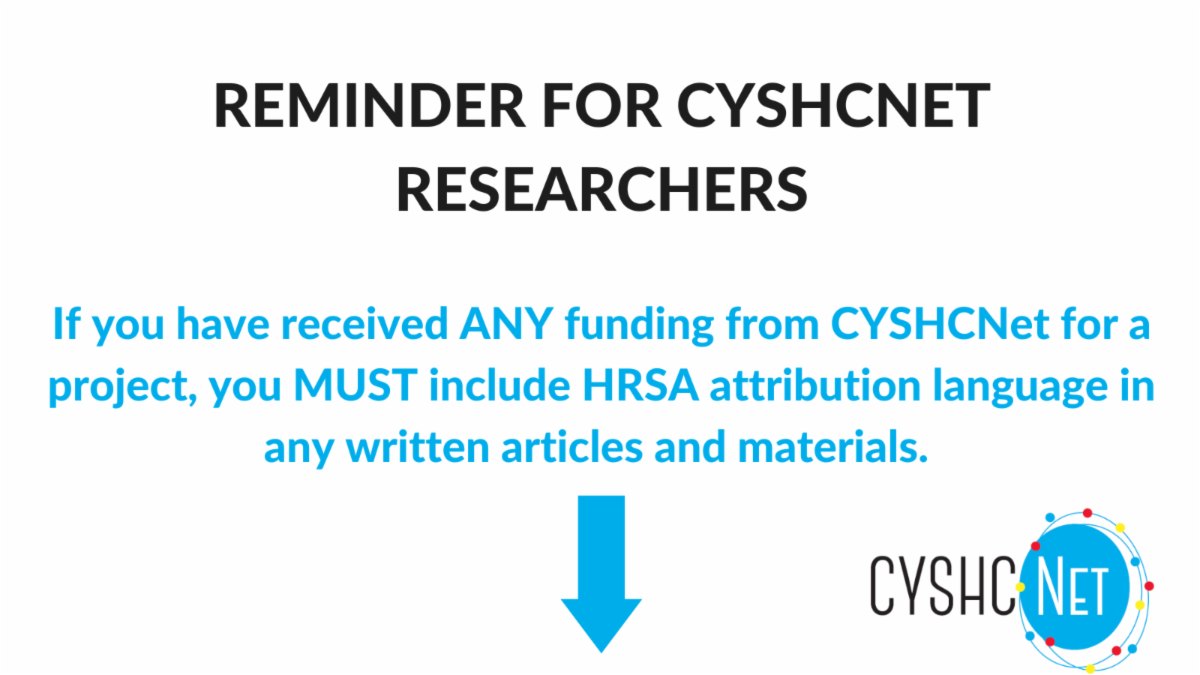
LANGUAGE: This project is supported by CYSHCNet, which is supported by the Health Resources and Services Administration (HRSA) of the U.S. Department of Health and Human Services (HHS) under UA6MC31101 Children and Youth with Special Health Care Needs Research Network. This information or content and conclusions are those of the author and should not be construed as the official position or policy of, nor should any endorsements be inferred by HRSA, HHS, and the U.S. Government. | |
-
The World's Worst Industrial Disaster Harmed People Even Before They Were Born. The 1984 Bhopal disaster, in which around 40 tons of methyl isocyanate leaked from a pesticide plant in the city of Bhopal in India exposed around 500,000 individuals to the toxic gas and in the short-term resulted in the deaths of thousands. In the decades since, thousands more have died or have been sickened by this exposure. A new study (linked in the article) now shows that the unborn infants who were exposed in utero experience long-term negative health impacts as well. This article discusses the disaster and its impacts, and also raises the question of what is owed to the then-unborn victims of what is now considered one of the worst industrial disasters to ever occur.
-
These Kids Revamped Their Schoolyard. It Could Be a Model to Make Cities Healthier. Access to parks and green spaces in the U.S. is distributed inequitably based on race and socioeconomic status. Access to these spaces comes with a broad range of physical and mental health benefits and is especially important for children. In large cities, it can be difficult to create more public green spaces due to the density of existing development. This article describes a case study of how one national nonprofit is working to increase accessibility to these spaces by improving schoolyard green spaces with the direct input of students.
-
It's Time to have the 'Fat Talk' with Our Kids — and Ourselves. In this interview, author and advocate Virgina Sole-Smith and host Brittany Luse discuss the prevalence of and damage that anti-fat bias can cause in children and adults of all body sizes. Topics discussed include significant research gaps on the actual health impacts of being fat, the financial incentives behind modern weight loss treatments, and how to help children make healthy choices in healthy ways.
-
Foster Kids in Casino Hotels? It Happened in Rural Nevada Amid Widespread Foster Home Shortages. From 2021-2022, more than half of U.S. states saw a decrease in the number of licensed foster homes available. In rural areas, the problems caused by this are compounded. In 2023 in Elko County, NV, a very rural part of the state, there were no beds available for foster kids. The result of this is that no children in need of foster care in this part of the state were able to remain in their communities and instead had to go elsewhere. In one case, the state had to house foster children temporarily in casino hotel rooms. This article examines the impacts of causes of these shortages, and what attempts are being made to remedy them.
-
Colorado Tackles Eating Disorders by Limiting Diet Pill Sales to Kids, Use of BMI in Determining Treatment. In response to the large and increasing numbers of eating disorders in the state and the nation more broadly, the acting Governor of Colorado, Dianne Primavera, recently signed legislation to create a program that will focus on addressing mental illness in the state, and place restrictions on the use of BMI as a diagnostic tool, as well as restrictions on the sale of diet pills to minors. BMI, which is a flawed, antiquated, and ineffective method of assessing weight and weight related health, has long been used by health care providers in spite of these widely known major deficiencies. In the context of eating disorders, the use of BMI as a metric often restricts the ability of patients to get the treatment that they need. This law is intended to refocus health care providers on health factors and behaviors that are truly relevant to these diseases and remove obstacles to effective care.
| | |
CYSHCNet is supported by the Health Resources and Services Administration (HRSA) of the U.S. Department of Health and Human Services (HHS) under UA6MC31101 Children and Youth with Special Health Care Needs Research Network. This information or content and conclusions are those of the author and should not be construed as the official position or policy of, nor should any endorsements be inferred by HRSA, HHS, and the U.S. Government. Website | | | | |