|
MAY GAZETTE
| Our 95th year!
May, 2017 - Vol 64, Issue 8
|
|
|
| Board of Governors |
President
Honeywell Building Solutions
President-Elect
Secretary
Past President
The HIDI Group
|
|
|
| President's Message |
One of our Chapter's key objectives in 2017 was to introduce a Women in ASHRAE (WIA) event into our monthly program. I am proud to announce that our first ever WIA event has been jointly organized by ASHRAE Toronto and CIBSE and will take place on Monday May 15th, 2017.
The topic for this dinner meeting, Gender Bias in Architecture, Engineering and Construction, will be covered by two keynote speakers and women in leadership positions in the HVAC/R industry - Fiona Cousins and Julia Keen (profiles available in Notice of Meeting below).
As I reflect on the purpose of this meeting - to promote the retention of women in architecture, engineering and construction - I cannot help but think about the many notable contributions made by women in leadership roles at ASHRAE.

On a personal note, an inspirational woman in ASHRAE that impacted my life was Professor Judith Dimitriu of Ryerson University and Past-President of ASHRAE Toronto. As a fourth year mechanical engineering student, I had the pleasure of taking several of Judith's courses. S
he encouraged me (and many others) to join ASHRAE as a student member and to remain engaged in the local HVAC/R industry. Thanks to Judith's encouragement, I began my journey with ASHRAE that has led to tremendous learnings and opportunities along the way.
Another inspirational leader that comes to mind is the late Lynn G. Bellanger, ASHRAE Society's first female President. Lynn served as President in the 2010-11 Society year. Her expertise in energy management and modeling shaped her presidential focus of Modeling a Sustainable World. Lynn passed away in October 2011 and to honor her remarkable legacy, ASHRAE created the Lynn G. Bellenger Memorial Fund, which is used to recognize women in engineering through scholarships and other means.
There are no shortage of accomplishments made by women in the HVAC/R industry. However, as the theme of our May meeting suggests, a bias still exists. As a community, it is our responsibility to demand the diversity and inclusion of our members and to create an equal opportunity environment that fosters collaboration.
Thank you for your continued support of ASHRAE Toronto and hope you enjoy the May edition of our Gazette.
Marco Ottavino,
P.Eng., MBA
ASHRAE Toronto President
416-771-3824
|
|
|
|
| Notice of Meeting |


May Dinner Meeting
Monday, May 15th 2017
5 pm - 6 pm registration & networking
6 pm - 9 pm dinner & presentation
Novotel Toronto Centre
45 The Esplanade, Toronto M5E 1W2
ASHRAE Toronto Chapter and CIBSE invite you to the last ASHRAE Toronto dinner meeting of 2016-2017.
Speakers - Fiona Cousins and Julia Keen will talk about Gender Bias in the AEC Industry, share their personal experiences and discuss how to retain women in the workforce.
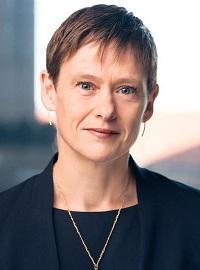 Fiona Cousins,
CIBSE Fellow, PE, LEED AP BD+C
Arup (New York)
Fiona Cousins is an Arup Fellow, a member of Arup's Americas Region Board and a member of Arup's Global Board.
Fiona is a mechanical engineer by profession and has spent much of her career engaged in HVAC design, with an area of specialization in thermal comfort and energy efficiency. She has extensive project experience and has worked on a wide range of projects, including the design of museums, archives, trading floors, laboratories, libraries and performing art centers. Fiona is a frequent presenter on transformative sustainable building design, very low-energy design, resilience and sustainability. She gave the 2016 CIBSE Annual Lecture: 'How building services Engineers can save Civilization'. She is a LEED Fellow.
Fiona served as the chair of the New York Chapter of the USGBC (Urban Green) from 2008-2009 and as chair of USGBC in 2016. She is also on the board of the Architectural League of New York and the Beverly Willis Architectural Foundation.
 Julia Keen
, ASHRAE Fellow, PE, PhD, HBDP, BEAP
Kansas State University, KS
Julia Keen is a Professor of Architectural Engineering and Construction Science at Kansas State University holding the Bob and Betty Tointon Engineering endowed chair. She also owns her own consulting company, Keen Designs, PA. Her specific areas of interest include HVAC design, energy codes, high performance design, HVAC education, and the advancement of women in the building design and construction industry.
Julia became involved in ASHRAE as a student member of the Kansas State University student branch. She has acted as the faculty advisor to this branch since 2003 during which time the chapter has routinely attended the ASHRAE winter meetings and the competition team that she has coached has finished first in the ASHRAE Design Competition five times. Through the years, Julia has held several chapter positions including President and CRC Chair of the Cedar Valley Chapter. She has also been involved in many Society level committees including: Planning, Publications, Conferences and Expositions, and Certification as well as chaired TC6.1-Hydronic and Steam Equipment and Systems. Julia served as a Director-at-Large to the ASHRAE Board of Directors (2013 - 2016). Her service to the organization was recognized in 2010 when she was given the Distinguished Service Award.
All attendees must pre-register on-line to attend.
No walk-in registrations will be permitted.
Need Assistance?
Feel free to contact the following members for further details:
ASHRAE Toronto CTTC Chair
|
| Gazette Sponsors |
ASHRAE Toronto Chapter thanks the following
companies for their support of the Gazette
 |
|
|
|
|
|
|
|

|
post
your business card here!
|
|
| April Meeting Summary |
The Road to 2030
The April ASHRAE Meeting was a joint meeting between the Toronto and Hamilton chapters and featured a discussion on the Toronto 2030 district and the steps required to meet the goals set as part of the 2015 Paris Climate Change Conference.
Instead of a typical meeting where we have one keynote speaker delivering a presentation, the style of this meeting was set up as an open discussion, led by a panel of five industry experts. The panel was led by Jeff Ranson, the Executive Director of the 2030 District. Joining him on the panel were Adrian Sluga, Senior Vice President of Jones Lang Lasalle; Steve Kemp, Principal at RDH Building Science; Ekatrina Tzekova, Building Research Manager at the Toronto Atmospheric Fund; and Duncan Phillips, Principal at RWDI Consulting Engineering.
The meeting began with each panelist providing a brief overview of their area of expertise and their views on low-carbon building design, deep-energy retrofits, designing for future climate conditions, and emerging policy and market drivers in the GTHA.
Jeff began by describing the intent of the Toronto 2030 District which is to act as
a catalyst for collective action on climate change in Downtown Toronto.
During the 2015 Paris Climate Change Conference, world leaders came up with a plan to limit global warming to less than 2°C. As part of that goal, Ontario has committed to reduce per capita greenhouse gas emissions by at least 43% by the year 2030 (this target accounts for projected population growth). The 2030 District uses the targets outlined by the Paris Climate Change Conference as its own goals for energy efficiency and GHG reductions.
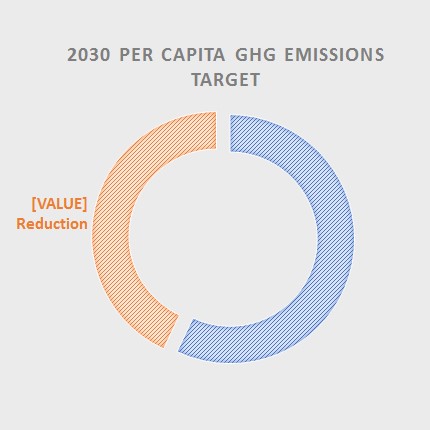
Ontario's goal for carbon emission reductions per capita by 2030
These goals may seem daunting, and while there have been steps taken towards making Ontario a more sustainable province, Ontario is currently not on track to reach this target by 2030. Based on our current trend, if we continue to meet our historical pace of conservation, we will fall short of our goals by approximately 40%.
So how do we make up for this shortfall and achieve our target in time? The answer may rely on our ability to create more energy efficient buildings. Buildings in Toronto are the largest contributor to emissions at 53% of the total GHGs produced. Transportation comes in at a distant second place, contributing 33%.
In order to reach these goals, we will need to change the way we approach both new building construction and upgrading existing buildings. The 2030 Challenge aims to have all new buildings be carbon neutral by 2030 and for all existing buildings to reduce their emissions by 50%. However, this can be very difficult to achieve. The first step is to start planning now. Since the majority of major building components have a service life of 20 or more years, new buildings essentially need to start planning to be carbon neutral now. Additionally, existing buildings need to start considering replacement with high efficiency components that meet the standards of 2030 performance as of today in order to reduce their emissions adequately.
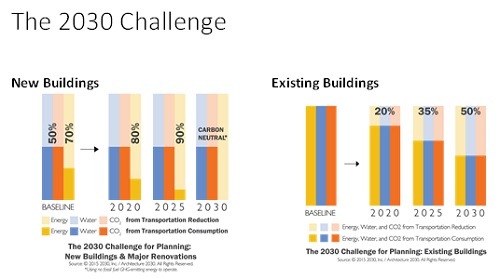
Predicted requirements for new and existing buildings to meet 2030 targets
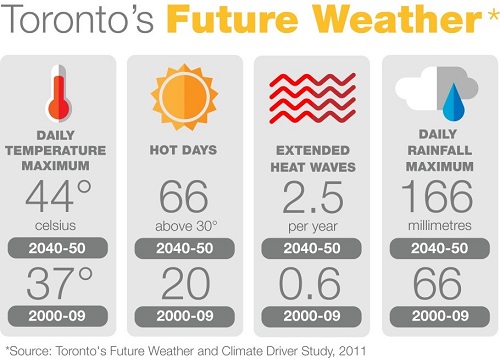
In addition to creating more energy efficient components, we will also have to address the changing climate in Toronto and will need to design buildings to perform differently under the changing conditions. We are expected to experience increases in daily temperature maximums, number of hot days above 30°C, daily rainfall maximums and more heat waves than in the past.
Predicted climate change for Toronto between 2010 and 2050
All of this information leads to the conclusion that our society needs to start making changes now. But how do we go about making these changes? What is the most important step to help achieve our goal? Mr. Ranson suggests that it is not a single action, but a combination of multiple, mutually reinforcing actions that will lead to positive progression. The transformation of the market will require sustained and aligned action across a number of areas including development of technologies, processes and best practices; improving financial tools and methods; engaging communities to develop public education, awareness and behavior change; redesigning the legal framework and contractual processes and improving industry training and promotion. Essentially, everyone must buy-in to the plan in order for this to work. Everyone from large-scale office towers down to individual home owners must contribute.
Jeff summarized his presentation with Three Big Challenges:
Challenge 1: Understanding Emissions from all Market Sectors
As a community, we know very little about the small, distributed emitters that make up a big portion of our footprint. How to we reach these areas and effectively design and deliver programs to these areas?
Challenge 2: Need Empowered Local Communities in Order to Scale Up
We cannot rely solely on top-down direct outreach as the costs are too high to reach every area. If we want to rapidly disseminate information and build capacity, we need to tap into existing networks and build up a community that works together.
Challenge 3: Work Collaboratively
There are several stakeholders in the industrial, government and public benefit sectors that work in isolation. Effective change will require strategic alignment across sectors towards a common goal.
Following this presentation on the 2030 District, the remaining four panelists provided their insights on the topic of climate change and the role of buildings. Adrian Sluga began by giving his views on the maintenance of existing buildings. He explained that energy conservation can be difficult in existing buildings. Part of the issue is that consultants do not always have a good understanding of what the real estate manager is doing with the buildings and as a result, does not provide cohesive solutions that work with the long term plan of the buildings. Additionally, the installation of more energy efficient systems usually means more complex controls with additional testing and labour to support the system. This can be costly to train operators and hiring additional staff, and difficult to maintain, resulting in sub-par operation. On top of this, the initial installation of new equipment can be costly and expensive since the building is already occupied and work must be done around tenant schedules. Finally, Mr. Sluga explained that while installing upgrades to increase energy efficiency can help, a large part of the solution comes from a culture change from an occupant perspective. The tenants must be willing to use the systems and be conscious of the energy saving culture. Again, the importance of contributions from various different stakeholders at multiple levels was mentioned.
Steve Kemp provided insight from the context of new buildings. He explained that while there have been a number of incentives over the past years to encourage buildings to become more efficient, we are now entering an era of stricter building code minimums and regulations as we aim to become net zero. Residential buildings are expected to continue to grow the most until 2030 and the large commercial buildings are going to have to largest changes as their commissioning standards are far behind those of housing and single family homes. One of the largest challenges will be addressing the enclosures of high-rise buildings which are predominantly glass. As new requirements come into effect, we should expect to see less glass and more brick to increase a building's efficiency.
Ekatrina Tzekova discussed the changes to energy policies that will likely be coming into effect and their impacts. Benchmarking and energy reporting are expected to become commonplace with commercial buildings over 250,000 ft2 being required to report their energy use by July of 2018. While not in place yet, it is likely that MURBs and larger buildings will be required to do the same in the future. The benchmarking system will take time to set in place since data will need to be collected and analyzed before we understand how buildings are performing. From this data, we will be able to set benchmarks and energy use goals for buildings to achieve. Using a Green Bank (i.e., carbon cap and trade, financing retrofits) is another policy that will likely become more common in the future to achieve the 2030 target. Ultimately, there will need to be "test buildings" that employ these policies and show improvement to show that the policies are viable and create interest for the incentives from potential clients.
Duncan Phillips gave his thoughts on the climate and how it will affect our built environment. He stated that from 1950 to today, the average number of days that we require heating have decreased by 8%, however the number of days that we require cooling has gone up by 30%, showing a prime example of how building requirements have changed over the last 67 years. Additionally, extreme weather events are becoming more common (i.e., forest fire in Alberta, flooding in Toronto) that are affecting where we live and how buildings are built. In some areas of Canada, the snow load is increasing, causing the structure of buildings to be designed differently. Additionally, increasing requirements for energy conservation such as increased insulation can result in the snow load lasting longer, causing further design changes to building designs. The environment is changing and we need to change the way we construct buildings. Mr. Phillips also touched on the idea of going beyond creating net zero buildings and thinking about net zero communities. Since certain buildings will not be net zero, we will actually need some buildings to be net positive in order to counteract the energy consuming buildings. Thinking about net zero at a community level will help to achieve the overall goals of the 2015 Paris Climate Change Conference.
The plan to create a community that is carbon neutral is a complex task that requires coordination and cooperation at all levels of the community and the world at large. Starting now rather than later is an important step towards achieving our goals. Every step matters and everyone needs to contribute in order for this to succeed. If you would like more information or want to get involved with the 2030 District, visit www.2030districts.org/toronto.
Michael Peterson
WSP Group
Mike.j.Peterson@wspgroup.com
|
| April Meeting Pictures |
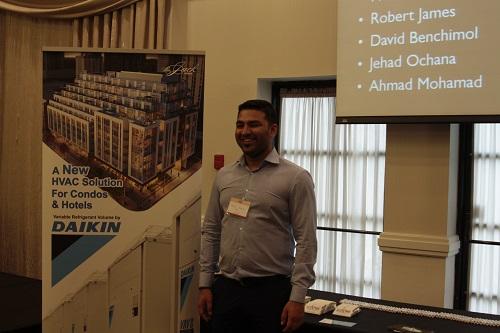
Event sponsor Kartik Singla of DXS
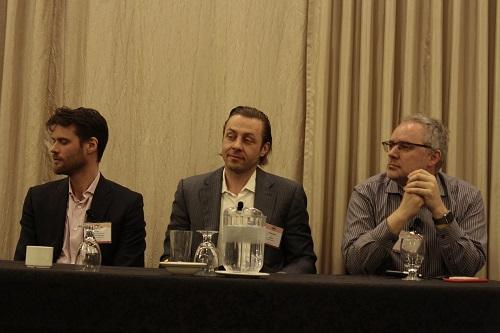
Featured presenters left to right:
Jeff Ranson (2030 District), Adrian Sluga (JLL), Steve Kemp (RDH)
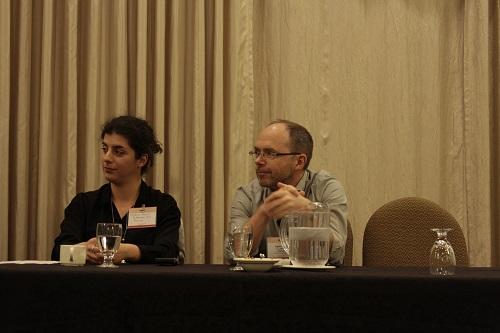
Featured presenters left to right:
Ekaterina Tzekova (The Atmospheric Fund) and Duncan Phillips (RWDI)
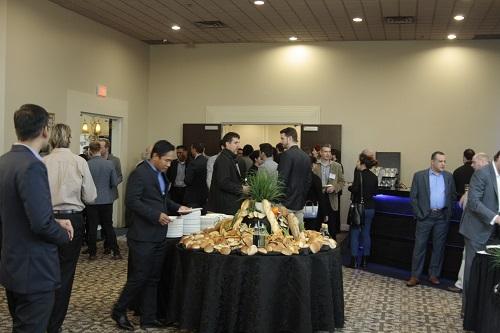


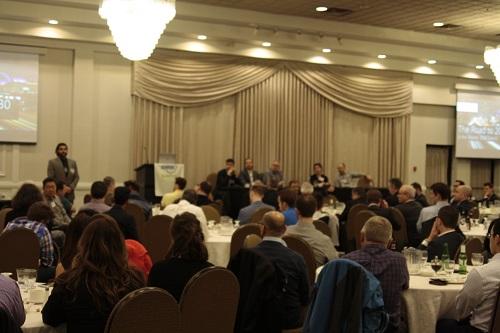
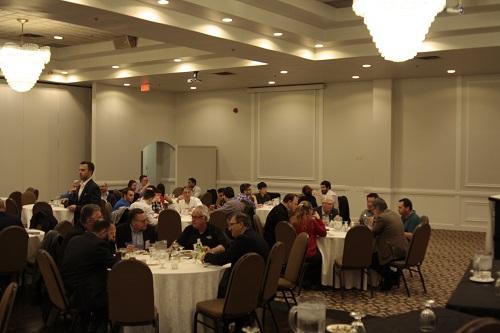
Photos by Niss Feiner of Delta-T Designs
|
 |
YEA Leadership Academy
|
YEA Leadership Academy 2017
"Early last month Badri and myself were privileged enough to be sent to the first ever ASHRAE Leadership Academy. At this academy we were able to learn about the organization behind ASHRAE, our place within as members, and leaders.
They imparted upon us the importance of leadership and unity under the ASHRAE umbrella, not just for the societies sake, but for the sake of the world. They imparted the importance of ASHRAE members and chapters being leaders in their communities and nations in order to help move the world forward in an environmentally and socially responsible way.
The day acted as a forum as well, where we could share our ideas, and experiences with many other members and learn what worked at their chapters and what didn't. The people in attendance were what made the event. I was astounded at how far people have traveled for a one day course. We had members in attendance from Egypt, Ireland, Bangladesh, India, Pakistan, Nigeria, and on and on. Within that short day we formed into a cohesive group, and thoroughly enjoying each-others company, even though we often referred to each other by which city they came from as we couldn't always remember names.
Drinks were drunk, karaoke was butchered, and linked-in contacts were shared. I don't think this happened by accident. The people of ASHRAE are the most important factor. There is a reason that Membership is at the very top of the ASHRAE structure. Without the members there is no ASHRAE, and forming bonds at events like this allows us to expand our web of networking, not only professionally, but allows us to keep sharing ideas, for the health and growth of our chapters, and society as a whole. It was an experience that I certainly shall not forget, and I would like to thank the chapter and the society for the support and opportunity to attend this event."
-Niss Feiner (Delta T Designs)
|
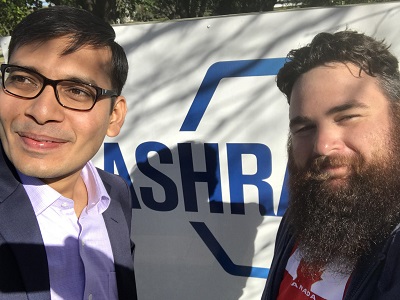 Badri Patel (left) and Niss Feiner (right) in Atlanta at ASHRAE HQ for the Leadership Academy
|
| PAOE |
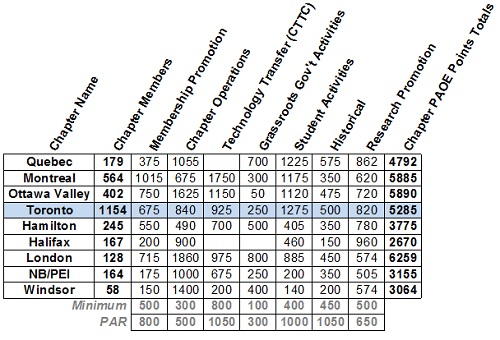
PAOE or Presidents Award Of Excellence, provides the chapters in Region II with a means of measuring success across a wide range of chapter operations. It is meant as a tool to guide the Board of Directors and Committee Chairs towards their goals. Below is a summary of PAOE Points for all of the Chapters in Region II so far this year.
Toronto Chapter President 2016-2017
|
| Social Media |
We want to hear from all members of the industry and are excited to share HVAC/building system news and current chapter events.
|
|
|
|
|
Statements made in this publication are not expressions of the Society or of the chapter and may not be reproduced without special permission of the chapter.
|
|
|