AITF logo l.png

Anchor Institutions Task Force News

October, 2022

AITF Highlights

Welcome to this October issue of 2022 AITF News. As usual, feel free to share your thoughts on how AITF can be a useful resource.

We are often reminded of the centrality of leadership to advancing an anchor institution’s engagement in its local community. As many leaders of anchor institutions that have championed this work over the years have retired, and are about to retire, we realize that the field as a whole and AITF in particular, must be intentional about steps forward. AITF has been working to create cohorts of future anchor leaders through an Anchor Fellows Program. Our third cohort was recently announced.  


The latest AITF contribution toward strengthening leadership and intentionally sustaining a commitment to AITF’s values in anchor institutions is AITF’s Leadership Guide, which we are pleased to present to you. The idea for this tool for existing and aspiring leaders of anchor institutions emerged out of lively discussions in AITF’s Higher Education Presidents’ Subgroup.  


This Guide provides insights on the numerous internal and external considerations anchor institutions must take into account to build and strengthen community partnerships, align external goals with the core mission and strategy of institutions, and sustain internal and external commitments over time. Additional materials to complement this Guide will be added in the future.  


----------------------------------------------------------------------------------------------------


This has been a monumental year for AITF for numerous reasons. But one area of growth that has been particularly noteworthy is the emergence of our work focusing on multi-institutional Anchor Partnerships (also known as Networks or Collaboratives). Our Anchor Partnerships Subgroup has been meeting throughout the year. The culmination of these discussions is a unique event entitled, the Power and Potential of Anchor Partnerships.  


This small-scale event on November 3 (10 am to 3 pm Eastern) will be an opportunity to connect representatives of anchor partnerships from across the U.S. to deepen our collective understanding about these important collaborations. As we have already been observing, these formations have been catalysts for change. They represent one compelling aspect of the future of the role of anchor institutions in their communities.


Those who will not be with us in person can listen to the dialogue via this link. The recording will be distributed in our next issue.


----------------------------------------------------------------------------------------------------


Campus Compact and the U.S. Department of Housing and Urban Development Office of Field Policy and Management announced a new higher education-focused collaboration, the HUD + Higher Ed Engagement Network. The Network, which will be led by Campus Compact in partnership with the Anchor Institutions Task Force (AITF), the Coalition of Urban and Metropolitan Universities (CUMU), and the University Economic Development Association (UEDA), will focus on strengthening connections and collaborations between higher education institutions and the 64 HUD field offices located throughout the country.


Resources from the Field

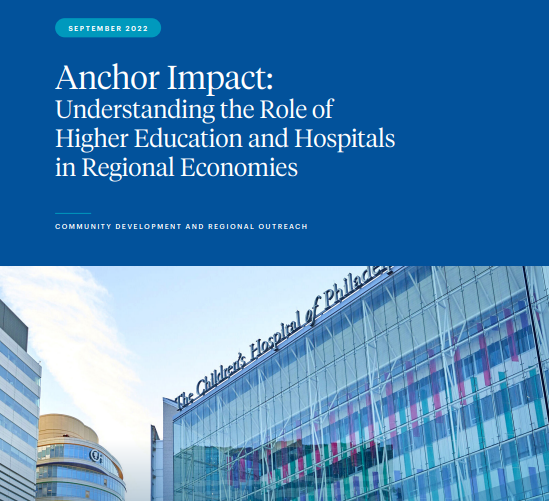
Report: Anchor Impact - Understanding the Role of Higher Education and Hospitals in Regional Economics 


The Anchor Economy Initiative at the Federal Reserve Bank of Philadelphia has created the Anchor Economy Dashboard, a new data set and website. The dashboard improves our understanding of anchor institutions’ role in the economy through four main contributions. This report provides an overview of the data contained in the Anchor Economy Dashboard. 

Report: Exploring Metropolitan Anchor Hospitals and the Communities They Serve


The American Hospital Association (AHA) identified and defined a particular set of urban safety net hospitals — the Metropolitan Anchor Hospital (MAH) — that serve large numbers of urban, low-income and historically marginalized individuals. This report describes the distinguishing attributes of these hospitals and the communities they serve.

Job Position: Senior Director of Community Engagement at Marquette University 


The role serves as the chief community engagement officer and primary contact for strategic community engagement initiatives and partnerships at the university, working in close consultation with the Associate Vice President for Public Affairs and the Vice President for University Relations. The Senior Director collaborates with various departments across campus to develop strategies for reaching institutional goals related to community engagement and works in close collaboration with the Vice President for Research and Innovation to help promote the scholarship of engagement and community-based research opportunities.

News & Articles

“Cities and the Urban University,” The Chronicle’s latest Trends Snapshot - from the Chronicle of Higher Education


October 27 - “Cities and the Urban University,” The Chronicle’s latest Trends Snapshot, looks at four ways colleges and institutions are embracing their role as a community anchor and working toward true partnership with the people and places beyond the campus. The four ways are: economic inclusion, leveraging coursework, community-school partnerships and offering off-campus classes.

Hospitals Are Screening for Social Determinants of Health, but Programs, Community Partnerships Lag - from Medical Economics


October 26 -  A study “Assessment of Strategies Used in US Hospitals to Address Social Needs During the COVID-19 Pandemic,” published Oct. 21, 2022, in JAMA Health Forum, found that Hospitals are integrating screenings to assess patients’ social determinants of health (SDOH), but programs and community partnerships to address SDOH have been slower to develop.

Robeson Community College Creates Intentional Partnerships with Local Industry  - from EducationNC


October 26 - From early childcare providers to manufacturers, Robeson Community College has partnered with local employers for years. But recently, the college has taken a more intentional approach to these partnerships. Robeson Community College (RCC) has an annual economic impact of $96.8 million in its region. And with nearly 100% of its students coming from southeastern North Carolina, creating valuable industry partnerships is key for the success of the college and its students. Melissa Singler, the college’s president, said being intentional drives the college’s industry relationships.  “Anytime we can go in and lift the company up in terms of training people they’ve already hired or training people specifically to be hired, it’s a win-win for our community,” Singler said. 

Research Shows Impact of Greater Manchester Universities as Civic University Agreement Reaches Milestone - from the University of Manchester


October 25 - Research has shown the impact of Greater Manchester’s universities on the city region, its people, and businesses, one year on from the signing of a flagship agreement. The Greater Manchester Civic University Agreement commits the five higher education institutions to collective action around the six priority areas of education and skills; reducing inequalities; jobs and growth; the digital economy; net zero; and the creative and cultural economy.

Libraries Add museums, Tool Rentals and Job Centers to Help Meet Community Needs and Stay Relevant - from CPR News


October 19 - Creating an interactive in-house museum. Renting out saws, cake pans and vegetable seeds. Providing job centers to connect the unemployed to companies with jobs to fill. These are some of the innovative, mission-expanding ways that libraries are staying relevant around the country and in Colorado, as the internet, smartphones and other technology have overwhelmed their traditional roles of lending books and doing research.

Milwaukee Ald. Rainey: Lauds Milwaukee Anchor Collaborative Plan to Hire and Spend More with City’s Underserved - from WisPolitics


October 17 - Exciting news for Milwaukee’s most disadvantaged neighborhoods comes as the Milwaukee Anchor Collaborative (MAC), which includes healthcare and educational institutions, has pledged to hire more people of color and spend more with minority-owned businesses in the most challenged neighborhoods of Milwaukee. 

Anchor Institutions Play Key Role in Digital Literacy: Benton Senior Fellow - from BroadbandBreakfast


October 13 - Anchor institutions should teach digital skills to low-income communities because they play a pivotal role in getting communities connected, a senior fellow at the Benton Institute, John Horrigan said at a National Digital Inclusion Alliance event on October 5.

Academic Journal Articles

Journal ArticleNguyen, A. T., Jones, E. J., O’Neal, K. S., Netter, M. K., & Dwyer, K. A. (2022). An Academic-Community Engagement: A Roadmap for Developing a Culturally Relevant Diabetes Self-Management Program among Vietnamese Americans. Collaborations: A Journal of Community-Based Research and Practice, 5(1). Link