Provided by the American Dairy Science Association® (ADSA®) in cooperation with Feedstuffs. If you received this issue of ADSA Dair-e-news from a friend and would like to receive your personal copy in the future, please contact keolson@prodigy.net
Opinion and editorial content included in the Dair-e-news represent the views of the authors. Publication does not represent endorsement of any position by the ADSA. Depending on your email preview settings, all text may not be visible. If you find that to be the case, simply click to open the email or use the link at the top to open the web version.
|
|
SPECIAL ADSA ANNUAL MEETING COVERAGE |
|
Welcome to our special edition of the ADSA Dair-e-news featuring coverage of the 2022 Annual Meeting. Attendance both in-person and virtual is excellent with registration now over 1,650 from 45 countries. If you are at the meeting, stop by the ADSA Booth (203,302) to say hello and get added information.
Special thanks to our undergraduate and graduate student writers for their coverage of sessions throughout the meeting. Their work makes the newsletter possible.
Below are a few of the highlights from Monday:
|
|
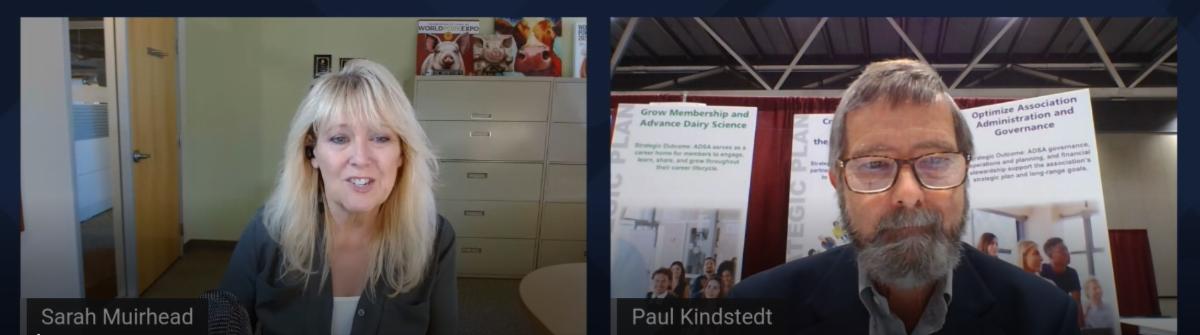
Dr. Paul Kindstedt, Professor of Food Science at the University of Vermont, is wrapping up his term as ADSA president. He talks with us about the past year and shares a bit about the organization's strategic plan and what’s ahead. To view.
|
|
Dr. Abele Kuipers of Wageningen University in the Netherlands joins us to talk about the importance of a global dairy community and the role ADSA can play driving that commitment in research and science. To view.
|
|
Share your insights on policy priorities
The 2023 USDA budget and the coming Farm Bill have major impacts on priorities areas for agricultural research and the funding that will be available to do the work. ADSA wants to be the strongest advocate possible and is seeking member input on priorities for:
· The Farm Bill,
· Funding for science,
· Climate change and
· The future workforce.
The FASS Science Policy Committee (SPC) is hosting a session titled “Farm Bill and Science Policy Discussion with USDA NIFA.” It will be held from 8:00 to 9:00 AM on Wednesday June 22 in room CC 2201. This is a great time to share your insights
Deb Hamernik, PhD, Deputy Director, Institute of Food Production & Sustainability (IFPS) for NIFA will be at the session to provide updates on NIFA. Members of the FASS SPC will provide an overview of the committee and its activities, updates on the current status of the Farm Bill and FY23 budget as they seek your input on policy priorities for ADSA and FASS to pursue.
If you can’t make this session, stop by the FASS Booth (#315) and share your policy priorities during the meeting. What areas of research can have the greatest potential impact for producers and consumers in the short and long term?
What are the three issues that you feel to be of greatest importance for ADSA to work on as the Farm Bill and Budget move forward and why they are they important?
|
|
By Caitlin Zaring
ADSA 2022 was kicked off Monday morning with many symposia. One was Extension Education Symposium: Using Social Media to Engage Dairy Consumers and Community. Dr. Gustavo Schuenemann led the session of three speakers.
Dr. Antonio Faciola from the Faciola Lab at the University of Florida discussed the pros and cons of social media to reach different audiences. He said Twitter is very popular among scholars; Facebook is used by middle-aged US citizens and frequently by citizens from countries outside the US. Instagram is used when targeting younger audiences such as undergraduate students.
The second speaker was Dr. Jillian Bohlen from the University of Georgia, who discussed using videos to target different audiences, including producers and consumers. Video content is projected to be 80% of internet traffic in 2022. Building off Dr. Faciola’s discussion, she proposed the best time to make social media postings is mid-morning between Tuesdays and Thursdays. The younger Instagram users viewed mostly afternoon, so postings on Instagram could be delayed, but distribution Facebook users were most active in the morning.
The final speaker was Allison Ryan from MVP Dairy, LLC. She discussed using social media to engage consumers and interact with viewers respectfully. Content selection and knowledge sharing were focal points of her talk. She shared her experience educating the public and dealing with legitimist questions and misunderstandings versus individuals or activist groups who disagree with dairy practices and the dairy industry. This session taught viewers how to target and reach larger audiences, communicate with your audience, and use social media metrics to determine programmatic impacts. This information can be used to further tailor social media outreach and promote the dairy industry. Key points from this symposia were ensuring content is direct, impactful, and purposeful while being relatable.
Caitlin Zaring is an upcoming Ph.D. student in the Department of Animal Science at the University of Tennessee under Dr. Elizabeth Eckelkamp. She holds a M.S. and B.S. in Animal Science from the same institution and an A.S. in Biology from a local community college. Her survey-based research describes the value-added dairy population and consumer preferences for value-added dairy products in Tennessee.
|
|
Utilizing fatty acids to increase milk fat and energy intake
By Loren Foley
This symposium focused on utilizing fatty acids in a variety of ways to increase milk fat and energy intake in lactating dairy cattle facing negative energy balance.
Dr. Uzi Moallem began the symposium discussing Israeli research on digestibility of diet components, particularly protected fats enriched with palmitic acid. He compared two fatty acids in the same form, as calcium salt, and looked at how they differ in their fatty acid profile as CS45:35 vs. CS80:10. Additionally, he compared CS80:10 to FF80:10, which are different forms with the same fatty acid profile.
The symposium also featured Dr. Caesar Matamoros and his work with Dr. Kevin Harvatine in Department of Animal Science at Penn State University. This research focuses on how sodium acetate supplementation can be used to increase milk fat production. Interestingly, he tested parity interactions, and looked at the difference in genetic potential for milk fat synthesis and energy requirements among cows.
José dos Santos Neto, a graduate student from Michigan State University, has evaluated the effects of infusing T80 either into the rumen or abomasum. His conclusions take into account the dry matter intake (DMI), nutrient intake, nutrient digestibility, and production responses.
Jair Parales-Giron, also of Michigan State University, is working to determine the effects of carbon-16 supplementation on DMI, milk fat yields, FCM, and ECM of primiparous cows during early lactation, specifically, the second and third weeks.
Sarah Bennett, a PhD student from Penn State University, talked about the blending of HMTBa into a fat supplement fed to a cow to combat milk fat depression.
Ursula Abou-Rjeileh, a graduate student at Michigan State University, is focused on determining if fatty acid supplementation may be a strategy to improve energy intake and reduce the negative energy balance in lactating animals. Her procedure looks at the effect if oleic acid on insulin sensitivity and mitochondrial function in AT of periparturient dairy cows.
Loren Foley is a senior at the University of Tennessee studying Animal Science and pursuing an accelerated Master’s degree with Dr. Eckelkamp in Ruminant Nutrition.
|
|
Session looked at what is known about automated milking system nutrition?
By Conor McCabe
Robotic milking systems have started to become highly prevalent across North American dairy farms stretching from a couple to a dozen box robotics or more per farm. We are getting to the point where we have enough herds utilizing robotic dairies to begin to understand the science of this management strategy but there remain major gaps that are unknown compared to our conventional parlor management system.
On Monday afternoon, the Canadian Society of Animal Science tried to answer some of these questions led by Dr. Greg Penner, Dr. Chelsea Gordon, and Dr. Trevor DeVries whom chaired a symposium discussion on the “New Frontiers of Automated Milking System Nutrition”. Their conversations touched on how quantifying appropriate bait feed given to cows is necessary to drive both production and prevent undersupplying nutrients for cows.
Other key considerations include cow flow towards the robot, how cow behavior influences cow eagerness to utilize the robot, and balancing cows’ time budget to ensure they can make it to the feed bunk, rest, and get milked all on her time budget. The talks were then followed up with conversations among the audience members in the room on what the future of robotic milking systems will look like and where the further research gaps remain. The symposium demonstrated that while the industry’s understanding of robotic milking systems has improved, it will take a multidisciplinary approach of cow behavior, nutrition, welfare, and timing to understand the best way to implement these management systems on farms.
Conor McCabe is the current GSD Production Division Director and a PhD student under Dr. Frank Mitloehner at UC Davis working on quantifying and mitigating the greenhouse gas footprint of dairy production in California.
|
|
Student Affiliate Division: Dairy production oral competition allows for opportunity to share knowledge
By Caleb Newman
The ADSA Student Affiliate Division (SAD) oral competition in dairy production was a great opportunity for students from across the country to share their knowledge about research in the dairy industry. Presentations in this session covered multiple topics related to production, including heat stress, nutrition, water usage, housing, and welfare.
· Will Strickland, a recent graduate from the University of Georgia, presented on the potential for dairy producers to improve cow cooling by implementing strategies used in other animal industries, with an emphasis on strategies currently used in the poultry industry.
· Caleb Newman, a recent graduate from the University of Tennessee, discussed the benefits of increasing the proportion of omega-3 fatty acids in the dairy cow diet, including potential improvements in milk fat composition and reproduction.
· Gregory Norris, a recent graduate from The Pennsylvania State University, discussed the importance of improving water productivity on dairy farms by installing water monitoring systems, installing water-efficient equipment, and growing forages which require less water.
· Isabell Revere, a student from the University of Florida, emphasized the role of housing type on the welfare of dairy cows, including a comparison of loose and tethered housing systems. She also discussed how different calf housing systems impact welfare and performance.
· Valerie Rakoczy, a student from the University of Wisconsin-River Falls, discussed the connection between animal behavior and how the animal experiences pain. She then explained how this connection relates to the practice of disbudding in dairy calves and explained the pros and cons of various disbudding protocols.
· Madison Sifford, a student from Virginia Tech, discussed the negative impacts of heat stress on dairy cows, particularly in dry cows. She also explained that heat stress can negatively impact production in the offspring of cows that experience heat stress during the dry period.
The winners of the SAD oral competition in dairy production will be announced later this week!
Caleb Newman is a recent graduate of the University of Tennessee with a BS in animal science. He will be pursuing a master’s degree at the University of Vermont, working in the lab of Dr. Eric Testroet.
|
|
Session focused on cheese and dairy products
By Caitlin Zaring
Led by Dr. Rodrigo Ibáñez from the Center for Dairy Research, one of ADSA 2022’s Monday afternoon symposia gave attendees insight into current research regarding various dairy products, with an emphasis on cheeses. Work from eight presenters was discussed during the two-hour symposia.
Dr. Tom O’Callaghan, University College Cork in Cork, Ireland, kicked off the session. The Irish dairy industry (a pasture-based seasonal dairy system) produces milk high in β-keratin. Giving butter, such as Kerrygold, the characteristic yellow color with creamy texture.
Presenter Caitlin Zaring, a graduate student at the University of Tennessee, found younger, married men who purchased local foods frequently were more knowledgeable of and had a higher purchase likelihood for milk produced and bottled by the same operation in Tennessee.
Other presenters, including Dr. Zeynep Atamer and Ph.D. student Jeff Kuhfeld, discussed the identification and impact of bitter peptides such as β-casein. These proteins were seen to lead to cheese developing an unpleasant bitter taste. Still, this bitter taste could be avoided by reducing calcium or bitter peptides, such as β-casein.
Additionally, research is being conducted to identify bitter peptides, which will be used to build future research on eliminating or controlling these identified peptides. Other studies presented the impacts of various production methods and compositions for cheese types.
Graduate student Maggie Becher, at the University of Wisconsin-Madison, analyzed pasteurization and curd stretching temperature impacts on the shelf-life of string cheese and reported that the higher temperatures in pasteurization and stretching lead to reduced proteolysis. Still, the eventual loss of stringiness was not prevented regardless of temperature level.
The final three presenters were graduate students from Utah State University (Lemin Ali and Anjali Verma) and the University of Wisconsin-Madison (Daniel Wilbanks). Lemin Ali found the composition of dairy produced played a role in product behavior and could be used to understand food structure and mouthfeel. Additionally, Anjali Verma found that galactose concentration and proteolysis affect browning and blistering of baked mozzarella. The final presenter found that high-pressure processing leads to shelf-stable, high-protein cultured milk beverages. This dairy product symposium showed us that small milk and cheese structure changes can lead to major dairy product distinctions.
Caitlin Zaring is an upcoming Ph.D. student in the Department of Animal Science at the University of Tennessee under Dr. Elizabeth Eckelkamp. She holds a M.S. and B.S. in Animal Science from the same institution and an A.S. in Biology from a local community college. Her survey-based research describes the value-added dairy population and consumer preferences for value-added dairy products in Tennessee.
|
|
Ruminant nutrition research and strategies explored
By Landon Whitehead
A Monday afternoon oral session regarding ruminant nutrition, chaired by Dr. Agustin Rius from the University of Tennessee, held many different thoughts and strategies for both producers and researchers.
Topics of interest included the “Production effects of extruded soybean meal in comparison with canola meal in lactating dairy cows” by S.F. Cueva.
Conclusions presented found that milk fat concentration as well as milk fat yield increased when using an extruded soybean meal compared to canola meal versus a solvent soybean meal.
Other intriguing data was found in “Effects of feeding method and frequency on lactational performance and enteric methane emission in dairy cows” by L F. Martins. Research conducted found that feeding concentrates separately increased feed efficiency, as well as the potential for decreasing methane production by feeding concentrates separately from forages at a rate of six times per day, versus three times per day.
In “Feeding spent hemp biomass to late lactating dairy cows: effects on performance, milk production, milk quality, and methane emission” by A. Irawan, using hemp as a feed inclusion saw no detriments to cow performance other than the reduction of butterfat percentage.
These are just a few of the fascinating aspects of the first day of presentations, with eight other speeches concerning anything from integration of algae based diets and its impact on iodine metabolism, feeding of α-amylase enhanced corn, as well as feeding of Saccharomyces cerevisiae fermentation product to Holstein cows.
Landon Whitehead is a recent graduate of Animal Science from the University of Tennessee - Knoxville. He will be continuing his education with a Masters in Agriculture Economics, also from the University of Tennessee - Knoxville.
|
|
Thanks to our Corporate Sustaining Members |
|
We appreciate your ongoing support of ADSA and the Journal of Dairy Science®
Ag Processing Inc.
ANDHIL LLC
Arm & Hammer Animal Nutrition & Food Production
Darling Ingredients Inc.
Diamond V
Global Agri-Trade Corporation
Grande Cheese Company
Lallemand Animal Nutrition
Pioneer
Quali Tech, Inc.
Renaissance Nutrition Inc.
Zinpro
Zoetis
Zook Nutrition & Management Inc.
|
|
Did you know that your ADSA Professional Membership, which is the least expensive of all national animal-related professional societies, includes all of the following benefits with no additional fees, charges or suggested donations?
* Electronic access to the Journal of Dairy Science®
* ADSA Annual Meeting registration at reduced member rates
* Discover Conference registration at reduced member rates
* Large Dairy Herd Management 3rd edition e-book at reduced member rates
* S-PAC: Free access to ADSA Annual Meeting, past JAM and ADSA divisional abstracts
* S-PAC subscription at reduced member rates
* A strong voice of advocacy for the animal sciences, animal agriculture and research
* Access to ADSA's large and growing recorded symposia library
* ADSA News (semi-annual association newsletter)
* ADSA Dair e-news (ADSA weekly industry newsletter)
* Access to member directory
* Peer recognition through ADSA, Foundation and Sponsored Award Program
* Discounted page charges in Journal of Dairy Science®
* Broad author recognition through ADSA/Elsevier press release program
* Linked In and You Tube sites for ADSA
* Quality networking with academic, government and industry professionals
* Travel awards for all graduate students attending Discover Conferences
* Opportunity to serve peers via committee and officer positions
|
|
American Dairy Science Association
1800 South Oak St., Suite 100, Champaign, IL 61820
|
|
|
|
|
|
|