Adverse Childhood Experiences (ACEs) and Homelessness | |
|
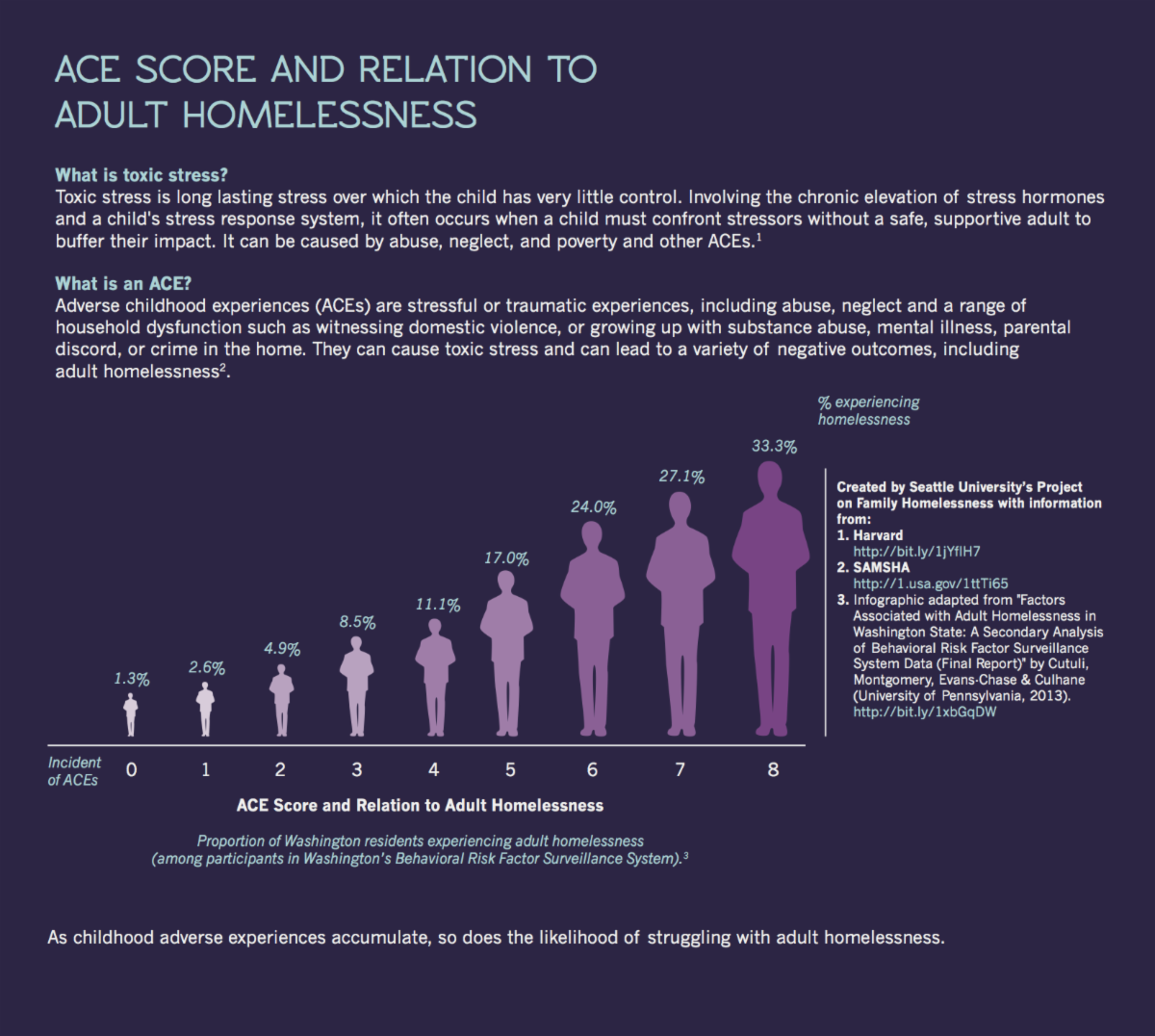
Studies have shown that having ACEs is linked to a risk of homelessness and housing instability in adulthood. As shown in this infographic, the higher the ACEs, the greater the risk of adult homelessness.
A systematic review and meta-analysis in the Lancet found that “the lifetime prevalence of ACEs is substantially higher among homeless adults than among the general population”. A paper in BMC Pediatrics found that “experiencing homelessness, whether unaccompanied or with family, is associated with increased health risk, and every additional ACE increases this risk.”
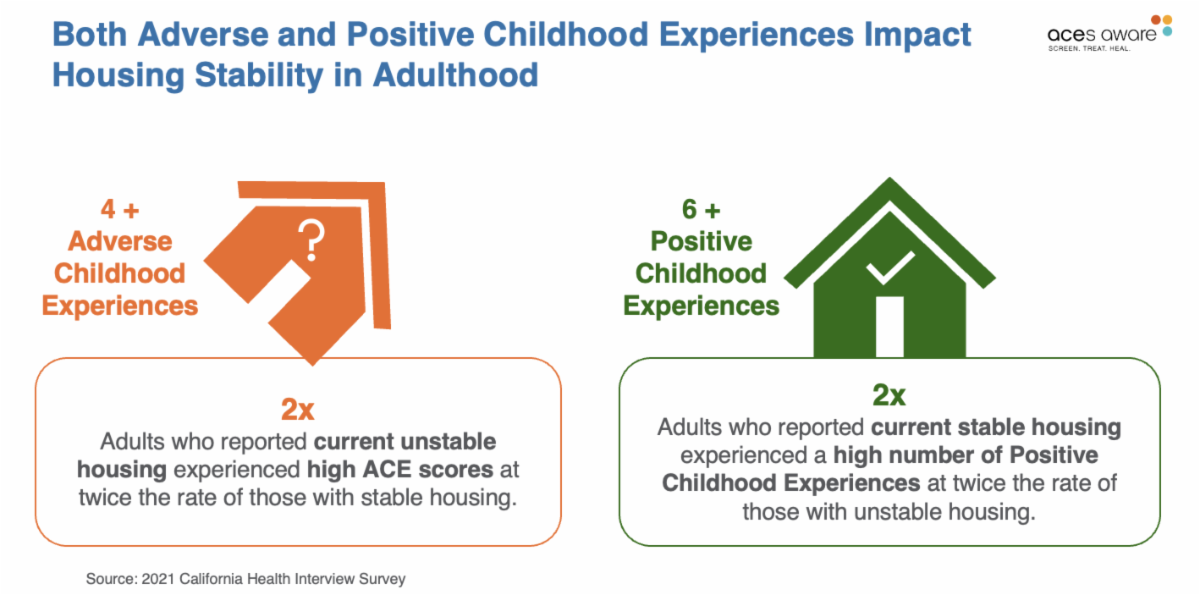
Recent data from the 2021 California Health Interview Survey (CHIS) also makes a connection between ACEs – as well as Positive Childhood Experiences – and housing instability.
The CHIS survey found that:

- Adults who reported current unstable housing experienced high ACE scores at twice the rate of those with stable housing.
- Adults who reported current stable housing experienced a high number of Positive Childhood Experiences at twice the rate of those with unstable housing.
| | |
|
|
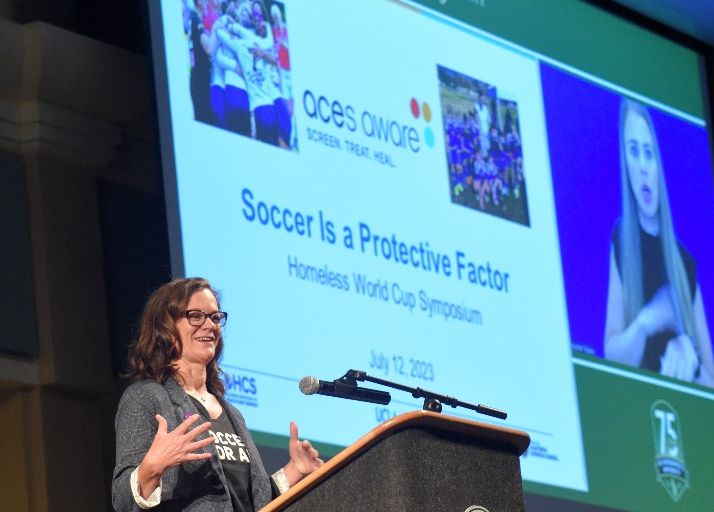
Dr. Shannon Thyne, Co-Principal Investigator of the UCLA/UCSF ACEs Aware Family Resilience Network (UCAAN), the organization that implements the ACEs Aware initiative on behalf of the California Department of Health Care Services, recently discussed the connection between childhood trauma and adult housing instability in her keynote address at the Homeless World Cup Symposium in Sacramento.
| |
|
Her presentation included an overview of ACEs and other adversities, and their impact on health, and focused on how Positive Childhood Experiences like sports can be a protective factor that mitigates the impact of ACEs and toxic stress.
“Studies have shown that engaging in sports helps build resilience and leads to better physical and mental health,” said Thyne. “Soccer can be a powerful tool to support healing from adversity and trauma.”
Learn more about how physical activity, supportive relationships, and other “stress buster” strategies can mitigate the impacts of trauma and toxic stress.
Resources for people who might be experiencing housing instability:
-
California 2-1-1 (2-1-1 makes it easy to find food, housing, job training, after-school programs, and much more.)
-
Find Help (Search and connect to financial assistance, food pantries, medical care, and other free or reduced-cost help.)
References:

| |
Safe Spaces Webinar: Supporting Schools and Care Settings to Be Trauma-Informed | | |
 
|
|
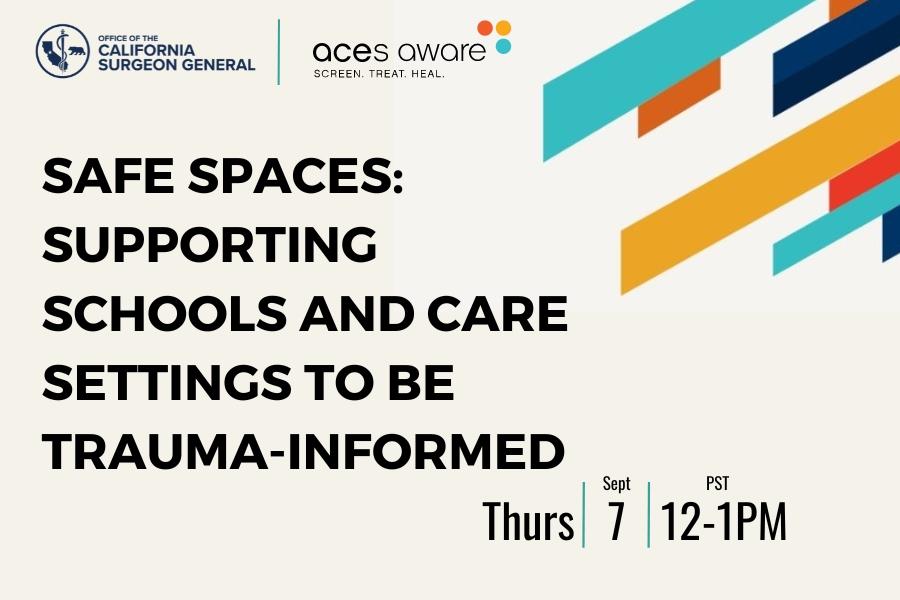
September 7, 2023
12 – 1 pm
Research suggests that Adverse Childhood Experiences (ACEs) affect student learning and behavior in the classroom. Children with three or more ACEs are five times more likely to have attendance issues, six times more likely to have behavior problems, and three times more likely to experience academic failure.

Trauma-informed schools and care settings offer a sanctuary of safety and support for young people. The Office of the California Surgeon General (OSG) recently launched a new online training for educators, school personnel, and early care providers to help recognize and respond to trauma and stress in children and share strategies for creating the conditions for safe and supportive learning environments for everyone.​
Join California Surgeon General Diana Ramos, the OSG team, and a panel of experts to discover more about the training, called Safe Spaces: Foundations of Trauma-Informed Practice for Educational and Care Settings, and learn about the opportunities and challenges for trauma-informed care in educational and care settings. Presentations will be followed by a question and answer session.
PS: Watch this video about the training to learn more.
| |
Mikah Owen Named Co-Principal Investigator of UCAAN | |
|
Mikah Owen, MD, has been named as a principal investigator of the UCLA-UCSF ACEs Aware Family Resilience Network (UCAAN), the organization that implements the ACEs Aware initiative on behalf of the California Department of Health Care Services and the Office of the California Surgeon General, effective immediately.
Dr. Owen has served as UCAAN’s Senior Director of Clinical and Academic Programs and Health Equity since August 2022. He joins Shannon Thyne, MD, from UCLA and Edward Machtinger, MD, from UCSF, as co-principal investigators.
Dr. Owen is a practicing pediatrician who works with system-impacted youth in the Sacramento County juvenile justice system. Prior to joining UCAAN, he was a clinical advisor to the ACEs Aware initiative and an Assistant Clinical Professor in the Department of Pediatrics at UC Davis. Owen earned an MD at UCSF and completed his Pediatric Residency at UC Davis and a fellowship in Community and Societal Pediatrics at the University of Florida College of Medicine – Jacksonville. He also completed the Pozen-Commonwealth Fund Fellowship in Health Equity Leadership at Yale University.
| |
 
|
Putting Implementation Into Action | |
|
Now Available on Demand:  ACEs Aware “Implementation with Intention” Webinar Series 
 
The recordings and materials for all six “Implementation with Intention” webinars are now available on demand on the ACEs Aware learning center. 
 
The series was designed to help California clinics implement ACE screening and response through sessions that provided practical, step-by-step guidance, as well as resources and tools to help clinics move further along their ACE screening implementation journey.
The webinars have been approved for AMA PRA Category 1 Credit™, ASWB, ABP-MOC, ABIM-MOC II credit. 
| |
 
| | |
Events, Resources, and Recent Research | | |
|
|
Upcoming ACEs Aware Webinars:
August 16: ACEs and Trauma-Informed Care in Reproductive Health: Fundamentals and Priorities in the Field.
Registration is now live →
September 7: Safe Spaces: Supporting Schools and Care Settings to Be Trauma-Informed
Registration is now live →

September 14, 12:30 – 1:30 pm: Science and Innovation Speaker Series: Leveraging the Biology of Adversity and Resilience to Transform Pediatric Practice
(Registration coming soon)
September 20, 12 – 1 pm: ACEs and Trauma-Informed Care in Reproductive Health: Creating Healing Spaces and Conversations​
(Registration coming soon)
| | |
|
|
The CYBHI Has a New Website!
The Children and Youth Behavioral Health Initiative (CYBHI), part of the Master Plan for Kids’ Mental Health, a historic investment by the State of California that takes a “whole child” approach to address the factors that contribute to the mental health and well-being of our children and youth, has a new website. The CYBHI works to reimagine a more integrated, youth-centered system where young people can find support for mental health and substance use needs where, when, and in the way they need it most.
Visit the new website →
| | |
|
|
Adverse Childhood Experiences are Associated with Vascular Changes in Adolescents that are Risk Factors for Future Cardiovascular Disease
January 2023 | Pediatric Nephrology
Read →
Adverse Childhood Experiences (ACEs) and Environmental Exposures on Neurocognitive Outcomes in Children: Empirical Evidence, Potential Mechanisms, and Implications
March 2023 | Multidisciplinary Digital Publishing Institute
Read →
When Adverse Childhood Experiences Present to a Statewide Child Psychiatry Access Program
March 2023 | National Library of Medicine
Read →
Structural Racism in Behavioral Health Presentation and Management
June 2023 | CDC Morbidity and Mortality Weekly Report
Read →
Adverse Childhood Experiences Among US Adolescents over the Course of the COVID-19 Pandemic
May 2023 | Pediatrics
Read →
Association of Adverse Childhood Experiences with Adulthood Multiple Sclerosis: A Systematic Review of Observational Studies
June 2023 | Brain Behavior
Read →
| |
Screening for ACEs, assessing risk for toxic stress, and responding with evidence-based interventions and trauma-informed care can significantly improve the health and well-being of individuals and families. | |
Already completed the training?
Providers with National Provider Identifiers should attest on the DHCS website so they can become eligible for Medi-Cal reimbursement for screening.
| |
|
Tip of the Month:
You don't have to be a therapist to be therapeutic.
| |
Follow ACEs Aware on Social Media | |
Don't forget to add questions@acesaware.org to your safe sender list. | | | | |