Trivia question answer
Jeremiah Wadsworth.
He began the war by handling commissary assignments in Connecticut. In 1777, Congress chose him to serve as deputy commissary general of purchases; by 1778, he was commissary general. He also served as commissary for Comte de Rochambeau's army. Glenn Weaver and Michael Swift, writing in “Hartford: An Illustrated History” (2003, American Historical Press), observed that Wadsworth openly acknowledged the fortune he made from contracts with the American and French governments, adding, “he always insisted he be paid for his produce and services in gold.”
Wadsworth went on to lead Hartford’s nascent banking, insurance, and textile industries. He founded Hartford’s first bank, the Connecticut National Bank.
Wadsworth also served in the Continental Congress in 1788 and as member of the Connecticut convention that ratified the U.S. Constitution in 1788. From 1789 to 1795 he served three terms in the U.S. House of Representatives.
It must also be noted, however, that Wadsworth owned slaves. Joel Lang, in an article published in the September 29, 2002, editions of the Hartford Courant, reported that Wadsworth “once bought a whole slave family.” And for a time, according to Lang, “Wadsworth owned 6,600 acres of plantation land in South Carolina and the 129 slaves who went with it.” He added: “The circumstances that made Wadsworth a slave master are complicated, but also revealing of the North’s innumerable ties to the slave economy.”
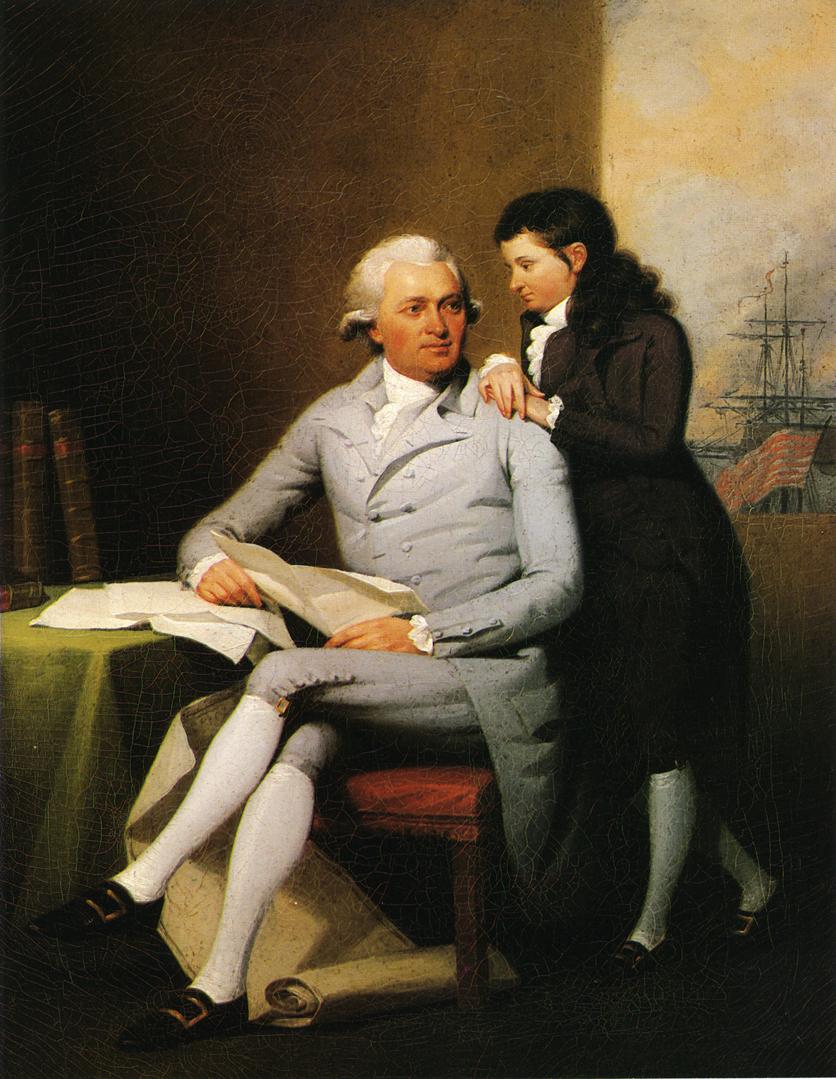
At right: Jeremiah Wadsworth and his son, Daniel, in a 1784 portrait by John Trumbull (Image: public domain.)
|