FAQ - Techny Edition
Frequently Asked Questions
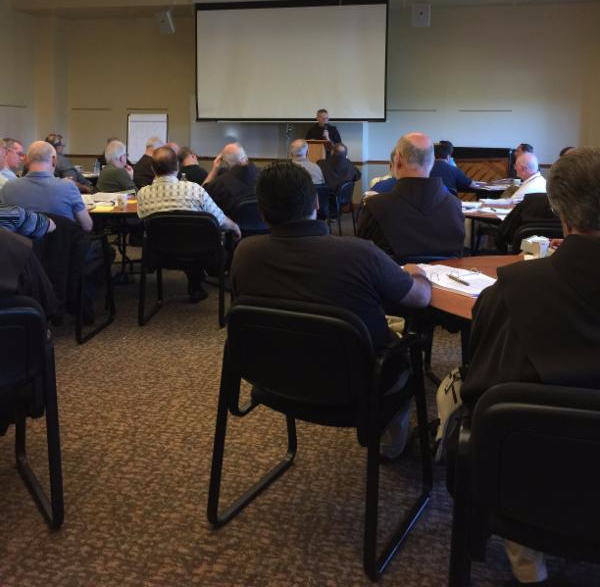
TECHNY, ILLINOIS - The friars gathered for the 2-day gathering have tried to anticipate some of the questions that would arise following this week's meeting. Here are some of them. If you have another question, please send it in:
exec@escofm.org
1. Are these four the only models we can consider?
We have been in a process of trying to narrow down our considerations for the sake of a productive conversation. The Interprovincial Commission presented possible models in their 2013 report to get the conversation going. The FIT created these models based on that prior work and the ongoing conversations with Provincial Ministers, Councilors and friars across the country into a more workable form. The hope is that our conversation is narrowing towards consensus and so these are the models for our consideration.
2. Can other models be added?
For the reasons stated above, no completely new models can be added. At some point, the number of models being considered needs to be curtailed or the conversation will never reach a conclusion.
3. Can these models be modified?
Having stated that no models made be added, we are aware that the models we are considering are not perfect and will need the input and modification offered through the national conversation on them that we are now beginning. So, modification will be a likely outcome of the conversations over the next year.
4. Is everyone still "at the table?"
Yes, at this point all seven U.S. Provinces have agreed to remain at the table and continue the conversation.
5. What if a province(s) withdraw from the process?
Each Province always retains an option of withdrawing from the process. All members have agreed from the beginning that they will move forward with which ever Provinces remain at the table. It isn't clear at this point what the reaction from the General Administration would be to a withdrawing province.
6. If my province withdraws, what are my options as an individual friar if I want to be part of reconfiguration?
Our General Minister has told us that when new structures are created, any friar will be permitted to join the new Province(s), this would include friars of non-participating Provinces. We refer to this as a period of open enrollment.
7. Are other countries/provinces in a similar process?
Yes, in fact most of the provinces of the world are engaged in some level of reconfiguration. The provinces of Germany and France have already completed a process of reduction to one province. In Spain the provinces have reduced to three. England recently became a dependent custody of the Irish Province. Italy is in the midst of a major reconfiguration. And, Canada is also in the midst of similar discussions.
8.
What are the implications for a particular province if they remain in a model/if they don't continue to participate?
This is exactly what we will be talking about nationally in the year(s) ahead. A consideration of various models will by its very nature include conversations about what it means to a particular province and its members. The implications will be different for each of the models and each of the provinces.
9. Am I committed to the model I prefer now? If I support a particular model now, must I still support that model in 2017?
No. The time to make an absolute commitment will be when an eventual proposal is under consideration by each province in chapter. Until then, the nature of the conversation might make an individual prefer one over the other for different reasons and that's okay.
10. Were other models considered and excluded, and if so, why?
Yes, as you can see from the FIT Report, we considered a total of six models. Some of the reasons two of them were rejected were things like they resulted in the fracturing of the membership of current provinces, or they were simply found to be impractical or unworkable. The friars gathered in Techny reviewed each one and determined which were useful moving forward and which were not. The ones that were not simply did not respond best to the criteria set out.
11. What will happen to senior friars?
We recognize and acknowledge that there is concern among our senior friars (and others) about what this future means for them. Will they be asked to move to another retirement or care facility? How will they be cared for? The friars gathered reaffirmed that concern for our senior friars remains among the highest priorities in the process of reconfiguration. It was also reaffirmed that this should involve as little stress as possible for our senior friars who have already given so much to our fraternity. Among the highlights in the models for consideration includes the establishment of a fund for the care of senior friars.
12. When can I start looking at new possibilities?
Effectively, nothing will change in terms of provincial structures until after 2017 and will be dependent upon the model approved and the provinces participating.
13. How do we prepare our lay staff and other partners in ministry for eventual changes?
We acknowledge a process that hopes to result in the reduction of the current number of provinces will have an impact on the lay people and other religious who are both our employees and partners in ministry. While not being able to predict anything specific at this point in the process, we commit ourselves to sensitivity and respect in dealing with our lay staff, other religious and partners in ministry.
14. What do we communicate to bishops and when?
We are making every effort to keep the many bishops we work and minister with updated as the process unfolds.
15. Why don't we just put our energy into more collaboration instead of restructuring?
The 2013 Commission report reminded us that "the status quo is not sustainable." While collaboration is an important part of our way of life and always valued, it is not the solution to our current situation.
16. How will decisions be made re: resources (manpower, money, etc.) in any restructuring model?
We don't have an answer for that at this stage in the process. It's just too soon to answer this question until we understand more clearly which model we are working towards.