TheBite-Logo-Final-plain.jpg

SUPPORTING SPONSOR

#60 | Zombie Apocalypse, Mole, and Ghost Town Reviver

“During the initial states of the zombie apocalypse,” reads a page in The Art of Eating through the Zombie Apocalypse, “most of your hunting will likely be for small- to medium-sized game and fish that will often be cooked whole or with minimal breaking down.” In other words, you’ll be able to get by awhile with pretty limited butchering skills. That’s assuming the apocalypse is a zombie apocalypse, and not some other kind of apocalypse, in which case we’re in no position to tell you what your hunting will be for.


Apocalypse jokes aren’t funny. We know that. But there is an actual Zombie Walk tonight in downtown Las Cruces (we don’t know how on-theme the food vendors there will be, but it is the year of Soylent Green, and we’re not opposed to bringing a little gore to the costume party smorgasbord, perhaps with these vampire mouth sandwich cookies), not to mention the bloody plastic arms rising from some of our neighbors’ yards. And what is Halloween about if not scary stories?


Costumes, of course. One of our favorite costumes of all time—not our own—was a papiér-mâché refrigerator with a door full of papiér-mâché condiments. Maybe that’s because we have a casual obsession with other people’s fridges. Maybe it’s because we like old-fashioned, homemade costumes—a preference magnified after we went digging for stats on Halloween candy packaging and got a glimpse of the plastic footprint of single-use costumes


But candy. This could have been a whole treatise on the history of Halloween, candy as currency, diabetes, and other sordid tales. Instead we’ll recommend taking a page from the Day of the Dead playbook, and making handmade tamales and calabaza en tacha the centerpiece of your celebrations of the liminal and the lives of those who’ve passed.


Thanks for reading. By the way, if you like this newsletter, please share it!

Delicious Things


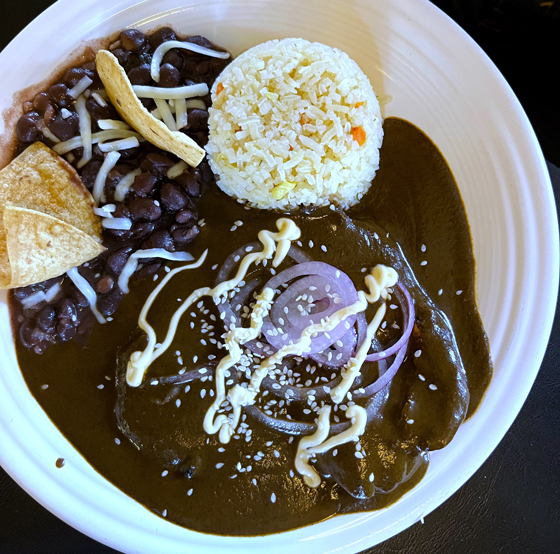
From the local markets to a cooking class in Teotitlán del Valle to fine dining at Origen to a meal in a local home, we consumed mole negro repeatedly in Oaxaca. Never were two mole negros alike, each nuanced, varying in accordance with a given chef’s selection of as many or more than thirty ingredients, traditionally including the charred seeds of the chilhuacle negro, chocolate, and many spices. Thinking these flavors were but a distant memory, we sat down at Paisano Cafe in Mesilla. Our first taste of their mole negro—sophisticated, rich, smoky, and ink-black, with discernible notes of ash—corrected our assumption. At Paisano Cafe, as in Mexico, the rice and chicken are merely a vehicle for eating the sauce. Spoonful after spoonful, we conjured Oaxaca with every complex bite.

Occasions


You still have a few months to catch Chocolate: The Exhibition at The New Mexico Museum of Natural History & Science in Albuquerque. What better time than now to learn how the humble cacao plant became a global cash crop—one, along with sugarcane, at least as important to modern-day Halloween’s origins as the Celtic tradition of souling? 


In Argentina, the 29th of each month—October included—marks the Dia de Ñoquis. At Cafecito in Santa Fe, you can celebrate the immigration of Italians to the South American country back in the nineteenth century with a serving of homemade gnocchi. The end of the month is when Italy’s Saint Pantaleon, said to have blessed some farmers with a miraculous harvest, was canonized. It was also just before payday, a time when the filling but inexpensive-to-make dish was a popular choice for families. 


A journey of a more metaphysical nature is celebrated on the Mexican Day of the Dead, when food and drink is offered to loved ones who, depending on one’s local culture and interpretation, are navigating between life and Mictlán (the land of the dead) or simply paying the living an extended visit. In Santa Fe, Chainbreaker and Homewise are hosting a celebration of Día de los Muertos today at Country Club Gardens on Airport Road. Meanwhile the city will offer its inaugural take on Día de Muertos on the Plaza. The Plaza event will feature an altar for sharing food, drink, and whatever else you might want to offer up to your dear departed, followed by a glow-in-the-dark dance party and candlelight parade. 


Speaking of lights and ancient festivals and celebrations rooted in harvest-time, Namah Fe continues today and tomorrow just down Guadalupe Street. Inspired by Diwali, an annual Indian festival of lights, the Santa Fe iteration (taking place mostly at Jean Cocteau Cinema) offers rangoli-making, Rajasthani dance, Vedic astrology, and snacks and drinks by local chef Paddy Rawal, which you can enjoy tonight while feasting your eyes on a variety of visually delicious treats, including celebrated Bhutanese director Khyentse Norbu’s Vara: A Blessing on the big screen. 


Tomorrow, Albuquerque’s El Vado holds its annual family-friendly Vadoween celebration. Local eateries Happy Chickenzz, Buen Provecho, and Bosque Burger offer such treats as Costa Rican tamales and empanadas and Cluckin’ Hot Chicken Wings alongside crisp pints from Ponderosa Brewery. 


The 2022 South Valley Marigold Procession and Celebration begins at 1pm on November 6 at the Gutierrez Hubbell House. Tip: sort out your parking situation ahead of time. Depending on when you’re reading this, you might still have time to register for the Muertos y Marigolds altar workshop. Either way, you can check out the ofrendas on display at the Gutierrez-Hubbell House till November 12. 


Not least, ABQ Resilience Boxes—including products from twenty local producers along with a zine-ful of recipes and stories from the Middle Rio Grande Valley—are on sale through October 31. For every box purchased, an equal box is redistributed in the community in partnership with Rio Grande High School and Isleta Pueblo–based Pueblo Resurgents. Featured farms include Ashokra Farm, Matt’s Mushroom Farm, FarmShark, and BlueFly Farms, among many others. Pick-up happens November 11 and 12 at Chispas Farm in Albuquerque’s South Valley.

Distillations


Atlas Obscura did a round-up of eight ghost towns you should visit for food and spirits (ha, ha), and three of the said eight are located within our very state. Yes, their criteria for a ghost town are a bit shaky, but that’s part of why food and drink can be found. 


Shelby Hinte took inspiration from the excellent St. George’s Gin for this Ghost Town Reviver; if you’re looking for a local substitute (and no, nobody is paying us to say this), we recommend Tumbleroot’s similarly terroir-forward High Desert and Botanical Gins. 


And speaking of mole: Willy Carleton’s story for edible New Mexico’s Chile issue won a Best of Edible award from Edible Communities. In addition to mole and salsa recipes, Carleton shares reflections on the chilhuacle pepper—and New Mexico’s own chile nativo—that you won’t find elsewhere. 

Got a tip? Wish we knew about your favorite bakery/brewery/hole-in-the-wall? Give us a shout!

Mission


The Bite satisfies a hunger for provocative, artful, community-minded, diverse stories about the raw, the cooked, the distilled & the fermented. We strive for inclusion and a wide range of perspectives in our coverage of the New Mexico food and drink industry, sparking readers to veer out of their comfort zones and into the open territory of the region’s culinary landscape.


By the way, if you enjoy this newsletter, please pass it on!

Subscribe to this Newsletter
Facebook  Twitter  Instagram
LinkedIn Share This Email