|
5 Reasons why working out on machines may put you at risk of injury and what to do instead.
Today, we have more technology, more health devices and exercise equipment than ever before. In particular, computerised strength training machines now promise you everything from protecting you against injury, to being the best type of strength training that there is! But do the claims really stack up in the light of the current health research. Read on to find out.
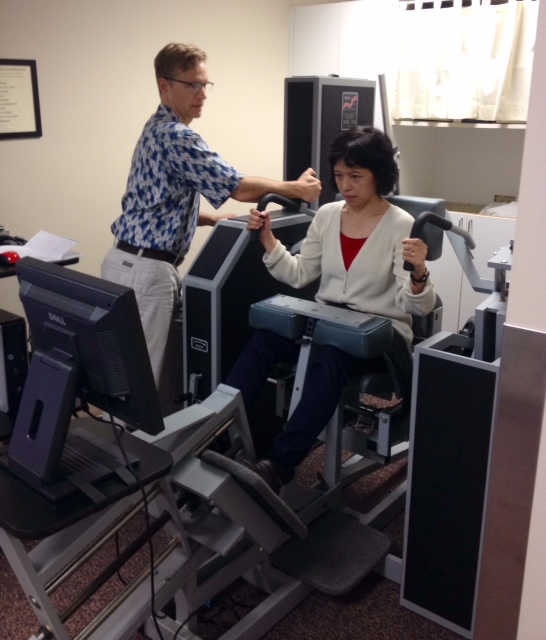
First a bit of background. This article is referring to computerised and non-computerised strength training machines, that dictate the direction of movement and not exercise equipment that uses cables, springs or slings. This is important because your physical health is dependent on your core stability. Essentially, this is the ability of your brain and body to utilize your muscular strength, endurance and control to maintain healthy working relationships of all your muscles and joints in all movements and under all conditions.
And unlike what most health articles and marketing would have you believe, core stability does not just refer to the stomach region, but the stability of all your joints close to your trunk especially your neck, back, shoulder and shoulder girdle as well as your hips, pelvis, and upper leg.
Global Vs Local Muscles
Over the last 30 years, advances in our understanding of the concept of core stability has led to a revolution in the rehabilitation and prevention of injury. The breakthrough came when it was recognised that muscles are differentiated in their makeup and function between global muscles and local muscles.
Global muscles (called prime mover muscles) are larger longer muscles that attach further away from your joints. They are dynamic, phasic muscles in that they switch on and switch off and provide power and strength to movement.
Local muscles (called stabiliser muscles) are small muscles that attach very close to where your joints contact each other. These local stabiliser muscles are often called tonic or postural muscles because they are always switched on providing a low level (5% maximum voluntary contraction), constant, directional tension to hold joints in ideal alignment.
Feed-forward Control - The Key to Injury Prevention
Even more amazing, it was discovered that these muscles actually contract before you move to counter-balance the pull of your large, global muscles. There is a feed-forward or preceding command to the small muscles around your joints to "stiffen" your skeleton in preparation for movement.
Most movements within our bodies operate on this feed-forward system. It seems that your brain and nervous system estimates the forces that are going to be applied to your body during the movement and prepares your muscles and joints in advance.
Joint stabilisation and body control should be sub-conscious and automatic. If it doesn't occur before movement, excessive or abnormal forces will result and you will be more at risk of injury. And this is exactly what happens following injury or with restrictive, regimented and inadequate every day movements and training. This automatic, sub-conscious control becomes impaired and you begin to lack the background stabilisation of your body that protects you from injury.
5 Reasons why strength training on machines does not protect you from injury
- Machines primarily work your global, prime mover muscles. Whilst strengthening these muscles might improve the strength, tone and look of your outer muscles, they have relatively little effect on your local, stabiliser muscles, leaving you vulnerable to injury insufficient stabilisation.
- Machines do not allow for functional movement, which is the type of movement that you do in everyday activities. Because machines dictate specific directions of movement, they do not allow your body segments to work together in a normal, functional way. Consequently, they don't prepare you for and protect you from everyday life activities.
- Because machines are exercise isolated muscles in precise, predetermined directions, they are more likely to lead to muscle imbalances, incorrect postures and movement patterns, excessive or abnormal stresses and eventually to pain and injury.
- Whilst machines might train your muscles, they do not train your brain. In other words, they don't train your nervous system's anticipatory and sub-conscious control of your body. To improve your sub-conscious control, you must do sub-conscious training.
- Training on machines doesn't provide the movement variety that is required in every day functional movements. You see, your body and your brain are very efficient at adapting to movement. This means that your body will get very good at doing machine based training, but this won't transfer well to everyday activities.
Is lack of strength, really the cause of your injury?
Most patients have attended Bodywise Health over the past year NOT because of some trauma but because of some insignificant, quick, unguarded movement that have done without thinking. Statements such as "I just bent over to pick up a pen" or "I just reached forward to open the window" are all too familiar when people give their accounts as to how they sustained their injuries. In almost all cases, strength or the lack of it, does not appear to be a factor as to the cause of their injury. What seems to be of a factor in the cause of these injuries is people's lack of sub-conscious movement.
Core Stability Vs Core Strength
Whilst health clubs, personal trainers and machine based rehabilitation centres often promote core strength as being paramount for optimal physical health, please understand that it is actually your core stability which is more important in protecting you from injury. Whilst core strength is a component of core stability, the more crucial components of core stability are the endurance of your muscles and your nervous system's background control of your joints, muscles and movement.
The term "core instability" implies lack of core control. Therefore, to improve your core stability you need to learn to stabilise better and the best way to learn to stabilise better is by "training" on progressively more "unstable" surfaces and then with increasingly more dynamic functional movements.
Some ideal unstable surfaces for training include swiss and bosu balls, pilates reformers, duradiscs, rockerboards, pools and even standing on one foot. The more unstable you are, the more you have to stabilise and the more you will train your brain and nervous system's ability to protect you from injury.
What are you training for?
Training is highly specific. If you want to look good, want to perform well on machines and are not concerned with avoiding or preventing injury, then by all means "work out" on resistance machines.
However, if your main goals are to perform optimally and prevent injury in sporting or every day functional activities, then you must "train" your brain and body in these activities. Your brain and body only know movements, not muscles. Correct, train and improve the control of your movements and you will not just look better but you will stay better, perform better and live better as well.
For a more detailed article with references,
please read.
Wishing you the best of health,
Michael Hall
Director
Bodywise Health
For more information on how Bodywise Health can help you to improve your core stability, please call Bodywise Health on 1 300 BODYWISE (263 994).
|