WW2 Oral History Newsletter
3 new books from Aaron and Chi Chi Press

1) Prisoners of War: An Oral History
"If you want stories," Bob Levine said to me thirty years ago, "you should interview prisoners of war."
I did want stories, and Bob was right. A veteran of the 90th Infantry Division who was wounded and captured in the battle for Hill 122 in Normandy, Bob invited me to a weekly meeting of ex-POWs at the VA Medical Center. There I met several former POWs I would later interview. And then I got involved in preserving the history of the ill-fated Kassel Mission, which produced a veritable treasure trove of stories about captivity.
In the twelve years I've been exhibiting at the Reading World War II Weekend and the Greenwood Lake Air Show, and the three years at the Naval Air Station Wildwood Wings & Wheels festival, many people have read one or more of my three major books, "Tanks for the Memories," "The D-Day Dozen" and "Up Above the Clouds to Die," so for this spring's events I wanted to add something new. The result is "Prisoners of War: An Oral History," which contains a brief introduction and 19 edited or partial transcripts selected from the 30 or so interviews I've done with former POWs.
I chose a book about POWs because while there are many individual memoirs, books about escapes, about evading, and about individual prison camps, I saw a need to see the prisoner of war experience almost as a separate branch of the service. For instance, airborne veterans almost all have bad knees; Navy and Coast Guard veterans have arms full of tattoos; Marine veterans also have tattoos along with a fierce loyalty to one another and the Corps; Air Corps veterans seem to be well-educated. Young men volunteered for the Marines because they wanted to fight the Japanese, or they enlisted in the Navy so they wouldn't have to go on marches and sleep in muddy foxholes with the infantry. Nobody signed up to be a POW and yet that's where 120,000 Americans and many more soldiers, sailors and flyers of British, Canadian and other nationalities wound up.
While training for combat often was extensive, there was virtually no training on how to surrender. There were 120,000 American POWs from all branches of the service in World War II, and many more British and other nationalities. Many former POWs had "low self-esteem," Bob Levine said, from months or years of not knowing if or when they would be freed. Hal Mapes' young wife was mortified when he picked up a piece of food that had fallen on the floor and ate it. "I thank you for saving my life," a member of Sergeant Tim Dyas' 82nd Airborne squad said when Tim visited him years after the war, "and then I turn around and curse you for surrendering."
"Prisoners of War" is available at Amazon in paperback and for Kindle. If you would like a signed copy, you can order it at Amazon by clicking on the link that says "order new" and then order from wwiioralhistory (that's me). While supplies last, I'll add a couple audio CDs of individual interviews in the book. You can also read the first interview, with ex-POW Herb Gold, by using the "Look Inside the Book" feature at Amazon.
2) From Paratrooper to Public Defender
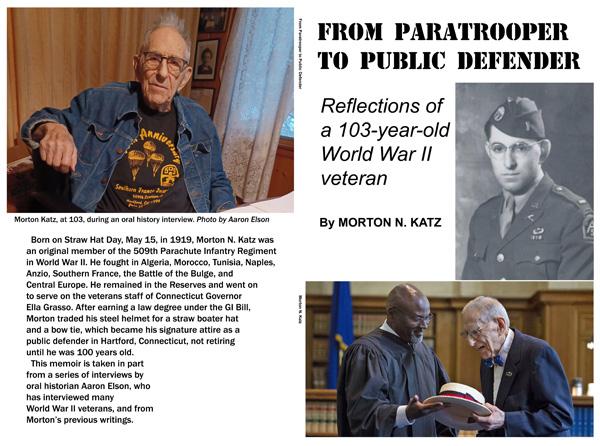
I interrupted work on the oral history of prisoners of war to interview Morton Katz, who was approaching his 104th birthday. The first time I met him, Morton reeled off one event from his life after another. After three hours he still wasn't finished, so I came back for two more interviews. Then I thought: It would be really cool to put this in a book, so I did. When "From Paratrooper to Public Defender" was ready to go to press, I contacted the library in Morton's hometown of Avon, Connecticut, and asked if they would host a book launch event. The program director said everybody at the library loved "Morty," who was a frequent patron until he gave up driving. When the event was held, 92 patrons, including most of Morton's chapter of the Veterans of Foreign Wars, showed up. Morton didn't disappoint the standing room only crowd as he stood at his walker and talked for an hour. Morton will turn 104 on May 15. Here's a video of him at the Avon Free Public Library on March 20 of this year, when he was 103 years old.

3) The Unfinished Autobiography of Hannah Climena Pixley Ariail

In 1996 I interviewed Elmer Forrest, the younger brother of Lieutenant Ed Forrest, in Lee, Massachusetts. Ed was killed on April 3, 1945. His was the only name I remembered from the stories my father told when I was young, so I always would ask the veterans of Company A, my dad's company in the 712th Tank Battalion, about him.
I had interviewed Elmer two years earlier, and I asked him if Ed was married. He said Ed had a girlfriend before he left for the war, and that she still lived in town. Her name was Dorothy Cooney and she still lived in Stockbridge.
I looked her up, and soon I would visit her whenever I went to the Berkshires. She was in her nineties, never married, and still lived in the house her father built on Church Street, near St. Paul's Episcopal Church.
Among other things, Dorothy said Ed proposed to her before he went overseas, and that she told him he had a lot on his mind, and that they should wait until he returned home.
On a later visit, Dorothy dropped a bombshell: She couldn't say for sure, but if I looked into it, she said, I might find that Ed's mother committed suicide. Elmer had said their mother died when Ed was 14 and he was 7, but I hadn't asked about her cause of death. So I called Elmer and asked if I could visit him again.
I wasn't sure that if he was seven at the time he would even remember how she died, but when I asked, he described how he sat in the kitchen eating ice cream and being afraid while people in the village were out looking for his mother, who, it turned out, had thrown herself into the Housatonic River.
Ed was the oldest of four siblings. He had a sister, Vera, who was two years younger than Ed, and a younger brother Warren, who died, according to Elmer, of being injured in a snowball fight. Actually he died of peritonitis when he was a child. I forget how old he was.
Toward the end of my second interview with Elmer, he said he had a story his sister wrote that might give me some insight about Ed. There were two stories, actually. The first was written by his grandmother, who lived with a spinster daughter on a remote mountain in the Berkshires. When the daughter passed away and the house was sold, a composition notebook was found in her effects.
The story ends in mid-sentence where the notebook ran out of space, and no second notebook was ever found, although one probably exited somewhere.
Despite ending on a bit of a cliffhanger, the tale of her childhood is so powerful, both violent and humorous, that it inspired Ed's sister Vera to press her mother to write her story, which she did. In it, she describes her mother's five unsuccessful suicide attempts before she succeeded on the sixth, flinging herself into the Housatonic River in the middle of the night. And it was Ed who discovered her the next day after his father passed her body by thinking it was a log.
No wonder Ed had a lot on his mind when he left for the war.
I hope to publish Ed's mother's story, with I call The Memoir of Vera Louise Forrest McCarthy Beckley, but I felt the time was right to start with The Unfinished Autobiography of Hannah Climena Pixley Ariail, which, I'm sure you'll agree, is a deeply moving story of a turbulent childhood.
I have to give a shoutout to the late Flora Brantley, Hannah Climena's great-granddaughter and Ed Forrest's niece, for organizing both books and making a few copies for the family.
When Hannah Climena's story went live on Amazon recently, a Facebook friend purchased the first copy, and this was her reaction:

Follow me on Twitter! @aaronelson1
Aaron Elson
Address:
12 Washington St., Unit 55
New Britain, CT 06051
Phone: 860-538-3161
aelson.chichipress@att.net