|
 |
Hello and Happy April!
I refrain from saying 'Happy Spring' as it sure doesn't feel like spring yet! I'm looking forward to warmer weather, as I'm sure many people are! I hope you all had a great Easter long weekend!
March was a busy month for PCAP, I don't know where the time went! Our 'Prairie's Got the Goods' week from March 19-24 was a success! We had 5 webinars and one podcast, which had at least 550 views combined! Topics ranged from presentations about soil carbon to species at risk habitat and stewardship. We've had overwhelmingly positive feedback from the programming from this week, as some topics were quite on point for many listeners! Thanks to everyone who contributed and tuned in!
As part of our Native Prairie Speaker Series, we had Krista Connick Todd of SODCAP Inc present at the Swift Current Creek Watershed Stewards AGM about Northern Leopard Frogs. We also had Lori Johnson from the Saskatchewan Burrowing Owl Interpretive Centre give an in-person presentation at Cabela's in Regina with a very special little companion, Peanut the Burrowing Owl! As always, he was a hit! We also had a webinar featuring Renny Grilz from Meewasin Valley Authority who discussed enhancing habitat for grassland birds and species at risk. All of the webinars can be viewed on our YouTube channel! Check them out if you missed them!
Our Native Prairie Speaker Series was on Wednesday April 4th at 12:00 PM. We had Leila Benmerrouche, from Saskatchewan Polytechnic, do a webinar about using Unmanned Aerial Vehicles for Natural Resource Management.
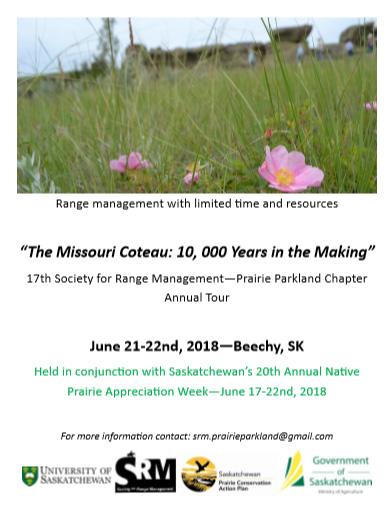
As for other projects, we're starting to organize for the 20th Native Prairie Appreciation Week (NPAW, June 17-23)! We're working with the Society for Range Management to plan this year's tour that will be held in the Beechy area, June 21-22 with the theme "The Missouri Coteau: 10,000 Years in the Making". This year's tour will have an emphasis on range management with limited time and resources, with topics such as plant ID, water quality and range management. You can register NOW!
This year (2018-2019) will be the last year of our current 2014-18 Framework. We will be working with our partners over the next year to develop the 2019-2023 PCAP Framework! It'll be an exciting time to reflect on what the PCAP Partnership has accomplished and where we'd like to go from here.
That's all for now! Have a great week everyone!
Carolyn Gaudet
SK PCAP Manager
306-352-0472
|
What the Heck is an AUM?
Originally published in Beef Business, written by Tara Mulhern Davidson
Forage production can be measured in several ways. Producers may count forage by the bale, or perhaps measure it as pounds per acre or even kilograms per hectare. When it comes to grazing however, the amount of grass available on rangeland is typically measured in Animal Unit Months, or AUM's. AUM's are used for grazing lease agreements, establishing fees, calculating stocking rates, and balancing pasture forage supply and demand...but what exactly is an AUM?
An
Animal Unit Month (AUM) is defined as the amount of forage a 1000 pound cow (with or without a calf) will eat in a one month time frame. It is a method of measuring forage, similar to bales or pounds. There is no firm number attached to one AUM, however many guides and publications suggest a cow will eat 1.5-3.5% of her body weight each day.
The adage "take half and leave half" applies, as AUM's do not account for the
entire amount of forage available in a pasture. They are measured with consideration for leaving adequate carryover for regrowth and habitat maintenance.
How much forage is available?
The amount of available AUMs a pasture can produce depends on many factors. With respect to native prairie, available AUM's will depend on the condition (species of plants) and rangeland health, the soil zone and range type. Below the chart is an example comparing two pastures with similar range types from different soil zones.
Table 1. Estimated Stocking Rates for Zones across Saskatchewan (in AUM/acres)
|
|
RANGE SITE
|
|
DRY BROWN SOIL ZONE
|
DARK BROWN SOIL ZONE
|
BLACK SOIL ZONE
|
|
|
rANGE CONDITION
|
Clayey
|
Loamy
|
Sandy
|
Clayey
|
Loamy
|
Sandy
|
Clayey
|
Loamy
|
Sandy
|
|
|
Excellent
|
0.25
|
0.25
|
0.20
|
0.45
|
0.45
|
0.40
|
0.55
|
0.55
|
0.45
|
|
|
Good
|
0.20
|
0.20
|
0.16
|
0.36
|
0.3
|
0.32
|
0.44
|
0.44
|
0.36
|
|
|
Fair
|
0.16
|
0.16
|
0.13
|
0.29
|
0.29
|
0.26
|
0.35
|
0.35
|
0.28
|
|
|
Poor
|
0.13
|
0.13
|
0.10
|
0.23
|
0.23
|
0.21
|
0.28
|
0.28
|
0.23
|
|
(adapted from Range Plan Development, Saskatchewan Pasture and Grazing Technologies Project, 1990)
Using the numbers from the chart, you will see a section of excellent native prairie on a
sandy range site in the
Dry Brown Soil Zone will provide about 128 AUM's of forage (640 acres multiplied by 0.20 AUM/acre). A section of excellent native prairie on a
sandy range site in the
Black Soil Zone will provide about 352 AUM's of forage (640 acres multiplied by 0.55 AUM/acre).
How much forage do I need?
Calculating stocking rates can be straight forward as long as your cows weigh 1000 pounds, but what happens if they weigh more? An
Animal Unit Equivalent (AUE) can be used when calculating stocking rates to better reflect the reality of your operation. For example, if your average grazing cows weigh 1300 pounds, you can use 1.3 as an animal unit equivalent. If you are grazing yearlings, you may use 0.6 or 0.7 as an animal unit equivalent when calculating stocking rates.
Using the numbers from the previous section, if your pasture in the Dry Brown Soil Zone provides
128 AUM's of forage, how many 1300 lb pairs would that support for a 5 month grazing season? What about the pasture in the Black Soil Zone with
352 AUM's
?
128 AUM's divided by (5 month grazing season x 1.3 AUE) = 19-20 cow-calf pairs in the Dry Brown Soil Zone
352 AUM's divided by (5 month grazing season x 1.3 AUE) = 54 pairs in the
Black Soil Zone
Available AUM's will not fluctuate a lot from one year to the next, however they may gradually shift. For example, if a previously overgrazed prairie pasture in poor range condition receives proper rest and recovers over a period of years, the plant community may shift, the range condition may improve, and available AUMs may increase to reflect the recovered prairie. Conversely, if pastures are grazed above their carrying capacity for a long period of time, condition and health of the range many deteriorate as well the pasture's ability to provide forage.
Achieving proper stocking rates on native range is both an art and a science. Carefully monitoring your range resources, and understanding how much forage your livestock are consuming, are key for ensuring your pastures will sustain the livestock, the environment, and your beef business long into the future.
|
|
Controlling Leafy Spurge one Flock at a Time
prepared by SK PCAP, printed by Realagriculture.com
While most pastures across Saskatchewan were blanketed with snow this past winter, the landscape will change quickly as warm weather arrives. Native prairie plants such as northern wheatgrass and needle-and-thread will soon spring to life, however their undesirable counterparts, such as leafy spurge, will too.
Leafy spurge is a perennial invasive weed many farmers and ranchers are unfortunately all too familiar with. Listed as a "noxious" species under the Saskatchewan Weed Control Act, producers are legally obligated to control leafy spurge, which is incredibly aggressive in pastures, hay land, wetlands, creeks, and ditches. Left uncontrolled, small patches quickly become large, continuous, thick infestations which choke out desirable forage, resulting in reduced productivity and impaired ecological function on entire landscapes.
Leafy spurge has a few key features, including showy yellowish-green bracts, milky sap, and waxy leaves. When the seeds are mature, the seed pods can shoot new seeds up to fifteen feet from the plant, and its root system extends down thirty feet. Because it is so tenacious, leafy spurge usually can't be controlled with a single type of management, but rather a combination of many control measures.
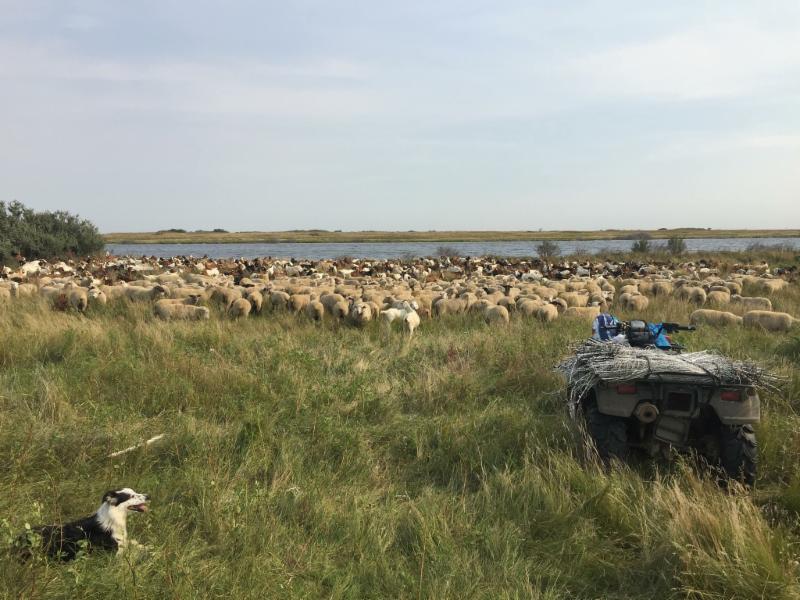
Grazing is one control option that has great potential. Leafy spurge is a highly nutritious plant, and one that sheep and goats readily eat. Stuart Chutter, a producer and contract grazer from Melville, SK, has experience shepherding large herds of sheep and goats in prairie community pastures in order to control leafy spurge.
|
|
Save the Date! The Society for Range Management Tour will be held in Beechy, SK June 21, 22, 2018!
Plan to attend the SRM NPAW Tour in Beechy, SK held in conjunction with Saskatchewan Native Prairie Appreciation Week on June 17-22, 2018!
|
|
|
|
|
|
|
SK PCAP Speaker Series
DYK: you can watch past Speaker Series presentations? Most of our previous presentations are available to watch at your convenience on our YouTube channel!

|
|
Conservation Volunteer Opportunities!
The Saskatchewan Ministry of Environment is looking for volunteers to locate Ferruginous Hawks!
Read the details...
Parks Canada has many volunteer opportunities at the Grasslands National Park -
check them out!
|
|
Wildlife Volunteer Opportunity
Do you enjoy spending time on native prairie in the spring? Have you noticed any sharp-tailed grouse in your travels? The Saskatchewan Co-operative Wildlife Management Survey (CWMS) is a volunteer-based survey that asks participants to provide wildlife observations across Saskatchewan. Formerly the Co-operative Deer Management Survey, this survey has expanded beyond deer to include observations of moose, elk, sharp-tailed grouse and wild turkey. Observations can be collected throughout the year, but for sharp-tailed grouse, one of the key periods is in the spring, when active lek locations can be documented.
All observations can be recorded by downloading the SK CWMS mobile application to your Apple or Android Smartphone. Once you have downloaded the SK CWMS App, please call 1-800-567-4224 toll-free or email centre.inquiry@gov.sk.ca for your
participant number and activation code.
|
|
Save the Date
Wild About Saskatoon NatureCity Festival
âniskopicikêwin: things are linked together
May 22-27, 2018
Saskatoon, SK
Keynote speaker - Harvey Locke (May 25)
Dozens of free events throughout the week.
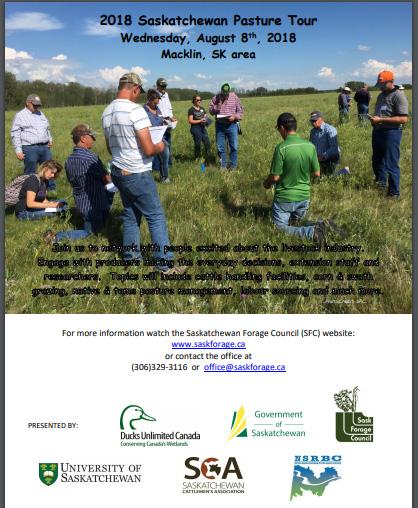
Saskatchewan Pasture Tour
|
|
|
August 8, 2018
Macklin, SK
For more information, visit
|
|
|
Tara Mulhern Davidson, Editor, Saskatchewan Prairie Conservation Action Plan Newsletter
306-625-7345 |
|
|
SK PCAP gratefully acknowledges financial support in 2017-2018 from:
Ducks Unlimited Canada, EcoFriendlySask.ca, Government of Canada - Habitat Stewardship Program for Species at Risk, Information Services Canada, Parks Canada - Grasslands National Park of Canada, Rancher's Stewardship Alliance Inc., Saskatchewan Beef Industry Development Fund,
Saskatchewan Ministry of Agriculture - Agriculture Awareness Initiative, Saskatchewan Ministry of Environment - Fish and Wildlife Development Fund,
SaskEnergy,
SaskPower, SaskTel, University of Saskatchewan - College of Agriculture and Bioresources, Water Security Agency.
SK PCAP gratefully acknowledges in-kind support for 2017-18 from:
Agriculture and Agri-Food Canada - Science and Technology Branch, Canadian Parks and Wilderness Association, Canadian Western Agribition, Environment Canada - Canadian Wildlife Service, Friends of Wascana Marsh, Meewasin Valley Authority, Native Plant Society of Saskatchewan, Nature Conservancy Canada, Nature Saskatchewan, Parks Canada - Grasslands National Park, Prairie Wind & Silver Sage, Ranchers Stewardship Alliance Inc., Redberry Lake Biosphere Reserve, Saskatchewan Association of Rural Municipalities, Saskatchewan Association of Watersheds, Saskatchewan Cattlemen's Association, Saskatchewan Environmental Society, Saskatchewan Forage Council, Saskatchewan Forage Industry Network, Saskatchewan Ministry of Agriculture, Saskatchewan Ministry of Environment, Saskatchewan Ministry of Economy, Saskatchewan Ministry of Education, Saskatchewan Ministry of Tourism, Parks, Culture and Sport - Royal Saskatchewan Museum and Friends of the Royal Saskatchewan Museum, Saskatchewan Research Council, Saskatchewan Stock Growers Association, Saskatchewan Wildlife Federation, Saskatoon Nature Society, SaskEnergy, SaskOutdoors, SaskPower, Society for Range Management - Prairie Parkland Chapter, South of the Divide Conservation Action Program Inc., University of Regina - Prairie Adaptation Research Collaborative, University of Saskatchewan - College of Agriculture and Bioresources, Wild About Saskatoon-Nature City Festival.
|
|
|
|