|
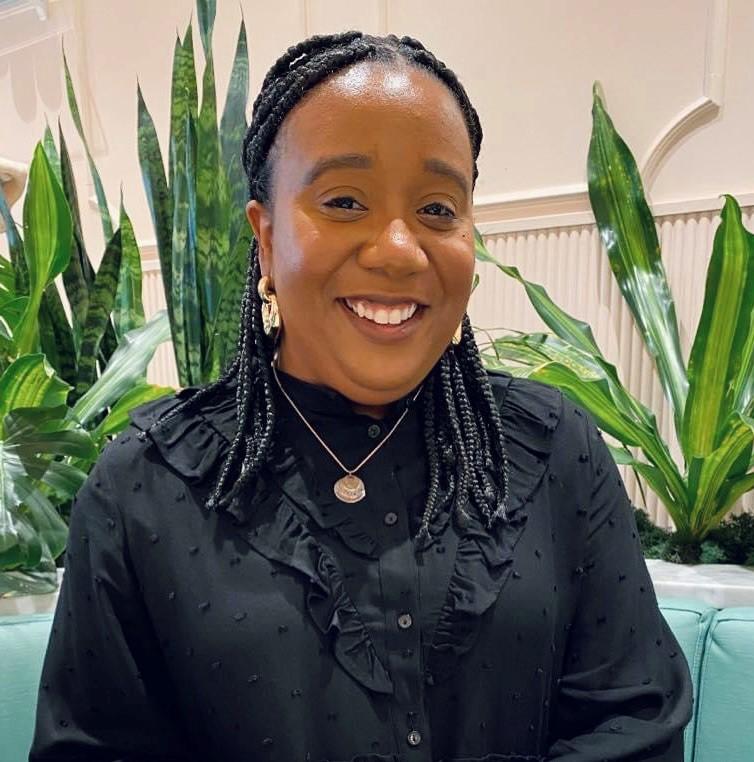
" Extending existing frameworks that are inherently limiting, to include people they were not originally meant to include is incredibly difficult, but the end goal is what motivates me and seems so rewarding."
~ Dr. Simone H. Stewart, Senior Industrial Policy Specialist in Climate & Energy Policy at the National Wildlife Federation (NWF), Global CO2 Initiative (GCI) Advisory Board Member.
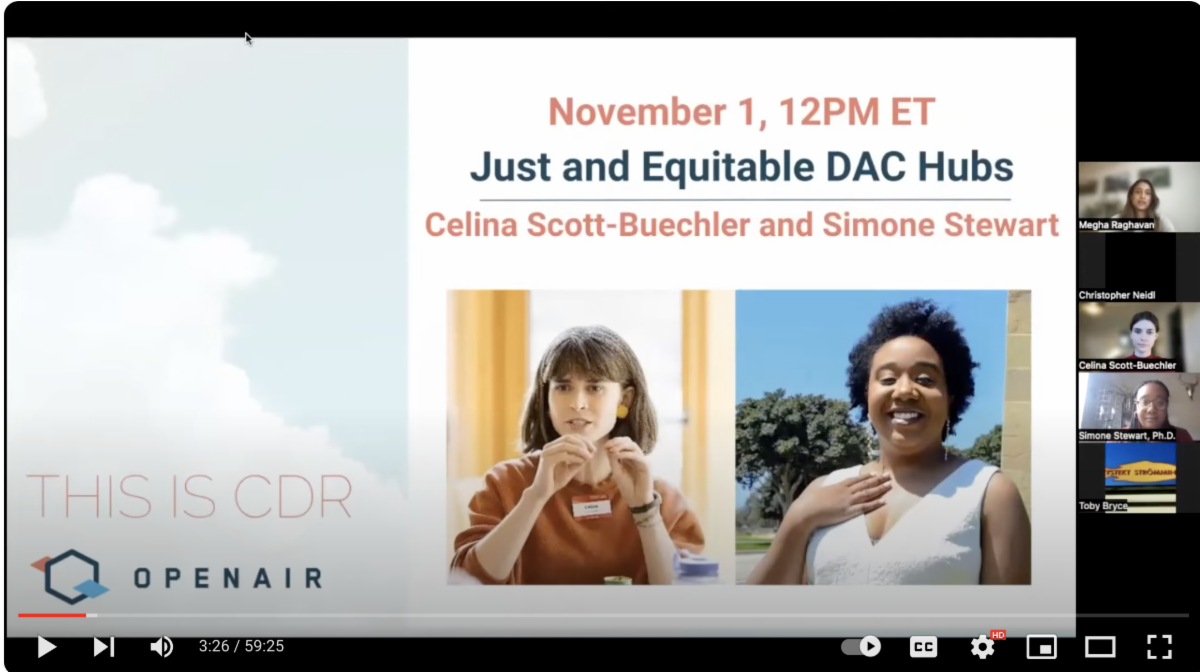
Simone, the newest member of the GCI Advisory Board, works at the intersection of carbon management (including carbon capture and carbon removal), energy/environmental justice, and policy. She holds a Ph.D. (Mechanical Engineering) from the University of California Santa Barbara and two B.A.’s (Physics and Spanish Language & Literature) from William Jewell College. Two of her many awards include being named a National Science Foundation Graduate Research Fellow and Dixon-Levy Graduate Student Association Service awardee which she received for her work on campus supporting BIPOC graduates in STEM fields. For two years Simone also worked as a Graduate Assistant at the UCSB Blum Center on Poverty, Inequality, and Democracy.
| |
What is a very simple explanation of what you do?
I help create policies that focus on cleaning up our environment and keeping communities and their rights safe. As far as carbon management, I do work on industry—the part of our society that makes goods we need to make buildings, highways, homes, and other structures (like steel, cement, and glass). Those industries produce a lot of pollution which hurts our planet. So I help the government and people who run projects think about how to use technology to create solutions to these problems. I also work with communities to help them learn about the environment, the danger our planet is facing, and share their thoughts and fears with the government.
| |
You work at the intersection of carbon capture and climate justice. What is your hope for this area? What advice do you have for those who may be more familiar with the former topic and not so much the latter?
My hope is that as environmental and climate justice become more mainstream talking points that they not only continue to be integrated and enshrined into political structures, but that everyone will continue to educate themselves about why environmental and climate justice is necessary. I also hope they will continue to seek out ways to challenge the systems that perpetuate injustice. In the future I hope carbon management becomes more interdisciplinary, that engineers and social scientists and community advocates are not siloed, that beyond expertise, people should have a foundational knowledge about the way technology and society interact.
For those knowledgeable about carbon capture but not environmental or climate justice, I would suggest that they
- seek out resources to define terms, discuss historic movements, familiarize themselves with historic policies and how they interact with modern society;
- confront the way that they as individuals, their industries, sectors, or organizations perpetuate and benefit from injustice; and
- engage with communities and listen with open minds.
| |
I think it is important to recognize that while it should not make the field “more valid” there is scholarly work on the subject of environmental and climate justice— it is not something that is new or should be considered ad-hoc. There are myriad ways to “get smart”, but I think it all begins with the acknowledgement and the true acceptance that injustice against groups is historic and entrenched in our society, from the U.S. to the Global South. And that it is not enough to only care about particular localities, but we must consider the impact of our work on disenfranchised communities around the world.
| |
In your work at NWF, you do a remarkable job of translating complex information for general audiences. Why is it important to you to do this?
Thank you! I feel the need to acknowledge my parents who both laid the foundation for my science-communication background, as my mother has a background in journalism and communications/PR while my father studied electronics. I put such an emphasis on science communication because for generations, certain spaces have used jargon and language to deny access to those they did not deem worthy. I think because of this, many great minds have been kept from the sciences where possibilities and innovation are endless. We limit ourselves when we refuse to carve out space for everyone, so I believe it is integral to our scientific journey to communicate what we know in a way everyone can understand and participate in.
As a scientist and engineer, I have always felt that my work was inherently connected to society, so I saw no point in developing my knowledge in a vacuum. If my goal was to make tools to help society, I had to understand society first. An engineer that cannot communicate might be a familiar stereotype for many, but I view it as a gap in what is possible.
| |
|
Previously you have spoken about some of the obstacles that you have faced in your educational and career path. Now that you have successfully addressed many of these obstacles, what advice do you have for others who might be in similar situations?
I think the most salient lesson I have learned throughout my academic and career journeys has been to find support, whether people amongst whom or an environment in which you can be your authentic self. So much of my time spent in my Ph.D. program was about shrinking myself, in response to criticism or toxic power dynamics — spaces in which I did not feel welcome or seen. I managed to thrive when I sought out places where I could do work I found fulfilling, collaborate with people who felt it was important that I project my whole self, and where my interdisciplinary desires were praised rather than shunned. It can take time to find those spaces, to unlearn the negativity that might be fueling imposter syndrome — a trend especially common for women of color like myself. While I have not overcome everything, and still work to seamlessly navigate new obstacles in my career, I try to remind myself that these spaces are better because I am in them, and that because of that I have a duty to show up as authentically as possible.
You work on tackling really big problems. What keeps you going and gives you hope for the future and for positive change?
The climate crisis is such a massive problem with so many interconnected moving parts, so I admit it is daunting, especially when you do work from a standpoint that historically prioritized positive outcomes or protections for certain kinds of people. Extending existing frameworks that are inherently limiting, to include people they were not originally meant to include is incredibly difficult, but the end goal is what motivates me and seems so rewarding.
| |
|
We tend to look at climate from such a scientific stance — global temperature rise, patterns of natural disaster. For these reasons it is a threat multiplier for already burdened and overlooked populations. So I choose to look at our future from that lens: what if we can find ways to reduce, diminish, or eliminate this threat multiplier? What if it is one fewer barrier marginalized and disenfranchised communities have to face? How might addressing the climate crisis have a ripple effect on democracy, public health, education, resource protection and human rights? So from that perspective the “bigness” of the task makes it a hard pill to swallow, but I think because of that there is so much hope to have for what we can do.
What is a fun fact about yourself that few people know?
While ironically, I have never had a strong love for the outdoors, I did briefly want to pursue marine biology when I was a child — though admittedly NWF was not on my horizon back then!
Perhaps more than a “few” people know this, though it is not common knowledge amongst my current sphere, but I was very dedicated to pursuing my Spanish Language degree in undergrad. I wrote a senior thesis in Spanish titled “Un laberinto invisible del tiempo: La deconstrucción de la realidad, el destino y el tiempo en las obras de Jorge Luis Borges” (An invisible labyrinth of time: The deconstruction of reality, destiny, and time in the works of Jorge Luis Borges) on the use of the fantastic to discuss metaphysical concepts in three short stories by Argentinian author Jorge Luis Borges.
| |
|
I considered myself to be pretty fluent in Spanish at the time and even traveled with colleagues from my physics department to Guatemala where I helped translate and teach a children’s science summer camp at a local community center where participants built solar powered lanterns and learned introductory Arduino coding.
| |
|
Keep in touch
We want to hear from you! Is there something or someone that you would like to see featured in a future issue? Let us know!
| | | | |