|
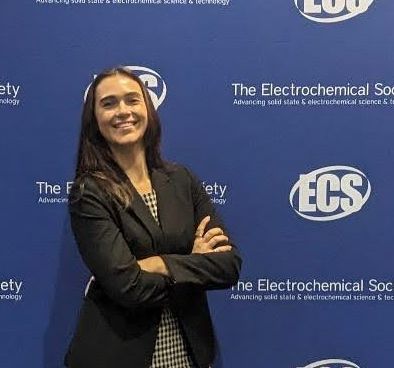
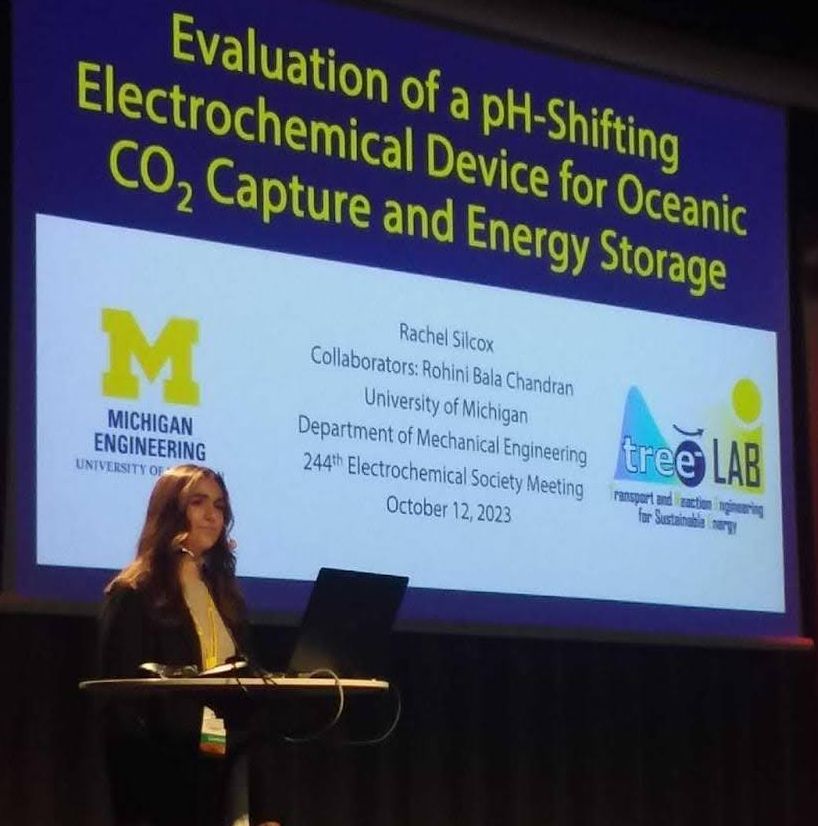
"We hope this new method will reduce the price of oceanic carbon capture by reducing the energy usage, taking advantage of variable electricity pricing throughout the day, and increasing the stability of the system."
~ Rachel Silcox, Mechanical Engineering doctoral candidate, member of Prof. Rohini Bala Chandran's TREE lab
| |
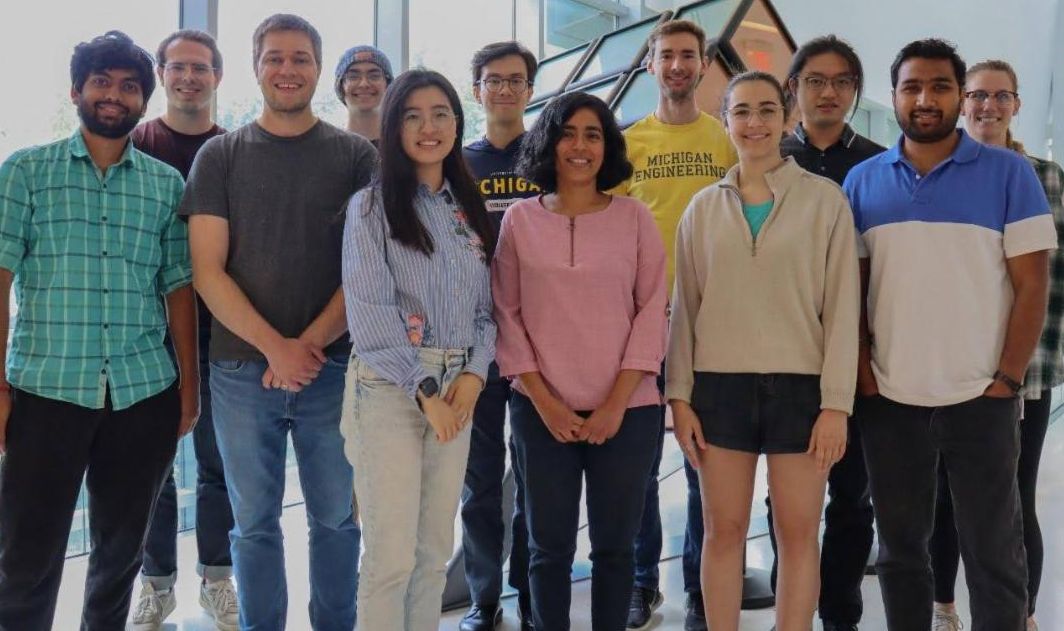
The work of the TREE Lab, led by Prof. Rohini Bala Chandran, Global CO2 Initiative Faculty Affiliate, is featured in this issue. The TREE lab recently received approval for their patent for taking CO2 out of seawater and has a publication, "Demand-side Flexibility Enables Cost Savings in a Reversible pH-Swing Electrochemical Process for Oceanic CO2 Removal," coming out soon in Cell Reports Physical Science.
| |
Who are the people in the lab working on this problem?
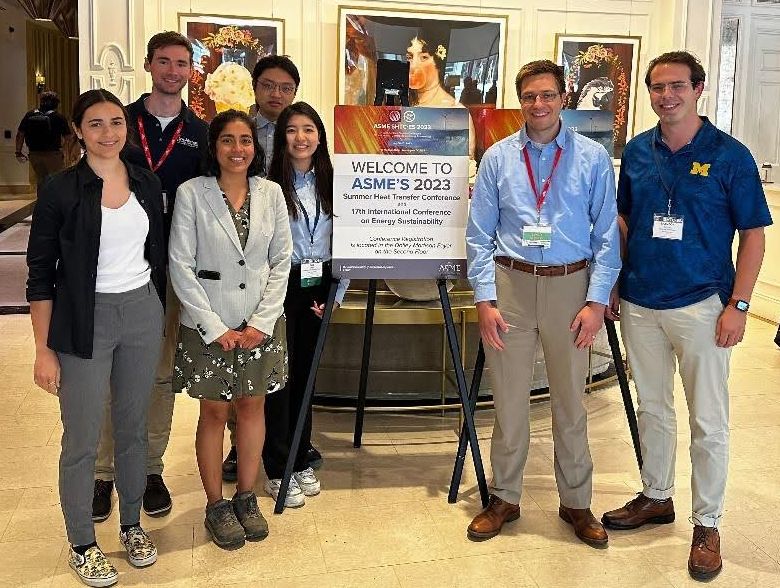
The TREE Lab, led by Rohini, began working on CO₂ capture from ocean water in 2021. Rachel Silcox, Ph.D. Candidate, Mechanical Engineering, has spearheaded this work with funding from the NSF Graduate Research Fellowship, Graham Sustainability through the Carbon Neutrality Acceleration Program, and Rohini’s startup funds. Contributors to upcoming work include Mechanical Engineering undergraduate students Tavi Kipnis, Declan Crowley, and Nicole France, and Master’s student Fernando Villavicencio.
| |
Can you explain the lab’s work pertaining to taking CO₂ out of water?
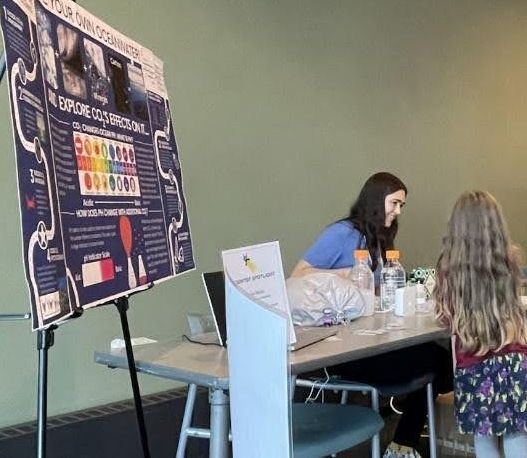
We remove CO₂ from ocean water by cyclically shifting the pH. By lowering the pH, dissolved bicarbonate ions already present in ocean water shift into the form of dissolved CO₂ molecules. We can then strip the CO₂ gas from its dissolved state in water. Then we increase the pH of the water back to neutral following the CO₂ extraction to make sure it is safe to release back to the ocean. This process is similar to how a baking soda volcano works. Adding acid to the solution reacts with the bicarbonate ions to produce gaseous CO₂ that we can then capture.
How did this idea come about?
Fundamentally, this idea stems from the urgent need to capture CO₂ at the gigaton scale to mitigate harmful effects of climate change. This specific idea came about as we were trying to think of ways to promote CO₂ removal running exclusively on renewable energy. CO₂ capture powered by natural gas or other CO₂-emitting fuel sources is not sustainable and to enable widespread CO₂ capture we need more renewable energy. However, many sources of renewable energy are variable, such as the sun only shining during the day. So we developed this CO₂ capture method with demand-side flexibility; it can use energy when the sun is shining and produce energy at night. By load-shifting, it is financially beneficial to run this process exclusively from renewable energy.
| |
Why focus on extracting CO₂ from water instead of air?
CO₂ that has been released into the air has entered the ocean and is causing ocean acidification, which has negative impacts on ocean life, e.g. killing coral reefs and other forms of ocean life. While any method that removes CO₂ from the environment will eventually remove it from the air and ocean, the diffusion of gas from the ocean into the air takes a significant amount of time, on the order of decades. Therefore, direct air capture (DAC) will not be quick enough to reverse negative effects on ocean life. By directly removing CO₂ from the air and the ocean, we can more directly help both of these environments.
| |
What do you do with CO₂ once it’s out?
Even though we are currently only focused on capturing CO₂ out of ocean water, pure CO₂ can have other applications or be stored for long-term removal from the environment. One possible use for the captured CO₂ is in renewable fuel production, where it can be converted into methane, methanol, or other hydrocarbons. Renewable carbon-based fuels will continue to play a vital role in sectors such as aviation, maritime transport, and peaking power plants.
| |
What happens to the water after you extract CO₂?
Since CO₂ is a weak acid, when we remove the dissolved CO₂ from the ocean water, the pH will increase. This ocean water with a slightly higher pH can be sent back to the environment. Once mixed into the ocean, it will help undo current ocean acidification.
Does this procedure need to be done in freshwater, salt water, or either one?
This process would work anywhere where the dissolved inorganic carbon content is relatively high (at least millimolar concentrations) and the water has good conductivity. Typically, ocean water better meets both of these criteria due the higher concentrations of ions in the solutions, but other source waters could be considered.
| |
Your discovery is a pretty big deal – so much so that you applied for a patent. Can you explain why?
Other processes for ocean water carbon removal have been published before, but we believe ours is the first that provides the combined benefits of demand-side flexibility and potential mitigation of salt formation which commonly occurs in ocean water pH- swing systems.
What are the implications of it?
Modeling in our current publication predicts this process could have reduced energy demand for oceanic carbon removal. Furthermore, projected cost-savings from demand-side flexibility and the potential for enhanced stability could make this process cheaper and more durable than previously reported methods. However, experimental quantification of this process’ performance needs to be completed before we can comment on the practical viability of this process. Therefore, the commercial implications are still largely unknown.
| |
What do you hope will come of it?
It’s crucial to leave no stone unturned with respect to carbon-neutral and carbon-negative technologies. We hope that the flexibility of our proposed process enables more effective integration with widely expanding renewable energy sources. Additionally, through innovative design, we hope to have a durable approach to continuously cycle ocean water between different pH levels. We hope this new method will reduce the price of oceanic carbon capture by reducing the energy usage, taking advantage of variable electricity pricing throughout the day, and increasing the stability of the system. With affordable carbon dioxide removal technology we are closer to achieving a carbon neutral world.
| |
Are you currently taking on lab members?
We are actively recruiting a postdoctoral position to work on device-scale physics-based modeling to produce fertilizer (urea) from wastewater nitrates and carbon dioxide. Please see our website for more details. We are always interested in working with talented undergraduate and master’s students on our project. Please reach out to rbchan@umich.edu and rsilcox@umich.edu if you are interested in working with us.
| |
|
Keep in touch
We want to hear from you! Is there something or someone that you would like to see featured in a future issue? Let us know!
| | | | |