|
A community is like a ship; everyone ought to be prepared to take the helm.
Henrik Ibsen
Dateline Charlottesville, VA
| |
|
In This Issue
- “Your job is to make your media central to their community”
- You can't teach old media new tricks
| |
|
“Your job is to make your media central to their community”
By Charles Benaiah
https://mediamakersmeet.com/charles-benaiah-your-job-is-to-make-your-media-central-to-their-community/
https://bit.ly/48LDPE3
In his latest op-ed, Charles Benaiah argues that news has lost the plot because it’s lost its primary focus, that is, to serve well-defined communities of mutual interest. And that rarely includes geography. Over to you, Charles….
Today’s New York Times has as much do with New York as it does wooder ice down the shore. Which is to say, not much. The city in the masthead is a relic to a time when where we lived mattered.
Ukraine war…Putin…GOP vs Biden…Alabama IVF… Trump vs GOP on IVF…CPAC…NRA misspending…Postwar Gaza…Oklahoma school shooting…Florida measles…Biden losing in Michigan… oh, and the owl we’ve come to love in Central Park flew into a building and died. Only one of first twelve stories was about New York. And it wasn’t the lead.
Why does this matter? Because news has lost the plot.
| |
|
I remembered that when I posted a version of my Canary story to LinkedIn the other day.
It was a blueprint for a media business built around a community. A woman I don’t know commented that she’s going to build it and invited people to DM her for access.
At one time a newspaper was media business built around a geographic community.
Today, geography doesn’t connect us. What does a New Yorker care about?
I lived there for half my life and I’ll be damned if I know. I couldn’t even tell you what united the people in my building.
Yes, if I went looking for it, the Times covers City Hall and zoning stuff and why MTA fares are going up. But those aren’t the stories people read.
Not the stories the Times tweets. And certainly not the stuff that makes money.
| |
The Times did what most news outlets don’t.
They found a community and made themselves a part of it.
Their community are people who prefer to see the world from a spot left of center.
They understand those people and cover stuff to suit them. You can call it catering or pandering. I call it smart.
What does the Cleveland Plains Dealer cover? City Hall, zoning, transit price hikes, the occasional owl, and stuff the Times covered for the people in Cleveland who view the world from the left of center.
Which makes the CPD a combination of irrelevant and redundant.
And, that’s why the Times is fine and other news outlets get clobbered. I’m not picking on Cleveland.
I could just as easily picked the Detroit Free Press, Peoria Journal Star, or Washington Post.
The Times, along with Fox News, The Wall Street Journal, and ESPN have locked up the big communities. Which leaves other media to find smaller communities. Notice — I didn’t say audiences. And that’s fine.
| |
|
Media is mature and small is all that’s left. Opportunities exist.
Like building a community for out of work media people who are enthusiastically looking for like-minded people and who hate that media is dying and who want a place to commiserate.
That last very run-on sentence defines a community connected by a common thread.
A new friend of mine plans to (re-)launch a Jewish magazine in a big city. Over coffee the other day, he gave me a couple of issues and asked what I thought of it. I’ve been pondering that for a few days. It’s… nice. Original art work. Smart stories.
But, for me, there was no there there.
You know? I have no idea what binds the Jewish community in Miami any more than Episcopalians in Houston or Poles in Buffalo.
Still, he asked for an answer so I’m going to give him one. Ask.
| |
|
When Stewart Butterfield started Slack, he monitored the customer feedback channels for a year. He read every complaint, every fan appreciation letter, every suggestion.
It’s tough work hearing what people don’t like about you. It’s nearly as tough to figure out what they’re asking for. After a few months, Butterfield said he could tell you what his community (there’s that word again) cared about. That’s what he prioritized.
There’s a reason Slack grew at breakneck speed despite a 92% churn rate, it found its community and latched on. Slack is in the business of being at the center of communities. That’s what people value. And, when people value you, you have value.
So, new friend, here’s my answer. Go synagogue to synagogue and… ask. Ask the community what they want. Chances are nobody has done that in decades. Maybe ever. Ask what unites them. Ask what they need. Then deliver it.
Because, and here’s the punchline, communities don’t care how nice your artwork is, they don’t care how smart your stories are, and they don’t care what you want to tell them, your job is to make your media central to their community. News can be a publisher’s paradise if it stops preaching at communities and starts sitting in the pews. We Coolio?
Charles Benaiah is the CEO of Watzan, a techy company for medical media. When he’s not running a media company, he reads about media, thinks about it, pull out what’s left of his hair dealing with it, and, then, he writes about it over on unCharles. Charles is a member of Media Makers Meet – Mx3 Collectif.
| |
|
You can't teach old media new tricks
By Charles Benaiah
https://uncharles.substack.com/p/suckitude-on-steroids
Mea culpa. Or some other old-sounding phrase. Too many unCharles posts have been too long recently. Not this one.
The other day, I wrote about Reddit. Wondering out loud how a company with 70M daily users, looks like Craig’s List version 1.0, and built no meaningful ad tech can lose money with nearly a billion dollars in revenue.
Somehow, on my way to teeing up the IPO as a way to up the price Google will eventually pay for this thing to refine its search results and fix the image of its wayward AI brand, I missed the off ramp to the old folks’ home for old media execs.
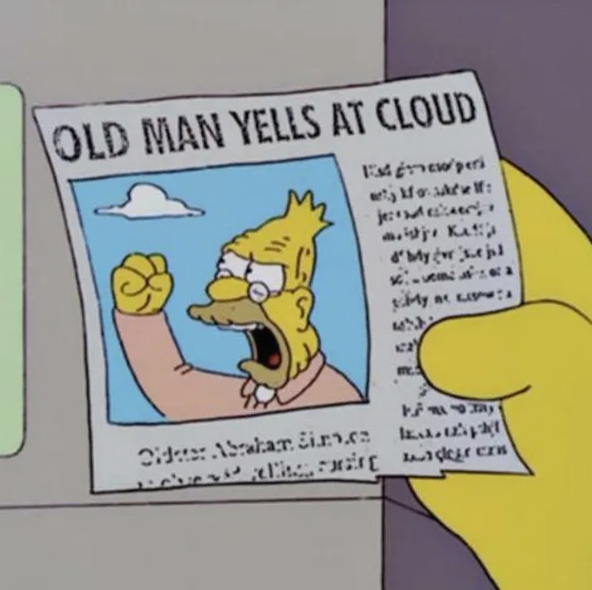
Old media likes to yell into its increasingly voiceless channels how they’re getting screwed. How it’s not their fault their businesses are failing. How newer companies are kicking their butts because they unlevel the playing field to gain a competitive advantage. Cue thirty-year-old Abe Simpson meme.
| |
|
To make sure they’re heard, they retweet themselves into feeds on X, and, these days, Threads, Mastodon, and Blue Sky. Mistaking likes from a self-selected echo chamber of their recently layed off colleagues as reasons to believe they’re right.
They’re not. They’re wrong.
Most old media is failing because they’re run by old media as old media in some cases by dinosaurs who roamed the planet when people paid roaming charges on cellular phones without apps.
What’s the real difference between Meta and Reddit? Or, TikTok and Reddit? Or, Snap and Reddit? Hell, keep going. Twitter and Reddit?
Twitter/X under new management and Reddit? Threads and Reddit? Even LinkedIn and Reddit?
All the folks who run these platforms use silly slogans like, “Connect the world” or, “Your camera.” But behind all the Buddhism in a thong psychobabble was a want be great and look slick doing it. If they didn’t make money, they gloated about revneue growth or user growth. Twitter (now X) was created by an entrepreneur, taken public, and taken private by a different entrepreneur. In LinkedIn’s case, it was bought by a — let’s go with — tech company, Microsoft.
| | |
|
"The Industry that Vents Together Stays Together"
Responses to all Articles and Bo-Rants are greatly encouraged
and may be included in " BoSacks Readers Speak Out"
All news items and the various opinions expressed in this newsletter are not necessarily the opinion of, nor in agreement with the opinions of BoSacks. They are just interesting thoughts and other opinions that BoSacks thinks you should know about.
After all, as the Japanese proverb goes:
"If you believe everything you read, perhaps you better not read."
"Heard on the Web" Media Intelligence:
Courtesy of The Precision Media Group.
Print, Publishing and Media Consultants
193 Brookwood Drive, Charlottesville VA 22902
Contact - Robert M. Sacks 917-566-7437
BoSacks@aol.com
www.bosacks.com
WHO IS BOSACKS ?-
http://www.bosacks.com/who-is-bosacks
|
| | | |