|
|
🇮🇹La Newsletter Italiana
by Sandro 'Sandrino' Cuccia
For Students and Instructors
of the Italian Language
at the
Osher Lifelong Learning Institute
University of Delaware
| |
|
Italian Phrases You Must Know
When Visiting Italia
| |
|
Salve a Tutti, spero che vi stiate
divertendo durante questo periodo estivo!
[Greetings Everyone, I hope you are all
having fun during this summer period!]
| |
YOUR MUST-KNOW WORDS AND PHRASES BEFORE TOURING ITALIA | |
|
Hopefully by now, my readers realize that the best way to learn Italian – in particular for travel – IS NOT to memorize an entire travel phrase book from start to finish. At the very least, while continuing your studies of La Bella Lingua, you should pick out a few key phrases that will come in handy over the course of your stay in Italia … and that you will actually remember!
If you think about it, you'll realize that there’s no point in learning complex sentences like...
“Il terminal D è per i voli internazionali.”
[Terminal D is for international flights.]
or very specific terms like “il doganiere” [customs officer] if you only ever use them once!
Many of you are at the point in your studies where you can begin to hold actual conversations in Italian. But, let's take a step back, along with our beginning students, and look at a selection of Italian words and phrases that visitors to Italia learn and/or know before the trip; if anything, because they are guaranteed to crop up over and over (and over) again.
Our more advanced students should use this article as a refresher, but there is the ever-present chance of learning one or more new things. I still do... all the time!
For new beginners, If you make the effort to memorize these common phrases, not only will you be able to communicate more effectively with Italians about your basic needs, but you will also demonstrate respect for the wonderful culture and language of Italia.
| |
|
TEST YOUR KNOWLEDGE!
In the article, I start each section of expressions by presenting you with a little self-check quiz. The words and phrases will be listed, and you should see if you know the meaning before continuing.
| |
|
"Buongiorno.": _________________
"Buonasera.": _________________
"Arrivederci.": _________________
"Ciao!": _______________________
"Ciao-Ciao!": ___________________
| |
|
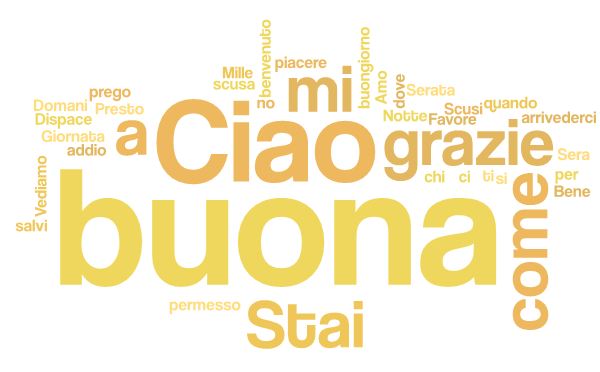
If you’re going to start anywhere, let it be with the most basic Italian greetings. Even if you forget everything else in this article, you can be sure that a friendly “Hello!” will go a long way towards making the Italians around you feel more comfortable and appreciated.
Here are most polite greetings you can use:
"Buongiorno."
➜ "Good day." / "Hello." (formal & informal).
This can be used all day until late afternoon, even if you're having a bad day.
"Buonasera."
➜ "Good evening." / "Hello." (formal & informal).
You use this starting late afternoon; five-ish or so.
Don't forget about the formal versus informal language elements in Italiano. The greetings above can also be used informally with family and friends, but in particular, they are to be used when addressing people you don’t know, such as shopkeepers, waiters, carabinieri, or anyone else who provides you with a service. Although they translate as 'Good day' and 'Good evening' respectively, they are often used in situations in which we would naturally say'Hello' in English.
"Arrivederci."
➜ "Goodbye." (literally, "Until we meet again.")
When saying goodbye, you will NEVER, EVER be wrong with sticking to the expression 'arrivederci' in all situations. It may be awkward when addressing a young child, where you could instead say "Ciao-Ciao!" when saying goodbye.
"Ciao!"
➜ "Hi!" / "Hello!" / "Goodbye!" (informal only)
"Ciao-Ciao!"
➜ "Bye-Bye!" (informal only)
If you do know someone well, you can switch over to everyone’s favorite informal greeting, "Ciao!". It's interesting to note that this word is used not only as a way of saying 'hello', but also to say 'goodbye'. However, "Ciao-Ciao!" (it's like saying "bye-bye") is NOT used to say 'hello'.
Remember... 'ciao' and 'ciao-ciao' are NEVER to be used when addressing people formally. Use these two ONLY for people you know.
| |
|
"Parla inglese?": __________________________
"Mi scusi, non parlo Italiano (molto bene).": _____________
"Come si dice...in italiano?": _________________
"Può scriverlo, per favore?": _________________
| |
|
Let’s face it, if you are a complete beginner, you are eventually going to want to communicate with someone in English, especially if your needs are more complicated than a simple trip to the 'bagno' ['bathroom'].
So, the best way to politely ask an Italian if he or she speaks English is:
"Parla inglese?"
➜ "Do you speak English?"
Of course, you may not be the one to initiate the conversation, in which case you can respond to the person by saying:
"Mi scusi, non parlo italiano (molto bene)."
➜ "I’m sorry, I don’t speak Italian (very well)."
In the example just above, the word 'scusi' (from the word 'scusare' ['to excuse'] is the FORMAL form, whereas 'scusa' is INFORMAL. Again, you are safe using the FORMAL in all situations.
A simpler way is to simply tell the other person that you don’t understand:
"Non capisco."
➜ "I don’t understand."
If you’re keen on increasing your Italian vocabulary and interact with the local populace as you travel, one phrase you simply cannot do without is just below.
For example, let's say you don't know how to say 'airport' in Italian. There is a good chance that Italians know English translations of the most common words such as this:
"Come si dice 'airport' in italiano?"
➜ "How do you say 'airport' in Italian?"
Your new Italian friend will hopefully respond in the following manner:
"Si dice 'aeroporto'."
➜ "We say 'aeroporto'."
Sometimes, verbal communication has its limits. This is why it is so important to be able to ask someone to write things down for you, especially if it’s important information such as an address, a telephone number, or the latest time of day that cappuccino can be ordered.
The best way to ask this question in Italian is:
"Può scriverlo per favore?"
➜ "Can you write it down please?"
Just so you know, another version you’ll often hear starts with 'Me lo...', where 'me' (pronounced 'meh') is a first-person pronoun ('me' in English). In this case, 'lo' is no longer placed at the end of the verb.
"Me lo può scrivere per favore?"
➜ "Can you write it down please?"
Here's another example:
"Può scrivere il numero di telefono per favore?"
➜ "Can you write down the telephone number please?"
| |
|
"Dov'è? (Dove è?)...": ___________________
"Dove sono...?": ________________________
"Come posso arrivare a/in...?": ______________
"Sto cercando...": ______________________
| |
|
One of the most essential Italian phrases every tourist needs to know is “Where is / Where are…?” After all, what could be more important than getting your bearings in a city that’s completely unfamiliar to you?
The SINGULAR version of this question is as follows:
"Dov’è la stazione?"
➜ "Where is the (train) station?"
"Dov'è il bagno?"
➜ "Where is the rest room?"
"Dov'è Sandrino?"
➜ "Where is Sandrino?"
"Dov'è la farmacia?"
➜ "Where is the pharmacy?"
Now... here are some examples in the PLURAL:
"Dove sono i negozi?"
➜ "Where are the shops?"
"Dove sono i bambini?"
➜ "Where are the kids?"
"Dove sono i soldi?"
➜ "Where is the money?"
"Dove sono i turisti americani?"
➜ "Where are the American tourists?"
"Dove sono i carabinieri?"
➜ "Where is the 'carabinieri' police?"
"Dove sono i panini di Sandrino?"
➜ "Where are Sandrino's sandwiches?"
Once you’ve memorized this question ('Dov'è...?' and 'Dove sono...?'), it is simply a matter of filling in the blank with the right noun.
Here are a few common places people look for while traveling around Italia:
il museo ➜ the museum
la fermata dell’autobus ➜ the bus stop
l'albergo ➜ the hotel
l'ufficio postale ➜ the post office
il manager ➜ the manager (yes, an anglicism)
il gelataio ➜ the ice cream vendor or shop
il pronto soccorso ➜ the emergency room
il calzolaio ➜ the shoe repairman (well, perhaps this is not a useful example)
il tabaccaio ➜ the generic term for this ubiquitous but important shop is 'tobacconist', but it's much more than this. Check out the little piece I put together about il Tabaccaio in the Pausa Caffè section further down.
If you’re feeling brave, you could also inquire how to reach a certain place by using the following phrase:
"Come posso arrivare alla biblioteca?"
➜ "How can (how do) I get to the library?"
"Come posso arrivare al Colosseo?"
➜ "How can (how do) I get to the Colosseum?"
Admittedly, the format of the phrases above require a little more knowledge of Italian grammar. They may contain two possible prepositions ('a' and 'in'). The preposition 'a' ['to'] changes form depending on the gender or number (singular vs plural) of the noun that follows. For example:
"Come posso arrivare alla stazione?"
➜ "How can I get to the station?"
"Come posso arrivare al manicomio?"
➜ "How can I get to the psychiatric hospital?"
(a polite way to say 'insane asylum')
"Come posso arrivare in centro?"
➜ "How can I get to the center-city (downtown)?"
"Come posso arrivare in Sicilia?"
➜ "How can I get to Sicily?"
That being said, and as I often remind my students: you will be understood even if you mix up 'a' and 'in', or if you use 'a' on its own.
By the way, a good number of Italians get these prepositions mixed up sometimes as well - including yours truly!
One final way of discovering the location of a place is by using the relatively simple expression:
"Sto cercando la Pizzeria Bellini."
➜ "I’m looking for the Bellini pizzeria."
"Sto cercando un parrucchiere."
➜ "I'm looking for a hairdresser."
If you want to go a step further, you can use the construction with the verb potere ['to be able to' or 'can'] and trovare [to find].
"Mi scusi, dove posso trovare un benzinaio?"
('mi scusi' is FORMAL)
➜ "Excuse me, where I can find a gas station?"
"Scusa bambino, dove posso trovare tua mamma?"
('scusa' is INFORMAL)
➜ "Excuse me, little boy, where can I find your mom?"
| |
|
➜ "Per favore.": ______________________
➜ "Grazie (mille).": ____________________
➜ "Prego.": __________________________
| |
|
Another way to endear yourself to the Italians you meet on your trip is to master your “pleases” and “thank you's”.
We already encountered the expression 'per favore' ['please'] in the phrase, "Può scriverlo, per favore?". Here it is again below, but this time on its own. (Incidentally, "per favore" and "per piacere" are used interchangeably.)
"Per favore." / "Per piacere"
➜ "Please."
"Thank you.", on the other hand, is "Grazie." or the ever popular "Grazie Mille" ["Thank you very much."] when you wish to be more emphatic.
"Grazie mille."
➜ "Thank you very much."
(Literally, "A thousand thanks.")
And when someone thanks you for something, the most direct way to respond is with the word "Prego." - not the jar of spaghetti sauce, but "You're welcome."
"Prego."
➜ "You’re welcome."
| |
|
➜ "Quanto costa?": ______________________
➜ "Quanto costano?": ____________________
| |
|
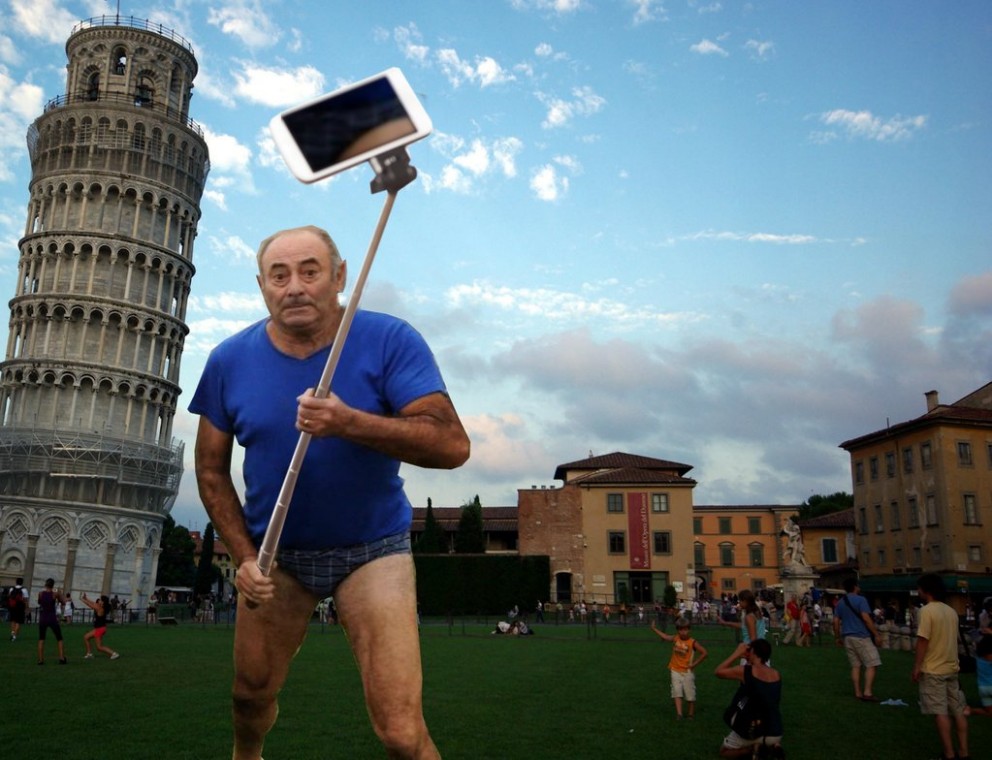
Whether you are buying un cannolo [a cannolo], un biglietto del treno [a train ticket], or picking out a souvenir selfie-stick, it’s important to know how much you will end up spending.
The easiest way to inquire about the price of something is:
"Quanto costa?"
➜ "How much does it/this cost?"
If you want to add the name of the object you are inquiring about to the phrase, you can use a noun accompanied by its definite article ('il', 'lo', 'la', etc.) or the demonstrative adjective ('questo' / 'questa' [this] ) - referring to a masculine or feminine noun.
"Quanto costa la sciarpa rossa?"
➜ "How much does the red scarf cost?"
"Quanto costa questa mappa?"
➜ "How much does this map cost?"
"Quanto costa questo libro?"
➜ "How much does this book cost?"
"Quanto costa il cagnolino in vetrina?"
➜ "How much does the doggie (puppy) in the window cost?"
If you are referring to more than one object, however – such as multiple souvenir selfie-sticks (I always say, "You can never have enough selfie-sticks on a trip."), you will need to put the sentence into the PLURAL.
Again, don’t worry if you accidentally use the singular form – Italians will understand you perfectly either way!
"Quanto costano?"
➜ "How much do they/these cost?"
For example...
"Quanto costano queste selfi-stick?"
➜ "How much do these selfie-sticks cost?"
"Quanto costano queste papere?"
➜ "How much do these ducks cost?"
(Inflection is on the 'a' in 'papere')
| |
|
Perché non ci facciamo una pausa per prendere un bel caffè mentre discutiamo dei fatti riguardo ...
IL TABACCAIO in Italia!
| |
QUESTO ARTICOLO È SPONSORIZZATO
DALLA LETTERA 'T'
[This article is brought to you by the letter 'T']
|  | |
THE 'TABACCAIO' SHOP
Why it's Essential to Life in Italia
The ubiquitous shop called 'il Tabaccaio' (sometimes called 'la tabaccheria’) ["the tobacconist"] is a cornerstone of Italian culture. Here in the States, the closest that might possibly resemble the Tabaccaio may be the bodega - though I've never had the occasion to visit one.
Often, a Tabaccaio can be part of, or attached to, another business - typically a café. Smaller versions are commonly located within places like train stations and airports. These businesses are clearly identified by the familiar 'T' sign discussed below.
The Tabaccaio is a place to purchase much more than just tobacco products. From paying bills to purchasing bus tickets and necessities, let's look at just SOME of the services and products offered at the Tabaccaio.
The Tabaccaio's iconic emblem consisting of a large 'T' on a small black or more modern blue rectangular sign, found in any Italian city, town and village, is associated with a place for locals to buy bus and metro tickets, pay their bills, or play the lottery.
But wait, there's more!
With the number of smokers gradually falling in Italia (although the recent pandemic reportedly acted as a setback for many former smokers), the non-tobacco related aspects of the Tabaccaio have become even more important to its owner’s income.
So what exactly can you do, see and purchase at a Tabaccaio?
Bus and subway tickets: Outside of a metropolitana [subway] station, the Tabaccaio is one of the few places where you can purchase tickets for local public transportation in Italia.
The vast majority of Tabaccaio shops (by the way, the plural is ('i tabaccai') sell these tickets, and customers pay no more than they would at the metro station – one simply asks the cashier for ’biglietti per i mezzi publici' [public transportation tickets]. 'Biglietti per l'autobus' ['city bus tickets'] can be purchased as well.
Bill payments: This is not so much for tourists, of course, but Italians are daunted by the prospect of navigating their way around an Italian phone or utility company’s website, and they certainly can't stomach waiting in long lines at the 'ufficio postale' ['post office'] during its limited hours of operation in order to pay their bills. The friendly corner Tabaccaio is their go-to place to pay most utility and phone bills for a small surcharge of one or two euro.
But that’s not all… Much like bills, fines for things such as traffic violations and parking tickets can be paid at the Tabaccaio, as well as social security contributions, and some other government charges such as waste/garbage taxes.
Thanks to Italian government bureaucratic practices, something called 'la marca da bollo' ['tax stamp'] and special paper forms are needed for many official transactions and applications - permit applications, for example. My own Italian birth certificate is on this special paper which is emblazoned with about a dozen marche da bollo as well as rubber-stamp cancellation marks! And this is still done to this day! Stamps, seals, and rubber stamp cancellations on special paper! What a wonderfully trite analog experience!
Of course, the Tabaccaio is the place to go for 'francobolli' ['postage stamps'] and other postal services, although it is not an official post office; it's more of a postal sub-station.
Phone and lottery cards: At the Tabaccaio, Italians can do such mundane things as top-up their phone credit for popular 'pay-as-you-go' phone contracts. However, playing 'la lotteria' [the lottery] is a popular pastime in Italia, and if you want to try your luck by purchasing a lottery ticket, the Tabaccaio is the place to head to.
GOL!! – Let's not forget about placing those sports bets! In fact, betting in the totocalcio - the Italian soccer pools - is a particular favorite of all Italian calcio [soccer] fans. Additionally, many Tabaccai are licensed to sell tickets for soccer matches, as well as for certain concerts and other large-scale stadium events.
Tobacco products: It’s no secret that one can buy cigarettes and other tobacco products at the Tabaccaio. In fact, it’s one of the only places in Italia where you can buy them, as - along with lottery tickets, postage stamps and tax stamps - these are state/government-controlled goods - a source of revenue - that require a special license to sell.
| 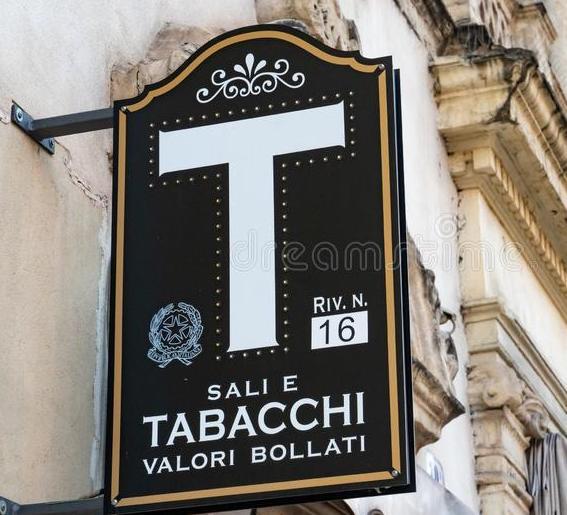 | |
Oddly enough, regular sale [table salt] used to fall under this restricted category – which is why you’ll often still see original Tabaccaio ’ T ’ signs still mounted outside the older shops. These signs clearly advertise the sale of “Sali e Tabacchi” ['salt and tobacco']. Any references to the sale of salt are just vestiges of days gone by.
Cianfrusaglie [odds-and-ends]: Of course, cigarettes, lotto cards and tickets aren’t the only items for sale at the average Tabaccaio. The range of products sold at an Italian Tabaccaio usually includes francobolli [postage stamps], cartoline [postcards], and biglietti d'auguri [greeting cards], cancelleria [stationery], riviste e giornali [magazines and newspapers], fazzolettini [tissues] and carte da gioco [playing cards], as well as candy, chewing gum, chocolate, and other snacks and bottled drinks. Let's not forget just about anything else that the Tabaccaio shopkeeper thinks may be conveniently available for his particular clientele - as long as it's not too bulky.
Finally, at the beloved Tabaccaio, one can also often find common stationery paraphernalia, small trinkets, as well as souvenirs, such as small handmade items, keychains, jewelry, children’s toys and of course, the ubiquitous selfie sticks.
Io adoro andare dal Tabaccaio!
[I love going to the Tabaccaio shop!]
Ecco.... la nostra pausa caffè e terminata. Torniamo al nostro bel articolo per tutti i nostri viaggiatori!
| IL NOSTRO ARTICOLO CONTINUA... | |
➜ "A che ora arriva...?": _________________________
➜ "A che ora parte...?": _________________________
➜ "Quanto tempo ci vuole per arrivare a...?": _________
________________________________________
| |
|
If you are planning to make your way around the country using public transportation, a very useful question that is worth memorizing is:
"A che ora arriva l'aereo?"
➜ "At what time does plane arrive?"
"A che ora parte la mongolfiera?"
➜ "At what time does the hot air balloon depart (take off)?"
Some common types of public transportation include:
l’autobus ➜ the bus
il treno ➜ the train
il tram ➜ the trolley
il taxi ➜ the taxi cab
il traghetto ➜ the ferry
la funivia ➜ the cable car
la nave ➜ the ship
l'aereo ➜ the airplane
la carrozza ➜ the carriage
il monopattino ➜ the scooter or skateboard
Once you’re on your way, you may wish to ask how much time it will take to get to your destination. Once again, the preposition 'a'[to] may change form depending on the noun that follows it.
"Quanto tempo ci vuole per arrivare a Palermo?"
➜ "How much time does it take to get to Palermo?"
"a Roma" ➜ "to Roma"
"al porto" ➜ "to the seaport"
"all’aeroporto" ➜ "to the airport"
"al posteggio di taxi" ➜ "to the taxi stand"
Finally, just for giggles ...
"Siamo arrivati?"
➜ "Have we arrived?"
(or better still: "Are we there yet?")
(for maximum effect, this should be asked every 5 seconds)
| |
|
➜ "C'è?": ________________________________
➜ "Ci sono?": _____________________________
➜ "C'è un/una/un' ... qui vicino?": _____________
___________________________________
| |
|
When you start to explore a new language, one of the first things to try is master the “there is” and “there are“ constructions.
Why is this?
Simply because these are among the most frequently used phrases in any language. The equivalent of “there is” in Italian is the contraction of ci [there] plus è [is] ➜ "c’è", (notice the apostrophe after the 'c' followed by the accented 'è'... whereas “there are” translates as "ci sono".
"C’è un bar."
➜ "There is a coffee-bar (café)."
(The Italian 'bar' is not the same as an American 'bar'. In Italia, 'un bar' is 'a café'.)
"Ci sono dei negozi."
➜ "There are some shops/stores."
'C’è' and 'ci sono' can be used to express not only a statement, as in the examples above, but also a question.
For example:
"C’è un bar?"
➜ "Is there a coffee-bar (café)?"
"Ci sono dei negozi?
➜ "Are there some (any) shops/stores?"
A variation that is quite common is with the ending 'qui vicino' ['nearby']. For example...
"C’è un ___ qui vicino?"
➜ “Is there a ___ nearby?“
"C’è un barbiere qui vicino?"
➜ "Is there a barber shop nearby?"
"C'é una banca qui vicino?"
➜ "Is there a bank nearby?"
"C'è un bancomat qui vicino?"
➜ "Is there an ATM nearby?"
Keep in mind, however, that 'un' (which is the masculine indefinite article) may change to 'una' if the object is feminine , ' un’ ' (notice the apostrophe) when the object is feminine and starts with a vowel, or 'uno' if the object is a masculine noun and starts with s + consonant, or z, or gn, or y.
For example:
"C’è UN museo qui vicino?"
➜ "Is there a museum nearby?"
"C’è UNA chiesa qui vicino?"
➜ "Is there a church nearby?"
"C’è UN'automobile qui vicino?"
➜ "Is there a car nearby?"
"C’è UNO zoo qui vicino?"
➜ "Is there a zoo nearby?"
"C'è UNO gnomo qui vicino?"
➜ "Is there a gnome nearby?"
"C’è UNO stadio qui vicino?"
➜ "Is there a stadium nearby?"
"C'è UNO scafandro qui vicino?"
➜ "Is there a spacesuit nearby?"
"C'è UNO yuppie qui vicino?"
➜ "Is there a male yuppie nearby?"
I realize that I am sounding like un disco rotto [a broken record], but again, don’t get too hung up on the various forms of the indefinite article. You will be understood even if you make a mistake!
After all... Italians are very understanding!
| |
|
➜ "Posso...": ________________________________
➜ "Può...": __________________________________
➜ "Vorrei...": _______________________________
| |
|
Three additional terms – posso, può and vorrei – are absolutely essential for travel around Italia. ('posso' and 'può' are based on the verb 'potere', and 'vorrei' (and 'voglio') from the verb 'volere' [to want]).
Let’s take a look at these individually.
"Posso..." translates as either a statement: “I can...”, or a question: "Posso...?" ["Can I...? / May I…?”].
These are easy to use, as they are always followed by the INFINITIVE form of the verb – the base verb form found in the dictionary.
"Posso venire." ➜ "I can come."
"Posso venire?" ➜ "Can I come?"
'Può' means “he can" / "she can" / "it can”.
However, it's important to note that when speaking in a FORMAL context, 'Può' translates as “You can…” or “Can you…?“. I suggest using this form whenever you address someone you don’t know, such as a person on the street, a waiter, a nun or a shopkeeper.
IF IN DOUBT, your safest bet is to always use the FORMAL when addressing anyone.
"Può scattarci una foto?"
➜ "Can you take a photo of us?"
(the verb 'scattare' literally means 'to snap' – as in 'to snap a photo').
"Può aiutarmi, per favore?"
➜ "Can you help me, please?"
Finally, there is the extremely useful and polite word to use in social settings – 'vorrei' – which means “I would like… / I’d like…“. It can be followed by verbs in the infinitive or by nouns.
Some examples...
"Vorrei un caffè, per piacere."
➜ "I would like a coffee, please."
"Vorrei comprare due biglietti."
➜ "I’d like to purchase two tickets."
"Vorrei essere baciato davanti la fontana di Trevi."
➜ "I would like to be kissed in front of Trevi Fountain."
'Vorrei...' ["I would like..."] is the polite way to ask for something, as opposed to 'voglio...' which means "I want" and is considered ill-mannered when asking for something.
I know this well because as a child, I was constantly scolded for being un maleducato [ill-mannered].
Here is a typical dialog:
SANDRINO:
"Mamma, voglio il mio doppio caffè macchiato!! E lo voglio ora!"
["Mom, I want my double macchiato!! And I want it now!"]
LA MAMMA:
"Sandrino! Chi ti ha insegnato di parlare in questa maniera? Smettila di fare il maleducato, e chiedi per bene! Altrimenti vai subito in camera tua senza cena!!"
[Sandrino! Who taught you to speak in this manner? Quit being so ill-mannered, and ask properly! Otherwise you will immediately go to your room without dinner!!"]
SANDRINO:
"Si mammina, hai ragione - ho fatto male. Per favore, vorrei il mio doppio caffè macchiato. Appena puoi, mammina. Però voglio subito una sfogliatella!!!"
["Yes mommy, you are right - my bad. Please.. I would like my double macchiato. At your convenience, mommy. However, I want a sfogliatella (pastry) right now!!"]
| |
|
➜ "Mi sono perso / persa.: ______________________
➜ "Ho perso...": ______________________________
| |
|
For most of us, getting lost is never part of our plans for foreign travel, but it happens, and it's important to be able to seek 'aiuto' ['help'].
The best way to do this is, first and foremost, to state that you are lost...
"Mi sono PERSO. / Mi sono PERSA."
➜ "I am lost." "I got lost."
(literally, "I lost myself.")
Referencing the example above, in Italian, adjectives have masculine, feminine and plural forms. In this case, 'perso' is the MASCULINE-SINGULAR form of 'lost', and 'persa' is the FEMININE-SINGULAR form.
If you are a male, you'd be likely to say things like, "Mi sono PERSO nei tuoi occhi." ["I am lost in your eyes."] As a woman, you might say, "Mi sono PERSA nel centro commerciale." ["I got lost in the mall."]
"Ci siamo PERSI. / Ci siamo PERSE."
➜ "We are lost. / We got lost."
'Persi' is the MASCULINE-PLURAL form, whereas 'perse' is the FEMININE-PLURAL form.
On the other hand, if you lose one of your precious belongings, you can say, as an example...
"Ho perso la mia selfi-stick!"
➜ "I've lost my selfie-stick!"
Huh?... look at that! selfie-sticks are females!!
Here are a few other things an unfortunate traveller might end up losing:
HO PERSO...
il portafogli ➜ wallet
il bagaglio ➜ luggage / baggage / suitcase
la carta di credito ➜ credit card
gli occhiali ➜ glasses
il passaporto ➜ passport
il biglietto ➜ ticket
l'aereo ➜ airplane
(as in, "I missed my flight.')
la testa ➜ head
(as in, "I lost my mind.")
| |
|
In conclusion, traveling around a foreign country – like Italia – is never easy when you barely or don’t speak the language. However, if you take a moment to memorize a few key travel phrases and words - like those presented in this article - you will be pleasantly surprised at how your trip will be far more relaxing and enjoyable than if you had made no effort at all.
Buoni studi! Buon appetito! e... Buon Viaggio!
Per adesso, vi do un caloroso CIAO-CIAO!
| |
🇮🇹La Newsletter Italiana
is written and published by
Sandro "Sandrino" Cuccia
sandrino@hey.com
| | | | | |